Reminder: ABC Micro Grants available

UPDATE May 12, 2014: This round of micro grants has been completed – see the results. As further micro grants become available, they will be described on the website.


The Center for Intercultural Dialogue will distribute micro grants for intercultural dialogue from a pool of $5000 made available by the Association for Business Communication. These micro grants are intended to support either or both of the two types of activities described in the mission of the Center: study of intercultural dialogues by Communication scholars, and/or participation in intercultural dialogue through academic interactions between Communication scholars based in different countries, or different linguistic and cultural regions. These grants are sufficient to provide seed funding only: no more than $1000 maximum can be awarded to any one individual. The goal is to encourage international, intercultural, interlingual collaborative research by giving enough funding to offset the cost of airfare only, while providing opportunity (and cause) for matching grants from universities.

ABC logo
If you already have multiple international connections, this grant is not for you – obviously you don’t need it. But if you are at a small college, or if you are a new scholar, or have not yet established significant international connections related to research, you are the intended audience for this competition. If you have been reading publications by an international scholar on a topic of potential relevance to your own research, consider a short trip to discuss ways to collaborate on a future project. If you do not know who has been doing relevant work, check the sources you’ve been reading lately, ask your colleagues, and/or think about who you know from graduate school or who you have met (or heard present an intriguing paper) at a conference. Find someone with similar interests but who takes a different theoretical or methodological stance by virtue of being based in a different cultural context.

The intention is to support the development of new intercultural, professional connections. Thus continuing collaborations are ineligible. Those based in the US are expected to propose travel outside the country. International scholars currently living outside their country of origin are asked to establish a new affiliation in a different region rather than proposing a return to their homeland. We recognize that much interesting work can be done within a country between cultural groups, however this grant program focuses on connecting researchers who are not yet connected, across cultural regions that are typically disconnected. This rationale of cross-cultural connection must be explicit in the project description.

The ABC Micro Grants Application requires applicants to describe their project, provide a brief resume, a short note from their department chair documenting their current status, and one from the host scholar expressing interest in holding conversations related to research. The initial deadline for review of proposals is February 1, 2014. If funds remain after the initial set of grants have been awarded, April 15, 2014 will be the second deadline.

The National Communication Association set aside similar funding for micro grants in 2012-13. Those projects have already been completed, and have been described in sufficient detail that they may serve as models for this year’s applications.

Contact the Center’s Director, Wendy Leeds-Hurwitz, with questions.

Recommended UNESCO Documents for Interculturalists

UNESCO sees intercultural dialogue as a central topic, and publishes frequently on related issues. In addition to the Intercultural Competences booklet that I worked on last year, which has had hundreds and hundreds of downloads from this site alone, several other publications may be of interest to intercultural scholars.

A Common Framework for the Ethics of the 21st Century

A New Cultural Policy Agenda for Development and Mutual Understanding

Asian-Arab Philosophical Dialogues on Globalization, Democracy and Human Rights

Cultural Diversity and Transversal Values: East-West Dialogue on Spiritual and Secular Dynamics

Exploring Synergies between Faith Values and Education for Sustainable Development

What UNESCO for the Future? Forum of Reflexion

World Social Science Report 2010: Knowledge Divides

My thanks to Yoshitaka Miike for these suggestions!

Wendy Leeds-Hurwitz, Director
Center for Intercultural Dialogue

Save

Harron Chair talk: Intercultural Dialogue

https://www.youtube.com/watch?v=9YSQPcEFp48%20

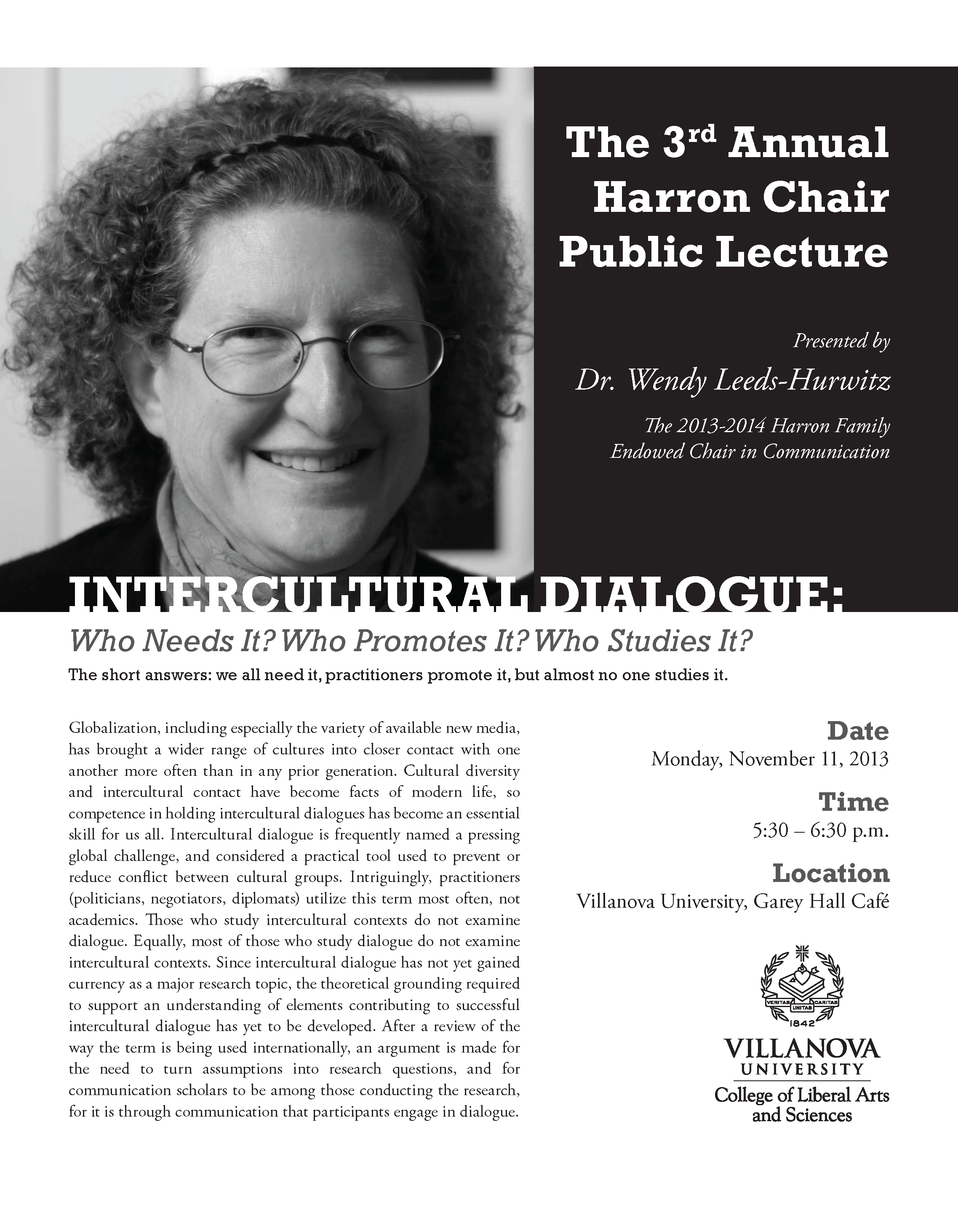
Harron Lecture flyerOn November 11, 2013, I presented the Harron Family Endowed Chair Lecture entitled “Intercultural Dialogue: Who Needs It? Who Promotes It? Who Studies It?” This is the one public lecture expected of the Harron Chair at Villanova University, and this semester I serve in that position. College of Liberal Arts and Sciences Dean Jean Ann Linney provided a brief history of the Harron Family Endowed Chair for the audience, and Dr. Maurice Hall, Communication Department Chair, introduced me. There was a large crowd (more than expected, about 75 – sorry about the lack of chairs for the last dozen to come!) and good questions from not only faculty members but also students. Thanks to Chad Fahs for videotaping, and Minh Cao who set up a new YouTube channel for the Center (more about that in a separate post), you can see an excerpt of the talk (above).

Wendy Leeds-Hurwitz, Director
Center for Intercultural Dialogue

Save

Micro Grants for Intercultural Dialogue Available!

UPDATE May 12, 2014: This round of micro grants has been completed – see the results. As further micro grants become available, they will be described on the website.


The Center for Intercultural Dialogue will distribute micro grants for intercultural dialogue from a pool of $5000 made available by the Association for Business Communication. These micro grants are intended to support either or both of the two types of activities described in the mission of the Center: study of intercultural dialogues by Communication scholars, and/or participation in intercultural dialogue through academic interactions between Communication scholars based in different countries, or different linguistic and cultural regions. These grants are sufficient to provide seed funding only: no more than $1000 maximum can be awarded to any one individual. The goal is to encourage international, intercultural, interlingual collaborative research by giving enough funding to offset the cost of airfare only, while providing opportunity (and cause) for matching grants from universities.

ABC logoIf you already have multiple international connections, this grant is not for you – obviously you don’t need it. But if you are at a small college, or if you are a new scholar, or have not yet established significant international connections related to research, you are the intended audience for this competition. If you have been reading publications by an international scholar on a topic of potential relevance to your own research, consider a short trip to discuss ways to collaborate on a future project. If you do not know who has been doing relevant work, check the sources you’ve been reading lately, ask your colleagues, and/or think about who you know from graduate school or who you have met (or heard present an intriguing paper) at a conference. Find someone with similar interests but who takes a different theoretical or methodological stance by virtue of being based in a different cultural context.

The intention is to support the development of new intercultural, professional connections. Thus continuing collaborations are ineligible. Those based in the US are expected to propose travel outside the country. International scholars currently living outside their country of origin are asked to establish a new affiliation in a different region rather than proposing a return to their homeland. We recognize that much interesting work can be done within a country between cultural groups, however this grant program focuses on connecting researchers who are not yet connected, across cultural regions that are typically disconnected. This rationale of cross-cultural connection must be explicit in the project description.

The ABC Micro Grants Application requires applicants to describe their project, provide a brief resume, a short note from their department chair documenting their current status, and one from the host scholar expressing interest in holding conversations related to research. The initial deadline for review of proposals is February 1, 2014. If funds remain after the initial set of grants have been awarded, April 15, 2014 will be the second deadline.

The National Communication Association set aside similar funding for micro grants in 2012-13. Those projects have already been completed, and have been described in sufficient detail that they may serve as models for this year’s applications.

Contact the Center’s Director, Wendy Leeds-Hurwitz, with questions.

University at Albany

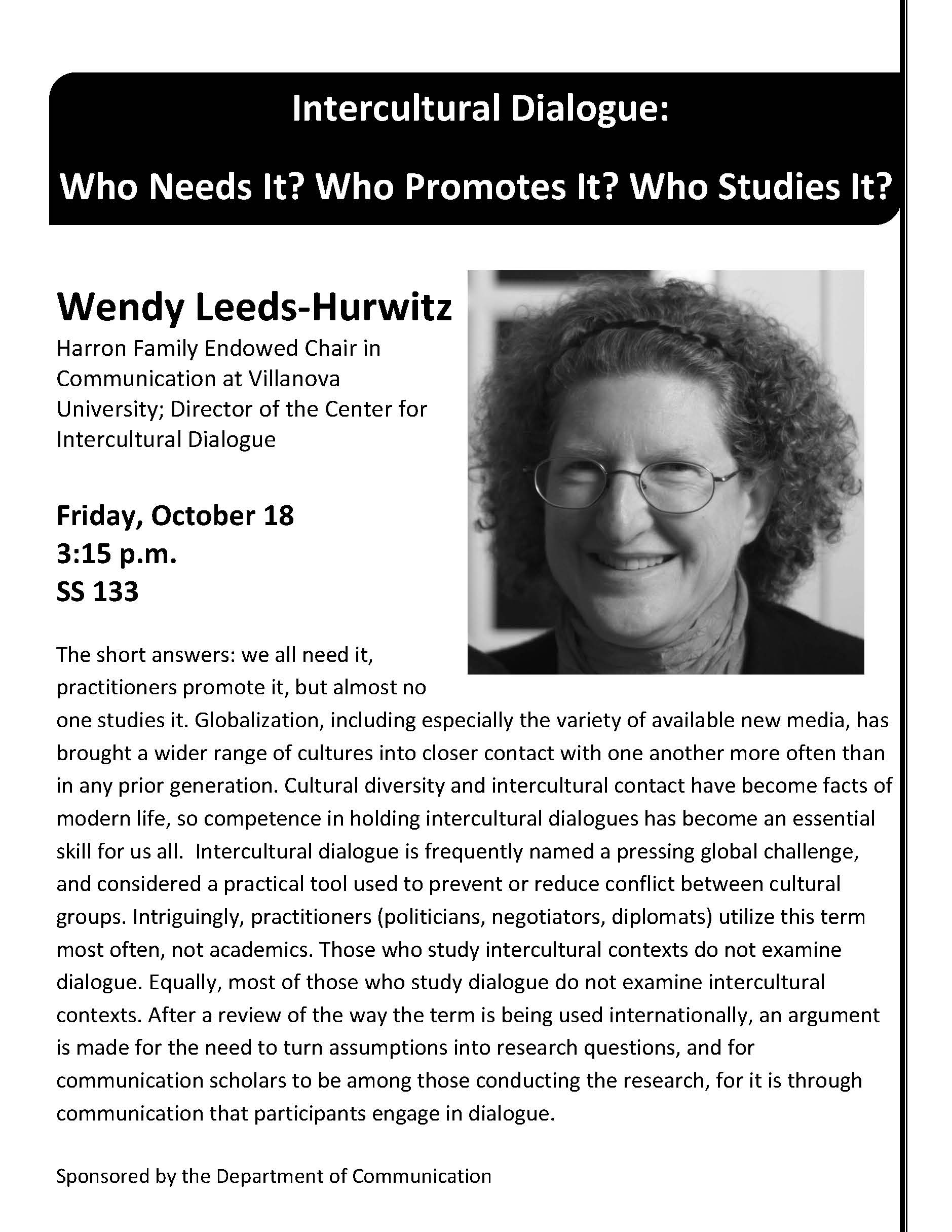
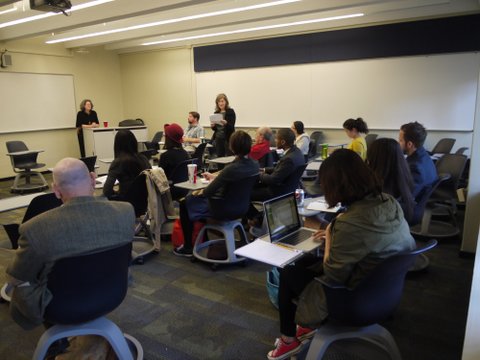
On October 18, 2013 I gave a talk at the University at Albany, State University of New York, entitled “Intercultural Dialogue: Who Needs it? Who Promotes it? Who Studies it?”

Albany flyer

My thanks to Prof. Teresa Harrison for organizing the event, and to Dr. Mihye Seo for integrating my talk into her Proseminar. While there I was able to catch up with several colleagues who I have known for many years (including Profs. Anita Pomerantz, Robert Sanders and Annis Golden) as well as meet several I had not yet met (Drs. Emilie Gould, Matthew Matsaganis).

U at Albany talk

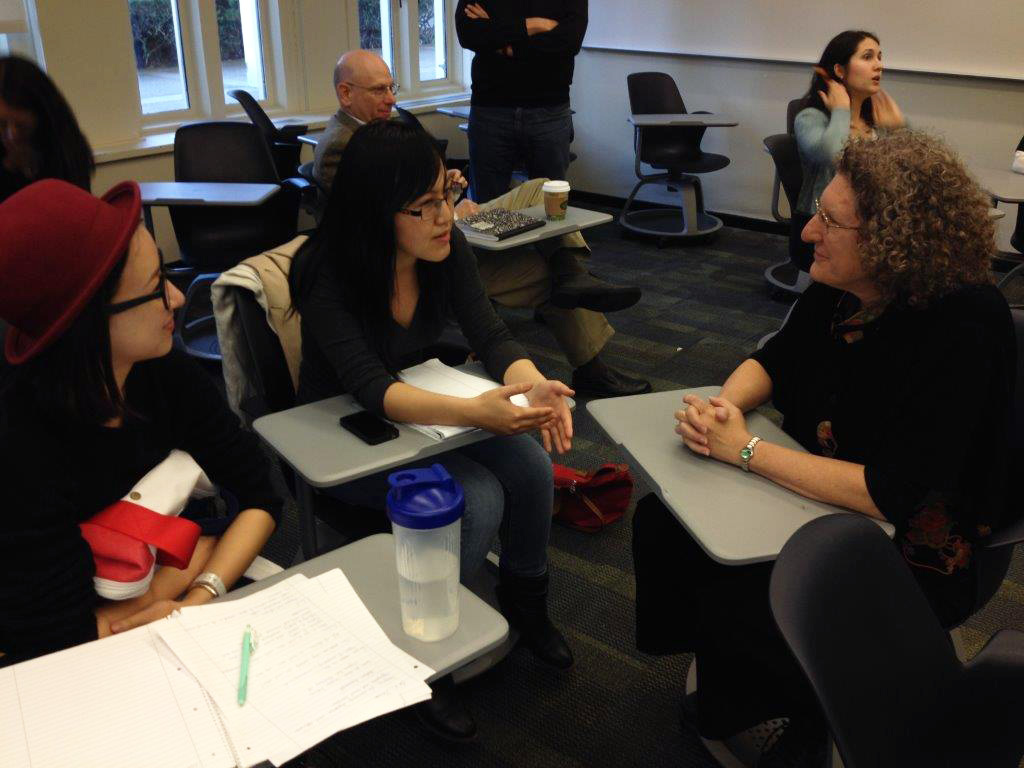
I also had the chance to talk with some of the graduate students, including Erting “Sa Sa” Sa and Sunny Zhao, below.

Albany students

Wendy Leeds-Hurwitz
Director, Center for Intercultural Dialogue

Summer Academy Peacebuilding & ICD

2nd International Summer Academy in Peace-building & Intercultural Dialogue
17.08 – 27.08.2014
Baar, Switzerland

IPD logo

The Institute for Peace and Dialogue is very glad to announce its next International Summer Academy in Peace-building & Intercultural Dialogue, which is going to be held in Switzerland 2014.  Its image as one of the most favourable places for traveling has made it more interesting to offer an exited and comprehensive program for our participants. Our experts, who are professionals in their fields will contribute to this event, with many years of experience in peace and conflict studies.

Nowadays unfortunately several frozen or ongoing conflicts between or within states still exist. Conflicts are different and if we look to the world mankind, how they are facing many new challenges, coupled with new dangerous situations, i.e. terrorist acts, non-legal arming of conflict sides, re-determination of borders, establishing new countries in the world map, non-providing territorial integrity, trafficking of arms, drugs and human; disputes on the implementation of transnational energy projects, democratization and false elections, revolution and internal political conflicts, armed guerrilla movements, violation and discrimination by nationalists, world economic crisis, climate change and unsafely biodiversity etc. Unfortunately the list is long. Conflicts are related and an integral part of human beings, as conflicts cause violation of human rights.

Existing conflicts weaken every kind of cooperation between nations and states. Without mutual cooperation and understanding, the future prosperity of the region would remain only as a good dream. Taking into consideration of peaceful behavior and engagements, we can make a decision on the strict belief, that opportunities for solving conflicts are feasible. Because in every conflict situation and tension forms we consequently face the below mentioned common situations:

1. Desperate situation and non-solving problems are not eternal;
2. It is possible to make common decision which both sides;
3. We can find common values, traditions and similar situation among conflict parties;
4. Protracted conflicts on the same time endanger regional development and prosperity;
5. Any mediation and negotiation actions are better than nothing.

Main Goal
The main goal of the summer academy is to support institutional academic peace education and strengthen peace-building skills and intercultural dialogue of the international society.

Language of the program
The International Summer Academy will be held in English.

Further information, and application, available from the Institute for Peace and Dialogue.

Human Library

An interesting approach to applied intercultural dialogue is a program called the Human Library. Here’s the basic description from the organization’s website:

“The Human Library is an innovative method designed to promote dialogue, reduce prejudices and encourage understanding.The main characteristics of the project are to be found in its simplicity and positive approach. In its initial form the Human Library is a mobile library set up as a space for dialogue and interaction. Visitors to a Human Library are given the opportunity to speak informally with “people on loan”; this latter group being extremely varied in age, sex and cultural background. The Human Library enables groups to break stereotypes by challenging the most common prejudices in a positive and humorous manner. It is a concrete, easily transferable and affordable way of promoting tolerance and understanding. It is a “keep it simple”, “no-nonsense” contribution to social cohesion in multicultural societies.”

Some basics of the group’s history (the complete story can be found here):

It started in Denmark in 2000, developed by an NGO, Stop the Violence, based in Copenhagen. Supported by the Council of Europe, and public libraries around the world, the Human Library has spread rapidly. Australia is the first country to establish a permanent Human Library; and an Australian prepared an academic study of the project. In 2013 Canada became the first country to create a National Human Library Day. Programs around the world have received a variety of awards.

Save

Intercultural Dialogue and New Media Research: An Interview with Robert Shuter

“Interviews”I recently sat down with Robert Shuter, director of the Center for Intercultural New Media Research, to talk about possible overlaps in our areas of interest. Here’s a brief summary.

Intercultural dialogue typically assumes people from different cultural backgrounds interacting face-to-face, with the intention of coming to some understanding of their areas of similarity and especially difference. Intercultural new media research examines the relevance of culture for mediated communication, specifically when using any of the new social media.

There is an obvious need for research into the ways in which technology can be used to facilitate intercultural dialogues. A few possibilities have already been investigated. One approach examines efforts to link students(especially those studying intercultural communication or learning a language) with peers located in different countries. As yet, there is only a little published research on this topic. A very different form of virtual intercultural dialogue involved placing large electronic screens in public spaces in Australia and Korea, facilitating virtual interaction between populations not typically in dialogue, and then analyzing the results.

Other studies have examined virtual collaboration but collaboration is frequently missing requisite dialogic elements like empathy and deep understanding. At the same time, it may lead to intercultural dialogue, and perhaps is a precursor to dialogue. Hence, the question remains: Is intercultural dialogue possible in the virtual world?

One possible answer may be found by considering Fred Casmir’s concept of third culture. Casmir posited that individuals from different cultures can optimize their relationship through the development of a third culture which combines elements of each of their cultures into a new whole. Dialogue is necessary to develop a third culture, which Casmir argues cannot be achieved without empathy and deep understanding of others. Once achieved, a third culture provides an ideal climate to interact because it is mutually accepting, supportive, and cooperative.

As Shuter puts it in a recent publication (2012): “Although third cultures are difficult to create in the physical world, some research suggests that they may be more achievable in virtual communities. McEwan and Sobre-Denton (2011) argue that the ease of technological access to cultural others combined with reduced social and economic costs significantly increase the probability of developing third cultures in the virtual world. Virtual communities, unlike organic ones, do not require leaving ones domicile to be an active member nor are they plagued by face threats due to social errors, according to the authors. In fact, new media provides users with technological tools to manage social distance, which McEwan and Sobre-Denton suggest increase cultural risk taking and experimentation, leading more readily to virtual third cultures.” (p. 225)

Andreas Pöllmann adapts Pierre Bourdieu’s concept of cultural capital to propose the relevance of intercultural capital. Essentially this expands beyond intercultural proficiencies (the typical list of intercultural skills, competencies, sensitivities required for intercultural competence) to include more subtle elements. A few examples to make his proposal concrete: those who are bilingual are especially useful in multilingual groups; those with international work experience can most quickly find their footing when sent to yet another country to conduct business. Such individuals should find their skills and experiences valued, and themselves much in demand, whether as employees or friends. The implications of cultural capital are enormous, as they suggest that those in the third world who are multilingual have something of great value that many in the first world lack. The question will be: how does intercultural capital play out in new media contexts?

Wendy Leeds-Hurwitz, Director
Center for Intercultural Dialogue

See the following articles for references to supplement these comments:

Leeds-Hurwitz, W. (2015). Intercultural dialogue. In K. Tracy, C. Ilie & T. Sandel (Eds.), International encyclopedia of language and social interaction (vol. 2, pp. 860-868). Boston: John Wiley & Sons.

McEwan, B., & Sobre-Denton, M. (2011). Virtual cosmopolitanism: Constructing third cultures and transmitting social and cultural capital through social media. Journal of International and Intercultural Communication, 4, 252–258.

Pöllmann, A. (2013). Intercultural capital: Toward the conceptualization, operationalization, and empirical investigation of a rising marker of sociocultural distinction. Sage Open, April-June 2013, 1-7.

Shuter, R. (2012). Intercultural new media studies: The next frontier in intercultural communication. Journal of Intercultural Communication Research, 41(3), 219-237.

UNESCO research fellowships

UNESCO / Keizo Obuchi research fellowships

UNESCO invites young post-graduate researchers in developing countries with a Masters degree or equivalent, to apply for fellowships. This Research Fellowship Programme is financed by Japan through funds-in-trust dedicated to the development of human resources.


The programme, named after the late Japanese Prime Minister Keizo Obuchi, offers a total of 20 fellowships to researchers. A maximum amount between US$ 6,000 – 10,000 will be awarded to the two candidates.

The aim is to impact on capacity building and research activities in one of four fields:

*Environment, with an emphasis on Water Sciences, Water Issues, Climate Change, Engineering Capacity Building in the Developing World;
*Intercultural dialogue;
*Information and communication technologies;
*Peaceful conflict resolution.

Applicants:
Post graduate researchers, no older than 40 years, can apply through their country’s National Commission. Priority will be given to women, candidates from the least developed countries and African researchers. Each Member State may nominate a maximum of two candidates. No applications will be considered from individuals.

The Member States of UNESCO who are eligible to apply are:
Africa – 46 Member States
Arab States – 12 Member States
Asia and The Pacific – 39 Member States
Latin America and the Caribbean – 29 Member States
Europe – 13 Member States
Tokelau – 1 Associate Member State
NB: the former 15 EU Member States are not eligible to apply.

All applications must be sent to the National Commission for UNESCO of the country of origin of the candidate that will then decide whether they will submit the application to UNESCO.

Deadline: 30 August 2013

Application form, eligible countries and further information: Click here

National Directory of Unesco national commissions: Click here

Key documents: UNESCO/Keizo OBUCHI research Fellowships programme internet: Click here

Global Dialogue prize 2013 awarded

The Global Dialogue Prize, introduced in 2009 as one of the world’s most significant awards for intercultural dialogue and value research, will be awarded at the opening day for the XXIII World Congress of Philosophy in Athens, August 4, 2013. The Award Committee of the Global Dialogue Prize has decided to bestow this year’s award on the Council for Research in Values and Philosophy, in particular recognition of the Council’s longstanding efforts in addressing sensitive issues of cultural heritage and contemporary change. Over the course of four decades the Council has grown to become the currently largest network for intercultural value research, with over 400 associated members from 65 countries. Since 1998, the Council has produced over 150 academic events and published 300 volumes of scholarly monographs and anthologies on values from a cross-culturally comparative or intercultural perspective.

The Council’s President Professor George F. McLean and its Executive Director, Dr Hu Yeping, who have built and directed the Council throughout four decades, will accept the award on behalf of the organization. For details see here. Read the statement of the award committee here.

GDP-Prize
The glass sculpture symbolizing the prize was designed by artist Silvana Nannini