CID VIdeo Competition Resources 2020

Job adsThe following resources discussing listening and intercultural dialogue are intended to help to those preparing entries for the CID Video Competition in 2020.

This year’s competition has the theme “listening is how intercultural dialogue starts.” This means students need to demonstrate their understanding of 2 concepts. The first is Listening. Materials published on the CID site that should be useful include:

Key Concepts in Intercultural Dialogue
#37: Dialogic listening

Constructing Intercultural Dialogues
#6: The privilege of listening first

As well as several posts related to listening:
LIST(e)N and The Day of Listening
Call for Papers: International Listening Association
Call for Papers: Special issue of International Journal of Listening on Listening in mediated contexts

The second part is Intercultural Dialogue. CID has produced a number of overlapping explanations, including:

Key Concepts in Intercultural Dialogue
#1:    Intercultural dialogue
#8:   Public dialogue
#10: Cross-cultural dialogue
#14: Dialogue
#81: Dialogue as a space of relationship
#84: Double intercultural dialogue

Constructing Intercultural Dialogues
#9: Intercultural dialogue as an activity of daily living
#11: Creating connection through intercultural dialogue partners

CID Posters
#3: Intercultural dialogue
#6: Dialogue defined
#8: Intercultural competence/intercultural dialogue

If you have further questions, see previously published competition rules, and FAQ. See the reflection by one winning team on creating their video. Or send an email with a question. When you’re ready to submit an entry, click here [URL to be added when the competition opens].

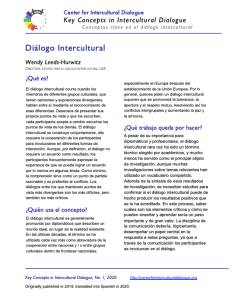
KC1 Intercultural Dialogue Translated into Spanish

Key Concepts in ICDContinuing translations of Key Concepts in Intercultural Dialogue, today I am posting KC#1: Intercultural Dialogue, which I wrote for publication in English in 2014, and which Milton Machuca-Galvez has now translated into Spanish.

As always, all Key Concepts are available as free PDFs; just click on the thumbnail to download. Lists of Key Concepts organized chronologically by publication date and number, alphabetically by concept, and by languages into which they have been translated, are available, as is a page of acknowledgments with the names of all authors, translators, and reviewers.

KC1 Intercultural Dialogue_Spanish

Leeds-Hurwitz, W. (2020). Diálogo Intercultural. (M. Machuca-Galvez, trans). Key Concepts in Intercultural Dialogue, 1. Available from:
https://centerforinterculturaldialogue.org/wp-content/uploads/2020/02/kc1-intercultural-dialogue_spanish.pdf

If you are interested in translating one of the Key Concepts, please contact me for approval first because dozens are currently in process. As always, if there is a concept you think should be written up as one of the Key Concepts, whether in English or any other language, propose it. If you are new to CID, please provide a brief resume. This opportunity is open to masters students and above, on the assumption that some familiarity with academic conventions generally, and discussion of intercultural dialogue specifically, are useful.

Wendy Leeds-Hurwitz, Director
Center for Intercultural Dialogue


Creative Commons License
This work is licensed under a Creative Commons Attribution-NonCommercial-NoDerivatives 4.0 International License.

CID Video Competition 2020: Listening is How Intercultural Dialogue Starts

Job adsThe Center for Intercultural Dialogue announces its third annual video competition, open to students enrolled in any college or university during spring 2020. Deadline: June 1, 2020, at midnight (east coast US time). Submissions now open.

CID Video Competition 2020


This year’s competition asks students to focus on listening, as listening is how intercultural dialogue starts.

Listening gives shape to speaking, inviting other people into a dialogue…Our acts of listening, like all communication, are shaped by our cultural and individual differences. – Elizabeth S. Parks

Listening is what happens when people stop focusing on what they say or do, and start attending to what someone else is saying or doing. Without listening, there can be no intercultural dialogue.

Intercultural dialogue is the art and science of understanding the Other. – Peter Praxmarer

Intercultural dialogue can include international, interracial, interethnic, and interfaith interactions, but it is always active (people doing something) rather than passive (people thinking about something).

Faculty members are invited to discuss intercultural dialogue in a class, perhaps showing winning entries from 2018 or 2019, and to suggest that students produce very short videos as their response. Students are encouraged to be creative, show off their knowledge and skills, and have fun with the topic.

The top award winner will receive a $200 prize. And the top three winners will receive a copy of Elizabeth Parks’ 2019 book, The Ethics of Listening: Creating Space for Sustainable Dialogue, courtesy of the publisher, Lexington Books.

All award-winning entries will be posted to the CID YouTube channel, and highlighted on the CID website, LinkedIn group, Facebook group, and Twitter feed, through posts describing the creators and highlighting each of their videos. Perhaps most important to student learning, all entries will be sent comments from the judges. Past winning entries have come from Italy, the UK, Peru, Spain, Denmark, Hong Kong, and the USA.

In addition to the rules below, a list of Resources and FAQ have been posted, as well asReflection by winning students, which provides peer-to-peer advice. Contact Wendy Leeds-Hurwitz, CID Director, with any questions.

Competition Rules:

  1. Entries must be between 30 seconds to 2 minutes in length. Longer videos will be disqualified.

  2. Entries may be submitted May 1-June 1, 2020. CID is not responsible for any entry that is misdirected, corrupted, or not received by this date. Judging will occur in June, and winners will be announced in July.

  3. Submissions will be evaluated based on: originality, clarity, showing how listening permits intercultural dialogue, effective use of technology, and overall impact.

  4. All part-time or full time undergraduate or graduate students (post-graduates for those outside the USA) currently enrolled at any university or college or community/ technical college/school, anywhere in the world, are eligible. If high school students wish to join in, they are welcome as well. Students can work independently or in groups. Given the topic, incorporating more than one viewpoint may be particularly appropriate. Ensuring that at least someone in the group knows something about the idea of intercultural dialogue, and at least someone has created a video before, should be useful.

  5. Videos should be created by students, not edited and corrected ahead of time by their instructors. Students must submit videos themselves.

  6. In addition to a video, each entry must be accompanied by a completed brief information form about the creator(s). This will be used as a resource in contacting winners, and then in sharing information about them on the CID website and other social media at the end of the competition.

  7. By submitting your entry, you are attesting that you have the necessary authorization to use the images, audio, text, music, and any other content contained in your video. Please do not enter if you are in violation of, or uncertain of your rights to, any copyrights, patents, trademarks, video, music or other intellectual property. Consult your faculty advisor if you have any questions or doubts about the content of your entry. Online resources include the Documentary Filmmakers Statement of Best Practices in Fair Use and the Code of Best Practices in Fair Use for Online Video; these and other such best-practices codes are available from the Center for Media and Social Impact.


  8. Submissions found incomprehensible, inappropriate, or in violation of intellectual property rights for any reason in the sole judgment of CID will not be accepted into the competition.

  9. Funding for the first prize cash award is provided by the Broadcast Education Association (BEA), one of the members of CID’s parent organization, the Council of Communication Associations.

UNESCO Survey on ICD

Applied ICDA new report, entitled the UNESCO Survey on Intercultural Dialogue 2017, presents the findings of groundbreaking survey developed by the UNESCO Sector for Social and Human Sciences and the UNESCO Institute for Statistics. This was the first UNESCO survey on intercultural dialogue conducted among its Member States. It was designed to take stock of the current conceptual understanding, policies, and legislation, as well as available data, resources and main stakeholders in this field.

The results provide unique perspective on country-specific policies on intercultural dialogue. They also offer a point of analysis for monitoring and policymaking purposes. The survey was sent to all 199 National Commissions for UNESCO in six official languages.

Key findings include:

  1. Defining intercultural dialogue: Context is crucial to defining and applying intercultural dialogue.

  2. Policy framework: The majority of respondents (71%) state that an intercultural dialogue policy is in place in their country, while only 38% of respondents confirmed the existence of a definition of intercultural dialogue at national level.

  3. Challenges: Past and present conflicts and violence represent significant and complex challenges to bringing different people together in dialogue.

  4. Enabling factors: An environment based on respect, tolerance and acceptance is essential to enable intercultural dialogue to thrive.

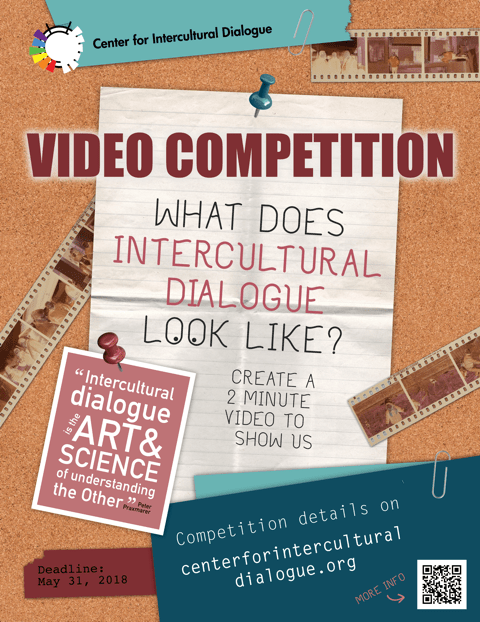
What Does Intercultural Dialogue Look Like? CID Video Competition

CID Video CompetitionREMINDER: This contest is coming up quickly, so tell your students and/or peers! Open to all students, undergraduate or graduate, anywhere in the world. First entries possible April 15, 2018; deadline May 31, 2018.

CID has organized its first ever video competition, open to students enrolled in any college or university during the 2017-2018 academic year.

CID Video Competition

To enter, participants must submit a video no longer than 2 minutes that highlights the importance of intercultural dialogue, responding to the question: “What does intercultural dialogue look like?”

Entries will be accepted April 15-May 31, 2018.

One winner will receive a $200 prize. The top entries will be posted to the CID YouTube channel, and be highlighted on the CID website, along with posts describing the creators and highlighting each of their videos, throughout the rest of 2018.

Submissions will be evaluated based on originality, clarity, cultural message, effective use of technology, and overall impact. Feel free to work independently or in groups. Get creative, show off your skills and, most importantly, have fun!

Video Competition FAQ

To submit an entry, click here.

Competition Rules

Continue reading “What Does Intercultural Dialogue Look Like? CID Video Competition”

CID Video Competition: What does Intercultural Dialogue Look Like?

CID Video CompetitionCID has organized its first ever video competition, open to students enrolled in any college or university during the 2017-2018 academic year.

WARNING: Please read the entry rules carefully! Several submissions have not met the requirements, and cannot be considered for a prize until they are revised. Make sure you submit a video file (not audio), that is between 30 seconds and 2 minutes (not 30 minutes!), with the last line “Intercultural dialogue looks like…” and upload it to the server provided (not to YouTube directly). Final deadline is May 31, 2018, at midnight (east coast US time).

NEW Clarification: When someone asks “Intercultural dialogue looks like…” in English, the “…” (read out loud as dot-dot-dot) means your job is to complete the sentence and include your answer as the last shot in the video. (So, “intercultural dialogue looks like a tiger, an ice cream cone, a braid, etc.” – choose whatever image makes sense given your video.) Please do NOT include the literal phrase “Intercultural dialogue looks like…” as the last shot in your video!

CID Video Competition

To enter, participants must submit a video no longer than 2 minutes that highlights the importance of intercultural dialogue, responding to the question: “What does intercultural dialogue look like?”

Entries will be accepted April 15-May 31, 2018.

One winner will receive a $200 prize. The top entries will be posted to the CID YouTube channel, and be highlighted on the CID website, along with posts describing the creators and highlighting each of their videos, throughout the rest of 2018.

Submissions will be evaluated based on originality, clarity, cultural message, effective use of technology, and overall impact. Feel free to work independently or in groups. Get creative, show off your skills and, most importantly, have fun!

To submit an entry, click here.

Video Competition FAQ

Competition Rules

Continue reading “CID Video Competition: What does Intercultural Dialogue Look Like?”

KC1 Intercultural Dialogue Translated into Greek

Key Concepts in ICDContinuing translations of Key Concepts in Intercultural Dialogue, today I am posting KC#1: Intercultural Dialogue, which I wrote for publication in English in 2014, and which Margarita Kefalaki has now translated into Greek.

As always, all Key Concepts are available as free PDFs; just click on the thumbnail to download. Lists of Key Concepts organized chronologically by publication date and number, alphabetically by concept, and by languages into which they have been translated, are available, as is a page of acknowledgments with the names of all authors, translators, and reviewers.

KC1 ICD_GreekLeeds-Hurwitz, W. (2017). Intercultural dialogue [Greek]. (M. Kefalaki, trans). Key Concepts in Intercultural Dialogue, 1. Available from: https://centerforinterculturaldialogue.org/wp-content/uploads/2017/08/kc1-icd_greek.pdf

If you are interested in translating one of the Key Concepts, please contact me for approval first because dozens are currently in process. As always, if there is a concept you think should be written up as one of the Key Concepts, whether in English or any other language, propose it. If you are new to CID, please provide a brief resume. This opportunity is open to masters students and above, on the assumption that some familiarity with academic conventions generally, and discussion of intercultural dialogue specifically, are useful.

Wendy Leeds-Hurwitz, Director
Center for Intercultural Dialogue


Creative Commons License
This work is licensed under a Creative Commons Attribution-NonCommercial-NoDerivatives 4.0 International License.

CID Poster #8: Intercultural Competence/Intercultural Dialogue

CID PostersThis is the next of the posters designed by Linda J. de Wit, in her role as CID intern. The quote is intended to clarify the concept of intercultural dialogue by showing how it relates to an older, more frequently used concept, intercultural competence. The photo of water used as background is Linda’s own. The citation for the quote is:

Leeds-Hurwitz, W. (2016). De la possession des compétences interculturelles au dialogue interculturel: Un cadre conceptuel [Moving from having intercultural competencies to constructing intercultural dialogues: A conceptual framework]. Les Politiques Sociales, 3/4, 7-22.

Intercultural competence/ Intercultural dialogueJust in case anyone wants to cite this poster, the following would be the recommended format:

Center for Intercultural Dialogue. (2017). Intercultural competence/Intercultural dialogue. CID Posters, 8. Available from:
https://centerforinterculturaldialogue.org/wp-content/uploads/2017/08/competence-dialogue.png

As with other series, CID Posters are available for free on the site; just click on the thumbnail to download a printable PDF. They may be downloaded, printed, and shared as is, without changes, without cost, so long as there is acknowledgment of the source.

As with other series, if you wish to contribute an original contribution, please send an email before starting any work to receive approval, to minimize inadvertent duplication, and to learn about technical requirements. As is the case with other CID Publications, posters should be created initially in English. Given that translations of the Key Concepts in Intercultural Dialogue have received so many views, anyone who wishes to translate their own poster into another language (or two) is invited to provide that as well. If you want to volunteer to translate someone else’s poster into a language in which you are fluent, send in a note before starting, to receive approval and to confirm no one else is working on the same one.

Wendy Leeds-Hurwitz
Director, Center for Intercultural Dialogue
intercult.dialogue AT gmail.com


Creative Commons License
This work is licensed under a Creative Commons Attribution-NonCommercial-NoDerivatives 4.0 International License.

CID Poster #3: Intercultural Dialogue

CID PostersThis is the third of the posters designed by Linda J. de Wit, in her role as CID intern. The quote by Peter Praxmarer does not come from a publication, but from a Skype conversation we had on April 25, 2017. I was struck by what he said, and how nicely it summed up the concept of intercultural dialogue, and requested permission to turn the definition into a poster, and he graciously agreed. In terms of visual design, Linda indicated “art” by the picture frame, and “science” by the design in the background. Hopefully this definition will find a wide audience, because I think it does a better and more concise job of explaining intercultural dialogue than other definitions I’ve seen.

Intercultural Dialogue definition

Just in case anyone wants to cite this poster, the following would be the recommended format:

Center for Intercultural Dialogue. (2017). Intercultural Dialogue. CID Posters, 3. Available from:
https://centerforinterculturaldialogue.org/wp-content/uploads/2017/07/art-and-science.png

As with other series, CID Posters are available for free on the site; just click on the thumbnail to download a printable PDF. They may be downloaded, printed, and shared as is, without changes, without cost, so long as there is acknowledgment of the source.

As with other series, if you wish to contribute an original contribution, please send an email before starting any work to receive approval, to minimize inadvertent duplication, and to learn about technical requirements. As is the case with other CID Publications, posters should be created initially in English. Given that translations of the Key Concepts in Intercultural Dialogue have received so many views, anyone who wishes to translate their own poster into another language (or two) is invited to provide that as well. If you want to volunteer to translate someone else’s poster into a language in which you are fluent, send in a note before starting, to receive approval and to confirm no one else is working on the same one.

Wendy Leeds-Hurwitz
Director, Center for Intercultural Dialogue
intercult.dialogue AT gmail.com


Creative Commons License
This work is licensed under a Creative Commons Attribution-NonCommercial-NoDerivatives 4.0 International License.

CID Poster #1: Intercultural Communication/Competence/Dialogue

CID PostersThis is the first of the posters designed by Linda J. de Wit, in her role as CID intern. This one provides a quick and easy way to understand, and differentiate between, the concepts of “intercultural communication,” “intercultural competence,” and “intercultural dialogue,” using a rooster and a sheep to represent members of different cultures (and she notes that the animals are vector designs by vecteezy.com). The article where these explanations of these concepts (as well as lots of other concepts) were published is:

Leeds-Hurwitz, W. (2016). De la possession des compétences interculturelles au dialogue interculturel: Un cadre conceptuel [Moving from having intercultural competencies to constructing intercultural dialogues: A conceptual framework]. Les Politiques Sociales, 3/4, 7-22.

Intercultural communication/competence/dialogue

Just in case anyone wants to cite this poster, the following would be the recommended format:

Center for Intercultural Dialogue. (2017). Intercultural communication, intercultural competence, intercultural dialogue. CID Posters, 1. Available from:
https://centerforinterculturaldialogue.org/2017/06/28/cid-poster-1/

As with other series, CID Posters are available for free on the site; just click on the thumbnail to download a printable PDF. They may be downloaded, printed, and shared as is, without changes, without cost, so long as there is acknowledgment of the source.

Now that the first poster is available as a model, the series is open to submissions. If you wish to contribute an original design, please send an email before starting any work to receive approval, to minimize inadvertent duplication, and to learn about technical requirements. As is the case with other CID Publications, posters should be created initially in English. Given that translations of the Key Concepts in Intercultural Dialogue have received so many views, where specific quotes are provided, anyone who wishes to translate their own poster into another language (or two) is invited to design that as well. If you want to volunteer to translate someone else’s poster into a language in which you are fluent, send in a note before starting, to receive approval and to confirm no one else is working on the same one.

Wendy Leeds-Hurwitz
Director, Center for Intercultural Dialogue
intercult.dialogue AT gmail.com


Creative Commons License
This work is licensed under a Creative Commons Attribution-NonCommercial-NoDerivatives 4.0 International License.