Louisa Edgerly-Microgrant Report

NCA Micro Grant Report
Louisa Edgerly, Independent Scholar

This report details my travel to the Republic of Congo to begin fieldwork on a collaborative research project with the International Conservation and Education Fund (INCEF), a US-Congolese nonprofit organization that produces educational films on topics related to public health and environmental conservation. The aim of my research is to develop descriptive accounts and interpretations of the intercultural communication that takes place between INCEF, their audience of rural Congolese villagers, and the global health workers and environmentalists who also work on the issues of human health and environmental conservation in Congo.

Identifying local partners
I learned about INCEF’s work – and its relevance to theories of intercultural communication – through conversation with an INCEF board member. Following this initial conversation in May of 2011, I drafted a project proposal outlining a possible collaboration between INCEF and the University of Washington’s Center for Local Strategies Research (UWCLSR) to study INCEF’s methods of communication and their process of project design through the lens of speech codes theory.

I sent the draft proposal to INCEF’s Executive Director, Cynthia Moses, and to UWCLSR. When all parties expressed interest in moving forward with the project, I then began to discuss possible dates for an initial research trip to Congo to observe INCEF’s work in place. Based on INCEF’s planned activities for 2012, Cynthia and I determined that November and December, 2012 would be a good time for my visit. I estimated that I could raise funds to cover a two-month stay in Congo, and to pay for travel of about a week to a remote location outside the capital city to observe INCEF’s project implementation.

Sunrise-smRaising research funds
Once I had chosen the dates for my research trip, I began by setting up an account on a crowd-funding web site called Petridish. I had done quite a lot of research on possible sources of funding for research, but as an independent scholar there were not many options available. The National Communication Association‘s Travel Microgrant was one notable exception, and I applied for this in addition to my other fund-raising efforts.

Crowd-funding offered the best – and fastest – mechanism to raise the $7,000 I estimated I would need to cover the costs of the entire trip. I created a short video to put on the Petridish web site, chose the different donation levels and the rewards for each level (a photograph from the trip, subscription to the trip’s blog, etc.), and set up the crowd-funding platform. In fifty days I raised just over $7,000 through my personal network of friends and family, using social media tools and email appeals. Petridish charged 4% of the total raised for providing the web site, and Amazon Payments also took a transaction fee from each donation made online. I was able to use the remainder to cover my direct research costs, including air fare, food, housing, and local transportation in Congo.

The timing of my travel depended to a great extent on INCEF’s schedule, and thus I had to depart for Congo before the decision about the NCA microgrants was announced. I crossed my fingers and booked my ticket for Brazzaville, Congo.

The NCA microgrant for $1,000 covered one third of the total round trip airfare from Seattle to Brazzaville, and thus allowed me to use other funds raised to cover unexpected expenses that arose during my field work, including several extra days spent in the northern town of Impfondo due to canceled flights, and the wildly unpredictable cost of gasoline, which increased travel costs within Congo.

Research Activities in Congo
The aim of my research in Congo was to study the communication methods used by INCEF, and to assess the degree to which they constituted a dialogic and participatory approach to intercultural communication. This field trip also aimed to allow me to see whether further academic collaboration might be able to offer some real benefits to INCEF, by offering a theoretical approach to intercultural dialogue that was compatible with their overall goals and experience, as well as helping them make connections with other organizations doing similar work.

In Brazzaville, I stayed in a guest room at INCEF’s headquarters, located in the Centreville neighborhood. The experience of studying human beings in their natural settings almost never goes completely smoothly, and this trip was no exception. INCEF’s Executive Director had intended in be in Brazzaville to meet me, but she was delayed several weeks and did not arrive until I had been there almost four weeks. The project that I had planned to observe was on hold due to lack of funds, and many of the activities that I had hoped to observe were likewise delayed or suspended. All of this provided me with the chance to explore Brazzaville and observe daily life there, to have longer conversations with INCEF’s staff, and to study their library of public health and conservation films in greater detail. The realities of living and working in a developing country, with inconsistent electrical supply, running water, and internet service also provided important background context to help me understand the structural barriers INCEF faces in their work every day.

My first weeks of observations and interviews with INCEF staff, and with individuals from other organizations such as the Wildlife Conservation Society that partner with INCEF in Brazzaville, provided me with a preliminary set of data to analyze, and important context for my later observations in the field. After four weeks in Brazzaville, I traveled north to the town of Impfondo, where I met with two of INCEF’s educators to prepare for a trip out to the village of Makolongoulou to screen several INCEF films as part of their work on violence prevention and public health with UNICEF. I conducted observations at a number of INCEF film screenings and at the facilitated discussions that followed, both in the village and in Impfondo. This trip gave me the opportunity to see INCEF’s communication methodology in practice, and added a great deal of information to the data I had collected through earlier interviews. From Impfondo, I returned to Brazzaville to conduct a few final interviews and prepare to return to Seattle.
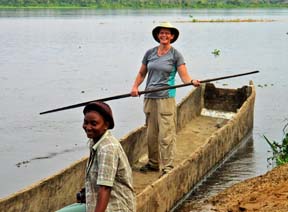
Louisa & Mika-sm

Further research activities
Back in Seattle, I have continued to pursue new contacts and find connections with researchers doing similar work. Perhaps unsurprisingly, I have found that many more people are interested in talking with me now that I have completed an initial field study, and I have begun to develop several promising contacts at the University of Washington in the departments of Anthropology and Computer Science and Engineering. I have written a paper based on my preliminary research findings, and submitted it to the NCA conference. I am also developing a project in collaboration with Public Health-Seattle & King County and the Masters of Communication in Communities & Networks program at UW. I will lead a year-long graduate student practicum to apply some of the communication methodologies used by INCEF – video, facilitated discussion, local perspectives and languages – to the task of reaching the many different cultural and language communities around King County, Washington with public health messages.

I remain in touch with INCEF’s Executive Director and I am actively pursuing ways to return to Congo to conduct more field research with INCEF staff. My research experience thus far has shown that there is a very clear connection to theories of intercultural dialogue in INCEF’s practice, and that engaging with these theories could enhance INCEF’s work on future projects. It has also become clear that continued involvement in scholarly research will benefit INCEF by raising their profile among possible donor organizations and academic institutions. In addition, this collaboration will offer them access to new technologies to assist in the dissemination of their films and educational tools. Another possibility that has opened up would involve INCEF in training local people in Congo to produce their own videos on public health and environmental topics, thus creating a more participatory process of two-way communication between citizens and policy makers in Congo. This methodological shift has emerged from the research connections I have begun to build as a result of my initial fieldwork.

The NCA travel microgrant played a very important part in the successful completion of my field trip to Congo. Completing this initial pilot study has given me a foundation of preliminary data and access to a whole new network of connections that would not have been possible without the travel grant.

[NOTE: Louisa Edgerly’s original project description is available here; further information about her project in a report to the Center for Local Strategies Research is here.]

Gate A-4 poem

[NOTE: Occasionally an author of fiction or a poet gets right to the heart of intercultural dialogue. One such example follows. If you have other suggestions, post links as comments.]

Gate A-4
by Naomi Shihab Nye

Wandering around the Albuquerque Airport Terminal, after learning
my flight had been delayed for four hours, I heard an announcement:
“If anyone in the vicinity of Gate A-4 understands any Arabic, please
come to the gate immediately.”

Well–one pauses these days. Gate A-4 was my own gate. I went there.

An older woman in full traditional Palestinian embroidered dress, just
like my grandma wore, was crumpled to the floor, wailing loudly. “Help,”
said the flight service person. “Talk to her. What is her problem? We
told her the flight was going to be late and she did this.”

I stooped to put my arm around the woman and spoke to her haltingly.
“Shu-dow-a, Shu-bid-uck Habibti? Stani schway, Min fadlick, Shu-bit-
se-wee?” The minute she heard any words she knew, however poorly
used, she stopped crying. She thought the flight had been cancelled
entirely. She needed to be in El Paso for major medical treatment the
next day. I said, “No, we’re fine, you’ll get there, just later, who is
picking you up? Let’s call him.”

. . .
And I looked around that gate of late and weary ones and I thought, This
is the world I want to live in. The shared world. Not a single person in that
gate–once the crying of confusion stopped–seemed apprehensive about
any other person. They took the cookies. I wanted to hug all those other
women, too.

This can still happen anywhere. Not everything is lost.

[The full poem can be read here]

Save

Create UNAOC – apps for intercultural dialogue

Learning Games Network and MIT-Education Arcade, is pleased to announce the results and current updates of CREATE UNAOC, the apps/games for intercultural dialogue challenge.

Late last year programmers around the world were invited to share their vision of how mobile apps and games can raise awareness and enable new opportunities for intercultural dialogue. The winning applications were presented at the 5th UNAOC Forum in Vienna, Austria, since then several of the award winning apps/games have been fully developed and are now available for download.

Among the 5 Winners and 5 Honorable Mentions are apps/games allowing users to improve their knowledge of Arab culture (Ibn Batuta), to experience the world’s cultural diversity through the eyes of children (Touchable Earth) and to become aware of the global crisis for one of the most basic need: Water (Get Water!). Other applications highlight the importance of critical thinking in journalism (Reality, still in development) or invite young people to discover the rich multi-cultural corollary of contemporary Europe (Cultural Shock).

Ed Gragert, The Huffington Post, highlights that “these games are examples of how new technologies can provide global education content in an engaging and fun activity.” Praising “Get Water!”, Jordan Shapiro at Forbes, is intrigued by the effect of these apps: “These are some big human rights issues that Get Water drags out of the invisible shadows and brings into the light of discussion. I’m now having surprisingly sophisticated conversations with my two sons (five and seven years old) about the privatization and commodification of water rights while we swap devices and controllers on the living room sofa…all because of a video game.”

Save

Intercultural Dialogue and Community Development

The Center for Louisiana Studies and the Department of Modern Languages at the University of Louisiana at Lafayette are pleased to host Dominique Sarny, professor and ethnologist at the University of Regina, Canada, for “Dialogue interculturel et développement communautaire : l’expérience des Francophones et des Métis de l’ouest canadien” (“Intercultural Dialogue and Community development: The Experience of Francophones and the Métis of Western Canada). In 2005, Professor Sarny and others began hosting round tables between the Fransaskois and the Métis of Saskatchewan. It is an undertaking of reconciliation and emancipation unique to Canada on behalf of two founding nations that can serve as a model to other communities in the Americas that wish to be brought closer together.

The Francophones and the Métis of Western Canada share a common historical, cultural and linguistic heritage as founding peoples. Since 1885, these two nations have had no direct contact, and their increasing marginalization as minority groups contributes to the loss of their respective identities and to assimilation. Framed in a rigorous methodology, the participants at the round table learn to become aware and profit together from a necessary convergence of identity and community development perspectives, as well as an active citizenship. This round table model is suggested for consideration by researchers and community participants in Louisiana, in a rich context of intermarriage of cultures (Cajun, Creole and Native American) who share a language and traditional cultural practices (music, songs, stories, etc.). This will allow for the sharing of results stemming from this experience, and to discuss a possible adaptation to this model to Louisiana’s reality in the context of an inclusive and united Francophonie, and the necessity to invent new forms of cooperation. This lecture will be held in the Griffin Hall Auditorium on the UL Lafayette campus, 141 Rex Street, room 147, Lafayette, LA at 3:30pm on Wednesday, April 24, 2013.

The Acadiana community is invited to attend this free lecture en français co-hosted by the Center for Louisiana Studies and the UL Lafayette Department of Modern Languages and sponsored by the Agence Universitaire de la Francophonie and Le centre de la Francophonie des Amériques. For more information
about this event, please contact the Center for Louisiana Studies Programming Division at 337.482.1320.

The free lecture en français will be held on Wednesday, April 24 on the UL campus at 6:30 pm in Griffin Hall Audotorium.

Original message posted to: http://www.katc.com/news/ethnology-professor-to-speak-on-intercultural-dialogue-in-canada/

Save

University of Macau

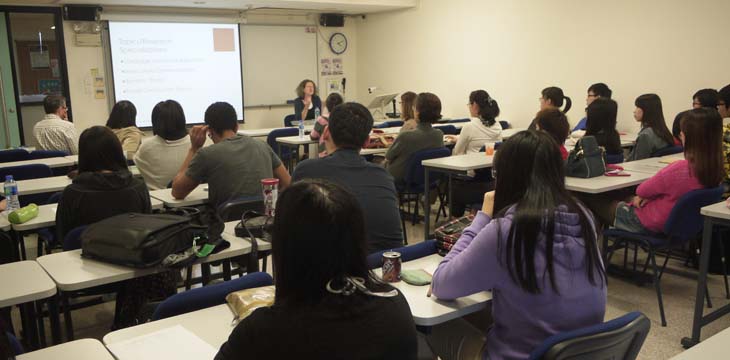
On April 15, 2013 I gave a talk entitled: “Asking cultural questions: Using ethnography to answer questions about cultural identity” for the Department of Communication at the University of Macau. The topic and case studies provided were related to my research.

UMacau-class

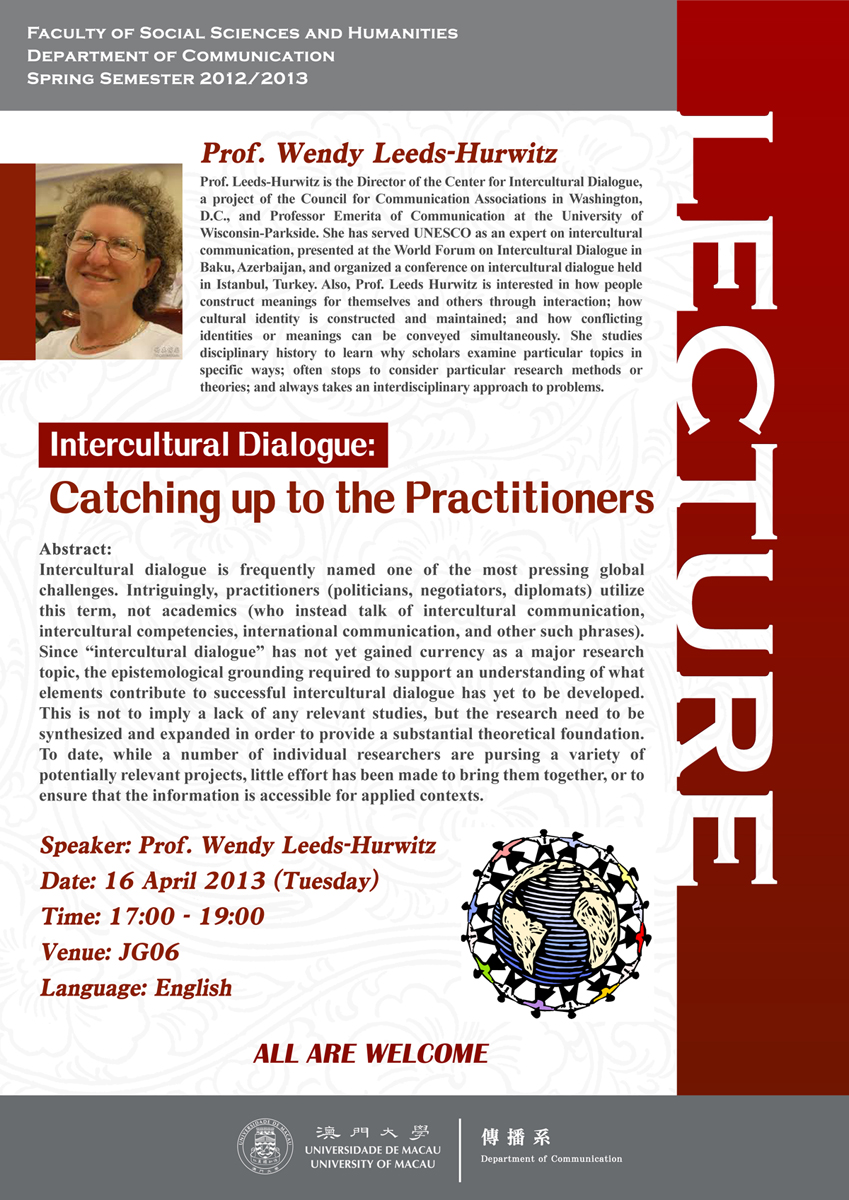
On April 16, 2013, I gave another talk in the Department, entitled “Intercultural dialogue: Catching up to the practitioners.” This talk was related to the Center for Intercultural Dialogue.

small-416 poster

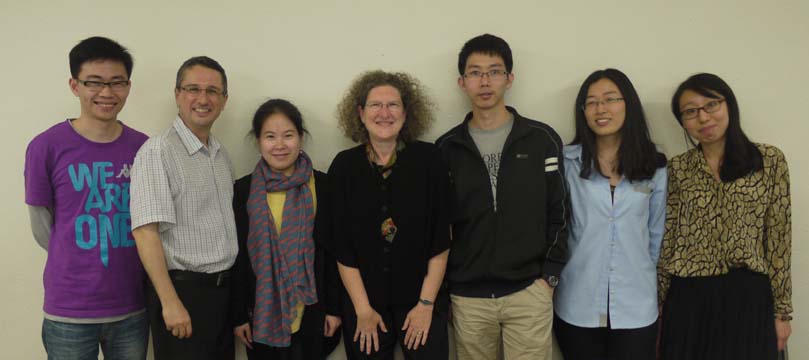
My thanks to Dr. Todd Sandel for organizing these events, and for all the time spent showing me around Macau, and to his students and colleagues for providing such a good audience, and asking provocative questions.

Sandel and graduate students with Leeds-Hurwitz

While at the University of Macau, I had the opportunity to connect with Dr. Martin Montgomery (Chair Professor and Head of Department), Dr. Timothy Simpson (Associate Dean, Faculty of Social Sciences and Humanities), Dr. TAN See Kam, Dr. Annie YANG, Dr. Ozge GIRIT, Dr. Mike Chinoy, and Dr. Andrew Moody. As Dr. Ingrid Piller (at Macquarie University in Australia) also happened to be present to give a talk of her own, I also was able to meet her. I am looking forward to continuing the conversations started on this trip.

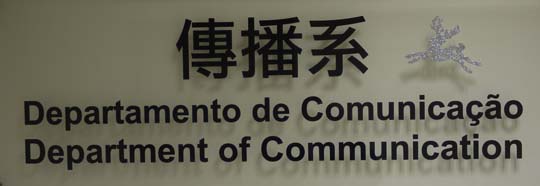
Being in Macau was particularly interesting given the combination of Chinese and Portuguese influences on the city. Whether on campus or elsewhere, most signs provide information in Chinese and Portuguese, and often English as well, as documented below.

UMacaulogo

Wendy Leeds-Hurwitz, Director
Center for Intercultural Dialogue

KAICIID Fellows

KAICIID Fellows Programme

In 2013, King Abdullah Bin Abdulaziz Centre for Interreligious and Intercultural Dialogue, in Vienna, Austria, will launch an international fellowship project. The “KAICIID Fellows” will be people who are planning to become religious functionaries and educators. The programme will run 2-4 times a year, where a Jury, chosen from the Centre’s Advisory Forum, will select five “Fellows” among applicants from the five major world religions. Coming from different regions and different faiths, these students will spend one to four months working and studying together in Vienna to deepen their knowledge about each others’ religions and to strengthen their commitment to interreligious dialogue. As potential future leaders within their respective religious communities, it is hoped that they will become multipliers of KAICIID’s mission for interreligious dialogue once they are back home.

During their stay in Vienna, they will have the possibility to work on their own research project, but they will also be given the opportunity to learn about other religions, both within their own group and by visiting university classes.

The “Fellows” will also contribute to and actively participate in KAICIID‘s activities, thus enhancing their interreligious insight, organisational competence and future leadership presence and impact. Instead of a final report, each participant will be asked to write a book chapter about her or his personal interreligious learning at KAICIID.

Objectives
*Engage students from different faiths, cultures and regions in interreligious dialogue on neutral ground;
*Facilitate a deep, long-lasting dialogue encounter;
*Give future religious leaders the tools, experience, networks and knowledge to pursue interreligious dialogue in their profession;
*Provide KAICIID with young people from different religious backgrounds who will actively participate and contribute to the Centre’s activities and programmes.

KAICIID will also provide a platform for alumni activities for its former “Fellows” to enable them to stay in contact and to reach out to further potential candidates for the programme.

Peacebuilding & Intercultural Dialogue Academy

International Summer Academy on Peacebuilding & Intercultural Dialogue
1-11 September 2013, Vienna, Austria

Project Introduction

Institute for Peace and Dialogue is very glad to call interested participants for its first International Summer Academy in Peacebulding & Intercultural Dialogue, which is going to be held in the middle of Europe, Vienna. Its image as one of the most favourable places for travelling, has made it more interesting to offer an exited and comprehensive programme for our participants. We offer you a 11 day training, with a professional education from our excellent experts, who are professionals with many years of experience in peace and conflict studies.

Nowadays unfortunately several frozen or ongoing conflicts between or within states still exist. Conflicts are different and if we can look to the world mankind facing with many new challenges, but on the same time with new dangerous situations: terrorist acts, non-legal arming of conflict sides, redetermination of borders, establishing new countries in the world map, non-providing territorial integrity, trafficking of arm, drug and human; disputes on implementation of transnational energy projects, democratization and false elections, revolution and internal political conflicts, armed guerilla movements, violation and discrimination by nationalists, world economical crisis, climate change and unsafely biodiversity etc. Conflicts are related and integral part of human beings, as conflicts cause unrespect to human rights, violation and clash of rights.

Existing conflicts weaken every kind of cooperation between nations and states. Without mutual cooperation and understanding, the future prosperity of the region would remain only as a good dream. Taking into consideration of all the mentioned useful thoughts above, we can make a decision on the strict belief, that opportunities for solving conflicts are feasible. Because in every conflict situation and tension forms we consequently face with the below mentioned common situations:

1. Desperate situation and non-solving problems are not eternal;
2. It’s possible to make common decision which both sides;
3. We can find common values, traditions and similar situations among conflict parties;
4. Protracted conflicts on the same time endanger regional development and prosperity;
5. Any mediation and negotiation actions are better than nothing.

MAIN GOAL
The main goal of the summer academy is to support institutional academic peace education and strengthen peacebuilding skills and intercultural dialogue of international society.

Save

Who needs Intercultural Dialogues?

On October 27, 2012, I gave a talk entitled “Who needs intercultural dialogues?” as part of the Conferência Ouvindo o Outro: sobre o diálogo entre culturas [Conference on Listening to the Other: About Dialogue between Cultures], held prior to the avant premiere of the play Sots l’Ombra d’un Bell Arbre [Under the Shadow of a Leafy Tree]: The future is unwritten at the Centro Cultural Carregal do Sal, Portugal. This is a reinterpretation of Ramón Llull‘s play from the 13th century, The Book of the Gentile and the Three Wise Men staged by Project Llull.

Project Llull poster

This was a co-production of Teatro de Cerca (Barcelona), Propositário Azul (Lisbon), Companhia Voadora (Santiago de Compostela), and Nicho Associação Cultural (Viseu, Portugal). Helena Tornero is the Spanish playwright who wrote the theatrical adaptation, Graeme Pulleyn is the British director, and Cristóvão Cunha is the Portuguese executive producer and international coordinator who invited me to participate in this wonderful collaboration.

Project Llull conference

Wendy Leeds-Hurwitz, Director
Center for Intercultural Dialogue

Grant $ for international travel

Micro Grants for Intercultural Dialogue

The National Communication Association allocated $5000 to be distributed as micro grants for intercultural dialogue through the Center for Intercultural Dialogue.

These micro grants are intended to support either or both of the two types of activities described in the mission of the Center: study of intercultural dialogues by Communication scholars, and/or participation in intercultural dialogue through academic interactions between Communication scholars based in different countries, or different linguistic and cultural regions. These grants are sufficient to provide seed funding only: no more than $1000 maximum can be awarded to any one individual. The goal is to encourage international, intercultural, interlingual collaborative research by giving enough funding to offset the cost of airfare only, while providing opportunity (and cause) for matching grants from universities.

If you already have lots of international connections, this grant is not for you – obviously you don’t need it. But if you are at a small college, or if you are a new scholar, and have not yet established significant international connections related to research, you are the intended audience for this competition. If you have been reading publications by an international scholar on a topic of potential relevance to your own research, consider a short trip to discuss ways to collaborate on a future project. If you do not know who has been doing relevant work, check the sources you’ve been reading lately, ask your colleagues, and/or think about who you know from graduate school or who you met (or heard present) recently at a conference. Find someone with similar interests who takes a different stance by virtue of being based in a different cultural context.

The intention is to support the development of new intercultural, professional connections. Thus continuing collaborations are ineligible. Those based in the US are expected to propose travel outside the country. International scholars currently living outside their country of origin are asked to establish a new affiliation in a different region rather than proposing a return to their homeland. We recognize that much interesting work can be done within a country between cultural groups, however this grant program focuses on connecting researchers who are not yet connected, across cultural regions that are typically disconnected. This rationale of cross-cultural connection must be explicit in the project description.

Applicants will need to describe their project, provide a brief resume, a short note from their department chair documenting their current status, and one from the host scholar expressing interest in holding conversations related to research. The initial deadline for review of proposals is November 15, 2012. If funds remain after the initial set of grants are awarded, March 15, 2013 will be the second deadline.

CID Grant Application NCA2012

December 18, 2012 UPDATE: The micro grants for intercultural dialogue have now been awarded, and all funding is being distributed as a result of the first round of applications, so there will not be a second round. See here for the results.

CFP Dialogue Facilitator training

Interested in becoming an INGO Dialogue Facilitator?

“Tensions between humans, intolerance and racism have never been as strong whilst the social and political actors continue to develop devices that would bring together the communities. The Conference of INGOs has postulated that the appropriate valuation of different cultures, languages and especially the acceptance of others for them to accept us in turn had to be learned to be effective.

The Dialogue Toolkit, which is the fruit of experience, field observation and discussion, was born of this principle and enables a plausible dialogue strategy. It involves training Facilitators of Dialogue, who, in turn, will train as many relays able to facilitate dialogue between cultures.

This call to become a “facilitator” goes to civil society actors engaged in community life to enable intercultural dialogue. The training will provide the keys to the understanding and use of this Dialogue Toolkit. Participants of this course will then conduct such dialogues and will also share this approach with local NGOs.

If you are experienced and interested in this introduction workshop, please complete the on-line questionnaire (follow the link) and return it as soon as possible. After reviewing the record, subject to availability, if you are selected for this first training session, we will tell you the practical aspects.”

Original post from http://www.dialoguetoolkit.net/news/2012/08/interested-in-becoming-an-ingo-dialogue-facilitator/