Louisa Edgerly-Microgrant Report

NCA Micro Grant Report
Louisa Edgerly, Independent Scholar

This report details my travel to the Republic of Congo to begin fieldwork on a collaborative research project with the International Conservation and Education Fund (INCEF), a US-Congolese nonprofit organization that produces educational films on topics related to public health and environmental conservation. The aim of my research is to develop descriptive accounts and interpretations of the intercultural communication that takes place between INCEF, their audience of rural Congolese villagers, and the global health workers and environmentalists who also work on the issues of human health and environmental conservation in Congo.

Identifying local partners
I learned about INCEF’s work – and its relevance to theories of intercultural communication – through conversation with an INCEF board member. Following this initial conversation in May of 2011, I drafted a project proposal outlining a possible collaboration between INCEF and the University of Washington’s Center for Local Strategies Research (UWCLSR) to study INCEF’s methods of communication and their process of project design through the lens of speech codes theory.

I sent the draft proposal to INCEF’s Executive Director, Cynthia Moses, and to UWCLSR. When all parties expressed interest in moving forward with the project, I then began to discuss possible dates for an initial research trip to Congo to observe INCEF’s work in place. Based on INCEF’s planned activities for 2012, Cynthia and I determined that November and December, 2012 would be a good time for my visit. I estimated that I could raise funds to cover a two-month stay in Congo, and to pay for travel of about a week to a remote location outside the capital city to observe INCEF’s project implementation.
Sunrise-smRaising research funds
Once I had chosen the dates for my research trip, I began by setting up an account on a crowd-funding web site called Petridish. I had done quite a lot of research on possible sources of funding for research, but as an independent scholar there were not many options available. The National Communication Association‘s Travel Microgrant was one notable exception, and I applied for this in addition to my other fund-raising efforts.

Crowd-funding offered the best – and fastest – mechanism to raise the $7,000 I estimated I would need to cover the costs of the entire trip. I created a short video to put on the Petridish web site, chose the different donation levels and the rewards for each level (a photograph from the trip, subscription to the trip’s blog, etc.), and set up the crowd-funding platform. In fifty days I raised just over $7,000 through my personal network of friends and family, using social media tools and email appeals. Petridish charged 4% of the total raised for providing the web site, and Amazon Payments also took a transaction fee from each donation made online. I was able to use the remainder to cover my direct research costs, including air fare, food, housing, and local transportation in Congo.

The timing of my travel depended to a great extent on INCEF’s schedule, and thus I had to depart for Congo before the decision about the NCA microgrants was announced. I crossed my fingers and booked my ticket for Brazzaville, Congo.

The NCA microgrant for $1,000 covered one third of the total round trip airfare from Seattle to Brazzaville, and thus allowed me to use other funds raised to cover unexpected expenses that arose during my field work, including several extra days spent in the northern town of Impfondo due to canceled flights, and the wildly unpredictable cost of gasoline, which increased travel costs within Congo.

Research Activities in Congo
The aim of my research in Congo was to study the communication methods used by INCEF, and to assess the degree to which they constituted a dialogic and participatory approach to intercultural communication. This field trip also aimed to allow me to see whether further academic collaboration might be able to offer some real benefits to INCEF, by offering a theoretical approach to intercultural dialogue that was compatible with their overall goals and experience, as well as helping them make connections with other organizations doing similar work.

In Brazzaville, I stayed in a guest room at INCEF’s headquarters, located in the Centreville neighborhood. The experience of studying human beings in their natural settings almost never goes completely smoothly, and this trip was no exception. INCEF’s Executive Director had intended in be in Brazzaville to meet me, but she was delayed several weeks and did not arrive until I had been there almost four weeks. The project that I had planned to observe was on hold due to lack of funds, and many of the activities that I had hoped to observe were likewise delayed or suspended. All of this provided me with the chance to explore Brazzaville and observe daily life there, to have longer conversations with INCEF’s staff, and to study their library of public health and conservation films in greater detail. The realities of living and working in a developing country, with inconsistent electrical supply, running water, and internet service also provided important background context to help me understand the structural barriers INCEF faces in their work every day.

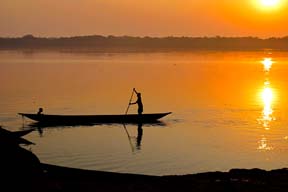
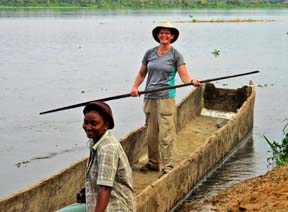
My first weeks of observations and interviews with INCEF staff, and with individuals from other organizations such as the Wildlife Conservation Society that partner with INCEF in Brazzaville, provided me with a preliminary set of data to analyze, and important context for my later observations in the field. After four weeks in Brazzaville, I traveled north to the town of Impfondo, where I met with two of INCEF’s educators to prepare for a trip out to the village of Makolongoulou to screen several INCEF films as part of their work on violence prevention and public health with UNICEF. I conducted observations at a number of INCEF film screenings and at the facilitated discussions that followed, both in the village and in Impfondo. This trip gave me the opportunity to see INCEF’s communication methodology in practice, and added a great deal of information to the data I had collected through earlier interviews. From Impfondo, I returned to Brazzaville to conduct a few final interviews and prepare to return to Seattle.
Louisa & Mika-sm

Further research activities
Back in Seattle, I have continued to pursue new contacts and find connections with researchers doing similar work. Perhaps unsurprisingly, I have found that many more people are interested in talking with me now that I have completed an initial field study, and I have begun to develop several promising contacts at the University of Washington in the departments of Anthropology and Computer Science and Engineering. I have written a paper based on my preliminary research findings, and submitted it to the NCA conference. I am also developing a project in collaboration with Public Health-Seattle & King County and the Masters of Communication in Communities & Networks program at UW. I will lead a year-long graduate student practicum to apply some of the communication methodologies used by INCEF – video, facilitated discussion, local perspectives and languages – to the task of reaching the many different cultural and language communities around King County, Washington with public health messages.

I remain in touch with INCEF’s Executive Director and I am actively pursuing ways to return to Congo to conduct more field research with INCEF staff. My research experience thus far has shown that there is a very clear connection to theories of intercultural dialogue in INCEF’s practice, and that engaging with these theories could enhance INCEF’s work on future projects. It has also become clear that continued involvement in scholarly research will benefit INCEF by raising their profile among possible donor organizations and academic institutions. In addition, this collaboration will offer them access to new technologies to assist in the dissemination of their films and educational tools. Another possibility that has opened up would involve INCEF in training local people in Congo to produce their own videos on public health and environmental topics, thus creating a more participatory process of two-way communication between citizens and policy makers in Congo. This methodological shift has emerged from the research connections I have begun to build as a result of my initial fieldwork.

The NCA travel microgrant played a very important part in the successful completion of my field trip to Congo. Completing this initial pilot study has given me a foundation of preliminary data and access to a whole new network of connections that would not have been possible without the travel grant.

[NOTE: Louisa Edgerly’s original project description is available here; further information about her project in a report to the Center for Local Strategies Research is here.]
Intercultural journal article award

The Intercultural Communication Division of the International Communication Association (ICA) Journal Article Award is presented to honor the author of an outstanding journal article, published within the last year that shows a clear advancement in communication theory and demonstrates state of the art methodologies.

Qualifications
The article must focus on research and theory within the frameworks of cross-cultural, international, or intercultural communication and must have been published within the year in a refereed (peer-reviewed) journal. The authors are not required to be current members of ICA.

Award
The award recipient will receive a certificate and $200.00 check

Criteria
Nominated papers will be judged by a panel of journal editors and reviewers.
· Contribution to the field of intercultural and international communication.
· Clarity of the article’s purpose
· Logical and smooth organization of the article
· Use and quality of references and citations
· Ability of the article to engage the reader

Submission Procedure
Please send an electronic copy of the article (PDF format is preferred) as an e-mail attachment to Steve Mortenson, IICD Division Chair at rocket@udel.edu.

Include a brief statement as to why the article should be considered for Journal Article Award (you may refer to the evaluation criteria above).

Deadline
Nominations must be received by May 20, 2013.

Contact
Questions regarding the award may be directed to Dr. Steve Mortenson at rocket AT udel.edu.

NCA Microgrant Reports

In fall 2012, the National Communication Association funded five international travel microgrants, as described in detail here. The reports are now (as of July 2013) all turned in, and have been posted to this site to serve as models for similar projects. The authors have provided details about how they funded their trips, how they made international connections, what they did while abroad, and what they learned from their trips.

Award winners were:

Sarah Bishop
Renee Cowan
Louisa Edgerly
Andrew Spieldenner
Santoi Wagner

Once again, my thanks to NCA for being willing to support these projects.

Wendy Leeds-Hurwitz, Director
Center for Intercultural Dialogue

Sarah Bishop-Microgrant Report

NCA Micro Grant Report
Sarah Bishop, University of Pittsburgh

With generous support from the Center for Intercultural Dialogue and the National Communication Association, I traveled to San Jose, Costa Rica March 29-April 7, 2013 to gather the reflections of graduate students who had studied abroad at universities in the United States for academic credit.  My goal, in short, was to discover how international academic travel influenced an individual’s sense of national identity.  In preparation for the trip, I worked to familiarize myself with the relevant research about study abroad.  Additionally, I read many of the multitudinous study abroad testimonies written by students and currently available on study abroad websites at numerous institutions.  By the time I boarded the flight for San Jose, I felt confident about the kinds of effects academic travel had on students, and I looked forward to adding the dimension of “effects on national identity” to the impressive canon of existing research.  During the interviews themselves, however, I was surprised to find that the interviewees reported experiences, emotions, and challenges about multiple aspects of the academic traveling experience that I had not encountered in any of the relevant literature.

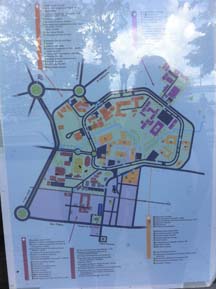
The preparation for this project included a two-month process of correspondence with the Director and other relevant staff at the Office of International Affairs at the University of Costa Rica (UCR).  I owe my deepest gratitude to this staff, including Ana Sittenfeld and Fatima Acosta, especially, for providing me with a list of interested participants as well as details regarding the group’s areas of research and U.S. destinations.  In addition, I completed extensive oral history training from Dr. Ron Zboray at the University of Pittsburgh.  One unexpected challenge arose when I estimated (based on flight costs at the time), that round-trip airfare to San Jose would cost no more than $800 USD.  The Center for Intercultural Dialogue generously granted this amount, but between the time the grant application was due and the time of my actual travel, flight costs had risen by more than $300, and I had to use my savings account to cover the remainder of the flight.  In the future, I will account for fluctuations in flight costs before finalizing my budgets.  Another challenge arose when I realized that none of the roads around the University of San Jose, where I conducted my research, are named.  In the absence of road signs, I relied on an iPhone photograph I had taken of a map I found on UCR’s campus and the patience of students willing to forgive my uncertain Spanish for direction.

UCR-smIn an effort to understand the ways an academic travel experience affects an individual’s sense of personal and national identity, as well as the intersection between study abroad, intercultural competence, and career preparation, I spent approximately one hour interviewing each graduate student.  Our conversation ranged from issues surrounding the legal preparations required before traveling abroad to negotiating needed friendships while away from home.  While I have yet to code and transcribe all of the interviews, one unexpected theme became apparent: though study abroad programs have been especially credited with encouraging a sense of global—rather than national—citizenship, in my own interviews, I found that the majority of students reported that study abroad strengthened, rather than compromised, their sense of national or geographic identity.  This finding requires further exploration and I hope to have the opportunity to find out whether study abroad alumni in other areas of the world report similar outcomes.

While multi-sited, international research is logistically complicated and time-consuming, my time in San Jose confirmed that in cases where interpersonal interaction and nonverbal communication are central to a project, video conferencing remains a poor substitute for face-to-face interaction and exchange.  I am honored to have had the opportunity to conduct this research, and look forward to reporting my full findings at a later date.

GuestHouse-sm

[NOTE: Sarah Bishop’s original project proposal is available here.]

UNAOC summer school 2013

The United Nations Alliance of Civilizations (UNAOC) is collaborating with Education First (EF) in the context of the first UNAOC-EF Summer School, which will take place in Tarrytown, NY, USA, from 24 to 31 of August 2013.

This UNAOC-EF Summer School will bring together 100 youth from all over the world for a week of discussions on pressing global challenges within the context of cultural and religious diversity. Several skills-building workshops will be offered with a view to strengthen participants’ ability on topics such as peace-building, human rights, advocacy, social entrepreneurship, etc.

This year marks the fourth UNAOC Summer School. Youth (between 18 and 35) who are interested in attending this year’s summer school can apply on or before 31 May 2013.

Selected participants will be provided with flight, accommodation, meals and full event access.

Note: The United Nations Alliance of Civilizations (UNAOC) and Education First (EF) expect to officially launch UNAOC-EF Summer School in Spring 2013. However, UNAOC and EF reserve the right to not select any applicants, or to cancel the Summer School for any reason. UNAOC and EF accept no liability for cancelling the Summer School or for anyone’s failure to receive actual notification of cancellation.

405 Lexington Ave 5th Floor (UNAOC) | New York, NY 10174 US

Save

CFP international volunteering

Call for Chapter Proposals for Edited Book

Working Title: Volunteering and Communication Vol. II: Studies in International and Intercultural Contexts

Publisher: Peter Lang

Objective of the Book:
The purpose of this book is to give voice to the experiences of volunteers specifically in international and intercultural settings. Few of our current resources (books, texts, handbooks) address the micro-level, data-based analysis of volunteering and volunteer management with our first book being an exception.  There is even less scholarship on volunteering in international and intercultural contexts. There are a few chapters addressing it in our first book. This book will begin with a guest-authored literature review chapter. Then contributors will write data-based chapters that provide in-depth analyses of a particular issue, topic, or type of volunteer based on some theoretical or conceptual organizational or intercultural framework. Each chapter will include a very brief field report from a practitioner with experience in the volunteer situation explored in the chapter.

In particular, the editors are interested in studies that fit one of three types:

1) Experiences Volunteering Abroad: These should be studies of individuals volunteering in another country, for example, individuals from the United States doing volunteer work in another country.

2) Experiences of Volunteers Internationally: These should be studies of volunteers living in countries outside the United States, for example, the experiences of volunteers from the Netherlands or Brazil or any other country.

3) Experience of Volunteers in Intercultural Settings: These should be studies of volunteers working in settings where they must reach across intercultural boundaries to accomplish their goals, for example, Turkish volunteers working with Syrian refugees.

Book Editors:
Michael W. Kramer, University Oklahoma, Department of Communication
Loril M. Gossett, UNC Charlotte, Department of Communication Studies
Laurie K. Lewis, Rutgers University, Department of Communication

Submission Process:
This edited book will present contributed chapters focusing on the three types of volunteer experiences described above. Editors seek contributed chapters that are data-based, and focused on the management and experience of volunteering. All methodologies are welcome including quantitative, qualitative, or textual/rhetorical analysis, as well as interdisciplinary work that seeks to combine communication perspectives with other disciplinary knowledge.

For consideration, authors should submit a 1-2 page abstract of the proposed chapter (not including title page and references). This proposal should include a description of the study, including its theoretical or conceptual framework, its current status (e.g., already IRB approved, data being analyzed, etc.) and include a brief summary of results if available. These submissions are due to the lead editor no later than July 31, 2013.

Submissions will be peer reviewed and decisions about inclusion in the book will be made by August 31, 2013. Selected authors will be expected to produce a full draft of their chapters by January 10, 2014. These drafts will be reviewed by the book editors for final decisions on inclusion in the book. Those accepted will submit revised versions by May 1, 2014.

Inquiries may be addressed to any of the editors. Submissions should be forwarded electronically (word document) to:
Michael W. Kramer
mkramer AT ou.edu

Copenhagen Bus School job ad

COPENHAGEN BUSINESS SCHOOL
Organizational Communication
Associate Professorship 

Copenhagen Business School invites applications for a vacant full-time position within the area of Organizational Communication at the Department of International Business Communication (IBC). Particularly relevant areas of research include:
– internal corporate communication and organizational discourse
– preferably with an interest in intercultural aspects, or
– the role of communication in identity and culture formation in organizations and corporations, or
– the transfer of information and knowledge in organizations.

IBC is dedicated to interdisciplinary and problem-focused research in business humanities and is dedicated to developing research-based knowledge that relates directly to the challenges business organizations face in an increasingly internationalized environment.

Applicants must have:
– a documented track record of published research in international journals
– documented strengths in the relevant fields of organizational communication
– teaching experience equivalent to a three-year Assistant Professorship.

The fields of research at IBC include the role of communication and language(-s) in interlingual and intercultural communication, the role of communication competences in organizations, the role of language and culture in communication technology and social technologies, as well as the teaching of language skills.

Appointment and salary will be according the agreement between The Ministry of Finance and The Danish Confederation of Professional Associations (AC).

Closing date: 15. June 2013
Copenhagen Business School must receive all application material, including all appendices (see items above), by the application deadline.

Save

Gate A-4 poem

[NOTE: Occasionally an author of fiction or a poet gets right to the heart of intercultural dialogue. One such example follows. If you have other suggestions, post links as comments.]

Gate A-4
by Naomi Shihab Nye

Wandering around the Albuquerque Airport Terminal, after learning
my flight had been delayed for four hours, I heard an announcement:
“If anyone in the vicinity of Gate A-4 understands any Arabic, please
come to the gate immediately.”

Well–one pauses these days. Gate A-4 was my own gate. I went there.

An older woman in full traditional Palestinian embroidered dress, just
like my grandma wore, was crumpled to the floor, wailing loudly. “Help,”
said the flight service person. “Talk to her. What is her problem? We
told her the flight was going to be late and she did this.”

I stooped to put my arm around the woman and spoke to her haltingly.
“Shu-dow-a, Shu-bid-uck Habibti? Stani schway, Min fadlick, Shu-bit-
se-wee?” The minute she heard any words she knew, however poorly
used, she stopped crying. She thought the flight had been cancelled
entirely. She needed to be in El Paso for major medical treatment the
next day. I said, “No, we’re fine, you’ll get there, just later, who is
picking you up? Let’s call him.”

. . .
And I looked around that gate of late and weary ones and I thought, This
is the world I want to live in. The shared world. Not a single person in that
gate–once the crying of confusion stopped–seemed apprehensive about
any other person. They took the cookies. I wanted to hug all those other
women, too.

This can still happen anywhere. Not everything is lost.

[The full poem can be read here]

Save

Tallinn University

On April 30, 2013, I met with several faculty members at the new Institute of Communication at Tallinn University in Tallinn, Estonia: Kaja Tampere, Professor and Founding Director of the Institute, and Josep Soler-Carbonell, Associate Professor of Intercultural Communication.

Tallinn University is in much the same situation as the University of Macau, interested in gaining an international reputation, and attracting international students. A new Communication Management master’s program started in the autumn of 2012, as well as a minor in International Journalism studies, both of which offer courses in English.

While in Tallinn, I also connected with Hando Sinisalu, Founder and CEO of Best Marketing International. He organizes international conferences on such topics as digital marketing. For those interested in using social media for marketing, his website provides wonderful case studies of best practices.

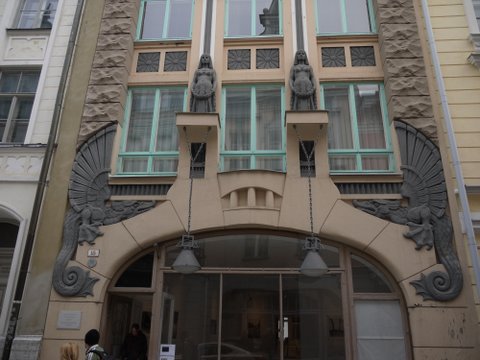
The old city of Tallinn is a UNESCO world heritage site, with buildings dated as early as the 1200s. But it also has a noticeable Art Nouveau influence, as can be seen in the Dragon Gallery.

P1570511

Wendy Leeds-Hurwitz, Director
Center for Intercultural Dialogue

CFP Middle East dialogue

The Digest of Middle East Studies (DOMES) and the Policy Studies Organization (PSO) are pleased to announce the Middle East Dialogue (MED) and call for papers. The MED2014 will be held at The Whittemore House: Washington DC on Thursday, February 27th, 2014.

The Middle East Dialogue has established an international reputation as a focal point for new research, and a forum for the exchange of opinions and different views about issues of social, political, and economic reforms.  In addition, discussions go on concerning women’s rights and roles in the new Middle East, and ethnic and religious tolerance.

Proposals are sought from individuals or groups on topics relating to the areas mentioned above. Proposals can be configured variously as twenty minute individual presentations, or round table discussions on particular topics. Proposals are encouraged to explore present, past and futuristic approaches to these issues and what if scenarios, as well as conflict resolution, and problem-solving solutions.

Proposals of one to two pages should be sent as email attachments by January 18th, 2014 to Mr. Daniel Gutierrez Sandoval at Policy Studies Organization (PSO) at dgutierrezs AT ipsonet.org. Proposals submitted before December 20, will receive notice of approval or rejection by December 31, 2013.   A panel of reviewers from DOMES International Editorial Board will recommend select papers for publications in the peer-reviewed journal Digest of Middle East Studies (DOMES), published by Wiley-Blackwell.

The early conference registration fee for speakers is $200; $250 for conference attendees, due by December 20th. Late registration fee will be $300 (registration fee covers breakfast, lunch and concluding reception) payable and mailed to: PSO: 1527 New Hampshire Ave., NW, Washington, DC 20036 Tel. (202) 349-9281; Fax (202) 483-2657).

Prof. Mohammed Aman, PhD
Editor-in-Chief, DOMES
Co-Chair, MED2014
University of Wisconsin-Milwaukee

Prof. Paul Rich, PhD
President, Policy Studies Organization
Co-Chair, MED2014
Washington, DC