CRASSH: Fellowships for Scholars from the Global South 2026 (UK)

FellowshipsScience, Politics and Justice Visiting Fellowships for Scholars from the Global South: Science, Politics and Justice, CRASSH, University of Cambridge, UK. Deadline: 24 February 2025.

The Centre for Research in the Arts, Humanities and Social Sciences (CRASSH) at the University of Cambridge is inviting applications for funded Visiting Fellowships for scholars from the Global South. The purpose of these Fellowships is to provide opportunities for scholars working at higher education institutions in the Global South to exchange ideas with other researchers based at CRASSH and elsewhere in the University of Cambridge and to draw benefit from access to the University’s collections and resources. It is hoped that these visits will lead on to future collaborations and exchanges.

For 2026, CRASSH will partner with the Department of History and Philosophy of Science. Applications are invited from scholars whose research is connected to the theme of science, politics and justice. This invites projects that study the ethics, politics and history of scientific, medical and technical knowledge-making and the multiple ways in which science has been leveraged by various groups in pursuit of justice. This may include proposals that focus on the participation of scientific and medical experts and activists in projects of anticolonialism, antiracism, climate and environmental justice, disarmament, gender equity, indigenous rights, reproductive rights, the repatriation of heritage and ancestors, or scientific and medical literacy. The call also welcomes projects that examine moral, ethical, and historical questions of science and engineering as contributors to crime prevention, policing, prosecution, and war. Equally, it includes projects that investigate the moral responsibility of scientific experts, as well as objectivity, neutrality, and value judgements in socially engaged science.

They invite applications from any discipline, including anthropology, archaeology, art history, digital humanities, ecology and environmental studies, history, philosophy, medical humanities, museum studies, science and technology studies, and sociology. Projects should aim to advance current understandings of science, politics, and justice through concrete case studies of science in action.

All Fellows selected under this scheme will be asked to work together to design an event related to the theme of this call, to take place during the term they are resident in Cambridge, and to present their own research at this event. This event will be co-hosted by CRASSH and the Department of History and Philosophy of Science. Fellows will also be invited to give a separate presentation on their research, if they wish, at the Department of History and Philosophy of Science.

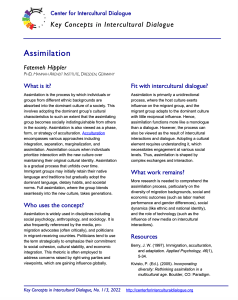
KC113 Assimilation

Key Concepts in ICDThe next issue of Key Concepts in intercultural Dialogue is now available. This is KC113: Assimilation, by Fatemeh Hippler. Click on the thumbnail to download the PDF. Lists organized chronologically by publication date and numberalphabetically by concept in English, and by languages into which they have been translated, are available, as is a page of acknowledgments with the names of all authors, translators, and reviewers.

Key Concepts in Intercultural Dialogue 113: Assimilation

Hippler, F. (2024). Assimilation. Key Concepts in Intercultural Dialogue, 113. Available from: https://centerforinterculturaldialogue.org/wp-content/uploads/2024/11/kc113-assimilation.pdf

The Center for Intercultural Dialogue publishes a series of short briefs describing Key Concepts in Intercultural Dialogue. Different people, working in different countries and disciplines, use different vocabulary to describe their interests, yet these terms overlap. Our goal is to provide some of the assumptions and history attached to each concept for those unfamiliar with it. As there are other concepts you would like to see included, send an email to the series editor, Wendy Leeds-Hurwitz. If there are concepts you would like to prepare, provide a brief explanation of why you think the concept is central to the study of intercultural dialogue, and why you are the obvious person to write up that concept.


Creative Commons License
This work is licensed under a Creative Commons Attribution-NonCommercial-NoDerivatives 4.0 International License.

U Birmingham: Assistant Professor in Digital Media & Intercultural Communication (UK)

“JobAssistant Professor in Digital Media and Communications (Intercultural Communication), University of Birmingham, Birmingham, UK. Deadline: 13 January 2025.

This position is in the Department of Linguistics and Communication, which is in the School of English, Drama and Creative Studies. As part of strategic growth and investment in Digital Media and Communications, the School seeks to recruit an Assistant Professor with effect from 1st April 2025 to be based on the University’s Edgbaston campus. The post holder will demonstrate particular expertise in intercultural communication, and be able to evidence experience of teaching and researching in this area.

The post holder will contribute high quality teaching to a suite of successful programmes which includes the BA in Digital Media and Communications launched on the University’s Edgbaston campus in September 2023, the MA in Digital Media and Creative Industries launched on the Edgbaston campus in September 2024, and the MA in Digital Media and Communications to be launched on the Edgbaston campus in September 2025. The post holder will also play an active role in the development of the Digital Media and Communications provision on the University’s Dubai campus, including optional travel opportunities to that campus.

Research excellence will include initiating, conducting and disseminating original research. The post holder’s research will have measurable outcomes reflected in growing national (and ideally international) reputation. In addition to delivering excellence in teaching and research, successful candidates will be expected to demonstrate academic citizenship, developing and maintaining generous, mutually respectful and supportive working relationships with all colleagues and students. Management and administration is likely to involve contributions at Departmental and School level, and/or making an important contribution to some managerial/leadership activities (e.g. working groups) within the University. This may include developing and making substantial contributions to knowledge transfer, enterprise, business engagement, public engagement, widening participation, school’s outreach, or similar activities at Department/School level or further within the University.

U Edinburgh: International Programmes (UK)

“JobSWAY Advisor (International Programmes), Edinburgh Global Unit, University of Edinburgh, Scotland, UK. Deadline: 6 January 2025.

The University of Edinburgh’s Study and Work Away Service (SWAY) oversees the management of international study and work placement experiences for students and staff, working in partnership with key internal and external stakeholders. The post holder will focus on the delivery of international study exchange activities and be responsible for monitoring and progressing a high volume of bilateral exchange agreement renewals, which will entail working with colleagues across the University to ensure compliance. The post holder will also contribute to delivering an overall student lifecycle experience, including signposting students to opportunities and raising awareness, liaising with Departments and Schools regarding the approval of proposed activities, administering records and grants, reporting, providing guidance and pastoral support to students pre-departure, while on placement and on return.

The post holder will ideally have experience working in study and work abroad, internationalisation and/or partnership development within the Higher Education sector. They should be able to adapt to a fast-paced and changing environment, have a good eye for detail and the ability to work on their own initiative. The post holder will be adept at forming effective working relationships with a diverse and growing set of stakeholders and have good team working skills. Previous experience working with contracts or collaboration agreements will be beneficial.


Turku Institute for Advanced Study Fellowships (Finland)

FellowshipsFellowships, Turku Institute for Advanced Study, University of Turku, Finland. Deadline: 8 January 2025.

Turku Institute for Advanced Studies (TIAS) invites applications for four Collegium and three Postdoctoral Fellow positions for three-year period starting from 1 September 2025. TIAS selects its Fellows via an international call for applications and welcomes applications from all disciplines within its five constituent faculties (Economics, Education, Humanities, Law and Social Sciences). Selection of successful applicants will be on the basis of academic excellence.

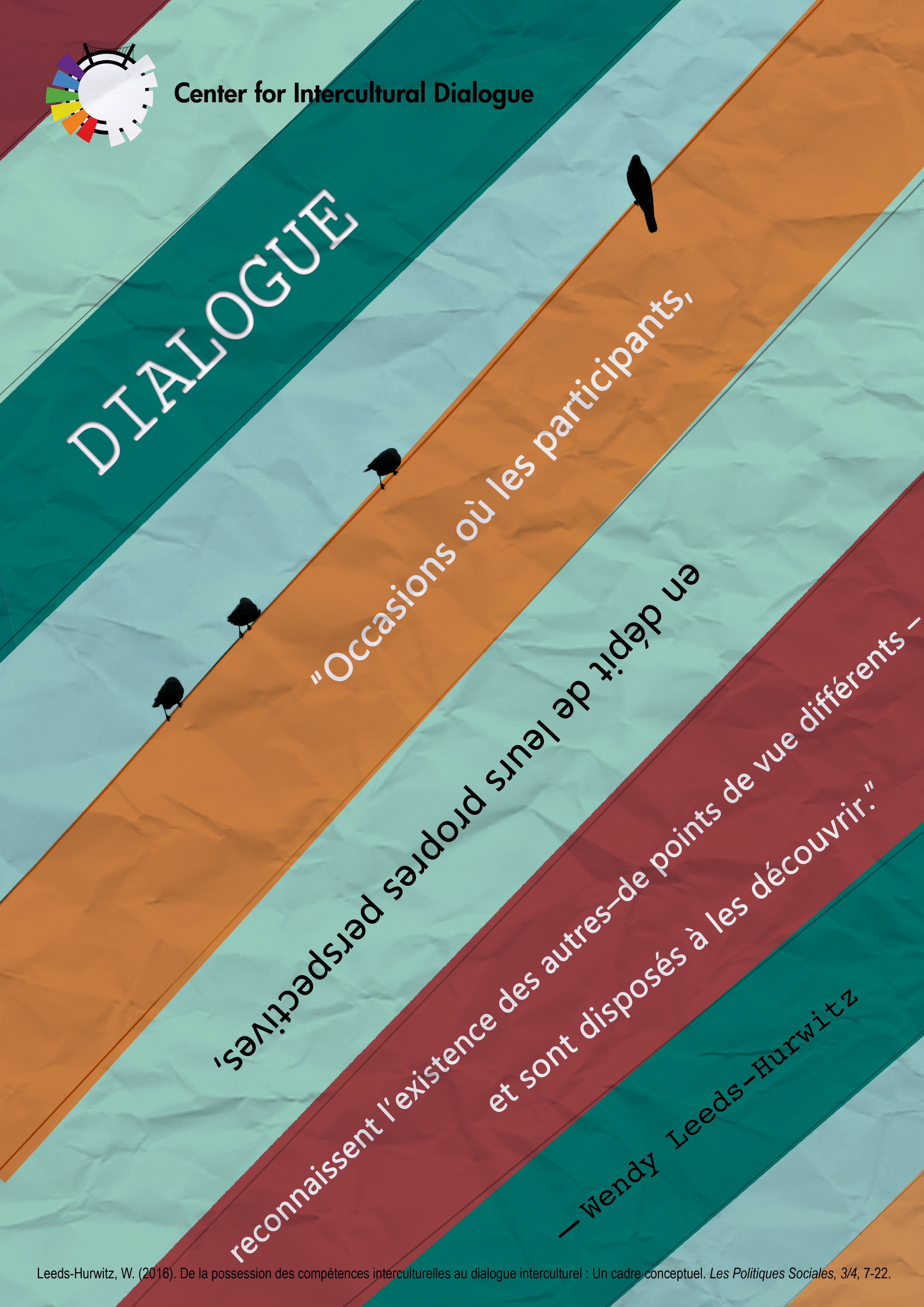
CID Poster 6: Dialogue Defined Translated into French

CID PostersThis is another of the posters designed by Linda J. de Wit, and now translated into French. For this poster, you literally have to look from a different perspective to read the quote; the picture of birds on a wire also represents taking different perspectives. The source of the quote is:

Leeds-Hurwitz, W. (2016). De la possession des compétences interculturelles au dialogue interculturel: Un cadre conceptuel [Moving from having intercultural competencies to constructing intercultural dialogues: A conceptual framework]. Les Politiques Sociales, 3/4, 7-22.

The French translation was provided by Léonie Potvin, and the graphic design work necessary to revise was by Yan Qiu. Here then is CID Poster 6: Définition du dialogue.

CID Poster 6: Dialogue defined Translated into FrenchJust in case anyone wants to cite this poster, the following would be the recommended format:

Center for Intercultural Dialogue. (2024). Définition du dialogue [L. Potvin, trans.]. CID Posters, 6. Available from: https://centerforinterculturaldialogue.org/wp-content/uploads/2024/10/cid-poster-6-dialogue-french.png

As with other series, CID Posters are available for free on the site; just click on the thumbnail to download a printable PNG. They may be downloaded, printed, and shared as is, without changes, without cost, so long as there is acknowledgment of the source.

As with other CID Publications, if you wish to contribute an original contribution, please send an email before starting any work to receive approval, to minimize inadvertent duplication, and to learn about technical requirements. As is the case any series, posters should be created initially in English. If you want to volunteer to translate a poster into a language in which you are fluent, send in a note before starting, to receive approval and to confirm no one else is working on the same one.

Wendy Leeds-Hurwitz
Director, Center for Intercultural Dialogue
intercult.dialogue AT gmail.com


Creative Commons License
This work is licensed under a Creative Commons Attribution-NonCommercial-NoDerivatives 4.0 International License.

CFP ECREA: Beyond Borders: Creative Methods and Reflexive Approaches to Migration, Media, and Intercultural Dialogue (Estonia)

ConferencesCall for submissions: Beyond Borders: Creative Methods and Reflexive Approaches to Migration, Media, and Intercultural Dialogue, ECREA Diaspora, Migration and the Media – International and Intercultural Communication Sections Conference, 16-18 September 2025, Tallinn University, Tallinn, Estonia. Deadline: 1 Febuary 2025.

Recent global challenges and the rise of far-right governments worldwide have intensified the persecution of migrants, transforming borders into harsh zones of exclusion and surveillance. In this climate, migration is increasingly criminalized, and those seeking safety and opportunity are often met with hostility, reinforcing narrow nationalist ideologies. This environment has posed new methodological challenges for research in migration contexts, as well as prompted reflexive considerations on how knowledge is generated, how participants are cared for, and how spaces are created to support human dignity and mobility.

This conference invites researchers to propose abstracts that address methodological and reflexive perspectives in the exploration of multifaceted migration experiences and intercultural communication in the context of migration persecution and border closing. Creative methods, such as digital storytelling, participatory media projects, ethnographic film, and arts-based research, offer rich and nuanced perspectives that address current challenges in migration criminalization. These methods not only capture the complexities of diasporic lives, but also empower communities to express their own narratives and co-create knowledge. Organizers encourage contributions that reflect on these innovative approaches to migration and media studies, as they have the potential to deepen our understanding of how identities, relationships, and cultural dialogues are shaped and redefined through media. Beyond methodological approaches, they also encourage researchers to explore more broadly a reflexive analysis of the dynamic intersection of migration, media, and communication.

New Europe College IAS: Fellowships 2025-26 (Romania)

FellowshipsFellowships, Institute for Advanced Study, New Europe College, Bucharest, Romania. Deadline: 10 January 2025.

New Europe College – Institute for Advanced Study in Bucharest (Romania) launches the annual competition for the 2025/2026 NEC Fellowships. Romanian and international postdoctoral scholars in all fields of the humanities and social sciences (including law and economics) are invited to apply. About 20 – 25 fellowships are available.

What they offer: A monthly stipend of 850 Euros (tax free); accommodation in Bucharest, comprising living quarters and working space; reimbursement of travel costs from the home/residence country to Bucharest and back. Depending on the program, fellows are offered a lump sum for a research trip to an institution of their choice. Fellows have free access to the NEC library and electronic resources.

What they expect: Fellows are expected to work on their projects and take part in the scientific events organized by NEC; presence at the weekly seminars discussing the progress of the Fellows’ work is compulsory. At the end of their Fellowship, Fellows are expected to hand in a research paper, reflecting the results of their work over the duration of the Fellowship. The papers will be included in the NEC yearbook.

Eligibility: NEC Fellowships are open to postdoctoral level scholars, Romanian and international, in all fields of the humanities and social sciences.

Duration: For Romanian citizens: a full academic year (10 months, starting in October 2025); for non-Romanian citizens: a full academic year or one term (5 months, starting in October 2025 or March 2026).

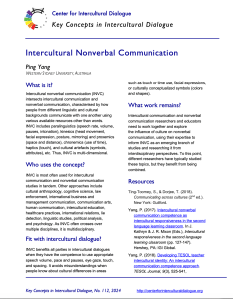
KC112 Intercultural Nonverbal Communication

Key Concepts in ICDThe next issue of Key Concepts in intercultural Dialogue is now available. This is KC112: Intercultural Nonverbal Communication, by Ping Yang. Click on the thumbnail to download the PDF. Lists organized chronologically by publication date and numberalphabetically by concept in English, and by languages into which they have been translated, are available, as is a page of acknowledgments with the names of all authors, translators, and reviewers.

Key Concept 112: Intercultural Nonverbal Communication

Yang, P. (2024). Intercultural nonverbal communication. Key Concepts in Intercultural Dialogue, 112. Available from: https://centerforinterculturaldialogue.org/wp-content/uploads/2024/12/kc112-intercultural-nonverbal-communication.pdf

The Center for Intercultural Dialogue publishes a series of short briefs describing Key Concepts in Intercultural Dialogue. Different people, working in different countries and disciplines, use different vocabulary to describe their interests, yet these terms overlap. Our goal is to provide some of the assumptions and history attached to each concept for those unfamiliar with it. As there are other concepts you would like to see included, send an email to the series editor, Wendy Leeds-Hurwitz. If there are concepts you would like to prepare, provide a brief explanation of why you think the concept is central to the study of intercultural dialogue, and why you are the obvious person to write up that concept.


Creative Commons License
This work is licensed under a Creative Commons Attribution-NonCommercial-NoDerivatives 4.0 International License.

Pew Research Center: Research Associate, Global Attitudes (USA)

“JobResearch Associate, Global Attitudes, Pew Research Center, Washington, DC, USA. Deadline: open until filled; posted 3 December 2024.

Pew Research Center’s Global Attitudes team conducts cross-national survey research on major international issues such as attitudes toward the U.S. and American foreign policy, views of China, democracy, religious practice and attitudes, as well as how people view conditions in their countries and their own lives. The bulk of the team’s work focuses on one large annual survey (25+ countries) but periodically the team also employs secondary data, qualitative data and experimental data.

The Pew Research Center’s Global Attitudes team has an immediate need for a Research Associate. This position will be involved in all aspects of the survey research process, including: drafting a questionnaire, script testing, managing a cross-national translation and verification process, data quality control, vendor relations, reviewing fieldwork and technical reports, and more. Ideally, a Research Associate will gradually be able to not only participate in but manage these tasks.

A Research Associate will also be involved in analysis and writing reports and other products. Reports on the Global Attitudes team are highly collaborative and a Research Associate will be expected to assist in background research, producing charts and tables, statistical analysis, and number checking, in addition to writing. The Research Associate may serve as a spokesperson for the Global Attitudes team and will discuss our research with key audiences such as the media and policymakers.

This position works closely with other researchers on staff and reports to the Associate Director of Global Attitudes Research.