Check Out Our New Brochure!

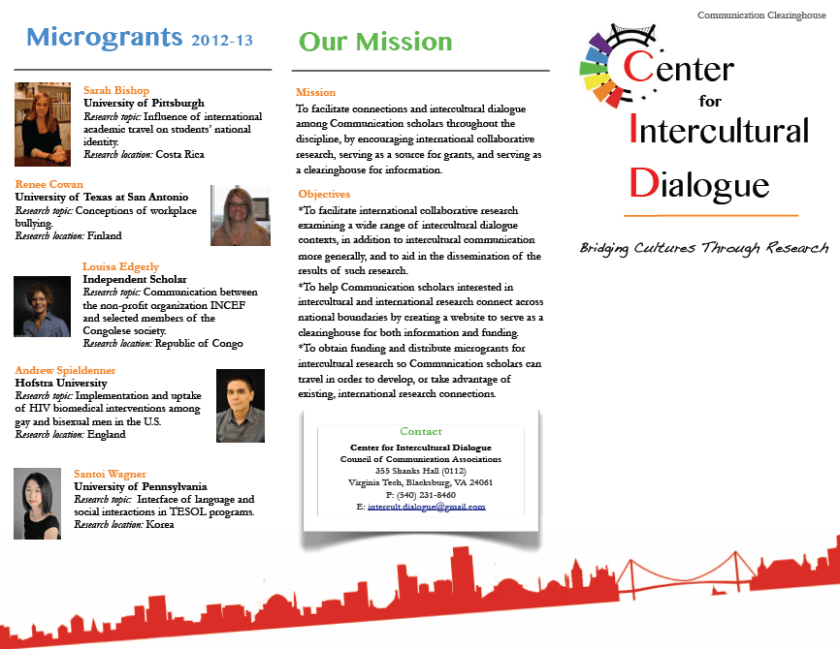
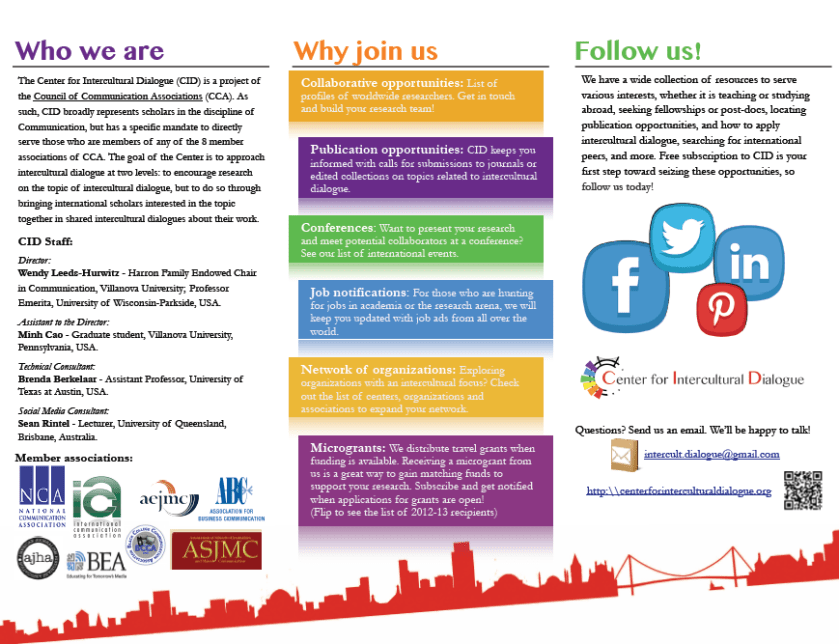
About CIDExciting news: Our new brochure is now available! Check it out to learn more about the Center for Intercultural Dialogue and don’t forget to share it with anyone who might be interested in our work!

cidbrochure_1

cidbrochure_2

UPDATE: The CID brochure has been updated since this post – the current version is available as a PDF here.

CFP 2nd Latin Am ICA conf Brazil 2014

2nd Latin America ICA Conference
Dialogues between Tradition and Contemporaneity in the Latin America and International Communication Studies (University of Brasilia, 26-28 de March, 2014)

ICA

Call for Papers
The Graduate Program in Communication of UNB and the International Communication Association (ICA) are pleased to invite you to submit papers for the 4th Latin American Conference ICA. Two forms are accepted, papers to WGs and proposition panels.

Deadline for submissions of papers and panel proposals: Until 15th January, 2014
Notification of acceptance: 29th January, 2014
Registration deadline at reduced fees: Until 5th February, 2014
Conference: 26-28 March, 2014

Registration will be open from November 30, 2013

Conference Chair: Luiz C. Martino
The organizing committee: Fernanda Martineli, Fernando Paulino, Liliane Machado, L.C. Martino e Sérgio de Sá.
Partners: ALAIC, SBPJor, INTERCOM, ABRAPCORP

Cross-Cultural Communication in Fragile States

USIP logoCross-Cultural Communication in Fragile States

Event Location
U.S. Institute of Peace

2301 Constitution Ave NW
Washington, DC
Start Date: Tuesday, November 19, 2013 – 9:00am
End Date: Thursday, November 21, 2013 – 5:00pm

How often have we heard the refrain, “We failed to understand the culture”? Most professionals are not prepared to operate in an environment of sudden stress, to remember key cultural lessons while under pressure. Participants will practice “reframing solutions” as they respond to differences in high and low context communication styles, individual versus collective organization, power distance, and temporal orientation.

Instructor: Peter Weinberger

Time and time again, we have heard the refrain about work in fragile states, “We failed to understand the culture.”  Most pre-deployment briefings do not prepare professionals to operate in an environment of sudden stress, to remember key cultural lessons while under pressure.

This course shows how to reframe solutions, to deal with local peoples respectfully while addressing functional problems on the ground. Learn and practice differences in high‐ and low‐context communication styles, individual versus collective organization, power distance, and temporal orientation.

CFP Things to remember conference

Things to Remember: Materializing Memories in Art and Culture
International Conference, Radboud University, Nijmegen (The Netherlands)
June 5-6, 2014

CALL FOR PAPERS

Confirmed Keynote Speakers
Dr Dylan Trigg, University College Dublin
Dr. Celeste Olalquiaga, independent scholar

Call for Papers:
Memory matters. It matters because memory brings the past into the present, and opens it up to the future. But it also matters literally, because memory is mediated materially. Materiality is the stuff of memory. Meaningful objects that we love (or hate) function not only as aide-mémoire but as memory itself.

The international conference Things to Remember: Materializing Memories in Art and Culture aims to explore a sustained focus on the materiality in and of memory. Such a focus helps to understand memory as a vibrant process, by analysing the active, creative and popular forms of remembering and forgetting. At the same time a materialist focus entails recognising certain forms of agency in material objects. As Bill Brown argues, a culture constitutes itself through its inanimate objects: ‘culture as it is objectified in material forms’. In this conference we want to draw cultural memory into the discourse of ‘new materialism’, inquiring how we remember with and through things. Here we avoid simple dualisms by foregrounding the intersections between the material and immaterial, natural and cultural, living or inert. Things make us remember (and forget), yet we also use things to bring about remembrance or forgetfulness. We therefore argue that memory is both mental and material.

The conference foregrounds the materiality of memory by investigating the vital relations between past and present, absence and presence, and remembrance and object. We thus interrogate the material transfers through which cultural memories of the past are expressed and circulated in art, media and popular culture. These transfers produce, re-present and transform mediated memories, literally giving shape to them in words, images, and objects. The conference pays as much attention to how we remember, create and re-create memories as to what we remember.

Cultural memory is taken as both an active process and a dynamic practice. In such processes and practices of remembering, objects and things are endowed with meaning, agency and affect. As Bergson put it poetically, recollection is like ‘a fold in a material’. This raises the question how cultural memory plays a role in the social and cultural life of objects. Or, vice versa, what is the role that material things and objects play in ‘doing’ memory? That role will entail a study of the interaction between the materiality of memory, its affective nature, and its ideological frameworks. The conference will explore how memory unfolds time in its objectified materializations, both looking forwards and backwards, and realizing the affective dimensions of the here and now.

This conference will be centred on the following questions: What kind of memory-work do objects do? How does materiality mediate memory, for the individual and for society? What is the role of memory and forgetting in the social and cultural life of objects? Or vice versa, what is the role that material things and objects play in constructing memories? How do art objects and practices bring the past in the present? And how do they open up possibilities for a different future? How is the object endowed with meaning, affect and agency through the recollections attached to it?

We are particularly interested in: analyses of what is at stake in the complex processes of remembering and forgetting, of recollecting and disremembering, of amnesia and anamnesis that make up cultural memory; studies of how memory, object and affect are contingent on one another in their relation to time, both looking forwards and backwards; and explorations of how art, media and popular culture, in producing material memories, may produce a relevant experience for the spectator, visitor, listener or reader.

The conference aims at covering a wide range of artistic disciplines: fine arts, architecture, literature, music, cinema, theatre, digital media and fashion. We welcome proposals for papers as well as for three-paper panels.

Possible topics can include but are not limited to:
Thing-memory
Art as a memory trigger
Literary and artistic interventions in cultural forgetting
Consumer culture as planned obsolescence
The consumption of the past in contemporary fashion
Remembering forgotten writers and artists
The production of presence and absence
The persistence of the historical past
Theories of matter, thing, and object
Trauma and materiality
Discarded and recycled objects
Souvenirs, gifts, kitsch objects
Toys, models, and miniature objects as things of memory
Ruins and material remains of the past
The internet of things as a technology of memory
The preservation, conservation and presentation of (in)tangible cultural heritage
Virtual ‘matter’: The presence (and absence) of the material in digital art and media
Embodied / (multi)sensory / kinesthetic memory
The musealization and monumentalization of the past through material objects

Our previous successful conferences resulted in two book publications:
Technologies of Memory in the Arts, edited by L. Plate & A. Smelik
(Palgrave/Macmillan, 2009).
Performing Memory in Art and Popular Culture, edited by L. Plate & A.
Smelik (Routledge, 2013).

Deadline for paper proposals: January 7, 2014

Please submit your proposal for a 20-minute paper; or for a panel session of three papers through the conference website.

Conference committee:
Marguérite Corporaal, Vincent Meelberg, László Munteán, Liedeke Plate, Anneke Smelik, Lianne Toussaint, Wouter Weijers

Contact information:
thingstoremember@let.ru.nl

IMÉRA Scientific director (France) job ad

Call for applications: IMÉRA/ Scientific director

The post of Scientific Director of IMÉRA (the Mediterranean Institute for Advanced Research) is currently vacant. IMÉRA is an Aix-Marseille University foundation, a member of the French Network of Institutes for Advanced Study (RFIEA) and part of the EURIAS network and the European network of University-Based Research Institutes. IMÉRA offers residency (for periods of 5 or 10 months) to researchers and artists, as well as shorter residencies for a number of multidisciplinary groups working on joint projects. Fellows carry out their personal research project in collaboration with teams and laboratories within Aix-Marseille University. IMÉRA aims to contribute to the emergence and development of world-class multi-, inter- and cross-disciplinary research approaches and to make young researchers familiar with such approaches on the territory of Aix-Marseille University.

The Scientific Director assists the President and the General Director of the Foundation for a two-year, renewable mandate. His/her responsibilities are to work in agreement with the General Director in order to devise and implement the programme of scientific activities. (S)he contributes to prospective planning, primarily as regards the development of the Institute’s international work, particularly on a Mediterranean level, and of its multidisciplinary programs. The Scientific Director of the Foundation is a member of the Board of Management and the Scientific Leadership Committee at the Institute.The successful applicant will be awarded an Excellence Research Chair of A*MIDEX Foundation allowing him/her to carry out and develop a personal research project with a multidisciplinary dimension, in an appropriate scientific context. As well as the salary, specific financial measures will also be provided so as to cover expenses relating to temporary staff, running costs and any light equipment. This post is open to all categories of professionals qualified to teach at University, and to all nationalities. Fluent English is required. Applicants must present an ambitious project.

Selection criteria will include the following:
• wide-ranging vision of multi- and cross-disciplinary methods in social and human sciences, science and the arts, and of their current relevance at international level;
• ability to develop innovative interfaces in cross-disciplinary studies and in the Mediterranean world;
• research interests aspiring to excellence;
• international scientific status;
• proven experience in directing research bodies or programs.

Applications should be addressed, by mail or email, to the President of the Foundation and should include a CV, a list of academic publications and an outline of a project presenting the candidate’s research and detailing his/her vision of cross-disciplinary research.

The deadline for applications is January 6th 2014, and they should be addressed to:
Monsieur le Président de la Fondation Universitaire IMéRA, 2 Place Le Verrier, 13004 Marseille, France.

Term of office: 2 years, renewable
Starting date: between March 1st and June 1st 2014

CFP Globalization: Texts, Performances, Practices

Call for Papers

Globalization: Texts, Performances, Practices
Type: Cross-Disciplinary International Conference
Institution: Department of Communication, Saint Louis University
Location: Madrid (Spain)
Date: 24.–26.4.2014
Deadline: 16.12.2013

__________________________________________________

The depth and breadth of what we regularly reference as globalization is still expanding. At the same time, in most moments, we as subjects are situated in palpable, immediate, super-organic localities. This and other paradoxes demonstrate that, however much “globalization” has become a widely circulated buzzword, we are still probing what it means for subjects in everyday terms.

Across three days, participants from all over the globe will reflect on the many registers in which the “structuring structures” of globalization play out as the conference assays to unpack “what’s going on.” While the event will be hosted by a Communication department, the organizers welcome cross-disciplinary effort.

Some specific areas of interest to the Organizing Committee include:

Globalization, on Screens Everywhere:
– Media, Technology, and Society
– The Practice of International Journalism
– Digital Journalism
– New Media: New Subjects?
– Film & Television as International Couriers
– International Political Economy of Media

Critical Intercultural Communication:
– Globalization and Subjectivity
– Culture, Identity & Mobility
– Tourism in Practice
– Glocalization and Cultural Heterogeneity
– Fluidity and Hybridity
– Performing Globalization
– Post-Colonial & Diaspora Studies
– New Cartographies

Global Organizations:
– Nations/TransNations
– The Confrontation with Neoliberalism
– The Corporation
– Human Rights & NGOs
– Modes of Protest

To be considered as a presenter, please email the following by 16 December 2013:
(1) Your name and title
(2) Institutional affiliation
(3) A title and abstract of your work (200-400 words)
(4) four “key words”

The conference’s designated language will be English in all its variants.

Keynote Addresses:
– Radha S. Hegde, New York University: “Migrant Bodies and the Politics of Recognition”
– Natalie Fenton, Goldsmiths/University of London: “Mediated Public Spheres: The Problem of Politics and Dream of Democracy”

Contact:
Department of Communication
Saint Louis University – Madrid Campus
Avenida del Valle 34
E-28003 Madrid
Spain
Email: madrid.comm.conference2014@gmail.com

CFP IJIR Intercultural Comm Competence issue

The International Journal of Intercultural Relations is inviting abstracts for a special Intercultural Communication Competence (ICC) issue, to be published in 2015. Research in ICC has developed significantly since the last special issue on this topic in IJIR, in 1989. The upcoming special issue will be a retrospective on 25 years of research in ICC as well as showcase of current research that will inform future directions. Disciplinary and interdisciplinary approaches to ICC are welcome. Topics may include (but not limited to) the following:

§  Theories/models of ICC, particularly those from cultural perspectives not well represented in the literature to date
§  Instruments and methodologies to measure ICC
§  Empirical studies of ICC in different contexts
§  Disciplinary and interdisciplinary approaches to ICC
§  Research-based methodologies and practices on developing ICC
§  Intercultural issues as they relate to ICC development such as identity, adaptation, empathy, relationship-building, conflict resolution, perspective taking
§  Literature reviews or meta-analysis of ICC

The abstract (500 – 600 words) should include a clear description of the proposed paper, relevant background, and description of methodology if applicable. If an abstract is selected, an invitation will be issued to submit a full manuscript. The manuscripts will then undergo the process of peer-review before the final selection is made.

Timeline for special issue:
Deadline for submission of abstracts: 16th December 2013

Invitations for submission of full manuscript will be sent out by: 27th January 2014

Deadline for submission of full manuscript: 14th April 2014

Publication of special issue: 2015

Please send abstracts and/or queries to the guest Editors of the special issue:
Dr Lily A. Arasaratnam
Dr Darla K. Deardorff

CFP Media, War & Conflict Journal

The Media, War and Conflict Journal is hoping to mark the 100 years since the start of World War 1 by publishing a themed issue of the journal in 2014.

We are particularly interested in offering an international perspective on the centenary and welcome contributions from beyond the UK and US and articles that reflect diverse national perspectives and topics related to World War 1.

Suggested topics include but are not limited to:

Mediations and re-mediations of World War 1
Remembering (and forgetting) World War 1 (including official and non-official commemoration, mnemonic outputs, mediated memory, visible and invisible war practices)
Historical and contemporary analysis of World War 1 (and relations to contemporary warfare) in, with and through media
World War 1 through contemporary security lenses (space-time connectivity, risk and resilience in the early Twentieth Century)
Political and military responses to World War 1 (then and now in, with and through media)
Representations and visualizations of World War 1 (verbal, visual, abstract knowledge, art, traditional media coverage, digital media, cultural artefacts)
Post war, reconciliation and community building related to World War 1
Ethical perspectives on representations and mediations of World War 1
Public responses to media representations of World War 1

Articles should be between 5,000 to 7,000 words. All articles should be accompanied by an abstract of 150 words and up to 6 keywords. The journal uses the Harvard system of referencing with the author’s name and date in the text, and a full reference list in alphabetical order at the end of the article. All submissions will be peer reviewed.

TO SUBMIT YOUR ARTICLE: Please use our online submission system to submit your article online.

Deadline for submissions: March 2014.

Comm conf of the Americas 2013

PC12: IX Communication Conference of the Americas (FELAFACS-NCA)

Wed, 11/20/13: 9:00 AM  – 6:00 PM
Marriott Wardman Park, Washington, DC
Room: Jefferson – Mezzanine Level

In 2010, the National Communication Association (NCA) and la Federación Latinoamericana de Facultades de Comunicación (FELAFACS) signed a Memorandum of Understanding to establish a long-term partnership and promote connections among communication scholars throughout the Americas. These international connections enable NCA members to share perspectives on communication research, teaching, and practice, and encourages new avenues for collaboration throughout the continent.In order to maintain and further develop these connections, we are organizing the NCA preconference: IX Communication Conference of the Americas (FELAFACS-NCA) to be held in Washington, DC. The aim of this preconference is to cultivate the international connections across communication scholars from Latin America, the United States, and Canada. This preconference supports NCA’s vision to further international connections that enable members to share their projects, perspectives and experience in field of communication research, teaching, and practice.The goal of this preconference is to promote dialogue among communication scholars throughout the Americas, to share perspectives on communication research, teaching and practice, and to encourage new avenues for collaboration.  

Some of the topics we will be broadly discussing at the conference are: our role in the development of professional communicators in the Americas, and photographic journalism and mass media in social memory and politics.  We highly encourage you to join us afterwards for an informal dinner networking and discussion, even if you cannot attend the whole conference.

Chair
Federico Varona, San Jose State University

Respondent(s)
Agrivalca Canelón, Universidad Católica Andres Bello
Ricardo Carniel Bugs, Universitat Autónoma de Barcelona
Vanesa Muriel Amezcua, Universidad Autónoma de Querétaro
Luis Felipe Gómez, San Jose State University
Jessica Retis, California State University, Northridge