Cal Poly Pomona job ad: Intercultural

CALIFORNIA STATE POLYTECHNIC UNIVERSITY, POMONA
Communication Department
Assistant Professor, Intercultural Communication

The Communication Department in the College of Letters, Arts, and Social Sciences at California State Polytechnic University, Pomona (Cal Poly Pomona) invites applications for a tenure-track position at the rank of Assistant Professor to begin fall 2015.

The Position: The faculty member will teach undergraduate courses in intercultural communication and some combination of the following undergraduate courses: interpersonal communication, group communication, negotiation and conflict resolution, persuasion, research methods, advanced research methods, and additional courses in the candidate’s areas of expertise. The position requires excellence in teaching and advising, research and publication, and service to the Communication Department, the College, and the University. The successful applicant will demonstrate commitment to students, student-centered learning, service learning, and other campus-wide initiatives. Applicants whose work incorporates a global perspective and a commitment to diversity in higher education are particularly encouraged to apply.

Minimum Qualifications:
*Ph.D. in Communication (completed no later than September 1, 2015)
*Ability to teach intercultural communication and some combination of the following undergraduate courses: interpersonal communication, group communication, negotiation and conflict resolution, persuasion, research methods, advanced research methods, and additional courses in the candidate’s areas of expertise
*Previous teaching experience
*Demonstrated potential for continued scholarly research and publication
*Demonstrated ability to be responsive to the educational equity goals of the University and its increasing ethnic diversity and international character

Application Procedure:  A completed online application will consist of the following:
*A cover letter that describes the candidate’s teaching and research experience and interests and that addresses the duties and qualifications articulated in the position description
*A curriculum vitae comprised of at least those elements specified on the application form and including the names, titles, addresses, and telephone numbers of at least five individuals who can speak to the candidate’s potential for success in this position
*Three recent confidential letters of recommendation (one or more of these letters may come from the five individuals referenced above) that speak to the applicant’s potential for success in this position. Reference letter writers please follow this link.
*A completed application form
*A transcript showing highest degree earned (an official transcript will be required of finalists)

The position is open until filled. First consideration will be given to completed applications received no later than November 17, 2014.  Early response is encouraged. An online application process will be used.

University of Amsterdam: 3 job ads

The University of Amsterdam, department of Communication Science, has three vacancies. More information can be found here:
Full professor in Health Communication
Full professor in Communication & Consumer Behaviour
Full professor in Corporate Communication

The closing date for all 3 positions is September 15, 2014.

How conducting assessment is similar to learning about new cultures

Guest PostsHow conducting assessment is similar to learning about new cultures.
By Trudy Milburn

As the new academic year gets underway, I’ve been thinking about the intersection between learning outcomes and assessment. In several posts, I will use examples from intercultural communication to illustrate some basic assumptions about culture and learning, and suggest ways to proceed.

First, consider the case of study abroad. Typically, instructors create basic goals for students engaged in this experience: to experience diverse cultures by engaging in observations, conversations and reflection. When I accompanied a group of students to Helsinki, Finland, my co-instructor and I provided a basic framework for students, suggesting how to learn about their upcoming adventure. For instance, we supplied them with Dell Hymes’ SPEAKING framework, to help them become more aware of practices that might be noticeable as culturally distinct. Consider a conversational exchange that occurred during our travels:

During a visit to a Finnish elementary school, we heard a U.S. student exclaim, “they’re wearing slippers to class!” Some jumped to immediate evaluations, “how lucky!” or “this must be a very lenient environment.” Others remained curious, “I wonder why they are allowed to do that?”

As instructors we noticed that the Hymes framework helped students to make initial observations about a way of acting (A). Upon reflection, I now recognize that they needed another way to articulate how this one observation fit into a larger cultural context before moving to evaluate if the observed behavior was good or bad. Carbaugh (2007) provides one such framework. To abbreviate [and change the steps slightly], he advocates that learning about other cultures begins with observations that lead to descriptions: what do you notice? After detailing the observation, one can compare the observation to other cultural practices that are known (often one’s own culture can serve as an initial basis for comparison). Following the comparison, one can start to inquire about the broader context within which the noticed behavior is a part. The social and cultural context that frames any one particular behavior helps us to understand how any given behavior can make sense, or be interpreted from the perspective of the people enacting that behavior. Finally, one can evaluate whether that behavior is valued or not within the given culture, as well as how it might be interpreted and valued or not within the comparative culture.

Let’s apply this to the slipper example above. First, U.S. study abroad students notice that Finnish elementary students wear slippers in class. They may notice this initially due to a comparison with their own experience: when they were in elementary school in the U.S. they did not wear slippers. Rather than jumping to the evaluation from the perspective of the comparative culture (that it is better or worse to wear slippers to class), they need to learn about the larger cultural context. Of which environmental and social factors is this behavior a part? In this case, the heavy winters and the value of playing outside for recess suggest reasons associated with the place where they are living as relevant to the interpretation of this practice. Because outdoor shoes would carry snow and slush into classrooms, they provide an area to stow outdoor winter-wear and don alternate indoor footwear, such as slippers and lighter articles of clothing. Recognizing these circumstances, the students would then dismiss any initial hypothesis that the teachers are more lenient than those in the U.S.

This example of intercultural discovery can serve as an analogy for outcomes assessment. When we are constructing a course, we may have a number of outcomes we hope students will achieve by the end of the course. In order to get to those outcomes, it might be useful for a student to recognize how those outcomes are different from current practice. The practices students bring with them to the classroom are based within particular cultural contexts. In order to demonstrate a new practice that is highly valued by the instructor, a student needs to begin to recognize the larger context within which this new practice is a part and within which it makes sense to engage in this new behavior.

In the next post, I will describe more about ways to create outcomes and assessments for intercultural communication.

References

Carbaugh, D. (2007). Cultural discourse analysis: Communication practices and intercultural encounters. Journal of Intercultural Communication Research, 36(3), 167-182. Available from:
http://works.bepress.com/donal_carbaugh/11/

Hymes, D. (1974). Foundations in sociolinguistics: An ethnographic approach. Philadelphia: University of Pennsylvania Press.

For further reading, please see:
http://www.cios.org/encyclopedia/ethnography/8references.htm

Download the entire post as a PDF.

CFP Women, Gender & Justice: International Perspectives

Call for Chapters/Papers: Women, Gender, and Justice: International Perspectives

We are in the process of editing a forthcoming book publication tentatively entitled Women, Gender, and Justice: International Perspectives to be published by an international publisher of progressive academic research. The book is dedicated to include issues & challenges pertaining to women and justice and/or gender and justice. Remember, any issue related to women or gender should be discussed from the point of view of justice (law or fairness). Authors are free to select any social, political or legal issues or regulatory challenges or legal reforms as a whole in their country or in any country.

Participants are invited to respond to this call for papers by:
Submitting an abstract of between 400-500 words, including title and keywords for an individual paper;
Submitting CV along with the abstract; to the editors: Anil Kumar and Dr Amitabh Vikram Dwivedi
Abstracts Due: 31 October 2014; Acceptance Advice: 1 November 2014
Book Publication: March 2016

Please mail the editors for more details & discussions.

(1) Anil Kumar, Assistant Professor
Department of Law, School of Legal Studies, Central University of Kashmir Nowgam Campus, Nowgam, Srinagar, 190 015 (Jammu & Kashmir) India

(2) Dr Amitabh Vikram Dwivedi, Assistant Professor School of Languages & Literature, College of Humanities & Social Sciences Shri Mata Vaishno Devi University, Katra, Jammu, 182 230 (Jammu & Kashmir) India

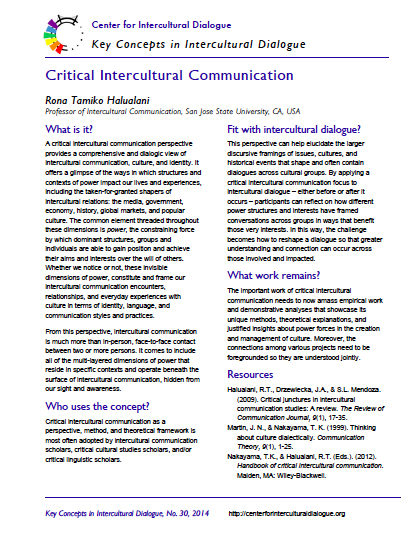
Key Concept #30: Critical Intercultural Communication by Rona Halualani

Key Concepts in ICDThe next issue of Key Concepts in intercultural Dialogue is now available. This is KC30: Critical Intercultural Communication by Rona Halualani. As always, all Key Concepts are available as free PDFs; just click on the thumbnail to download. Lists organized  chronologically by publication date and numberalphabetically by concept in English, and by languages into which they have been translated, are available, as is a page of acknowledgments with the names of all authors, translators, and reviewers.

kc30-sm

Halualani, R. (2014). Critical intercultural communication. Key Concepts in Intercultural Dialogue, 30. Available from:
https://centerforinterculturaldialogue.org/wp-content/uploads/2014/08/key-concept-critical-icc.pdf

The Center for Intercultural Dialogue publishes a series of short briefs describing Key Concepts in intercultural Dialogue. Different people, working in different countries and disciplines, use different vocabulary to describe their interests, yet these terms overlap. Our goal is to provide some of the assumptions and history attached to each concept for those unfamiliar with it. As there are other concepts you would like to see included, send an email to the series editor, Wendy Leeds-Hurwitz. If there are concepts you would like to prepare, provide a brief explanation of why you think the concept is central to the study of intercultural dialogue, and why you are the obvious person to write up that concept.


Creative Commons License
This work is licensed under a Creative Commons Attribution-NonCommercial-NoDerivatives 4.0 International License.

CFP IAICS Culture, Communication – Hong Kong 2015

IAICS-2015 Call for Submission

The 21st International Conference of the International Association for Intercultural Communication Studies (IAICS) cum The 11th Biennual International Conference of the China Association for Intercultural
Communication (CAFIC)

Conference Theme: Culture, Communication, and Hybridity in an Age of Globalization
Conference Time: July 15-18, 2015
Conference Venue: The Hong Kong Polytechnic University, Hong Kong

Topic areas are broadly defined as, but not limited to, the following:
Advertising and marketing across cultures
Bilingual and multilingual communication
Bilingual education
Comparative literature
Conflict, mediation and negotiation across Cultures
Corporate culture and management
Crisis/risk communication
Cross-cultural adaptation
Cross-cultural interaction
Culture and diplomacy
Digital communication across cultures
Ethnic studies
Gender issues and communication
Glocalization
Group/Organizational communication
Health communication
Intercultural communication competence
Intercultural communication and politics
Intercultural and multilingual education
Intercultural pragmatics
Interethnic communication and relations
Interpersonal communication and relations
Language and cultural hybridity
Language planning and policy
Media and transcultural communication
Multiple cultures and interculturality
Philosophy and human behavior patterns
Psychological communication studies
Public opinions and public policy
Public relations
Rhetorical communication
Second language education
Social media and communication
Sustainability and globalization
Transculturality in global context
Translation studies
Verbal and nonverbal communication

Guidelines for Submissions
Categories: Abstract, panel proposals, and workshop proposals may be
accepted.
1. Abstract, 150-250 words in English, including positions,
affiliations, email addresses and mailing addresses for all authors.
2. Panel proposals reflecting the conference theme may be submitted. All
panel proposals should provide a 100-word rationale and a 100-200 word
abstract of each panelist’s paper; include affiliation and email
addresses for each panelist.
3. Workshop proposals relevant to the conference theme may be submitted.
Proposals should be 3-5 pages in length, single spaced.

Deadline: Please submit abstracts by January 11, 2015, and panel/workshop proposals and roundtable discussion sessions by February 1, 2015.

Conference Working Languages: English and Chinese
Conference host: Department of Chinese and Bilingual Studies, The Hong Kong Polytechnic University

Mira Awad on the concept of Bahlawan (acrobat)

Mira Awad describes the concept of Bahlawan- بهلوان, an Arabic term meaning an acrobat. Mira describes how it has felt to walk on a tightrope all of her life, from childhood in an Arab village in the north of Israel, to Tel Aviv, to the world stage. Her song Bahlawan uses the metaphor of being an acrobat to describe the need for balance in intercultural contexts.

With a Palestinian father and Bulgarian mother, she is now married to a Ukrainian who walks his own tightrope, given that he has one parent who is Christian and another who is Jewish.

Mira is a multidisciplinary international performer (singer, songwriter, actress) who has hosted tv shows. She established her own world music label called LabelFree, and also writes music for theater and film. She represented Israel at Eurovision 2009, together with Noa, and made it to the finals with the song There must be another way. A relentless peace activist, Mira is identified with the agenda of dialogue and co-existence, and uses performance to build bridges for resolutions.

UNC Chapel Hill postdocs for faculty diversity

UNC-Chapel Hill Postdoctoral Program for Faculty Diversity

As part of a continuing commitment to building a culturally diverse intellectual community and advancing scholars from underrepresented groups in higher education, The University of North Carolina at Chapel Hill Carolina Postdoctoral Program for Faculty Diversity (CPPFD) offers postdoctoral research appointments for a period of two years. The purpose of CPPFD is to develop scholars from underrepresented groups for possible tenure track appointments at the University of North Carolina and other research universities. Postdoctoral scholars will be engaged full-time in research and may teach only one course per fiscal year. This program is funded by the State of North Carolina. Deadline is November 15, 2014.

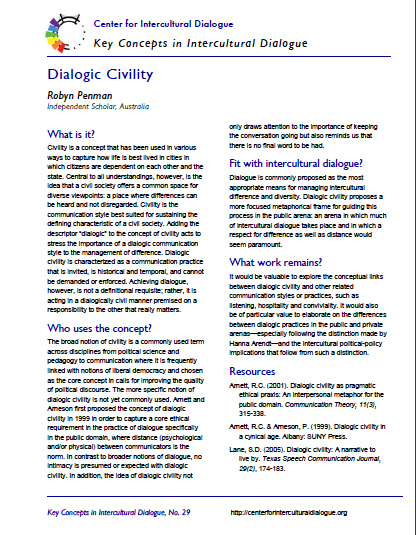
Key Concept #29: Dialogic Civility by Robyn Penman

Key Concepts in ICDThe next issue of Key Concepts in intercultural Dialogue is now available. This is KC29: Dialogic Civility by Robyn Penman. As always, all Key Concepts are available as free PDFs; just click on the thumbnail to download. Lists organized  chronologically by publication date and numberalphabetically by concept in English, and by languages into which they have been translated, are available, as is a page of acknowledgments with the names of all authors, translators, and reviewers.

kc29-sm

Penman, R. (2014). Dialogic civility. Key Concepts in Intercultural Dialogue, 29. Available from:
https://centerforinterculturaldialogue.org/wp-content/uploads/2014/08/key-concept-dialogic-civility.pdf

The Center for Intercultural Dialogue publishes a series of short briefs describing Key Concepts in intercultural Dialogue. Different people, working in different countries and disciplines, use different vocabulary to describe their interests, yet these terms overlap. Our goal is to provide some of the assumptions and history attached to each concept for those unfamiliar with it. As there are other concepts you would like to see included, send an email to the series editor, Wendy Leeds-Hurwitz. If there are concepts you would like to prepare, provide a brief explanation of why you think the concept is central to the study of intercultural dialogue, and why you are the obvious person to write up that concept.


Creative Commons License
This work is licensed under a Creative Commons Attribution-NonCommercial-NoDerivatives 4.0 International License.

Dorm Room Diplomacy

I just ran across an interesting example of applied intercultural dialogue that may be of particular interest either to students taking, or faculty teaching, courses on intercultural topics:

“Founded by students at the University of Pennsylvania in 2009, Dorm Room Diplomacy fosters intercultural dialogue and mutual understanding among an international group of university students. Dorm Room Diplomacy employs videoconference technology to facilitate virtual exchanges that help students to see the individuals behind reductionist cultural stereotypes.

The videoconference program occurs each academic semester, and the same set of 8 students join in a virtual dialogue with a trained facilitator each week. Dorm Room Diplomacy is entirely student-run, encouraging students to take ownership over the dialogue process, establish campus chapters, and empower themselves and their peers. As a non-partisan organization, Dorm Room Diplomacy does not engage in political activities or advocacy, other than the promotion of intercultural dialogue. “

For more information, and for the source of this quote, go to the website for Dorm Room Diplomacy.