Study International Public Relations in London 2015

Study International Public Relations in London Summer 2015!

From the tower of London to Westminster Abbey’s soaring arches, this London-based seminar offers students the opportunity to live in one of the most cosmopolitan cities while interacting with and learning from international public relations practitioners.

The seminar will be held May 31June 26, 2015 at Regent’s University in London. Dr. Ashli Q. Stokes, Associate Professor at the University of North Carolina at Charlotte and co-author of Global Public Relations: Spanning Borders, Spanning Cultures will lead this year’s seminar. The Public Relations in the United Kingdom program is designed to acquaint students with the complexities of public relations practice in an international setting.  In addition to classes led by Dr. Stokes, students will attend lectures led by some of Europe’s leading practitioners and educators, work on internationally-themed projects, and take part in field trips to public relations firms and other relevant organizations throughout the greater London area.

Students will attend classes directed by Dr. Stokes during the week at Regent’s University London, located in the heart of central London just a short distance from Buckingham Palace and world-famous shopping on Oxford Street. Classroom coursework will be supplemented by visits to various international public relations and related organizations.

Space is limited to 18 students and spots are already being filled. Past attendees have come from schools all over the nation. Don’t miss your chance to study PR in London!

Interested students may also contact Dr. Ashli Stokes for more information.

Cross-cultural Business Conference (Austria)

The international “Cross-Cultural Business Conference 2015” has been announced by the University of Applied Sciences Upper Austria. The conference provides an opportunity for lecturers, researchers and practitioners to advance knowledge and discuss latest developments in the field of management and business.This year’s conference at the School of Management in Steyr mainly focuses on the key management subjects of the study program Global Sales and Marketing in an intercultural environment. Moreover, this conference will be carried out in cooperation with the School of Informatics/Communications/Media, chairing two sessions.

Conference Days: May 21-22, 2015

Authors are encouraged to prepare and submit papers for the following sessions:
*Session A: Intercultural Perspectives in Global Business and HR Management
*Session B: Intercultural Perspectives in Global (B2B)Marketing and Sales Management
*Session C: Intercultural Perspectives in Higher Education Research
*Session D: Intercultural Perspectives in Informatics, Communication & Media

Richard D. Lewis, best-selling author of “When Cultures Collide”, will present the keynote address.For more information please download the Call for Papers.Deadline extended to December 7, 2014.

The conference is accompanied by the annual “International Week“, an event where international lectures convey business related topics to our students.

Save

CFP ICADA-SIS 2015 (Thailand)

Call for Abstracts–The 4th  ICADA—SSIS 2015

The National Institute of Development Administration (NIDA) organizes the Fourth International Conference on Advancement of Development Administration—Social Sciences and Interdisciplinary Studies 2015 (the 4th ICADA—SSIS 2015) at NIDA, Bangkok Campus, Thailand, on May 28-30, 2015. The major theme is “ASEAN and Globalization: Transparency, Integrity, and Sustainability.”

At the conference, scholars in social sciences and interdisciplinary studies and those who have worked in the area of social and economic development will present their research/review articles related to the major theme. This will be beneficial to academia and professionals, both nationally and internationally.

We would like to extend our invitation to scholars, university instructors and students, and independent researchers to submit their abstracts of their research/review articles for presentation at the conference. The deadline for abstract submission is March 15, 2015.

Crystal Guo CID Intern Profile

Crystal GuoCrystal Guo (in Chinese, Guo Bailing) is a student in the Master of Arts in International and Intercultural Communication at Royal Roads University, Victoria, BC, Canada. Graduating from Tianjin Foreign Languages Studies University in China 2014, she majored in English (international journalism) for her bachelor’s degree. Having studied under an exam-oriented educational system, she has the courage to follow her heart and embrace the diversity of western cultures. Without biased judgment, she is able to understand people, regardless of their different races or religions and appreciate their merits.

In the process of following her dream to become a media worker, Crystal has actively tried to obtain diversified hands-on experiences through working as a support English teacher in poor western China and through participating in the Work and Travel USA Program in Grand Canyon Resort. She learns quickly and has compelling intellectual ability. She can grasp the essence of theoretical knowledge and apply it flexibly and practically. In addition to that, she has mastered good research techniques to review and assimilate large amounts of complex information in an efficient and effective manner.


Work for CID:
Crystal was one of several students completing small projects as interns for CID in 2014. Her particular project was to expand the database of international teaching opportunities. 

Beyza Björkman Profile

ProfilesBeyza Björkman is Associate Senior Lecturer at Stockholm University, Department of English, Centre for Academic English.


Beyza BjorkmanSince 2005, she has been doing research on the use of English as the medium of instruction in Swedish higher education. Her general research interests include the use of English as a lingua franca (ELF) for academic purposes, spoken academic discourse in general, academic literacy, linguistic equality, language change and language policy.

Her most current research on ELF focused on the pragmatic aspects of English as a lingua franca as the medium of instruction, focusing on polyadic lingua franca speech in student-student interaction. More recently, she has published on language policy work at Swedish universities, focusing on actual language practices vs language management issues, as well as attitudes towards the use of English in Swedish higher education. She is currently doing research on the spoken genre of PhD supervisor-PhD student interactions in supervision meetings.

For more information on Beyza’s research and publications, visit her website.


Work for CID:
Beyza Björkman wrote KC40: English as a Lingua Franca.

U Iowa job ad: Asian Studies Endowed Chair

THE UNIVERSITY OF IOWA
College of Liberal Arts & Sciences/International Programs
Asian Studies Endowed Chair

The University of Iowa College of Liberal Arts and Sciences and UI International Programs invite applications for the position of C. Maxwell and Elizabeth M. Stanley Family Chair of Asian Studies. Geographic area of specialization is open to East and Southeast Asia, with an emphasis on transnational and cross-cultural topics. A successful candidate will demonstrate a high level of proficiency and research competence in a relevant East or Southeast Asian language. The appointment will be within one of the following units: Department of Anthropology, Department of Communication Studies, Department of History, or the School of Journalism and Mass Communication. The successful applicant will also hold a 0% appointment in International Programs, and is expected to be an active participant in the activities of the Center for Asian and Pacific Studies. Review processes, teaching assignments, and primary responsibility for mentorship will reside within the department of appointment.

TO VIEW POSITION QUALIFICATIONS AND TO APPLY: visit http://jobs.uiowa.edu and reference requisition #65204. The review of applications will begin on November 1, 2014 and continue until the position is filled.

The Departments and the College of Liberal Arts & Sciences are strongly committed to diversity; the strategic plans of the University and College reflect this commitment. All qualified applicants are encouraged to apply and will receive consideration for employment free from discrimination on the basis of race, creed, color, national origin, age, sex, pregnancy, sexual orientation, gender identity, genetic information, religion, associational preference, status as a qualified individual with a disability, or status as a protected veteran. The University of Iowa is an equal opportunity/affirmative action employer.

CFP Communication History conference (Italy)

CFP: Bridges and Boundaries – Theories, Concepts and Sources in Communication History
An International Conference in Venice, Italy – September 16-18, 2015

Organizer: Communication History Section of the European Communication Research and Education Association (ECREA)
Co-Sponsor: Centre for Early Modern Mapping, News and Networks (CEMMN.net) – Queen Mary University of London

Fernand Braudel in his seminal essay “History and the Social Sciences: The Longue Durée” pointed out that many academic disciplines/fields which study different aspects of social life inevitably encroach upon their neighbors, yet often remain in “blissful ignorance” of each other. Braudel and others have repeatedly called for historians and social scientists to overcome their deep ontological and epistemological differences in order to work together.

Despite much progress in this regard, communication history remains one of the fields where profitable interdisciplinary dialogue can still take place. Being aware of this need, the Communication History Section of ECREA invites researchers who focus on various aspects of the history of communication, media, networks and technologies (broadly defined), to come together with two main aims: 1) to explore the bridges and boundaries between disciplines; 2) to exchange ideas about how communication history is being done and how it might be done, while emphasizing theories, concepts and sources beneficial to their research, as well as emerging trends and themes.

A three-day conference will take place in Venice, one of the great hubs of early modern communication, at Warwick University’s seat in Palazzo Pesaro Papafava. The opening keynote address will be delivered by Professor Mario Infelise, a leading scholar of early modern print and journalism and the head of the graduate program in the Humanities at the University of Venice Ca’ Foscari. Instead of traditional panels and papers, the conference aims to foster dialogue among scholars of various disciplines through topically organized round-tables, master classes, and countless opportunities for informal discussions.

The organizing committee invites scholars to submit abstracts (max. 400 words) in which they address one of the main themes listed below and outline a short intervention that they might contribute to a round table on that theme. Such interventions should focus mainly on theoretical or methodological approaches, issues and experiences that the speaker has engaged with in his/her research. Historical case studies can be presented only so far as they contain a high degree of historiographical/theoretical significance. Interdisciplinary roundtable sessions will be organized in which participating scholars will also discuss questions raised by a chair and the audience, based on these proposals.

The deadline for abstract submission is January 10, 2015. The conference registration fee will be 140 euro and participants will be asked to cover their own travel expenses. Abstracts should be submitted through the conference website.

Main Themes:
(1) Theories and Models
Grand theories or meta-narratives often have at their core information networks and communication technologies. To what extent are theoretical premises advocated by scholars such as Braudel, Innis, McLuhan, Habermas, Luhmann, Benedict Anderson, Lefevbre – and more recently by Hallin and Mancini, Castells, Gitelman, Simonson, Mosco, Hendy, Hesmondalgh, F. Kittler, Fickers – applicable in historical inquiry? How has your own research in communication history been inspired by such concepts and theories?

(2) Space and Place
Communication networks and information technologies are always embedded in a material setting that can foster or hinder certain communication practices, call into being new forms of exchange, and drive technological development. What is the place of the geographical imagination in current communication history research? How valuable are the ideas of ‘place’ and ‘space’ in historical research? What are the current trends within the field of historical geography that can advance our understanding of communication history?

(3) News and Networks
How valuable is the idea of ‘the network’? What were the technologies that historically mediated the spread of information through networks? Who participated in networks used in advancing what Bourdieu later called cultural capital? To what extend did such networks contribute to the rise of public opinion and the public sphere? Can we talk about historical continuities between the early modern republic of letters and what Castells later popularized as the network society?

(4) Alternative Media
In order to understand communication history as a long-term, inclusive process, which alternative media or communication technologies (besides the familiar ‘mass media’ of the 20th century) need to be considered, and how? Possibilities might include migration flows, civic and religious ceremonies, theatre, preaching, fashion, the visual arts or architecture. What kinds of methodological or theoretical implications does their consideration carry?

(5) Sources and Methods
The progressive digitization of archives and libraries is opening access to primary sources for increasingly wider circles of scholars. What are the advantages and challenges raised by this development? To what extent do issues of materiality matter particularly to the realm of media and human communication research? What are the most relevant sources that you use for your own research?

(6) ‘New’ Media
At one time, even the oldest communication technologies were looked upon as suspicious novelties. Socrates famously condemned writing; the introduction of print may have been hailed by some as a ‘revolutionary’ enterprise – a term now often applied also to the digital age. What are the lessons that scholars can learn from studying critical periods during which one dominant technology is replaced by a new mode of communication? How do such lessons serve our understanding of the phenomenon called new media?

Organizing Committee:
Dr. Rosa Salzberg, University of Warwick, United Kingdom
Dr. Gabriele Balbi, Università della Svizzera italiana, Switzerland
Dr. Juraj Kittler, St. Lawrence University, USA

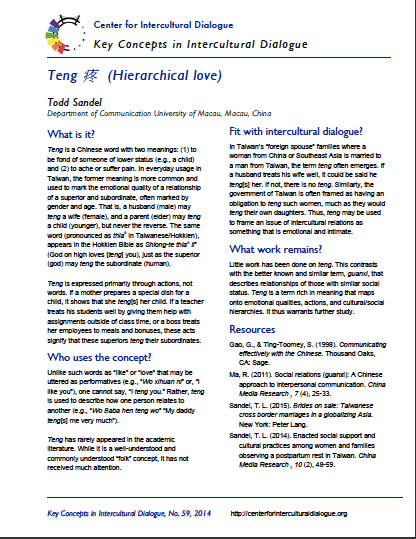
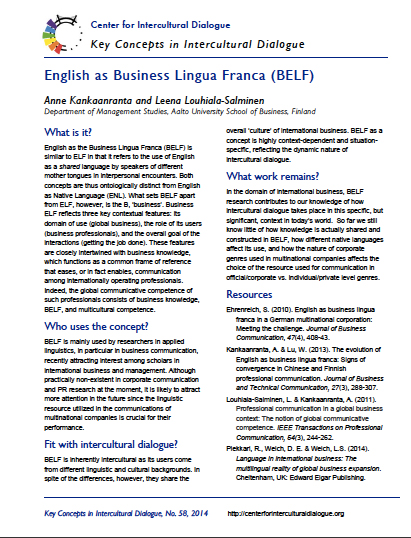
Key Concept #39: Otherness and the Other by Peter Praxmarer

Key Concepts in ICDThe next issue of Key Concepts in intercultural Dialogue is now available. This is KC39: Otherness and the Other by Peter Praxmarer. [NOTE: this concept was updated in 2016, and the original 2014 version replaced.] As always, all Key Concepts are available as free PDFs; just click on the thumbnail to download. Lists organized  chronologically by publication date and numberalphabetically by concept in English, and by languages into which they have been translated, are available, as is a page of acknowledgments with the names of all authors, translators, and reviewers.

KC39 Otherness_v2Praxmarer, P. (2016). Otherness and the Other(s). Key Concepts in Intercultural Dialogue, 39. Available from:
https://centerforinterculturaldialogue.org/wp-content/uploads/2016/08/kc39-otherness_v2.pdf

The Center for Intercultural Dialogue publishes a series of short briefs describing Key Concepts in intercultural Dialogue. Different people, working in different countries and disciplines, use different vocabulary to describe their interests, yet these terms overlap. Our goal is to provide some of the assumptions and history attached to each concept for those unfamiliar with it. As there are other concepts you would like to see included, send an email to the series editor, Wendy Leeds-Hurwitz. If there are concepts you would like to prepare, provide a brief explanation of why you think the concept is central to the study of intercultural dialogue, and why you are the obvious person to write up that concept.


Creative Commons License
This work is licensed under a Creative Commons Attribution-NonCommercial-NoDerivatives 4.0 International License.

Jana Simonis CID intern profile

Jana SimonisJana Simonis is a doctoral candidate in the Department of Communication Studies at Southern Illinois University Carbondale (SIUC). Her academic research is located mostly within critical intercultural communication, postcolonial studies, critical communication pedagogy, and international student-centered research. In 2009, she graduated with her Bachelor of Arts in Translation, Interpretation, and Cultural Studies from Johannes Gutenberg-Universität Mainz, Germany. She attended SIUC as a foreign exchange student for a year before being admitted to the Master of Arts in Speech Communication in 2010. In 2012, she graduated with her Master’s degree and joined the program as a doctoral student.

Jana also has served on the board of the International Student Council at her university for two years in a row and currently holds the position of President. She has also worked on creating an Intercultural Relations position within the Speech Communication Organization of her department so that international students could get their voices, ideas, and concerns heard. In her capacity as an international student leader, she has worked hard to increase visibility and inclusivity of international students on her campus and the larger community.

Much of Jana’s research and professional experience focuses on building international relations and engaging in intercultural dialogue. She has come to truly appreciate this field of work and hopes to continue her efforts in a career that will allow her to engage in international relationship-building and intercultural dialogue.


Work for CID:
Tracy was one of several students completing small projects as interns for CID in 2014. Her particular project was to create a database on graduate student programs related to intercultural dialogue.

Loyola Marymount U job ad (Los Angeles)

The Department of Communication Studies at Loyola Marymount University in Los Angeles seeks applicants for a tenure-track, Assistant Professor position in the areas of Interpersonal, Intercultural and/or Organizational Communication Studies, beginning Fall 2015. The Communication Studies Department is one of the largest undergraduate programs at LMU, with approximately 500 majors. In keeping with LMU’s Mission, our department emphasizes the ethical and effective deployment of communication in pursuit of a more just and humane world. We also strive to help students foster the knowledge and skills necessary to develop more satisfying personal and professional relationships. Our faculty is committed to scholarship and service projects that support our Mission and reflect a critical orientation toward the discipline.  We are committed to developing a culturally diverse environment for our faculty and students.

This position requires a critical/cultural orientation to the field of communication and a global perspective on the issues of marginalized communities, participatory culture and social justice. We are particularly interested in candidates whose areas of expertise include, but are not limited to, one of the following areas of study: global communication, non-profit culture, environmental justice, eco-tourism, alternative organizing, social entrepreneurship, and digital social innovation.  Candidates must be able to teach classes in Interpersonal Communication, in addition to classes in one or both areas of Intercultural and Organizational Communication.

Position Qualifications:
Applicants must have a doctorate in Communication Studies, Interpersonal Communication, Organizational Communication and/or Intercultural Communication, in hand at the time a contract is offered. Final appointment is dependent on a confirmed terminal degree status. Applicants who have not yet completed their doctorate must demonstrate progress verifiable by evidence and substantive enough to ensure completion of their degree at the time of appointment.

In addition to teaching required courses in Interpersonal Communication and one or both of Intercultural and Organizational Communication, this position also involves teaching and developing required and elective courses related to the Department’s curricular clusters of “Organizing and Relating,” and “Advocacy, Public Relations and Non-Profit Culture.” Application materials should clearly demonstrate the ability to teach the anticipated courses. The successful candidate will be expected to adopt a teacher-scholar model of professional engagement with a commitment to service and an established, or promise of a, productive research agenda. We value relevant professional, practical, and international experience in addition to the required academic qualifications. Proficiency in more than one language also is valued.

Application Details:
Completed applications will be reviewed beginning on December 1, 2014 and will continue until the position is filled. A complete application portfolio requires: 1) a letter of application; 2) a current curriculum vitae; 3) official transcripts; 4) representative scholarship (such as published article/s, key dissertation chapters, competitively selected conference papers, manuscript submissions); 5) complete copies of original teaching evaluations (including qualitative comments) reflecting at least two of her/his most recent years of university level teaching [note: summaries of course evaluations are not acceptable]; 6) a statement of teaching philosophy; 7) sample syllabi related to this position; 8) at least three letters of reference; and 9) if the candidate does not have a doctorate, evidence of timeline and anticipated completion.

Application materials should be sent to: Dr. Nina M. Reich, Search Committee Chair, Department of Communication Studies/Foley Building, 1 LMU Drive – MS 8231, Los Angeles, CA 90045. Materials must be received by December 1, 2014 to ensure full consideration. All materials must be submitted in hard copy format; electronic delivery of materials will not be accepted. Inquiries or comments (including those regarding required materials) should be directed to Dr. Nina M. Reich by e-mail.

LMU places value on those who can share and teach differing points of view. Strong candidates will be committed to and effective in supporting and enhancing a culturally rich and diverse learning environment. We also value those who will bring sensitivity to the independent cultural role of religions.

Loyola Marymount University, a comprehensive university in the mainstream of American Catholic higher education, seeks professionally outstanding applicants who value its mission and share its commitment to academic excellence, the education of the whole person, and the building of a just society. LMU is an equal opportunity institution actively working to promote an intercultural learning community. Women and minorities are encouraged to apply.