South Asian Film Festival (Montreal)

An eclectic mix of award-winning films from the Indian subcontinent and its diaspora
Kabir Centre for Arts & Culture
The South Asian Film Festival of Montréal, 6th edition
Friday, November 4 – Sunday, November 6
Click HERE for all film descriptions and trailers

Kabir Centre for Arts & Culture is pleased to announce the 6th edition of the South Asian Film Festival of Montréal (SAFFMontréal), organized in collaboration with the Mel Hoppenheim School of Cinema of Concordia University, on November 4, 5 and 6. This innovative festival presents an eclectic choice of inspiring and thought-provoking films made in the countries of the Indian subcontinent (India, Pakistan, Bangladesh, Nepal, Sri Lanka, Afghanistan and Maldives) and its diaspora. These engaging and entertaining films have their focus on South Asia; while at the same time compel audiences to realize how much there is in common among cultures throughout the world, identifying both shared life-struggles and joys. Admission is free, with donations gratefully appreciated. Discussions are held after each screening.

The South Asian Film Festival will be presenting 17 films this year; short and long, documentaries and feature films, including comedy, drama and music. All films are subtitled in English and explained in French, with various original languages such as Urdu, Hindi, Tamil, Marathi, Malayalam, Bengali and English, as well as silent films, making them accessible to as many people as possible. The films have been carefully chosen from more than 1000 entries and all screenings will be followed by a talkback between spectators and a panel of experts. Directors for some of the films will be present, other times the directors will interact with the audience via Skype. Most of the films are recent and have won awards at international festivals. As in previous years, the films are drawn from different parts of the Indian subcontinent; recognized as the largest producers of films on the planet.

Dominican University Job Ad: Intercultural Communication

Assistant Professor, Corporate Communication at Dominican University

The Dominican University Communication Arts and Sciences Department is seeking a tenure-track assistant professor of Corporate Communication to begin fall 2017. The successful applicant will supervise the undergraduate discipline, work with long-time adjuncts, and build on links forged with Dominican’s Brennan School of Business, ELS language service and other stakeholders. We desire a specialist in communication between and among individuals and groups within organizations and external publics.

Classes would include:
*Organizational communication,
*Intercultural communication and
*Interpersonal communication.

The successful applicant could supplement these core skills with strengths in strategic communication, leadership and communication technology in organizations.

As a member of the CAS department, the successful applicant would also advise students and contribute to the department’s basic courses, such as Introduction to Communication Theory and Practice, Public Speaking, and the Departmental Capstone. The course load is three courses per semester.

The successful application would have the opportunity to revise the discipline to meet current and future demands of the fast-changing corporate world. We welcome candidates whose experience in teaching, research, or community service has prepared them to contribute to our commitment to diversity and excellence. Ph.D. in hand preferred.

Dominican University is a Catholic, comprehensive teaching university located in River Forest, a suburb of Chicago, with an enrollment of about 3,600 students.

To Apply:
Applicants must submit online. Please provide the following application materials:
~cover letter that outlines qualifications for the position.
~curriculum vitae
~teaching philosophy statement
~recent teaching evaluations (please submit as “other”)
~recent writing sample

Official transcripts and letters of recommendation will be required of finalists; submission instructions will be provided to applicants as necessary.

For consideration for interviews at the National Communication Association convention applications must be received by Nov. 1. Other applications must be received by Dec. 1

Dominican University is an equal opportunity employer. The University is dedicated to the goal of building a diverse faculty and staff committed to teaching and working in a multicultural environment.  We look forward to a diverse pool of applicants who bring varied experiences, perspectives and backgrounds.  Upon request, reasonable accommodations in the application process will be provided to individuals with disabilities.


Neslihan Demirkol Profile

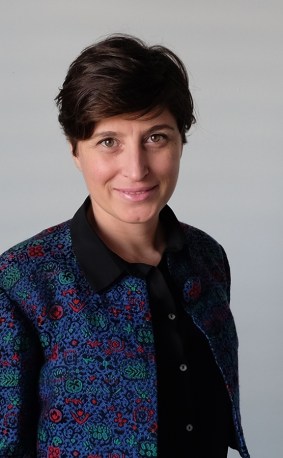
ProfilesNeslihan Demirkol is a research associate of the Corpus Musicae Ottomanicae (CMO) project, based within the University of Münster, Germany.

Neslihan Demirkol

She holds an M.A and PhD from Bilkent University. She worked as a lecturer between 2014-2016, and as an assistant professor between 2016-2019 in the Department of Turkish Language and Literature at the Social Sciences University of Ankara, Turkey. She spent one year in the Islamic Studies Department within the Institute for Asian and Oriental Studies at the University of Zurich, for her postdoctoral studies as a Swiss Government Excellence Scholarship holder for the 2018-2019 academic year.


Her research and teaching interests are modern Turkish literature, literary theories, literary history, translation studies, adaptations and translations of One Thousand and One Nights in Turkish and their influences in Turkish literature. Her MA thesis focuses on the definition of loyalty in literary translations from a cultural perspective. Her Ph.D dissertation criticizes the mainstream discourse of Turkish literary modernization and provides a new perspective to the literary history with emphasize on the literary translations using Pierre Bourdieu’s sociological approach to the dynamics of cultural production. She has experience in teaching academic writing in Turkish and Ottoman language classes.

Demirkol was a member of the Expert Committee for Intercultural Dialogue of the Turkish National Commission for UNESCO between 2008 and 2013. She has been a member of ÇEVBİR (Professional Association of Translators) since 2006. She has been on the editorial board of Kebikeç, a peer-reviewed academic journal in the field of humanities and social sciences, since 2011; and fe journal, an international peer-reviewed academic journal in the field of feminist critique and gender studies, since 2018.

Selected Publications:

Demirkol, N. (2016). “Lutf ile, ta’bîr eyle “: Kaya Sultan and Melek Ahmed Paşa anlatısında rüyaların işlevi. In  H. Çolak, Z. Kocabıyıkoğlu-Çeçen & N. I. Demirakın (Eds.), Ayşegül Keskin Çolak’a armağan tarih ve edebiyat yazıları (pp. 39-51). Ankara: Kebikeç Yayınları.

Demirkol, N., & M. Kalpaklı. (2014). Eternal narratives of the silk road: The Thousand and One Nights from Samarkand to Istanbul. Bulletin of IICAS, 19, 81-97.

Demirkol, N. (2013). Gathering around a table: Meals and cuisine as a means of interculturality. In E. Ölçer-Özünel & N. Tunsu (Eds.), Sharing the same taste: The Turkish and Romanian Common Traditional Cuisine Workshop Proceedings (pp. 23-30). Ankara: UNESCO.

Demirkol, N. (2011). Çeviride sadakatin yeni tanımları: Shakespeare’in A Midsummer Night’s Dream’i için Can Yücel’in Bahar Noktası bir ihtimal midir? Kebikeç, 32,  187-237.

Demirkol, N. (2011). Hüsn ü Aşk’ta Hüsn’ün âşık rolünün imkânsızlığı üzerine. Journal of Turkish Studies, 35, 193-204.

Demirkol, N. (2010). The role of women in the interaction and transfer between the Turkish and Macedonian cuisine culture. In M. Kalpaklı, N. Demirkol et. al. (Eds.), Sharing the same taste: The Turkish and Macedonian Common Traditional Cuisine Workshop Proceedings (pp. 74-78). Ankara: UNESCO.

Demirkol, N. (2010). The role of gender in the performances of traditional music. In M. Ö. Oğuz, M. Kalpaklı, et al. (Eds.), The Existing Musical Forms and Traditional Cultures of the Peoples of the Border Regions of Turkey and Bulgaria Workshop Proceedings (pp. 43-49). Ankara: UNESCO.

Demirkol, N., & M. Kalpaklı (Eds.). (2010). Binbir Gece’ye bakışlar. İstanbul: Turkuaz Yayınları.

Demirkol, N., & M. Kalpaklı, et. al. (Eds.). (2010). Sharing the same taste: The Turkish and Macedonian Common Traditional Cuisine Workshop Proceedings. Ankara: UNESCO.


Work for CID:

Neslihan Demirkol translated KC3: Intercultural Competence and KC5: Intercultural Communication into Turkish.

Key Concept #3: Intercultural Competence Translated into Persian

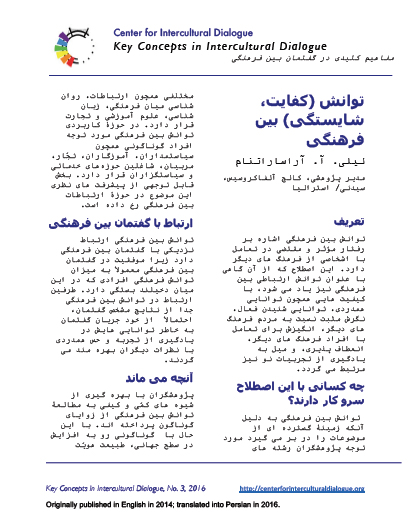
Key Concepts in ICDContinuing translations of Key Concepts in Intercultural Dialogue, today I am posting KC3: Intercultural Competence, written by Lily A. Arasaratnam and first published in English in 2014, which Ramin Hajianfard has now translated into Persian.

As always, all Key Concepts are available as free PDFs; just click on the thumbnail to download. Lists of Key Concepts organized chronologically by publication date and number, alphabetically by concept, and by languages into which they have been translated, are available, as is a page of acknowledgments with the names of all authors, translators, and reviewers.

KC3 Intercultural Competence_PersianArasaratnam, L. (2016). Intercultural competence [Persian]. (R. Hajianfard, Trans). Key Concepts in Intercultural Dialogue, 3. Available from:
https://centerforinterculturaldialogue.org/wp-content/uploads/2018/08/kc3-intercultural-competence_persian-revised.pdf

If you are interested in translating one of the Key Concepts, please contact me for approval first because dozens are currently in process. As always, if there is a concept you think should be written up as one of the Key Concepts, whether in English or any other language, propose it. If you are new to CID, please provide a brief resume. This opportunity is open to masters students and above, on the assumption that some familiarity with academic conventions generally, and discussion of intercultural dialogue specifically, are useful.

Wendy Leeds-Hurwitz, Director
Center for Intercultural Dialogue


Creative Commons License
This work is licensed under a Creative Commons Attribution-NonCommercial-NoDerivatives 4.0 International License.

U Virginia Job Ad: Media & African or African-American Studies

Assistant/Associate Professor of Media Studies at University of Virginia

The Department of Media Studies at the University of Virginia seeks to hire a tenure-track Assistant Professor or tenured Associate Professor. We welcome applicants specializing in media and the African American experience or media and African and/or African Diaspora studies, with a preference given to those in the first area. The appointment begins with the fall term of 2017, with an anticipated start date of July 25, 2017. The successful candidate at the assistant professor level must have a Ph.D or be ABD with expected completion by May; show evidence of research promise in the field of media studies; and demonstrate a commitment to innovative and effective teaching. Associate professor candidates must have an outstanding publication record of innovative research in media studies and proven teaching excellence. In either case, the successful candidate must hold a Ph.D at the time of appointment.

This position is part of a larger University of Virginia hiring initiative in the Global South that seeks to foster inter-disciplinary and cross-disciplinary teaching and research. The candidate hired will be appointed for the first two years as an Andrew W. Mellon Fellow with the Institute of Humanities and Global Cultures, an appointment that will provide one course release per year.

To apply, candidates must submit a Candidate Profile through Jobs@UVA, search for posting number 0619561, and electronically attach the following: a cover letter of interest that describes research agenda and teaching experience, a curriculum vitae, and contact information for three references. Also, separately by e-mail, please arrange for three (3) confidential letters of recommendation that speak to research excellence be sent to: Professor Aniko Bodroghkozy, Search Committee Chair at this address: mediastudiessearch[at]gmail.com

For priority consideration, please submit all application materials and letters of reference by November 1, 2016. The position remains open until filled. Questions regarding the application process may be sent to the Search Committee Chair: ab4vs[at]virginia.edu

The University will perform background checks on all new faculty hires prior to making a final offer of employment.

The University of Virginia is an equal opportunity/affirmative action employer. Women, minorities, veterans and persons with disabilities are encouraged to apply.

U Utah Asia Job Ad (South Korea)

Lecturer Position in Communication (non-tenure track) at University of Utah

The University of Utah’s Department of Communication seeks a lecturer for its Utah Asia Campus (UAC) to commence January 1, 2017.  Depending on experience, appointment may be at the assistant, associate, or professor-lecturer level.  The teaching load is 4 courses or sections per semester.
The successful candidate will have a Ph.D. (A.B.D. considered) in communication and experience with US higher education.  Excellent teaching ability is required.  All courses are taught in English.  Housing for US citizens will be provided by the IGC (Incheon Global Campus).

Two programs in communication, strategic communication and journalism, are offered at the UAC.  Strengths in one of these two areas is most desirable, but abilities to teach outside these areas is also desirable.  Core courses at the UAC include Analysis of Argument, Principles of Public Speaking, Introduction to News Writing, Theoretical Perspectives in Communication, Intercultural Communication, Introduction to Media Business & Ethics, Visual Communication, Digital Journalism, Video Production, Principles of Advertising, Cross Cultural Documentary, Communication, Visual Editing, Strategic Communication Theory & Practice, Magazine Writing, Mass Communication Law, PR Cases & Campaigns, and Media Ethics.  Other, more “elective” communication courses are taught as well.

Established in 2014, the UAC has a growing presence in Songdo, South Korea.  A new building, solely for the University of Utah on the Incheon Global Campus, was occupied this year.  Built on reclaimed land, the campus is 30 minutes from Incheon International Airport, a major gateway and transportation hub for East Asia.  Seoul may be reached by bus, subway, or taxi, and is less than an hour away by car.

Formal review of applications will begin November 15 and continue until the position is filled. Applicants must submit a cover letter highlighting teaching experiences and credentials; a CV; a writing sample; evidence of teaching excellence; and a list of three references that includes contact information.  To apply click here.  Questions about the position may be directed to Kent A. Ono, Department Chair and Search Committee Chair, at Kent.Ono[at]Utah.edu.

The Department of Communication is committed to removing barriers that have been traditionally encountered by individuals from underrepresented groups; strives to recruit faculty who will further enhance our diversity; and makes every attempt to support their academic, professional, and personal success while they are here. The University of Utah recognizes that a diverse faculty benefits and enriches the educational experiences of the entire campus and greater community.

The University of Utah is an Affirmative Action/Equal Opportunity employer and does not discriminate based upon race, national origin, color, religion, sex, age, sexual orientation, gender identity/expression, status as a person with a disability, genetic information, or Protected Veteran status. Individuals from historically underrepresented groups, such as minorities, women, qualified persons with disabilities and protected veterans are encouraged to apply. Veterans’ preference is extended to qualified applicants, upon request and consistent with University policy and Utah state law. Upon request, reasonable accommodations in the application process will be provided to individuals with disabilities. To inquire about the University’s nondiscrimination or affirmative action policies or to request disability accommodation, please contact: Director, Office of Equal Opportunity and Affirmative Action, 201 S. Presidents Circle, Rm 135, (801) 581-8365. Full benefits are provided for both same sex and different sex couples. The University of Utah values candidates who have experience working in settings with students from diverse backgrounds, and possess a strong commitment to improving access to higher education for historically underrepresented students.

Tulane University: 2 Job Ads

POSITION 1: Assistant Professor in Race, Ethnicity, and Media at Tulane University

The Department of Communication at Tulane University invites applications for a tenure track position at the Assistant Professor rank focusing on race and/or ethnicity and the ways it structures the production, distribution and/or consumption in U.S. media industries and institutions. We are especially interested in qualified applicants whose research addresses intersectionality, critical ethnic studies, television and technological convergence, and/or political economy. We encourage scholars who can teach the critical analysis of media to apply.

POSITION 2: Assistant Professor in Transnational identities and digital media studies at Tulane University

The Department of Communication at Tulane University invites applications for a tenure track position at the Assistant Professor rank focusing on the cultural-political implications of digital media in global contexts. We are especially interested in qualified applicants whose research addresses intersections of cultural identities, new media, and social/political formations. Possible areas include the role of digital and new media in political struggles, postcoloniality, populism, mobile communication, social networking, technological affordances, and/or cultural production. We encourage scholars who can teach fieldwork methods to apply.

FOR BOTH POSITIONS:

Qualified candidates for this position will hold a PhD degree in Communication or a related field by May 2017. Candidates should submit a letter or application, a curriculum vitae, three recommendation letters, and two writing samples (articles, papers or chapters). Whenever applicable, candidates should submit up to two syllabi of courses taught and teaching evaluations. Questions can be directed to Dr. Vicki Mayer (vmayer[at]tulane.edu), Chair of the Search Committee. Review of applications will begin 7 November 2016 and will continue until the position is filled. All application materials should be submitted online.

Tulane University is an equal employment opportunity/affirmative action/persons with disabilities/veterans employer committed to excellence through diversity. Tulane will not discriminate against individuals with disabilities or veterans. All eligible candidates are encouraged to apply.


Université de Montréal 2 Job Ads: International/Intercultural Communication and Rhetoric (Canada)

Université de Montréal
Département de communication
Faculté des arts et des sciences

POSITION 1:

Assistant or Associate professor in International and/or Intercultural Communication

The Département de communication is seeking applications for a full-time tenure-track position at the rank of Assistant or Associate Professor in International and/or Intercultural Communication.  Candidates situating their work in the perspectives of globalisation, postcolonial and/or subaltern studies are also welcome to apply.

Responsibilities
The appointed candidate will be expected to teach at all three levels of the curriculum, supervise graduate students, engage in ongoing research and publication, and contribute to the academic life and reputation of the University.

Requirements
– Ph.D. in Communication or in a related field.
– Evidence of dynamism and creativity in teaching and pedagogy.
– Candidates are expected to demonstrate how their research contributes debates within international and/or intercultural communication studies.
– Proficiency in the French language

POSITION 2: Assistant Professor in journalism studies at University of Montreal
The Département de communication is seeking applications for a full-time tenure-track position at the rank of Assistant Professor in journalism studies.

Responsibilities
The appointed candidate will be expected to teach at all three levels of the curriculum, supervise graduate students, engage in ongoing research and publication, and contribute to the academic life and reputation of the University.

Requirements
– Ph.D. in communication, or in a related field.
– Evidence of dynamism and creativity in teaching and pedagogy.
– Candidates are expected to demonstrate how their research contributes debates within journalism studies.
– Proficiency in the French language

FOR BOTH POSITIONS

Linguistic Policy: The Université de Montréal is a Québec University with an international reputation. French is the language of instruction. To renew its teaching faculty, the University is intensively recruiting the world’s best specialists. In accordance with the institution’s language policy, the Université de Montréal provides support for newly-recruited faculty to attain proficiency in French.

Starting Date: On or after June 1st, 2017.

Constitution of application
— The application must include the following documents:
– a cover letter
– a curriculum vitæ
– copies of recent publications and research
– evidence of teaching effectiveness
– a statement of research interests
– a statement of teaching interests
— Three letters of recommendation are also to be sent directly to the department chair by the referees.

Deadline
Application and letters of recommendation must be sent to the chair of the communication department by November 7, 2016 at the following address:
M. Thierry Bardini, directeur
Département de communication
Faculté des arts et des sciences
Université de Montréal
C. P. 6128, succursale Centre-ville
Montréal (QC) H3C 3J7

Application and letters of recommendation can also be sent by e-mail to the following address: thierry.bardini[at]umontreal.ca.

Equal Access Employment Program
Université de Montréal promotes diversity in its workforce and encourages members of visible and ethnic minorities as well as women, Aboriginal people, persons with disabilities and people of all sexual orientations  and gender identities to apply.

Immigration Requirements
We invite all qualified candidates to apply. However, in accordance with immigration requirements in Canada, please note that priority will be given to Canadian citizens and permanent residents.


CFP Britain, Canada & the Arts (London)

Britain, Canada, and the Arts: Cultural Exchange as Post-war Renewal
15-17 June 2017

CALL FOR PAPERS
Papers are invited for a major international, interdisciplinary conference to be held at Senate House, London, in collaboration with ENCAP (Cardiff University) and the University of Westminster. Coinciding with and celebrating the 150th anniversary of Canadian Confederation, this conference will focus on the strong culture of artistic exchange, influence, and dialogue between Canada and Britain, with a particular but not exclusive emphasis on the decades after World War II.

The immediate post-war decades saw both countries look to the arts and cultural institutions as a means to address and redress contemporary post-war realities. Central to the concerns of the moment was the increasing emergence of the United States as a dominant cultural as well as political power. In 1951, the Massey Commission gave formal voice in Canada to a growing instinct, amongst both artists and politicians, simultaneously to recognize a national tradition of cultural excellence and to encourage its development and perpetuation through national institutions. This moment complemented a similar post-war engagement with social and cultural renewal in Britain that was in many respects formalized through the establishment of the Arts Council of Great Britain. It was further developed in the founding of such cultural institutions as the Royal Opera, Sadler’s Wells Ballet, the Design Council and later the National Theatre, and in the diversity and expansion of television and
film.

While these various initiatives were often instigated by a strong national if not nationalist instinct, they were also informed by an established dynamic of social, political, and cultural dialogue. In the years before the war, that dynamic had been marked primarily by the prominent, indisputably anglophile voices of such influential Canadians in Britain as Beverly Baxter and Lord Beaverbrook. In English-speaking Canada, an established recognition of Britain as a dominant, if not originating, influence on definitions of cultural excellence continued to predominate. In the years following the war, however, that dynamic was to change, and an increased movement of artists, intellectuals, and artistic policy-makers between the two countries saw the reciprocal development of an emphatically modern, confident, and progressive definition of contemporary cultural activity.

This conference aims to expose and explore the breadth of this exchange of social and cultural ideals, artistic talent, intellectual traditions, and aesthetic formulations. We invite papers from a variety of critical and disciplinary perspectives — and particularly encourage contributions from scholars and practitioners working in theatre, history, literature, politics, music, film and television, cultural studies, design, and visual art.

Some indicative post-war cultural figures and areas of influence:
Henry Moore and the Art Gallery of Ontario
John Grierson at the National Film Board
Leonard Brockington and the CBC
Sydney Newman, Alvin Rakoff and British and Canadian television drama
Tyrone Guthrie, Barry Morse, Tanya Moiseiwitch, Alec Guinness, Maggie Smith, John Neville, Christopher Newton, Robin Phillips, Barry Morse, Brian Bedford, Christopher Plummer, Donald Sutherland, and others: developments in staging, acting, repertoire, and theatre-design at the Stratford Festival, the Shaw Festival, the Old Vic, the Chichester Festival Theatre, the National Theatre
Powys Thomas at the CBC, the Stratford Festival, and the National Theatre School of Canada
Celia Franca, Gweneth Lloyd, and national ballet
Robertson Davies as novelist, actor, cultural critic in Britain and Canada; at the Stratford Festival; at the University of Toronto’s Massey College
Yousuf Karsh and the iconography of the mid-twentieth century
Intellectual exchange and influence: Northrop Frye, Harold Innis, Marshall McLuhan, John Kenneth Galbraith
Elizabeth Smart and the London literary scene
Ronald Bryden and theatre criticism in London
Benjamin Britten and Michael Tippett: Canadian tours and compositions
Glenn Gould as musical interpreter, recording artist, celebrity personality, documentarian
Mordecai Richler, the cultural scene in London, and the dramatization of Anglophone Quebec
Mazo de la Roche and Lucy Maud Montgomery: literary influence and adaptations
Ben Wicks as cartoonist, journalist, and post-war memoirist

Other areas of exploration include (but are certainly not limited to):
Quebec and ‘French Canada’ in the British artistic scene
The cultural presence and influence of the Governor General
Publishers and publishing networks
Newspapers, media magnates, and editorialists from Beaverbrook to Black
Universities and the ‘modernisation’ of higher education
Popular culture and popular music
Cultural policy-making
Traditions of humour and satire
‘Distinct cultures’ within the larger nation
Constructions of indigeneity and native culture
National culture as anti-Americanism
Definitions of diversity, audience, and national identity
Architecture and urban development
More recent and contemporary exchanges in literature, art, politics, theatre, film, design, television, and the media

Proposals (max. 250 words) for papers of 20 minutes can be sent to the organizers, Irene Morra (Cardiff University) and John Wyver (University of Westminster), at canbritconference[at]gmail.com (mailto:canbritconference[at]gmail.com) by 1 November 2016.


CFP Intercultural Communication: Adapting to Emerging Global Realities

Call for Chapters of a Textbook Reader of the 21st Century Type
Intercultural Communication: Adapting to Emerging Global Realities: A Reader (2nd Edition)
Edited by Wenshan Jia, Ph. D., Professor of Intercultural/Global Communication, Chapman University

Professors/scholars of intercultural communication are all invited to submit original research or innovative theoretical position chapters to be considered for inclusion in the 2nd edition of a 21st century type of textbook reader Intercultural Communication: Adapting to Emerging Global Realities-A Reader scheduled for publication by August 7, 2017 by Cognella. While any topic of intercultural communication in a global context is welcomed, topics focusing on new developments of intercultural communication based on the evolving global dynamics and structures as well as the emerging global trends of the early 21st century, such as the relationship between intercultural communication and global citizenship and the relationship between intercultural communication and new media, are particularly welcomed. Preference is also given to solid chapter contributions addressing issues of strategic intercultural communication between emerging economies such as the BRICS and the established economies such as the G7 as well as among the BRICS countries such as China and India, China and Russia, China and Brazil, China and South Africa and so on. Last but not least, submissions addressing applied topics such as intercultural communication effectiveness and competence in such sectors as the global institutional and corporate arenas, global public diplomacy, global health and global environmental changes, and global creative industry as well as case studies of new transnational strategic initiatives such as the United States’ Pivot to Asia, China’s One Belt One Road Initiative, alternative visions for the future of EuroAsia by countries such as the US, Russia, Japan, and India, immigration and refugee issues in both the US and EU, and Brexit so on are highly encouraged.  A variety of innovative research approaches such as a mix of the qualitative, quantitative, and critical are accepted.

A proposal of no more than 500 words is due, along with a biography of 50 words and a list of intercultural communication or related courses one teaches or has an interest in teaching, by October 31, 2016. Tentative selections based on the proposals will be made according to the criteria of fit, originality, and quality. The full manuscript of 5000 to 7000 words will be due on January 31, 2017. Formal selections for inclusion in the textbook will be made after a rigorous professional review process. No previously published articles/chapters will be accepted. Send all submissions electronically with the E-mail subject title “IC Submission to WSJ” to: Dr. Wenshan Jia’s assistant John Wu at johnwu0414[at]163.com & copy it to Wenshan Jia at jia[at]chapman.edu.  If you have any questions, please contact Wenshan Jia directly. To view the full call for chapters, go here.