EPRIE 2017: Migration, Integration & Belonging (South Korea & Japan)

Applications are being accepted for participation in EPRIE 2017: ‘Migration, integration, and belonging’, to be held from June 21 to July 3 in East Asia (South Korea and Japan).

As an intercultural exchange program, EPRIE (Exchange Program for Regional Integration in East Asia and Europe) aims to contribute through enhanced dialog to improving cooperation among neighboring countries in East Asia and Europe, and to support the process of integration in each region. By strengthening transnational relations, EPRIE shall actively contribute toward promoting international understanding.

Participants will compare historical developments before and after the Second World War, examine the political and social dimensions of mutual relations, and analyze relevant regional cooperation and challenges. Each topic will be dealt with various perspectives and will be presented with the assistance of specialists from the field of politics, economics, academia and media.

In addition, key competencies in intercultural cooperation will be mediated. Through intensive collaborations at the seminar, a network will be created that shall seek to serve long-term cooperation.

Organizer is the Korea Verband e.V., a politically independent association based in Berlin.

Eligibility

Target groups are young people aged between 25 and 35 years from Europe (mainly France, Germany, Poland) and East Asia (mainly China, Japan, Korea). Program participants will include young professionals, and postgraduate students in Master and Research degrees from the field of Area Studies as well as from the disciplines of History, Social and Communication Sciences, among others.

Application deadline will be on Sunday, March 26, 2017

CFP Women’s Network of ECREA Workshop (Slovenia)

Women’s Network of ECREA is pleased to invite submissions to a workshop to be held on the 11th April 2017 at the Educational Research Institute, Gerbiceva 62, Ljubljana, Slovenia.

The aim of this year’s international workshop is to tackle some of the (most) relevant issues of the classroom communication today. Amid them are – as identified – classroom experiences with immigrant children which entails also wider analyses and examples of communication among teachers, children and their families. Furthermore, in this vein, we will engage in analysing gendered discourses in education and communication. Contributions dealing with these aspects will be welcomed, as well as those covering wider research areas pertaining to our key words that are: gender, migration and interaction (separately or interconnectedly), possibly in connection with educational discourses and/or media coverage of these discourses.

Organizing committee:

Chair: Valerija Vendramin, Ph. D., senior research associate, Educational Research Institute, Ljubljana, Slovenia

Vice chair: Teija Waaramaa, Ph.D., Docent/Adjunct Professor, Tampere Research Centre for Journalism, Media and Communication (COMET), Faculty of Communication Sciences (COMS), University of Tampere, Tampere, Finland

Vice chair: Tulay Atay-Avsar, Ph. D., Mustafa Kemal University, Faculty of Communication, Department of Journalism, Antakya, Hatay, Turkey

Abstract submission and additional information:
Valerija Vendramin

Registration: Please send a note of confirmation to Valerija Vendramin.

There is no registration fee. Transport, accommodation and meals are at your own expense.

Important dates:
February 20th – call for papers
March 6th – 2nd call for papers
March 21st – deadline for abstract submission
March 27th – notification of acceptance and final program
March 30th – deadline for registration
April 11th – Women’s Network International Workshop, Ljubljana, Slovenia

Reminder: Some years ago Women’s Network of ECREA asked scholars to write an essay of 1–2 pages titled: “Me, my academy and my family”. The essay was “Your Story” about your choices and reconciliation between academic career and family life. Some of us also met in Tallinn University at our workshop in 2013 where we decided to publish a book on this theme.

We would now like to invite scholars to write a longer story/contribution about the reconciliation of your academic career and family life. It could also be more analytically oriented or a combination of both perspectives. The recommended length is 15–25 pages.

The editor-in-chief is Teija Waaramaa. Please contact her for all additional information, submission of articles and the like. (Important: please state your intention beforehand, i.e. before actually submitting a contribution.)

The deadline set for the submission of the contributions is April 9th 2017.

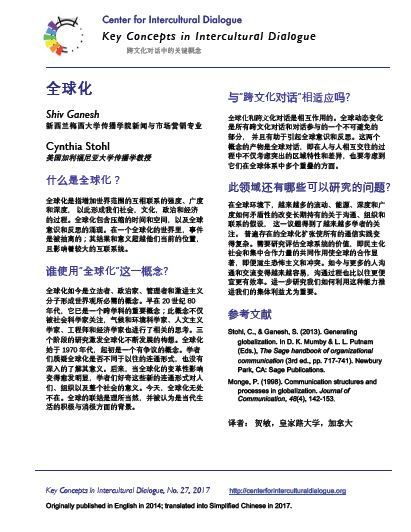
Key Concept #27: Globalization Translated into Chinese

Key Concepts in ICDContinuing translations of Key Concepts in Intercultural Dialogue, today I am posting KC#27: Globalization, first published in English in 2014, which Min He has now translated into Simplified Chinese.

As always, all Key Concepts are available as free PDFs; just click on the thumbnail to download. Lists of Key Concepts organized chronologically by publication date and number, alphabetically by concept, and by languages into which they have been translated, are available, as is a page of acknowledgments with the names of all authors, translators, and reviewers.

KC27 Globalization_Chinese-simGanesh, S., & Stohl, C. (2017). Globalization [Simplified Chinese]. (M. He, Trans). Key Concepts in Intercultural Dialogue, 27. Available from:
https://centerforinterculturaldialogue.org/wp-content/uploads/2017/03/kc27-globalization_chinese-sim.pdf

If you are interested in translating one of the Key Concepts, please contact me for approval first because dozens are currently in process. As always, if there is a concept you think should be written up as one of the Key Concepts, whether in English or any other language, propose it. If you are new to CID, please provide a brief resume. This opportunity is open to masters students and above, on the assumption that some familiarity with academic conventions generally, and discussion of intercultural dialogue specifically, are useful.

Wendy Leeds-Hurwitz, Director
Center for Intercultural Dialogue


Creative Commons License
This work is licensed under a Creative Commons Attribution-NonCommercial-NoDerivatives 4.0 International License.

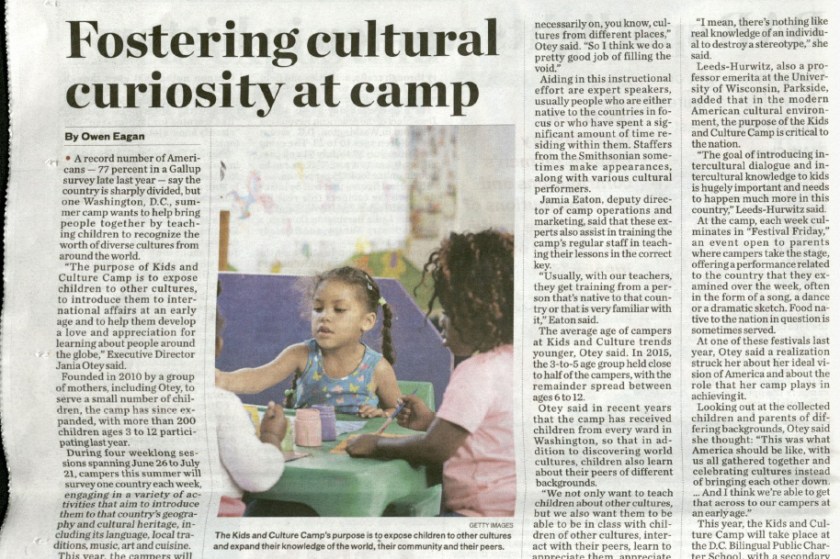
Kids and Culture Camp

Fostering Cultural Diversity at CampEagan, O. (28 February 2017). Fostering cultural curiosity at camp. The Hill.

“there’s nothing like real knowledge of an individual
to destroy a stereotype”

Owen Eagan, who as writing a story for The Hill, a Washington, D.C. newspaper, contacted me a few weeks ago, to ask about intercultural dialogue. While I have no specific knowledge of or experience with the camp he was writing about, I did agree to make a few generalizations about intercultural dialogue, some of which are quoted in the attached article.

Wendy Leeds-Hurwitz, Director
Center for Intercultural Dialogue

Save

Save

Save

Save

CFP EDEN: Diversity Matters (Sweden)

DIVERSITY MATTERS
26th European Distance and E-learning Network (EDEN) annual conference
13-16 June, 2017 in JÖNKÖPING, SWEDEN

Call for contributions:

The responsibility of the scholarly community includes the proper handling of diversity in education with respect to learners’ profiles, backgrounds, generations, cultures with different languages, literacies, and ways of communication as well as diversity in media and technology enhanced learning environments.

We need renowned reflections of practice that support paradigm-changing transformations based on systematic knowledge.

Join the Conference in Jönköping to tell about your research, projects and experience connected to diversity challenges.

Due to numerous extension requests received, the online submission will remain open until further notice. Submissions that relate to the Conference Scope and one or more of the Conference Themes are still welcome in paper, poster, workshop, training, demonstration and synergy formats.


Survey: New Media in Intercultural Communication Courses

Use of New Media in Intercultural Communication Courses – Call for Survey Participants

Sachiyo Shearman and Mariko Eguchi are conducting an online survey about the use of new media in intercultural communication courses among those who teach Intercultural Communication, Cross-cultural Communication, or the courses with another title which deals with Culture and Communication.  If you currently teach intercultural communication courses or if you have taught intercultural  communication courses in the past, please consider participating in this survey.

This survey takes no more than 10 minutes to complete.  The first page provides the informed consent form of the study with more details.

If you are interested in getting the summary of this survey, please contact Sachiyo Shearman via email.

Feel free to share this link with instructors who teach intercultural communication, or other related courses.

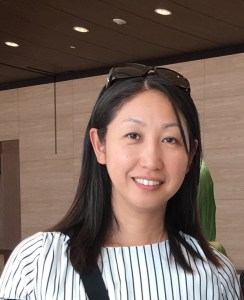
Sachiyo M. Shearman Profile

ProfilesSachiyo M. Shearman (Ph. D., Michigan State University) is an associate professor in the School of Communication at East Carolina University.

Sachiyo M. Shearman

She teaches courses such as Cross-Cultural Communication, Conflict and Communication, and Research Methods both at the undergraduate and the graduate level.  Her research interests include cross-cultural comparative studies in communication styles and preferences, individual differences (such as dogmatism) and cognitive information processing in conflict resolution and intercultural communication in various contexts such as work and family.  Her research has been published in journals such as Communication Quarterly, Communication Research Reports, Human Communication Research, Journal of Intercultural Communication Research, Journal of Family Communication, The International Journal of Human Resources Management, and Asian Journal of Social Psychology.

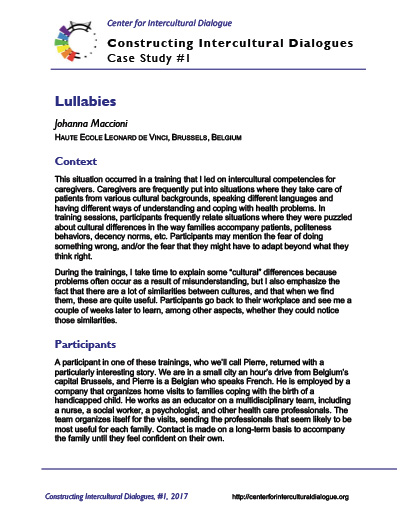
Constructing Intercultural Dialogues #1: Lullabies

Constructing ICDFollowing the recent announcement of a new series to be published by the Center for Intercultural Dialogue, the first issue of Constructing intercultural Dialogues is now available. Here is “Lullabies” by Johanna Maccioni.

As a reminder, the goal of this series is to provide concrete examples of how actual people have managed to organize and hold intercultural dialogues, so that others may be inspired to do the same. As with Key Concepts in Intercultural Dialogue, these may be downloaded for free. Click on the thumbnail to download the PDF.

Constructing ICD #1Maccioni, J. (2017). Lullabies. Constructing Intercultural Dialogues, 1. Available from: https://centerforinterculturaldialogue.org/wp-content/uploads/2017/03/constructing-icd-1.pdf

If you have a case study you would like to share, send an email to the series editor, Wendy Leeds-Hurwitz.


Creative Commons License
This work is licensed under a Creative Commons Attribution-NonCommercial-NoDerivatives 4.0 International License.

U Reading Postdoc: Family Language Policy (UK)

The Institute of Education at the University of Reading is seeking to appoint a motivated postdoctoral research fellow (full time, 27 months fixed term) to work on an ESRC-funded project jointly developed by University of Reading, UCL and Birkbeck. The project is entitled: Family Language Policy: A Multi-level Investigation of Multilingual Practices in Transnational Families. The project aims to explore what types of Family Language Policy (FLP) exist in the UK at the national level, how FLP is shaped, established, and implemented at the community level, and what language practices are negotiated at the family level.

The successful applicant will be involved in designing a national survey and conducting multi-level family language policy-related sub-projects within the Chinese communities and with different types of families. The applicant will be expected to manage the day-to-day project objectives, under the supervision of Dr Curdt-Christiansen, Professor Li Wei and Professor Zhu Hua.

Closing Date : 29/03/2017

U Leeds Job Ads: Language Education (UK)

Chair in Language Education
Lecturer in Language Education (two posts)
University of Leeds, UK

The University of Leeds is seeking to appoint a Chair and two Lecturers in Language Education, to join the Language Education Academic Group in the School of Education.

The deadline for applications for all posts is 27 March 2017. Interviews will be held in late April 2017. For further information about these posts, and the application process, please follow the links below:

Post 1 (ref ESLED1034): from 1 September 2017 or as soon as possible thereafter. University Grade 10.

Posts 2 and 3 (ref ESLED1032): from 1 September 2017. University Grade 8.