Short Course on Ethnography, Language & Communication (UK)

Key concepts and methods in ethnography, language & communication
11-15 September 2017, London

Is ‘qualitative data analysis’ too vague for you? Are you wondering how to do justice to your data?

If you are researching social processes, institutions, culture or identity, but are unsure about how to analyse the discourse data from your fieldwork, then consider joining this five day research training course.

The programme is designed to help PhD and post-doctoral researchers to navigate the twin perils of over- and under-interpreting discourse data. It introduces a range of key perspectives and tools used to study language and communication ethnographically and it facilitates the study of social practice in a wide range of different settings – education, workplace, recreation, health etc. Initiated with ESRC funding in 2007 and now based in the King’s ESRC Interdisciplinary Social Science Doctoral Training Centre, this will be our 9th ELC five-day course.

The course will be held at King’s College London from Monday to Friday, and it is taught by an international team from several leading research institutions: Prof Ben Rampton (Director), Dr Jeff Bezemer, Prof Jan Blommaert, Dr Adam Lefstein, Dr Julia Snell.

The deadline for applications is 1 May 2017. Spaces are limited, so candidates are advised to apply as soon as possible. Some funding will be available for bursaries.

CFP Multivoicedness in European Cinema (Ireland)

Multivoicedness in European Cinema: Representation, Industry, Politics
ECREA Film Studies Section Conference
10th and 11th November, 2017
University College Cork, Ireland

European cinema has evolved from a homogenous and selective object of study, mostly shaped by frameworks of national industry, identity and culture, to a much more diversified field, reflecting the shift to a post-colonial, post-communist, post-national, globalised Europe. In the context of an increasingly diverse but also split society, in which social polarisation is on the increase due to the crisis of the Eurozone and the decline of the welfare states, and in which popularism and nationalisms are on the rise, resulting in the strengthening of the Fortress Europe project, this conference aims to turn the spotlight on the less-represented and less-audible voices in European cinema in all its forms: fiction, documentary, mainstream, art house, independent, exploitation, art film. With an inclusive focus encompassing issues of production, distribution and reception, of representation and of form, of dissent and of control, the conference invites contributions that engage from a wide range of theoretical perspectives and methodological approaches with the politics of difference and with the representation and/or expression of alternative viewpoints in European films / in films made in Europe.

Abstracts are invited on topics related to Multivoicedness in European Cinema, including but not limited to:

  • Multivoicedness in national and transnational European cinemas
  • Peripheries, borders, and grey areas: falling between the cracks, speaking from the margins
  • Ethics and/or aesthetics of alternative voices
  • Audiodescription, subtitling and dubbing of multivoiced films
  • Cultural and market negotiations: translating cultures, crossing borders
  • Participation, dissent, resistance: audiences, politics, and public discourse
  • Alternative European cinemas and the global market
  • Other voices: niche markets, new forms of consumption
  • Deterritorialising identities, becoming migrant/minoritarian
  • Polyglot cinema: speaking from multiple subject positions
  • Genders and genres: decentering and in-betweennes
  • Alternative film festivals and other cinemas
  • Speaking in tongues: the audiences of multivoiced films
  • Queering European cinema
  • Nonfiction and commitment: documenting the silenced subject
  • Speaking for oneself: multiple forms of first-person filmmaking
  • Transnational, cosmopolitan, global: what European cinema
  • A continent in motion: multiple commitments, divided belonging
  • The New Europeans in films / making films
  • Margins of industrial practices, alternative forms of production, distribution and reception
  • Speaking parts: person, character, actor, star

Submission deadline: May 2nd 2017.

Intercultural Challenges of the Deaf HIV/AIDS Epidemic

Guest PostsIntercultural Challenges of the Deaf HIV/AIDS Epidemic. Guest Post by Leila Monaghan.

I grew up in New York and worked in the theatre industry in the 1980s. The profound impact of the AIDS epidemic was clear. Death was everywhere. When I returned to school to study Deaf culture I learned of the impact of AIDS on the Deaf community. One of my fellow students at the Gallaudet 1988 summer program was Gene Bourquin, part of the early Gay Men’s Health Crisis buddy network providing support for people with AIDS across New York City. From him I learned how the city’s flourishing gay Deaf community had been massively impacted. He shared the story of an isolated Deaf man in the Bronx he had worked with, his first buddy and one of the earliest to die.

Continue reading “Intercultural Challenges of the Deaf HIV/AIDS Epidemic”

Global Campus of Human Rights Contest: Memory & Reconciliation

Photo ContestThe Global Campus of Human Rights has launched the third edition of the GC Visual Contest, open to photographers and video-makers, professionals and amateurs, from any part of the world. The goal of the contest is to create synergies between academia, Human Rights defenders and artists to reach a wider international public and foster a better understanding of the issues concerning human rights and their protection.

THE THEME
The visual contest will be open from 1st May and will accept submissions through June 30, 2017. The theme for 2017 is “Memory and Reconciliation”. Memory and how do we envision the past has a potent impact on the creation of the present and future of a country and the current understanding of human rights concerns.
The GC Visual Contest originates from the belief that photography and videos are powerful tools that can raise awareness and push for social change. Furthermore, the purpose of this contest is to create a network of artists, intellectuals and professionals interested in strengthening the protection of human rights and the promotion of democracy and peace.

A collective memory manifests itself in decisions regarding the commemoration of dates, trials of former oppressors, establishment of sites and museums of memory, artworks and memorials and its role in the public education. This photo and video competition seeks to promote reflection on the various collective rememberings and experiences of the past and to which extent it is possible to establish conditions for crime recognition and forgiveness.

DETAILS
The competition will have two category levels, for professional artists and amateurs to which students and Alumni from the Global Campus are particularly encouraged to apply. A number of images and videos will be selected to be displayed on a dedicated online gallery and in connection to GC events/activities ensuring international exposure also thanks to different partners and social media channels. Winners will be determined by an international jury composed of leading experts in the field of photography and documentary filmmaking and of members of the GC network.

The best pictures and short videos could receive special mentions by the partners of the contest and will be presented at the events of the Regional Masters of the Global Campus in Africa, Asia-Pacific, Caucasus, Latin America and the Caribbean, Middle East and North Africa, South East Europe.

This initiative is funded by the European Union and receives the patronage of the United Nations Regional Information centre for Western Europe (UNRIC). The Global Campus of Human Rights is a unique network of one hundred participating universities around the world, seeking to advance human rights and democracy through regional and global cooperation for education and research. 

Leila Monaghan Profile

Profiles

Leila Monaghan (Ph.D., UCLA) teaches linguistic and cultural anthropology at Northern Arizona University. Leila Monaghan

Her research interests are broad and include the history of Deaf communities, the impact of HIV/AIDS, the narrative construction of disability, and the role of Native women in the Plains Indian Wars. Co-edited books include Many Ways to be Deaf, and Barriers and Belonging: Personal Narratives of Disability. She is also editor of the new journal Language, Culture and History.

Selected publications:

Jarman, M., Monaghan, L., & Harkin, A. Q. (Eds.). (2017). Barriers and belonging: Personal narratives of disability. Philadelphia: Temple University Press.

Monaghan, L. (2012) Perspectives on intercultural communication and discourse. In C.B. Paulston, S. Kiesling & E. Rangel (Eds.), Handbook of intercultural discourse and communication (pp. 19-36). Malden, MA: Wiley-Blackwell.

Monaghan, L. F., Schmaling, C., Nakamura, K., & Turner, G. H. (Eds.). (2003). Many ways to be deaf: International variation in Deaf communities. Washington, DC: Gallaudet University Press.

Monaghan, L., Goodman, J., & Robinson, J.M. (Eds.). (2012). A cultural approach to interpersonal communication: Essential readings. Malden, MA: Wiley/Blackwell.

Senghas, R.J., &  Monaghan, L. (2002) Signs of their times: Deaf communities and the culture of language. Annual Review of Anthropology, 31(1), 69-97.


Work for CID:

Leila Monaghan wrote KC11: Intercultural Discourse and Communication, and Constructing Intercultural Dialogues #5: Intercultural Dialogue and Deaf HIV/AIDS, as well as a guest post on Intercultural Challenges of the Deaf HIV/AIDS Epidemic.


NOTE: Leila Monaghan passed away in February 2022. She was one of the first to mention the Istanbul conference on intercultural dialogue in 2009 in print, a delight to correspond with, and she will be sorely missed.
– Wendy Leeds-Hurwitz

Canterbury Christ Church University PHD Scholarships (New Zealand)

Canterbury Christ Church University (New Zealand) welcomes applicants for full-time PhD scholarships (a stipend of £13,000 p.a. and tuition fee waiver for three years). Applications are invited across a range of subjects and themes.

Among the topics that seem likely to attract interest to those following the Center for Intercultural Dialogue may be these (follow the link above for their complete list):

Education: Language and Intercultural Education; Equality, Inclusion and Social Justice; Pedagogy and Identity

Arts and Humanities: Applied Linguistics; Film Studies; Media and Cultural Studies

Social and Applied Sciences: Politics and International Relations; Sociology; Tourism Studies

Closing date: 18th April 2017. Registration date: 1st October 2017.

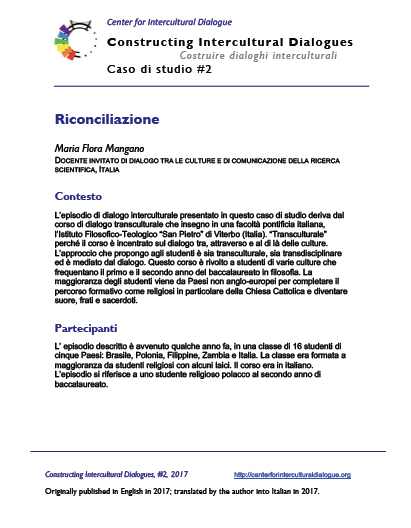
Constructing Intercultural Dialogues #2: Reconciliation Translated into Italian

Constructing ICD #7The first translation of one of the new Constructing intercultural Dialogues case studies is now available. CICD #2: Reconciliation, by Maria Flora Mangano, was published in English earlier this year, and she has now translated it into Italian. As with the continuing CID series, Key Concepts in Intercultural Dialogue, these may be downloaded for free. Click on the thumbnail to download the PDF.

A list of all case studies in this series, organized chronologically by publication date and number, is available, as is a page of acknowledgments with the names of all authors, translators, and reviewers.

CICD 2_ItalianMangano, M. F. (2017). Riconciliazione. Constructing Intercultural Dialogues, 2. Available from: https://centerforinterculturaldialogue.org/wp-content/uploads/2017/04/constructing-icd-2_it.pdf

If you have a case study you would like to share, or if you would like to translate one, send an email to the series editor, Wendy Leeds-Hurwitz.


Creative Commons License
This work is licensed under a Creative Commons Attribution-NonCommercial-NoDerivatives 4.0 International License.

Save

U Cambridge Job Ad: Centre for Educational Dialogue Research (UK)

Research Associate (Full-time, fixed-term) or Senior Research Associate (Part-time, fixed-term)
University of Cambridge

We wish to appoint a full-time Research Associate or a part-time (0.7 FTE) Senior Research Associate to support and develop the research of the Centre for Educational Dialogue Research (CEDiR) at the Faculty of Education in central Cambridge.

The appointed researcher will work closely with Professor Rupert Wegerif to develop the research base of dialogic education at Cambridge, with particular interests in dialogic education with technology, global dialogue for peace, and classroom dialogue. A key part of the work will be pro-actively seeking funding and bid writing. In addition there will be writing articles for high impact journals and practitioner journals, and working to organise research events and animate a research community which is both local and international. You will help to develop and seek funding for projects assessing group thinking. You will also develop and seek funding for projects using the internet to promote and sustain international dialogue.

Applicants must hold a PhD in a relevant subject, and have relevant qualitative and quantitative research training and experience. You should have a good understanding of dialogic education and some experience of related research. You should also demonstrate evidence of contributing to the development of bids and of writing for publication. For appointment as a Senior Research Associate you will have substantial experience as a Research Associate, along with proven ability to manage research groups and projects, and evidence of successful bids for research funding.

Fixed-term: The funds for this post are available for 3 years in the first instance.


University College London Job Ad: Applied Linguistics

Research Assistant (2 years) – Ref:1640327 ESRC-funded Family Language Policy project – Somali community in London
UCL Institute of Education, University College London

Duties and Responsibilities:
You will be a member of the UCL Centre for Applied Linguistics, which is located in the UCL Institute of Education. The UCL Centre for Applied Linguistics is a centre of international excellence in research and teaching in bilingualism and multilingualism, second language acquisition and assessment, discourse analysis, sociolinguistics, language-in-education policy and practice, English language teaching and teacher development, corpus linguistics, and intercultural communication.

The successful applicant will be involved in conducting family-based linguistic ethnography within the Somali community in London with different types of families. The post-holder will be expected to manage the day-today project objectives, under the supervision of Professor Li Wei, and to work in collaboration with the other project team members based in Reading University and Birkbeck College, University of London.

The post is available and funded from 01 September 2017 until 31 August 2019.

Key Requirements:
Candidates should have postgraduate qualifications in applied linguistics, with extensive knowledge of the Somali community in the UK and extensive knowledge of linguistic ethnography. Good knowledge of standard statistical analysis and demonstrable skills in verbal and written communication are expected.

Closing Date: 7 May 2017, latest time for the submission of applications: 23:59
Interview date:  TBC