Sachiyo M. Shearman Profile

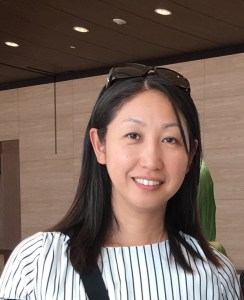
ProfilesSachiyo M. Shearman (Ph. D., Michigan State University) is an associate professor in the School of Communication at East Carolina University.

Sachiyo M. Shearman

She teaches courses such as Cross-Cultural Communication, Conflict and Communication, and Research Methods both at the undergraduate and the graduate level.  Her research interests include cross-cultural comparative studies in communication styles and preferences, individual differences (such as dogmatism) and cognitive information processing in conflict resolution and intercultural communication in various contexts such as work and family.  Her research has been published in journals such as Communication Quarterly, Communication Research Reports, Human Communication Research, Journal of Intercultural Communication Research, Journal of Family Communication, The International Journal of Human Resources Management, and Asian Journal of Social Psychology.

Constructing Intercultural Dialogues #1: Lullabies

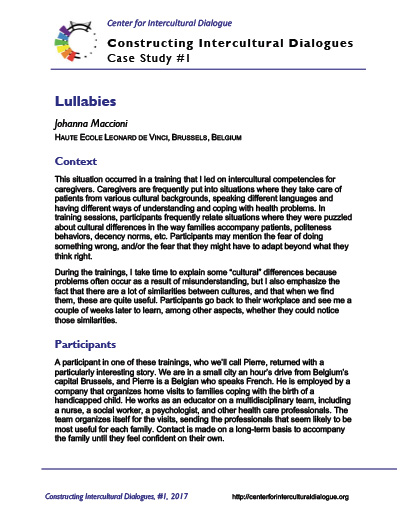
Constructing ICDFollowing the recent announcement of a new series to be published by the Center for Intercultural Dialogue, the first issue of Constructing intercultural Dialogues is now available. Here is “Lullabies” by Johanna Maccioni.

As a reminder, the goal of this series is to provide concrete examples of how actual people have managed to organize and hold intercultural dialogues, so that others may be inspired to do the same. As with Key Concepts in Intercultural Dialogue, these may be downloaded for free. Click on the thumbnail to download the PDF.

Constructing ICD #1Maccioni, J. (2017). Lullabies. Constructing Intercultural Dialogues, 1. Available from: https://centerforinterculturaldialogue.org/wp-content/uploads/2017/03/constructing-icd-1.pdf

If you have a case study you would like to share, send an email to the series editor, Wendy Leeds-Hurwitz.


Creative Commons License
This work is licensed under a Creative Commons Attribution-NonCommercial-NoDerivatives 4.0 International License.

U Reading Postdoc: Family Language Policy (UK)

The Institute of Education at the University of Reading is seeking to appoint a motivated postdoctoral research fellow (full time, 27 months fixed term) to work on an ESRC-funded project jointly developed by University of Reading, UCL and Birkbeck. The project is entitled: Family Language Policy: A Multi-level Investigation of Multilingual Practices in Transnational Families. The project aims to explore what types of Family Language Policy (FLP) exist in the UK at the national level, how FLP is shaped, established, and implemented at the community level, and what language practices are negotiated at the family level.

The successful applicant will be involved in designing a national survey and conducting multi-level family language policy-related sub-projects within the Chinese communities and with different types of families. The applicant will be expected to manage the day-to-day project objectives, under the supervision of Dr Curdt-Christiansen, Professor Li Wei and Professor Zhu Hua.

Closing Date : 29/03/2017

U Leeds Job Ads: Language Education (UK)

Chair in Language Education
Lecturer in Language Education (two posts)
University of Leeds, UK

The University of Leeds is seeking to appoint a Chair and two Lecturers in Language Education, to join the Language Education Academic Group in the School of Education.

The deadline for applications for all posts is 27 March 2017. Interviews will be held in late April 2017. For further information about these posts, and the application process, please follow the links below:

Post 1 (ref ESLED1034): from 1 September 2017 or as soon as possible thereafter. University Grade 10.

Posts 2 and 3 (ref ESLED1032): from 1 September 2017. University Grade 8.


New Journal: UnMediated: Politics & Communication

UnMediated: Journal of Politics and Communication is pleased to announce an open call for submissions for its inaugural issue, to appear in print and online in early summer 2017. Abstracts and subsequent essays should be theoretically substantial but accessible, with a view to engaging a broad spectrum of readership. Submissions are sought in particular from those in communication and media studies, political science, information and computer sciences, and visual and performing arts; additionally, submissions are welcome both from independent researchers and those with a current institutional affiliation.

THEME

Whether through written word or visual narrative, submissions to the inaugural issue of UnMediated should explore the notion of communication on the margins. This thematic necessarily rests on the belief that changes in the social and material environment at once influence and are influenced by divergent communications practices. From the mediation of mass migration to the challenges of data-driven infrastructure development, this issue will examine how practices of communication intersect with and augment the structural dimensions of daily political life among marginalized people, locales, and movements. Possible topics might include, but are by no means limited to:

  • The journalistic gaze: intellectual copyright and (self)representation of marginalized peoples
  • Tomorrow’s harvest: digital exclusion and the age of data-driven infrastructure and design
  • Abstention, refusal, and the (im)permanence of digital memory
  • Visualization, interactivity, and the aestheticization of political literacy
  • Political consequences of crowdfunding, upvoting, and the will of the majority

Submission deadline for pitches and abstracts: March 15, 2017

U Bristol Job Ad: Applied Linguistics & TESOL

Lecturer in Education (TESOL/Applied Linguistics)
University of Bristol, UK

The Graduate School of Education is seeking to appoint an outstanding individual to make a significant contribution to the School’s long established Teaching English to Speakers of Other Languages (TESOL) / Applied Linguistics provision. The successful individual will contribute to our successful Masters programmes, doctoral supervision, and to extending the School’s research profile in this area. This is a full academic role, and the post-holder’s contribution will span scholarship, teaching, research and administration. Candidates will be at the forefront of their field, and will be expected to play a significant role in the delivery of the School’s research strategy.

The successful candidate will be a thoughtful, dynamic, creative and ambitious self-starter, keen to develop their research and teaching in a supportive and high-performing environment. You will be an experienced doctoral supervisor, and have experience of supervising doctoral candidates through to completion. We welcome applicants who have interests that complement our existing research strengths. Candidates who can clearly articulate how their research and teaching interrelate are of particular interest to us, as are those who bring methodological insights. This is a key appointment and represents a fantastic opportunity to contribute to the development of an established area of academic endeavour for the School.

The closing date for applications is 26 March 2017.

CFP ECREA Doctoral Summer School 2017 (Italy)

The European Media and Communication Doctoral Summer School

… brings together members of the European research community to this summer school in order to debate contemporary issues in media, communication and cultural studies. The summer school aims to provide a supportive international setting where doctoral students can present their ongoing work, receive feedback on their PhD-projects from international experts and meet students and academics from other countries, establishing valuable contacts for the future. The 2017 Summer School will take place at Università Cattolica del Sacro Cuore, Milan, Italy from July 24 to August 4, 2017. The application phase for the European Media and Communication Doctoral Summer School 2017 is now open. The deadline for submitting the application is April 1, 2017.

Peace Profile of Sebastiano D’Ambra

Guest PostsPeace Profile: Sebastiano D’Ambra
Guest post by Belinda F. Espiritu

A Peace Profile is a short biography about an individual peace activist or an organization dedicated to working for peace. It describes the individual or organization, what actions they have taken in working for peace, and what contributions or achievements they have made to foster peace in a particular peace issue or area of conflict.

Multiple peace profiles have been published in Peace Review: A Journal of Social Justice in recent years. Among the peace activists described have been the following notable persons: Arundhati Roy, Aung San Suu Kyi, Dorothy Day, Gush Shalom, Gustavo Gutierrez, Herbert Jose de Souza, Jayanti Kirplani, Jeanette Renkin, Martin Buber, Muhammad Ali, Nelson Mandela, David Dellinger, Jayaprakash Narayan, Larry Hartfield, Le Xun, Stephen Biko, Salvador Allende, Federation of African Women’s Peace Networks, Afghan Peace Volunteers, Christiana Thorpe, and many more.

Continue reading “Peace Profile of Sebastiano D’Ambra”

CFP Art in Diverse Settings

CALL FOR SUBMISSIONS

We are delighted to invite chapter contributions for the forthcoming book Art in diverse settings. We have signed a contract with the global academic publisher Sense and we expect to repeat the successful experience with the publication of our former book Art and intercultural dialogue (Sense, 2016). We plan to publish the manuscript one year from now.

We have secured twelve chapters, which is a very good start, but there is room for more chapters (as we do not discard the possibility of a two volume publication) so we are still in the process of gathering new authors. Our aim is to guarantee the global scope, diversity of views, quality and relevance. You may find below the provisory table of contents (to review in accordance with chapter titles).

We invite submissions for an edited volume concerning the role of art in diverse social settings. Contributions range from theoretical to methodological approaches, thus the chapters in the book can be seen as exemplary case studies, describing concrete intervention projects which use some form of art (photography, literature, poetry, music, drama, film, illustration, graffiti,…) or composed artistic expression (such as pop-art, street art, video-art…) as medium for communication in the contexts of social and professional organizations, public spaces or the community in general. The collection is intended to include a wide range of theoretical and methodological approaches highlighting a variety of conceptual, contextual and cultural issues. Please find below a list of relevant chapters/ themes for the volume.

Should you be interested please send your biographical note (of aprox. 200 words), the title of your chapter and an abstract of 300 words to both Susana Gonçalves and Suzanne Majhanovich. Full papers (of aprox. 5000 words, including notes and references) will be due August 30th, 2017.

Art in diverse settings (Sense, expected 2018), edited by Susana Gonçalves and Suzanne Majhanovich

Provisory Table of Contents

Introduction
Art and society

  1. Art in civil society
  2. Art and politics
  3. Art and technologies
  4. Art, culture and worldviews
  5. Art and ethics
  6. Art and active citizenship
  7. Art and remembrance

Art and identities

  1. Art, minorities and refugees
  2. Art and gender
  3. Art and ageing
  4. Art and madness
  5. Art and childhood

Art in specific social settings

  1. Art in schools
  2. Art in sports
  3. Art in hospitals
  4. Art in prisons
  5. Art education in the museum
  6. Arts and Media in Citizenship Education
  7. Art and business/ advertisement
  8. Art in the public space (urban art)
  9. Street Art, youth and Community Education
  10. Art and youth: HIP HOP
  11. Art programmes for social integration: juvenile offenders and photography
  12. Art and Design to improve Life Education
  13. Art and incremental housing in the slums

Art & Intercultural Dialogue

“Book NotesGonçalves, S., & Majhanovich, S. (Eds.). (2016). Art and intercultural dialogue. Rotterdam: Sense Publishers.

How can art act as an intercultural mediator for dialogue? In order to scrutinize this question, relevant theoretical ideas are discussed and artistic intervention projects examined so as to highlight its cultural, political, economic, social, and transformational impacts. This thought-provoking work reveals why art is needed to help multicultural neighbourhoods and societies be sustainable, as well as united by diversity. This edited collection underlines the significance of arts and media as a tool of understanding, mediation, and communication across and beyond cultures. The chapters with a variety of conceptual and methodological approaches from particular contexts demonstrate the complexity in the dynamics of (inter)cultural communication, culture, identity, arts, and media. Overall, the collection encourages readers to consider themselves as agents of the communication process promoting dialogue.

Contents and Preface