Constructing Intercultural Dialogues #5: Intercultural Dialogue and Deaf HIV/AIDS

Constructing ICD

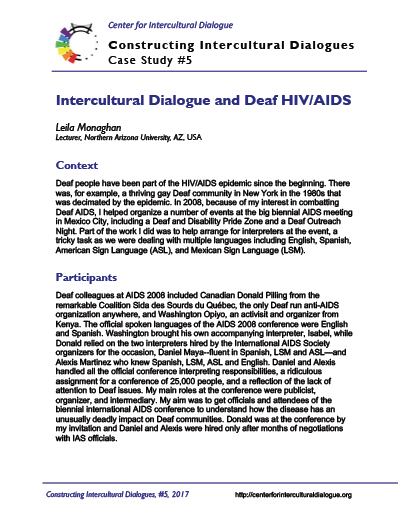
The fifth issue of Constructing intercultural Dialogues is now available, “Intercultural Dialogue and Deaf HIV/AIDS,” by Leila Monaghan.

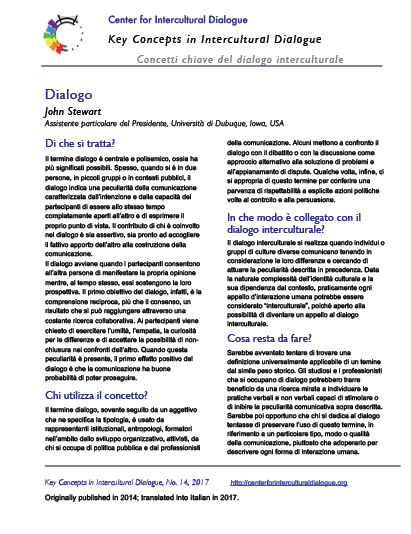
As a reminder, the goal of this series is to provide concrete examples of how actual people have managed to organize and hold intercultural dialogues, so that others may be inspired to do the same. As with Key Concepts in Intercultural Dialogue, these may be downloaded for free. Click on the thumbnail to download the PDF.
CICD 5 MonaghanMonaghan, L. (2017). Intercultural dialogue and Deaf HIV/AIDS. Constructing Intercultural Dialogues, 5. Available from: https://centerforinterculturaldialogue.org/wp-content/uploads/2017/04/constructing-icd-5.pdf

If you have a case study you would like to share, send an email to the series editor, Wendy Leeds-Hurwitz.


Creative Commons License
This work is licensed under a Creative Commons Attribution-NonCommercial-NoDerivatives 4.0 International License.

Zhejiang U Job Ad: International Studies (China)

Senior Lecturer/Associate Professor/Professor in International Studies
Zhejiang University, China – College of Humanities and Social Science
Deadline: June 13, 2017

The School of International Studies specialises in research fields and specialisations for the following areas: Second Language Acquisition, Pragmatics, Language Testing, Studies of Chinese as a Second Language, British & American Literature, Medieval English, Renaissance Literature, Theoretical Linguistics, Intercultural Communication, French Language and Literature, German Language and Literature, Japanese Language and Literature, Russian Language and Literature.

The newly launched “One-hundred Talents Program” is aimed at attracting outstanding scholars both at home and abroad. To those recruited via this program, the university is to adopt an international academic standard and procedure – the tenure track system. The university plans to recruit roughly 50 distinguished scholars from both China and abroad by the “One-hundred Talents Program”. Ample funds are available for this program to ensure that scholars have a favourable academic environment and optimum working and living conditions so that they can be dedicated to academic research and the advancement of their fields.

Responsibilities:

  1. He/She who holds this position should engage in high-quality teaching.
  2. Zhejiang University “Hundred Talents Program”(Humanities and Social Science) includes “Type A” and “Type B”.
    Type A: The applicant should be engaged in a high-level research, participate in the planning, developing and implementation of academic discipline(s), facilitate international academic communication and research cooperation, promote international reputation, gradually form a leading and competitive role in the academic discipline.
    Type B: The applicant should be engaged in a high-level research and establish a research orientation, facilitate international academic communication and research cooperation and become an active and influential scholar in the field.

Aarhus U Job Ad: International Business Comm/Health Comm (Denmark)

Associate Professor (Lektor) in International Business Communication and Health Communication

University of Aarhus – School of Communication and Culture

Applications are invited for the position of associate professor (lektor) in international business communication and health communication, at the School of Communication and Culture, Aarhus University.

The appointment is tenured, and begins on 1 November 2017 or as soon as possible thereafter.

The place of employment is Jens Chr. Skous Vej, 8000 Aarhus C.

The position
The position is at the Department of English, which is part of the School of Communication and Culture, and involves research, teaching and supervision duties related to international business communication and health communication.

We are looking for a dedicated candidate who 1) has contributed to research in international business communication, especially domains such as health communication, translation studies and online communication; and 2) is qualified to teach core courses in international business communication, health communication, professional text production, translation, technical communication, and research and academic methodology at BA and MA levels, as well as elective seminars in subjects related to his or her area of research within the field of business communication including health communication and online communication.

A position as associate professor includes tasks and responsibilities in all of Aarhus University’s core activities in the areas of research, teaching, talent development and knowledge exchange. Participation in the daily life of the department is a high priority, and we emphasise the importance of good working relationships, both among colleagues and with our students.

Teaching in this position takes place in both Danish and English, so applicants must have native or near-native command of both Danish and English.

Research
The successful applicant is expected to pursue research in the fields of health communication and international business communication, and to publish within these fields.

Teaching
The position includes teaching at the BA and MA levels in English in national and international contexts, English-language proficiency and academic writing and methods, including obligatory courses in specialised communication and translation as well as health communication (the latter taught in Danish and English). Responsibilities also include teaching interdisciplinary courses for students at the Department of English and possibly at the School of Communication and Culture as a whole, including relevant courses in intercultural studies for which the Department of English is responsible.

Read the full job description and apply online here

Application deadline: 3/5/2017

U Nottingham China Job Ad: Applied Linguistics

Assistant Professor(Lecturer) in Applied Linguistics/ELT

The University of Nottingham Ningbo China (UNNC) was the first Sino-foreign university to open its doors in China. This award winning campus offering a UK style education has grown to establish a student body of over 7,000 in just 12 years.

The School of English at the University of Nottingham Ningbo China is a thriving, expanding and research-active school, established with the support of the School of English at the University of Nottingham, UK. This school provides two UG and PG degree programmes each since 2008 and offers our students the same degree certificates as those who study in the UK campus.

The successful candidate for the Assistant Professor in Applied Linguistics and English Language Teaching will be expected to deliver lectures and seminars in the areas of Applied Linguistics and English Language teaching. We are looking for someone specializing in at least two of the following areas: intercultural communication, pedagogy of teaching English to young learners, language acquisition and discourse analysis. The candidate is required to deliver teaching to all levels of the undergraduate and postgraduate programmes in the school. In addition, the candidate is expected to conduct research, obtain research funding, contribute to Research and Knowledge Exchange activities, supervise undergraduate, masters’ and doctoral students and undertake administrative duties.

Closing date: 24 April 2017

MOOC on Racism and Antisemitism

This just came to my attention. I’m publishing the notice in French because the course will be in French, so if you can’t read this, you probably can’t benefit from the course. 

Le racisme et l’antisémitisme

Un Mooc pour réfléchir à l’action antiraciste
offered by FMSH: fondation maison des sciences de l’homme

Le racisme et l’antisémitisme sont des notions sujettes à bien des interprétations, analyses et discours. Elles nous sont familières, mais les difficultés surgissent dès qu’il s’agit de les définir avec précision.

Ce Mooc propose d’abord un état des lieux, d’une part historique, et d’autre part consacré à l’actualité de ces phénomènes, avant de réfléchir à l’action antiraciste.

Dans quelle mesure le racisme et l’antisémitisme sont-ils indissociables des mutations de nos sociétés occidentales ? Comment les crises politiques et économiques, la fracture sociale et la fragmentation culturelle ou encore l’hypermédiatisation influencent-elles l’évolution de ces phénomènes ? Quel type d’actions peut-on entreprendre pour lutter ?

Original, ce Mooc repose en majorité sur des entretiens initiés et conduits par le sociologue Michel Wieviorka. Ces entretiens donnent de l’épaisseur, de la vitalité et un certain dynamisme à la réflexion sur ces questions très délicates. Dans ce cadre, les intervenants sont en position de préciser leur pensée à travers le dialogue et non pas seulement de délivrer un savoir. Le public a de son côté, la possibilité d’entrer dans leur réflexion et d’observer leur cheminement intellectuel.

Les plus grands spécialistes français et internationaux ont été sollicités pour discuter des expressions et des formes que peuvent prendre le racisme et l’antisémitisme, mais aussi pour parler des doctrines et théories qui en sont le socle. L’action antiraciste est également au cœur des questionnements de ce Mooc, son développement et son renforcement par la connaissance en sont un des objectifs principaux.

Format
Ce Mooc se construit en 5 semaines thématiques. Chaque semaine est composée de vidéos et d’un module complémentaire (infographies, images d’archives, extraits de films documentaires, documents sonores, graphiques etc.) qui permettra d’aller plus loin dans la réflexion. A la fin de chaque semaine, vous pourrez tester vos connaissances.

Prérequis
Ce Mooc ne nécessite aucun prérequis spécifique, il est adapté et ouvert à tout public désireux d’élargir ses questionnements et de renforcer ses connaissances sur le racisme et l’antisémitisme. Il vise néanmoins plus particulièrement à former des éducateurs exerçant au sein de l’enseignement supérieur et de recherche. Les référents « racisme et antisémitisme », récemment désignés dans les établissements d’enseignement supérieur et de recherche, et caractérisés par une grande variété de profils (enseignants-chercheurs, responsables de ressources humaines, responsables vie étudiante, directeur à la formation et à la pédagogie, etc.), sont également tout particulièrement concernés par cette formation.

Toute personne intéressée par la thématique pourra aussi y trouver des ressources et des informations pour enrichir ses connaissances.

Informations pratiques
Fin d’inscription : 22 avr 2017 | Début du Cours : 15 mar 2017 | Fin du cours : 23 avr 2017 | Effort estimé : 3 h/semaine | Langue : Français

Inscrivez-vous dès maintenant !

Ce Mooc a été réalisé par FMSH-Production et se trouve en ligne sur la plateforme Fun mooc


L’enseignant
Michel Wieviorka est connu à l’échelle internationale pour ses ouvrages sur la violence et le terrorisme, mais aussi sur le racisme et l’antisémitisme, dont certains sont traduits en plusieurs langues. Il a dirigé de vastes enquêtes ayant abouti notamment à ses livres sur La France raciste (éd. du Seuil, 1992), ou sur La tentation antisémite (éd. Robert Laffont, 2005), et il a publié aussi bien des ouvrages théoriques sur ces thèmes (notamment : L’espace du racisme, éd. du seuil, 1991) que des synthèses destinées à un plus vaste public (Le racisme, une introduction, La Découverte, L’antisémitisme expliqué aux jeunes, éd. du Seuil, 2014). Docteur d’Etat ès Lettres et Sciences Humaines, directeur d’études à l’Ecole des Hautes Etudes en Sciences Sociales, il est le Président du directoire de la Fondation Maison des Sciences de l’Homme (FMSH). Il a été directeur du Centre d’analyse et d’intervention sociologiques (CADIS, EHESS-CNRS) entre 1993 et 2009.

Les intervenants

  • Etienne Balibar : philosophe, professeur émérite de l’université Paris-Ouest-Nanterre-La-Défense, professeur associé à l’Université de Kingston (Londres) et Visiting Professor à l’université Columbia (New York).
  • Philippe Bataille : sociologue, directeur d’études à l’EHESS. Membre du Centre d’éthique clinique de l’hôpital Cochin.
  • Gwénaële Calvès : professeur de droit public à l’université de Cergy-Pontoise, spécialiste du droit français et européen de la non-discrimination.
  • Jean-Yves Camus : politologue, chercheur associé à l’IRIS, spécialiste des nationalismes et extrémismes en Europe. Directeur de l’Observatoire des Radicalités Politiques (ORAP), Fondation Jean Jaurès.
  • Teun Van Dijk : linguiste néerlandais, spécialiste de l’analyse critique du discours, professeur à l’Université Pompeu Fabra de Barcelone.
  • Pierre Haski : journaliste et chroniqueur international, Cofondateur de Rue89.
  • Joël Kotek : historien et politologue. Professeur à l’Université Libre de Bruxelles et chargé de cours à l’Institut d’Etudes Politiques de Paris.
  • Hervé Le Bras : directeur d’études à l’EHESS, directeur de recherches émérite à l’INED.
  • Nonna Mayer : directrice de recherche émérite au CNRS, rattachée au Centre d’études européennes de Sciences Po, membre de la Commission nationale consultative des droits de l’homme.
  • Edgar Morin : sociologue et philosophe, Directeur de recherche émérite au CNRS
  • Pap N’Diaye : professeur des universités à l’Institut d’études politiques de Paris (Histoire nord-américaine) et directeur du département d’histoire de Science Po Paris.
  • Gérard Noiriel : directeur d’études à l’EHESS. Il conduit des recherches sur la sociohistoire de l’État-nation et de l’immigration.
  • Odile Quintin : ancienne Directrice Générale de l’Emploi et des Affaires Sociales, et de l’Education, la Jeunesse et la Culture de la Commission Européenne. Professeur à ESCP Europe et Présidente du Cercle Erasmus.
  • Andrea Rea : sociologue, professeur à l’Université Libre de Bruxelles. Directeur du Groupe d’étude sur l’Ethnicité, le Racisme, les Migrations et l’Exclusion (le GERME).
  • Daniel Sabbagh : directeur de recherche à Sciences Po (CERI), co-animateur du groupe de recherche “Politiques antidiscirminatoires” et membre du comité de direction de l’Alliance de Recherche sur les Discriminations (ARDIS)
  • Jacques Sémelin : professeur à Sciences Po Paris et directeur de recherche au CNRS affecté au CERI.
  • Zeev Sternhell : historien et penseur politique israélien, titulaire de la chaire Léon-Blum de science politique à l’université hébraïque de Jérusalem.
  • Lilian Thuram : membre du Haut Conseil à l’intégration, fondateur de la Fondation Lilian Thuram-Éducation contre le racisme. Footballeur international français à la retraite.


CFP Contemporary Developments on Media, Culture and Society: Argentina and Latin America (Argentina)

Contemporary Developments on Media, Culture and Society: Argentina and Latin America

We invite submissions to the conference “Contemporary Developments on Media, Culture and Society: Argentina and Latin America.” The conference, organized by The Center for the Study of Media and Society in Argentina (MESO), will take place on Friday, November 03, 2017, at Universidad de San Andrés in Buenos Aires, Argentina.

This will be the third annual conference organized by MESO on the interactions between media, culture and society. This third annual conference is sponsored by the Center for Global Culture and Communication at Northwestern University.

Submissions should contribute to ongoing conversations about media, culture, and society in empirical, theoretical or methodological ways. They might also broaden our knowledge about the relationship between media, culture,and society at the national and regional level. Articles may refer to different aspects of communication, media, and cultural goods and services in the areas of journalism, entertainment -cinema, theater, television, music, etc. – advertising and marketing, public relations, social media, and video games, among others.

The deadline for submission is May 15, 2017. Abstracts should be sent by email to mediosysociedad@udesa.edu.ar . The subject of the mail should be “Last Name, Name – Medios y Sociedad 2017”. A selection committee will evaluate the abstracts and the results will be notified to the authors on July 1, 2017.

Short Course on Ethnography, Language & Communication (UK)

Key concepts and methods in ethnography, language & communication
11-15 September 2017, London

Is ‘qualitative data analysis’ too vague for you? Are you wondering how to do justice to your data?

If you are researching social processes, institutions, culture or identity, but are unsure about how to analyse the discourse data from your fieldwork, then consider joining this five day research training course.

The programme is designed to help PhD and post-doctoral researchers to navigate the twin perils of over- and under-interpreting discourse data. It introduces a range of key perspectives and tools used to study language and communication ethnographically and it facilitates the study of social practice in a wide range of different settings – education, workplace, recreation, health etc. Initiated with ESRC funding in 2007 and now based in the King’s ESRC Interdisciplinary Social Science Doctoral Training Centre, this will be our 9th ELC five-day course.

The course will be held at King’s College London from Monday to Friday, and it is taught by an international team from several leading research institutions: Prof Ben Rampton (Director), Dr Jeff Bezemer, Prof Jan Blommaert, Dr Adam Lefstein, Dr Julia Snell.

The deadline for applications is 1 May 2017. Spaces are limited, so candidates are advised to apply as soon as possible. Some funding will be available for bursaries.

CFP Multivoicedness in European Cinema (Ireland)

Multivoicedness in European Cinema: Representation, Industry, Politics
ECREA Film Studies Section Conference
10th and 11th November, 2017
University College Cork, Ireland

European cinema has evolved from a homogenous and selective object of study, mostly shaped by frameworks of national industry, identity and culture, to a much more diversified field, reflecting the shift to a post-colonial, post-communist, post-national, globalised Europe. In the context of an increasingly diverse but also split society, in which social polarisation is on the increase due to the crisis of the Eurozone and the decline of the welfare states, and in which popularism and nationalisms are on the rise, resulting in the strengthening of the Fortress Europe project, this conference aims to turn the spotlight on the less-represented and less-audible voices in European cinema in all its forms: fiction, documentary, mainstream, art house, independent, exploitation, art film. With an inclusive focus encompassing issues of production, distribution and reception, of representation and of form, of dissent and of control, the conference invites contributions that engage from a wide range of theoretical perspectives and methodological approaches with the politics of difference and with the representation and/or expression of alternative viewpoints in European films / in films made in Europe.

Abstracts are invited on topics related to Multivoicedness in European Cinema, including but not limited to:

  • Multivoicedness in national and transnational European cinemas
  • Peripheries, borders, and grey areas: falling between the cracks, speaking from the margins
  • Ethics and/or aesthetics of alternative voices
  • Audiodescription, subtitling and dubbing of multivoiced films
  • Cultural and market negotiations: translating cultures, crossing borders
  • Participation, dissent, resistance: audiences, politics, and public discourse
  • Alternative European cinemas and the global market
  • Other voices: niche markets, new forms of consumption
  • Deterritorialising identities, becoming migrant/minoritarian
  • Polyglot cinema: speaking from multiple subject positions
  • Genders and genres: decentering and in-betweennes
  • Alternative film festivals and other cinemas
  • Speaking in tongues: the audiences of multivoiced films
  • Queering European cinema
  • Nonfiction and commitment: documenting the silenced subject
  • Speaking for oneself: multiple forms of first-person filmmaking
  • Transnational, cosmopolitan, global: what European cinema
  • A continent in motion: multiple commitments, divided belonging
  • The New Europeans in films / making films
  • Margins of industrial practices, alternative forms of production, distribution and reception
  • Speaking parts: person, character, actor, star

Submission deadline: May 2nd 2017.

Intercultural Challenges of the Deaf HIV/AIDS Epidemic

Guest PostsIntercultural Challenges of the Deaf HIV/AIDS Epidemic. Guest Post by Leila Monaghan.

I grew up in New York and worked in the theatre industry in the 1980s. The profound impact of the AIDS epidemic was clear. Death was everywhere. When I returned to school to study Deaf culture I learned of the impact of AIDS on the Deaf community. One of my fellow students at the Gallaudet 1988 summer program was Gene Bourquin, part of the early Gay Men’s Health Crisis buddy network providing support for people with AIDS across New York City. From him I learned how the city’s flourishing gay Deaf community had been massively impacted. He shared the story of an isolated Deaf man in the Bronx he had worked with, his first buddy and one of the earliest to die.

Continue reading “Intercultural Challenges of the Deaf HIV/AIDS Epidemic”