CFP Language & Borders Conference (UK)

ConferencesLANGUAGE AND BORDERS: RETHINKING MOBILITY, MIGRATION AND SPACE, UNIVERSITY OF BRISTOL (UK) 26 MARCH – 27 MARCH 2018
Deadline for abstracts: 14 November 2017

The widespread movement of people and their linguistic repertoires has contributed to growing pressure on the model of the nation-state and related notions of linguistically and culturally homogeneous societies. Supposed homogeneity of communities is contingent on the notion of the border as a device of containment. However, in light of increased population movement, recent multidisciplinary approaches seek to capture the complex qualities of the border as both a locus of mobility (a line to be crossed – a bridge) and a site of enclosure (an untraversable barrier – a wall). So what are borders, how are they constructed and how do they impact our lived experience? Additionally, how can sociolinguistic and cognate research enhance our understanding of the interface between language and borders?

In this context, it has become increasingly urgent to reconsider how ‘migration’ is theoretically conceptualized, especially because ‘migration’ itself has become a salient object of contemporary discourse. This objectification and frequent vilification of migration potentially casts a shadow on the complex and diverse forms of (im)mobility that social actors experience, be it in relation to their own (im)mobility or that of others. Discussion of the roles of borders, mobility and migration in sociolinguistic research encourages us to reflect on the broader concept of space, and on its role in the formation and perpetuation of language ideologies. At this conference, we aim to address a number of questions, including:

– What constitutes a border for sociolinguistic researchers? What linguistic practices do borderlanders engage in?
– As sociolinguists, what can we learn from multidisciplinary approaches to border studies? What insights can be drawn from advances in geography, sociology, history, anthropology, politics and cultural studies?
– How do different sociolinguistic methodological frameworks (qualitative, quantitative, mixed) address borderland scenarios.

Confirmed Keynote Speakers: Brigitta Busch (University of Vienna), Carmen Llamas (University of York), Clare Mar-Molinero (University of Southampton).

This conference invites contributions from researchers in a range of disciplinary backgrounds, whose work focuses on the role of language in relation to borders, mobility, migration, and/or space. The conference has been generously supported by the British Academy’s ’Tackling the UK’s International Challenges’ initiative, as part of an ongoing project by Dr James Hawkey (Bristol) and Dr Kristine Horner (Sheffield).

Continue reading “CFP Language & Borders Conference (UK)”

María José Coperías-Aguilar Profile

ProfilesMaría José Coperías-Aguilar is a professor at the University of Valencia, where she teaches in the Department of English and German Philology.

MJ Coperías-Aguilar

She has a PhD in English Literature. Her main teaching areas are literature, cultural studies and English for specific purposes, especially for the media. She has participated in many international conferences and published widely on several fields of English studies both in books and journals. Her main areas of research are cultural studies, intercultural communicative competence, the media, and literature by women. She is a member, and the current Secretary, of the International Association for Languages and Intercultural Communication (IALIC).

Selected publications:

Coperías-Aguilar, M.J. & Gómez-Mompart, J.Ll. (2019). Hispanic cultural identity in US Spanish-Language newspapers. In R. A. Lind (Ed.), Race / gender / class / media: Considering diversity across audiences, content, and producers (pp. 109-114). New York, Routledge.

Coperías-Aguilar, M.J. (2019). Diversity and second language acquisition in the university classroom: A multilingual and multicultural setting. In A. Gras-Velázquez (Ed.), Project-based learning in second language acquisition: Building communities of practice in higher education (pp. 9-24). New York,  Routledge.

Coperías-Aguilar, M.J. (2015). Double intercultural dialogue in the Hispanic press in the United States: the case of New York newspapers. Language & Intercultural Communication, 15(3), 376-390.

Gómez-Mompart, J.L. & Coperías-Aguilar, M.J. (2014). Importancia de la prensa hispana. La victoria de Obama en los periódicos en español estadounidenses [The importance of the Hispanic press. The victory of Obama in newspapers in Spanish in the United States]. Comunicación y Sociedad / Communication and Society, 27(2), 101-124.

Coperías-Aguilar, M.J. (2010). Intercultural Communicative Competence as a Tool for Autonomous Learning. Revista de Estudios Canarios, 61, 87-98

Coperías-Aguilar, M.J. (2009). Intercultural Communicative Competence in the Context of the European Higher Education Area. Language & Intercultural Communication, 9(4), 242-255.

Coperías-Aguilar, M.J. (2007). Dealing with Intercultural Communicative Competence in the Foreign Language Classroom. In Alcón, E. & Safont, P. (eds.), Intercultural Language Use and Language Learning, Dordrecht, Springer, 59-78.

Coperías-Aguilar, M.J. (2002). Intercultural Communicative Competence: A Step beyond Communicative Competence. ELIA. Estudios de Lingüística Inglesa Aplicada, 3, 85-102.

Coperías-Aguilar, M.J. (1998). Intercultural (Mis)Communication. The Influence of L1 and C1 on L2 and C2: A Tentative Approach. Cuadernos de Filología Inglesa, 7(1), 99-113.


Work for CID:
María José Coperías-Aguilar wrote KC84: Double Intercultural Dialogue.

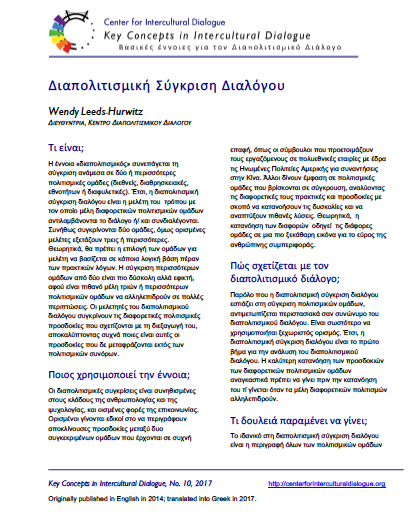
KC10 Cross-Cultural Dialogue Translated into Greek

Key Concepts in ICDContinuing translations of Key Concepts in Intercultural Dialogue, today I am posting KC#10: Cross-Cultural Dialogue, which I wrote for publication in English in 2014, and which Rania Spiridakou has now translated into Greek.

As always, all Key Concepts are available as free PDFs; just click on the thumbnail to download. Lists of Key Concepts organized chronologically by publication date and number, alphabetically by concept, and by languages into which they have been translated, are available, as is a page of acknowledgments with the names of all authors, translators, and reviewers.

KC10 Cross-cultural dialogue_GreekLeeds-Hurwitz, W. (2017). Cross-cultural dialogue [Greek]. (R. Spiridakou, Trans). Key Concepts in Intercultural Dialogue, 10. Available from:
https://centerforinterculturaldialogue.org/wp-content/uploads/2017/09/kc10-cross-cultural-dialogue_greek.pdf

If you are interested in translating one of the Key Concepts, please contact me for approval first because dozens are currently in process. As always, if there is a concept you think should be written up as one of the Key Concepts, whether in English or any other language, propose it. If you are new to CID, please provide a brief resume. This opportunity is open to masters students and above, on the assumption that some familiarity with academic conventions generally, and discussion of intercultural dialogue specifically, are useful.

Wendy Leeds-Hurwitz, Director
Center for Intercultural Dialogue


Creative Commons License
This work is licensed under a Creative Commons Attribution-NonCommercial-NoDerivatives 4.0 International License.


NTU Singapore Job Ad: Interactional Linguistics

Job adsTenure-track Assistant Professor in Interactional Linguistics, Nanyang Technological University, Singapore

The School of Humanities, NTU, invites applications for a tenure-track Assistant Professorship with specialisation in Interactional Linguistics. Applicants with expertise in Interactional Linguistics, Conversation Analysis, Membership Categorization Analysis, Ethnomethodological Discourse Analysis or related fields are welcome to apply. Experience in working with Malay and other South-East Asian languages and communities would be an advantage.

Candidates must possess a PhD in a relevant field, completed by the commencement date of the appointment. The main criteria for selection are academic and teaching excellence. The successful candidate is expected to show evidence of high quality scholarly output that demonstrates potential for independent research leading to peer-reviewed publications and the ability to secure research funding, as well as strong potential for outstanding teaching contributions at both the undergraduate and graduate levels.

The successful candidate can expect to start as soon as July 2018.

To receive full consideration, applications should be dispatched to the Search Committee by 30 October 2017. The review of applications will continue until the position is filled and only shortlisted candidates will be notified.

Central College Job Ad: Conflict Resolution, Negotiation or Peace Studies (Iowa)

Job adsAssistant Professor of Communication Studies specializing in Conflict Resolution, Negotiation and/or Peace Studies at Central College, Pella, Iowa. Deadline: October 15, 2017. Full-time, tenure-line appointment beginning August 2018.

Candidates should have a PhD (ABD may apply) in Communication Studies or relevant field and some evidence of scholarly productivity.

Candidates should be committed to undergraduate teaching and have an understanding of and appreciation for the liberal arts environment. Responsibilities for this position include teaching introduction to communication theory and a presentation course in addition to developing and teaching upper level courses in conflict resolution, negotiation and/or peace studies. Applicants should be able to teach in these areas of communication as they apply to at least two of the following: interpersonal, intergroup, intercultural, organizational, community, national, and/or international contexts. Specific foci may include, but are not limited to, negotiation, mediation, peace communication, conflict/dispute resolution, and/or multicultural or international dialogue. The successful candidate will be expected to participate in curriculum development and be able to teach the College’s first-year or senior-year interdisciplinary seminar. In addition to teaching, all faculty at Central College are expected to participate in the life of the college and to demonstrate an ongoing commitment to professional development.

Continue reading “Central College Job Ad: Conflict Resolution, Negotiation or Peace Studies (Iowa)”

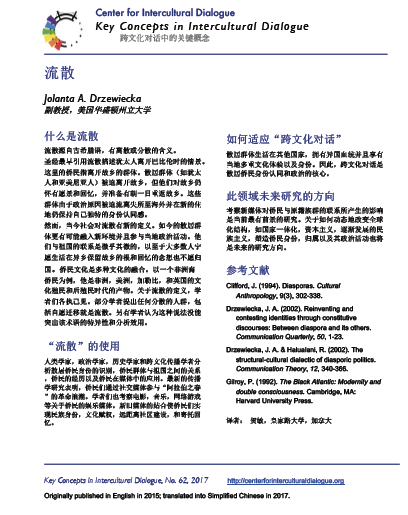
KC62: Diaspora Translated into Simplified Chinese

Key Concepts in ICDContinuing translations of Key Concepts in Intercultural Dialogue, today I am posting KC#62: Diaspora, which Jolanta A. Drzewiecka published in English in 2015, which Min He has now translated into Simplified Chinese.

As always, all Key Concepts are available as free PDFs; just click on the thumbnail to download. Lists of Key Concepts organized chronologically by publication date and number, alphabetically by concept, and by languages into which they have been translated, are available, as is a page of acknowledgments with the names of all authors, translators, and reviewers.

KC62 Diaspora_Chinese-simDrzewiecka, J. A. (2017). Diaspora [Simplified Chinese]. (M. He, Trans). Key Concepts in Intercultural Dialogue, 62. Available from:
https://centerforinterculturaldialogue.org/wp-content/uploads/2017/09/kc62-diaspora_chinese-sim.pdf

If you are interested in translating one of the Key Concepts, please contact me for approval first because dozens are currently in process. As always, if there is a concept you think should be written up as one of the Key Concepts, whether in English or any other language, propose it. If you are new to CID, please provide a brief resume. This opportunity is open to masters students and above, on the assumption that some familiarity with academic conventions generally, and discussion of intercultural dialogue specifically, are useful.

Wendy Leeds-Hurwitz, Director
Center for Intercultural Dialogue


Creative Commons License
This work is licensed under a Creative Commons Attribution-NonCommercial-NoDerivatives 4.0 International License.

MA Collaborative & Dialogic Practices Started (US/Mexico)

Graduate StudyThe Taos Institute, USA, and Kanankil Institute in Merida, Mexico, together offer a new program: Master of Arts degree in Collaborative and Dialogic Practices.
In this two-year online learning program participants will learn about and explore different applications of Collaborative and Dialogic Practices related to professional life as educators, social workers, managers, coaches, mediators, lawyers, psychotherapists, doctors, nurses, and communications working with individuals or organizations. The collaborative approach is based on an ideological shift in the way we think about language and knowledge. It is relating and conversing in a manner that includes a way of thinking with, talking with, acting with, and responding to the people with whom we meet in our professional activities.

The Master of Arts degree in Collaborative and Dialogic Practices (CDP) will introduce social construction and CDP for those new to it and help those familiar with it to deepen their understandings and practices. Drawing on the works of thinkers and practitioners such as Mikhail Bakhtin, Hans-Georg Gadamer,Kenneth Gergen, Jean Francois Lyotard, Maurice Merleau-Ponty, John Shotter, Ludwig Wittgenstein, as well as Harlene Anderson, Harry Goolishian, Lynn Hoffman, SheilaMcNamee, Tom Andersen, and Jaakko Seikkula, it specifically focuses on relational constructionist understandings of language and meaning-making, polyvocality, transformative dialogue, and appreciative and future-oriented perspectives.

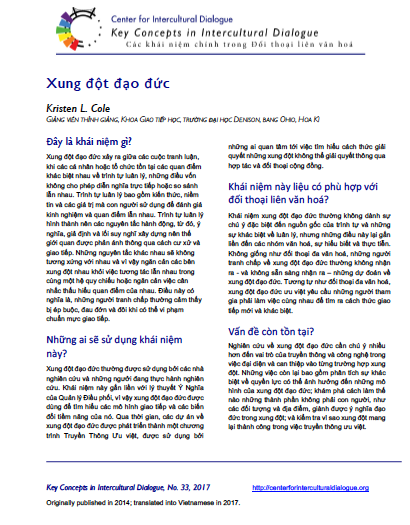
KC33 Moral Conflict Translated into Vietnamese

Key Concepts in ICDContinuing translations of Key Concepts in Intercultural Dialogue, today I am posting KC#33: Moral Conflict, which Kristen L. Cole wrote for publication in English in 2014, and which Thu Huynh has now translated into Vietnamese.

As always, all Key Concepts are available as free PDFs; just click on the thumbnail to download. Lists of Key Concepts organized chronologically by publication date and number, alphabetically by concept, and by languages into which they have been translated, are available, as is a page of acknowledgments with the names of all authors, translators, and reviewers.

KC33 Moral Conflict_VietnameseCole, K. L. (2017). Moral conflict [Vietnamese]. (T. Huynh, trans). Key Concepts in Intercultural Dialogue, 33. Available from:
https://centerforinterculturaldialogue.org/wp-content/uploads/2017/09/kc33-moral-conflict_vietnamese.pdf

If you are interested in translating one of the Key Concepts, please contact me for approval first because dozens are currently in process. As always, if there is a concept you think should be written up as one of the Key Concepts, whether in English or any other language, propose it. If you are new to CID, please provide a brief resume. This opportunity is open to masters students and above, on the assumption that some familiarity with academic conventions generally, and discussion of intercultural dialogue specifically, are useful.

Wendy Leeds-Hurwitz, Director
Center for Intercultural Dialogue


Creative Commons License
This work is licensed under a Creative Commons Attribution-NonCommercial-NoDerivatives 4.0 International License.

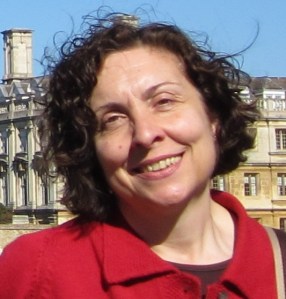
Marianna Kyriakou Profile

ProfilesMarianna Kyriakou has a Bachelor’s Degree in French Language and Literature from the University of Cyprus (Cyprus), a Master’s Degree in Applied Linguistics and a PhD in Linguistics from the University of Sussex (UK).

Marianna Kyriakou

Her research is in the field of sociolinguistics. Specifically, she focuses on the study of diglossia, language attitudes, and identity (particularly ethnic identity), and how these three areas influence one another. Marianna is particularly interested in the concept of classic diglossia (Ferguson, 1959) and proposes an extension of the term in order to describe modern diglossic societies such as Cyprus. She is currently working on articles on diglossia, proposing a new extension of the term as this applies to the case of Cyprus as well as on articles on language and ethnic identity.

Marianna’s 12 years of work experience includes English and French language teaching at private schools and other institutions. During these years, she had the opportunity to attend many seminars regarding the teaching of English as a second language and to receive new and updated knowledge regarding English language teaching methodologies and approaches. She has also taught lessons on Methodologies of Second Language Acquisition at University and worked as a translator and proof-reader and participated in educational projects sponsored by the Ministry of Education in Cyprus. She is currently teaching Linguistics at the University of Central Lancashire, Cyprus.


Work for CID:
Marianna Kyriakou wrote KC85: Diglossia, and then translated it into Greek. She has also frequently served as a reviewer for Greek.

KC79 Social Cohesion Translated into Simplified Chinese

Key Concepts in ICDContinuing translations of Key Concepts in Intercultural Dialogue, today I am posting KC#79: Social Cohesion, which Narine Nora Kerelian and Gizem Arat wrote for publication in English in 2016, and which Yan Sun has now translated into Simplified Chinese.

As always, all Key Concepts are available as free PDFs; just click on the thumbnail to download. Lists of Key Concepts organized chronologically by publication date and number, alphabetically by concept, and by languages into which they have been translated, are available, as is a page of acknowledgments with the names of all authors, translators, and reviewers.

KC79 Social cohesion_Chinese-simKerelian, N. N., & Arat, G. (2017). Social cohesion [Chinese]. (Y. Sun, trans). Key Concepts in Intercultural Dialogue, 79. Available from:
https://centerforinterculturaldialogue.org/wp-content/uploads/2017/09/kc79-social-cohesion_chinese-sim1.pdf

If you are interested in translating one of the Key Concepts, please contact me for approval first because dozens are currently in process. As always, if there is a concept you think should be written up as one of the Key Concepts, whether in English or any other language, propose it. If you are new to CID, please provide a brief resume. This opportunity is open to masters students and above, on the assumption that some familiarity with academic conventions generally, and discussion of intercultural dialogue specifically, are useful.

Wendy Leeds-Hurwitz, Director
Center for Intercultural Dialogue


Creative Commons License
This work is licensed under a Creative Commons Attribution-NonCommercial-NoDerivatives 4.0 International License.