Wild Publics: Language Under the Conditions of Late Modernity (Germany)

EventsWILD PUBLICS. Language under the conditions of late modernity – 16th Blankensee ColloquiumMarch 22-24, 2018, Freie Universität Berlin.

From 22nd to 24th of March 2018, we will organise a conference at FU
Berlin, Germany, discussing the construction of public space in relation
to language under the conditions of late modernity.

The conditions of public language in late modernity lead to changed and changing notions of public space: new spaces emerge; existing spaces become reconfigured and gain in complexity. Old divisions of private and public are shaken up, and existing forms of discursive authority and power relations are changed. We suggest that this can be observed in discourses and language uses as they manifest themselves in public space.

Continue reading “Wild Publics: Language Under the Conditions of Late Modernity (Germany)”

KC89: Xenophobia

Key Concepts in ICDThe next issue of Key Concepts in intercultural Dialogue is now available. This is KC#89: Xenophobia, by Anastasia Karakitsou. (Note that “xenophobia” was dictionary.com’s word of the year in 2016, so this concept is particularly timely.) Click on the thumbnail to download the PDF. Lists organized chronologically by publication date and numberalphabetically by concept in English, and by languages into which they have been translated, are available, as is a page of acknowledgments with the names of all authors, translators, and reviewers.

KC89 XenophobiaKarakitsou, A. (2017). Xenophobia. Key Concepts in Intercultural Dialogue, 89. Available from:
https://centerforinterculturaldialogue.org/wp-content/uploads/2017/12/kc89-xenoophobia.pdf

The Center for Intercultural Dialogue publishes a series of short briefs describing Key Concepts in Intercultural Dialogue. Different people, working in different countries and disciplines, use different vocabulary to describe their interests, yet these terms overlap. Our goal is to provide some of the assumptions and history attached to each concept for those unfamiliar with it. As there are other concepts you would like to see included, send an email to the series editor, Wendy Leeds-Hurwitz. If there are concepts you would like to prepare, provide a brief explanation of why you think the concept is central to the study of intercultural dialogue, and why you are the obvious person to write up that concept.


Creative Commons License
This work is licensed under a Creative Commons Attribution-NonCommercial-NoDerivatives 4.0 International License.

Arizona State U Job Ad: Languages & Cultures

Job adsAssistant Professor, Communication at Arizona State University. Deadline: January 5, 2018.

The Languages and Cultures Program in the College of Integrative Sciences and Arts on the downtown Phoenix Campus at Arizona State University invites applications for a tenure-track Assistant Professor in Communication. The College of Integrative Sciences and Arts (CISA) offers an exciting and innovative interdisciplinary communication degree program.  Expectations for this position include: teach a 2/2 load with a significant research agenda; contribute to curriculum development; deliver excellent undergraduate instruction; conduct research publishable in premier academic venues; assist and/or develop grant proposals; and service required appropriate to rank; eligible to apply for graduate faculty status in M.A. and Ph.D. programs at ASU’s other campuses.  This is an academic-year appointment with an expected start date of August 2018. The Assistant Professor position is a benefits-eligible appointment with tenure implications.  Salary is competitive to commensurate with experience.

The major offers three areas of emphasis: Communication and Culture, Law and Community Advocacy, and Communication, Technology & Society.  We seek interdisciplinary human science scholars who will take advantage of opportunities to make interdisciplinary connections with ASU faculty in the humanities and social sciences.


U Westminster Job Ad: Academic Coordinator (Uzbekistan)

Job adsSenior Academic Coordinator – UoW-WIUT Partnership, University of Westminster – Vice Chancellor’s Office (London and Tashkent, Uzbekistan).  Deadline: 7 January 2018.

The University of Westminster co-founded Westminster International University in Tashkent (WIUT) in 2002. The academic portfolio, grounded in programmes in Business Administration, Economics, Commercial Law, and Business Information Systems, has been extended to include Masters’ courses in International Business and Management, International Commercial Law and Applied Economics. WIUT as an institution has been developed on the model of a UK University and is a validated partner of the University of Westminster.

Based at the University of Westminster but with a substantial proportion of time spent in Tashkent, and reporting to the Deputy Vice Chancellor for Global Engagement, the postholder will work with UoW and WIUT colleagues to take forward the development of the partnership. The post will be of two years’ duration, in the first instance and is full time (35 hours per week) with a start date of February 2018. The post entails no line management responsibility but involves substantial work with a wide range of stakeholders, academic and administrative, at UoW and WIUT. Effective coordination across Faculties (Colleges) and Professional Services teams at UoW and across the two institutions engaged in the partnership is key to the successful execution of the role, as is the ability to produce, deliver and ensure effective monitoring of partnership development and project plans.

We are looking for a committed and talented professional, with a higher degree and substantial HE experience, including experience of programme management; project management; international partnership management; quality assurance in the international context; and effective team working. You will have excellent skills in the area of interpersonal interaction, communication and intercultural awareness; and will have strong empathy to cultural difference and diversity.

CFP Widening the Lens: Beyond the Orient & Occident (Dubai)

ConferencesCall for Abstracts: Widening the Lens: Beyond the Orient and Occident in Narrative Perspectives of the East and West. The American University in Dubai, April 5-7, 2018.

We live in an age in which mass media representations of the Middle East have done much to influence Western attitudes toward the region’s peoples and cultures.  Similarly, Middle Easterners’ views of the West have also been affected.  That these representations have so consistently advanced disparaging stereotypes has resulted in an unfortunate legacy of cultural misunderstanding that demands investigation and redress. The literary arts, from the Middle Ages to Modernity have all too often represented cultural differences in ways that have aided in the construction and/or perpetuation of an antagonistic East/West divide.  While the exploration of this divide has been valuable, what is now needed is an exploration of how literature has also engaged in productively complex, nuanced intercultural dialogues that complicate, fracture, and ultimately widen the narrow lens used to frame the relationships between East and West. The conference, Widening the Lens: Beyond the Orient and Occident in Narrative Perspectives of the East and West, seeks to explore how the dialogue between literatures of the Middle East, North Africa, Europe, and North America approach, inspire, challenge, and ultimately benefit each other. In other words, this conference intends to consider that literature can help correct the divisions caused by entrenched cultural stereotypes, and that this help can take a myriad of forms.

Continue reading “CFP Widening the Lens: Beyond the Orient & Occident (Dubai)”

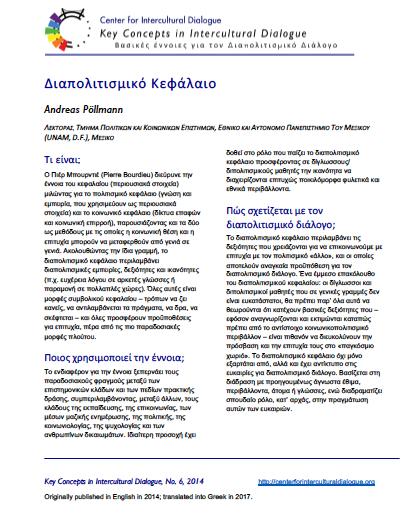
KC6 Intercultural Capital Translated into Greek

Key Concepts in ICDContinuing translations of Key Concepts in Intercultural Dialogue, today I am posting KC#6: Intercultural Capital, which Andreas Pöllmann wrote for publication in English in 2014, and which Anastasia Karakitsou has now translated into Greek.

As always, all Key Concepts are available as free PDFs; just click on the thumbnail to download. Lists of Key Concepts organized chronologically by publication date and number, alphabetically by concept, and by languages into which they have been translated, are available, as is a page of acknowledgments with the names of all authors, translators, and reviewers.

KC6 Intercultural Capital_GreekPöllmann, A. (2017). Intercultural capital [Greek]. (A. Karakitsou, trans). Key Concepts in Intercultural Dialogue, 6. Available from:
https://centerforinterculturaldialogue.org/wp-content/uploads/2017/12/kc6-intercultural-capital_greek.pdf

If you are interested in translating one of the Key Concepts, please contact me for approval first because dozens are currently in process. As always, if there is a concept you think should be written up as one of the Key Concepts, whether in English or any other language, propose it. If you are new to CID, please provide a brief resume. This opportunity is open to masters students and above, on the assumption that some familiarity with academic conventions generally, and discussion of intercultural dialogue specifically, are useful.

Wendy Leeds-Hurwitz, Director
Center for Intercultural Dialogue


Creative Commons License
This work is licensed under a Creative Commons Attribution-NonCommercial-NoDerivatives 4.0 International License.

Paper Airplanes: Turkish & English Tutors Wanted

Applied ICDPaper Airplanes is looking for volunteer Turkish tutors and English tutors, and English tutor coordinators for the spring term (Jan. 14-May 15, 2018). Paper Airplanes provides free, one-on-one virtual language and skills instruction to people affected by conflict. Our goal is to help our students learn critical languages and marketable skills for their pursuit of higher education and employment. No prior tutoring experience or Arabic language skills required, although both are appreciated. Please contact Paper Airplanes Director of Programming, Dr. Anna Farrell, with any questions.

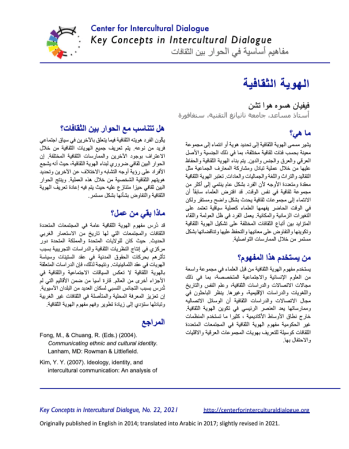
KC22 Cultural Identity Translated into Arabic

Key Concepts in ICDContinuing translations of Key Concepts in Intercultural Dialogue, today I am posting KC#22: Cultural Identity, which Vivian Hsueh-Hua Chen wrote for publication in English in 2014, and which Salma Tariq Shukri has now translated into Arabic.

As always, all Key Concepts are available as free PDFs; just click on the thumbnail to download. Lists of Key Concepts organized chronologically by publication date and number, alphabetically by concept, and by languages into which they have been translated, are available, as is a page of acknowledgments with the names of all authors, translators, and reviewers.

KC22 Cultural identity_Arabic_vwChen, V. H.-H. (2021). Cultural identity [Arabic]. (S. T. Shukri, trans). Key Concepts in Intercultural Dialogue, 22. Available from:
https://centerforinterculturaldialogue.org/wp-content/uploads/2021/07/kc22-cultural-identity_arabic-v2.pdf

If you are interested in translating one of the Key Concepts, please contact me for approval first because dozens are currently in process. As always, if there is a concept you think should be written up as one of the Key Concepts, whether in English or any other language, propose it. If you are new to CID, please provide a brief resume. This opportunity is open to masters students and above, on the assumption that some familiarity with academic conventions generally, and discussion of intercultural dialogue specifically, are useful.

Wendy Leeds-Hurwitz, Director
Center for Intercultural Dialogue


Creative Commons License
This work is licensed under a Creative Commons Attribution-NonCommercial-NoDerivatives 4.0 International License.

UC London Postdoc: Multimodal Communication (UK)

PostdocsResearch Associate in Multimodal CommunicationUniversity College London – UCL Division of Psychology and Language Sciences – Experimental Psychology. Deadline: 21 December 2017.

Applications are invited for the post of Research Associate in the Institute of Multimodal Communication, located within the Experimental Psychology Research Department, UCL. The project, funded by a ERC grant awarded to Gabriella Vigliocco, investigates the role of multimodal cues (such as gesture and eyegaze) in language learning and processing. The successful candidate will be expected to develop and implement multimodal computational models to be used to predict behavioural and neural responses. The appointee will also be expected to contribute to the writing of manuscripts and presenting the data at international conferences. Strong support for personal and professional development will be available. This post in funded for 2 years, in the first instance.

Applicants must hold a PhD, or have submitted their thesis, in Experimental Psychology, AI, Computer Science, Cognitive Science, or Linguistics, and have computational experience. The ability to work as part of a research team is essential, as is the ability to problem-solve in a technical setting. Programming skills are essential.

U Tampere Doctoral Fellowships: EuroAgeism (Finland)

FellowshipsTWO DOCTORAL RESEARCHER POSITIONS IN THE FACULTY OF SOCIAL SCIENCES, UNIVERSITY OF TAMPERE, FINLAND

The University of Tampere is an internationally renowned research-led university and one of the few in the world to specialize in the social sciences (more information on Finland and Tampere).

The Faculty of Social Sciences, University of Tampere, Finland, invites applications for two Early Stage Researchers (Doctoral Researcher) positions for three years (36 months) in the Marie Skłodowska-Curie, Innovative Training Network EuroAgeism research programme. The planned commencement date for the positions is in June – October 2018.

Programme overview

The EuroAgeism research programme, funded under Horizon 2020, MSCA-Innovative training network, consists of a multi-disciplinary, multi-sectorial, science-policy international network of researchers, policy makers and social and health care professionals. The goal of the network is to train professionals who can function effectively and comfortably at any of the intersections between science and policy.

EuroAgeism is a consortium of high-profile universities, research institutions and an NGO that are located in Israel, Belgium, Czech Republic, Poland, the Netherlands, United Kingdom, Finland and Sweden. Across participating universities a total of 15 Early Stage Researcher positions are being advertised.

Doctoral Researchers will benefit not only from leadership by expert research supervisors, but also from secondments in academia, policy and health organizations, training and transferable-skills courses and active participation in workshops and conferences over the course of the program.