KC103 Geoculture Translated into Simplified Chinese

Key Concepts in ICD

Continuing translations of Key Concepts in Intercultural Dialogue, today I am posting KC#103: Geoculture, originally written by Mohammed Guamguami for publication in 2021, and now translated by Mingshi Cui into Simplified Chinese.
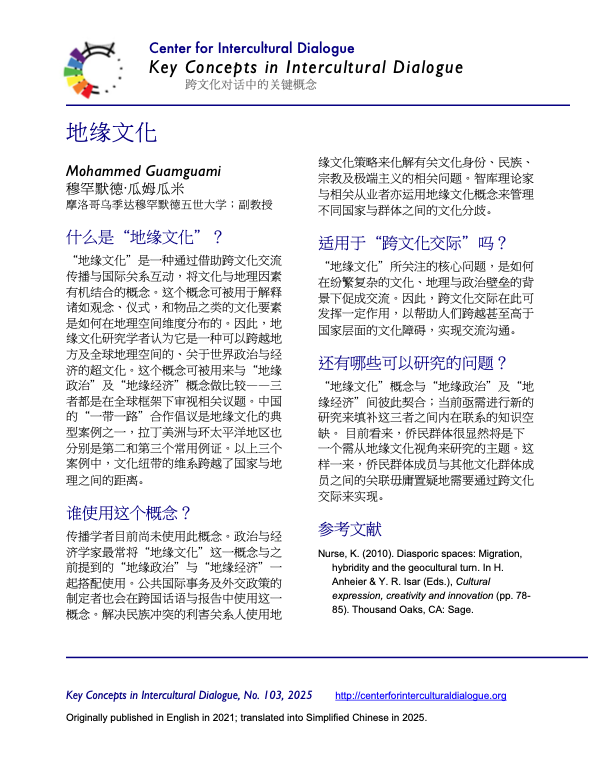
KC103 Geoculture_Sim Chinese

As always, all Key Concepts are available as free PDFs; just click on the thumbnail to download. Lists organized chronologically by publication date and numberalphabetically by concept in English, and by languages into which they have been translated, are available, as is a page of acknowledgments with the names of all authors, translators, and reviewers.

Guamguami, M. (2025). Geoculture [Simplified Chinese]. (M. Cui, trans). Key Concepts in Intercultural Dialogue, 103. Available from: https://centerforinterculturaldialogue.org/wp-content/uploads/2025/06/kc103-geoculture_sim-chinese.pdf

The Center for Intercultural Dialogue publishes a series of short briefs describing Key Concepts in Intercultural Dialogue. Different people, working in different countries and disciplines, use different vocabulary to describe their interests, yet these terms overlap. Our goal is to provide some of the assumptions and history attached to each concept for those unfamiliar with it. As there are other concepts you would like to see included, send an email to the series editor, Wendy Leeds-Hurwitz. If there are concepts you would like to prepare, provide a brief explanation of why you think the concept is central to the study of intercultural dialogue, and why you are the obvious person to write up that concept.


Creative Commons License
This work is licensed under a Creative Commons Attribution-NonCommercial-NoDerivatives 4.0 International License.

UNAOC: Communications Specialist (USA)

“JobCommunications Specialist, United Nations Office for Project Services, United Nations Alliance of Civilizations, New York, NY, USA. Deadline: 20 July 2025.

The United Nations Alliance of Civilizations was created to serve as a soft-power political tool of the United Nations Secretary-General for conflict prevention and conflict resolution. It is a coalition against extremist forces, a movement to advance mutual respect for cultures, traditions, and religious beliefs, and a platform to bridge divides and overcome prejudice, misconceptions, misperceptions, and polarization. The United Nations Alliance of Civilizations was intended to promote collective action in society as a means of addressing the threats that emerge from the hostile perceptions that foment violence, overcoming cultural and social barriers, reducing tensions, and improving relations between societies and communities with diverse cultural and religious backgrounds, and combatting violent extremism.

The incumbent of this position will be personnel of UNOPS under its full responsibility. Functional responsibilities will include:

  • Within assigned authority, the Communications Specialist will provide support to the Spokesperson and communication team in developing, writing and preparing written material for delivery by the High Representative and senior management and managing communications, both external and internal, between the senior management and a wide range of audiences, including media.
  • Perform day-to-day tactical communications such as social media posts, news items, letters, and informational updates, all with a view to build strong, bold, sharp and principle-based brand; works with UN departments, funds and agencies to develop ways to implement and collaborate on campaigns system-wide and to incorporate the campaign message and themes into all relevant events and products.
  • Participate in the development and implementation of assigned programme/projects in the area of communication activities.
  • Identify problems and issues to be addressed and propose corrective actions.
  • Research, analyze and present information gathered from diverse sources that could/may impact the work of UNAOC.

Osnabrück U: Postdoctoral Researcher in Reflexive Migration Research (Germany)

Postdocs

Postdoctoral Researcher in Reflexive Migration Research, Osnabrück University, Osnabrück, Germany. Deadline: 25 June 2025.

The DFG-funded Collaborative Research Centre ›Production of Migration‹ (SFB 1604) examines the conditions and functions of the social production and negotiation of migration across disciplines. The aim of SFB 1604 is to establish reflexive migration research as an approach to the study of society. SFB 1604 is located at Osnabrück University (Germany) – a university with diverse research activities that attract students and scientists from all over the world to a city with a high quality of life. The SFB 1604 is seeking to appoint a Postdoctoral Researcher (m/f/d) (Salary level E 13 TV-L, 100%). The position is to be filled as soon as possible and is initially limited to two years.

Your tasks:

  • Development and submission of a high-quality funding proposal (Heisenberg Programme (DFG), ERC Grant, Emmy Noether Programme (DFG) or comparable programmes) for a research project within the topics of the Collaborative Research Centre by mid-2026. In terms of concept and research focus, the project should be closely aligned with the Collaborative Research Centre and deepen and/or supplement its ongoing work.

  • On-site participation in the events and activities of the SFB in Osnabrück

  • Active participation in the theoretical development of the SFB and its publication projects

U Limerick PhD Studentship: ID Compression (Ireland)

“Studentships“PhD studentship in Psychology to work with the project ID-Compression, University of Limerick, Ireland. Deadline: 10 July 2025.

There are 2 studentships available for this project; the one that is most likely of interest to followers of this Center is for a PhD in Social Sciences with an interest in Social Identity.

The ERC-funded ID-COMPRESSION project explores the idea that issue-based polarization is information compressibility, where attitudes provide redundant (i.e. compressible) information about groups and identity. This framework conceptualizes people holding attitudes as a social information system where people are located by their own attitudes and can easily locate each-other in the social system from a few expressed attitudes. The more compressible the social information system, the fewer bits of information are required to locate people within it. These ideas flow from the social identity and social representations approaches to attitudes. Team members are particularly excited to explore conversion pathways where, they hypothesize, people’s willingness to adopt an idea will depend on their current location in the social information system. The PhD candidates will work as part of this team testing these ideas with secondary data, social experiments and simulations. They will particularly explore whether and how information becomes compressible when it is passed through simple social networks, whether social information compression maps to polarization (e.g. that people compress social information more in highly polarized contexts), and will experimentally test the concept of conversion pathways. Applied mathematicians in the group will develop metrics and methods for estimating compressibility, and for mapping it to other measures of polarization

Royal Roads U: Postdoc Possibilities (Canada)

Postdocs

Multiple postdoc opportunities, Royal Roads University, Victoria, BC, Canada. Deadline: 3 July 2025.

Royal Roads University (RRU) invites expressions of interest from those wishing to develop a Canada Postdoctoral Research Award (CPRA) application. CPRA award amounts of $70,000 (taxable income) per year for 2 years (non-renewable) are used to fund a postdoctoral researcher position at the university and are subject to MERCs (mandatory employment related costs). RRU seeks expressions of interest specific to a series of research topics; that most likely relevant to followers of this Center is this one:

Dr. Juana Du is seeking a postdoctoral scholar to support her research interests which include the impact of cultural awareness and assumptions on intercultural experiences; communication and intercultural adjustment of sojourners, particularly around international students and business expatriates; organizational culture, learning and knowledge sharing in multinational and multilingual organizations in different cultural and institutional contexts. Her recent research projects examine organizational identification in global virtual teams and boundary conditions, with an emphasis on the role of emerging technology, and AI literacy at the hybrid workplace.

CFP: Intercultural Competence in a Rapidly Changing World (USA & Online)

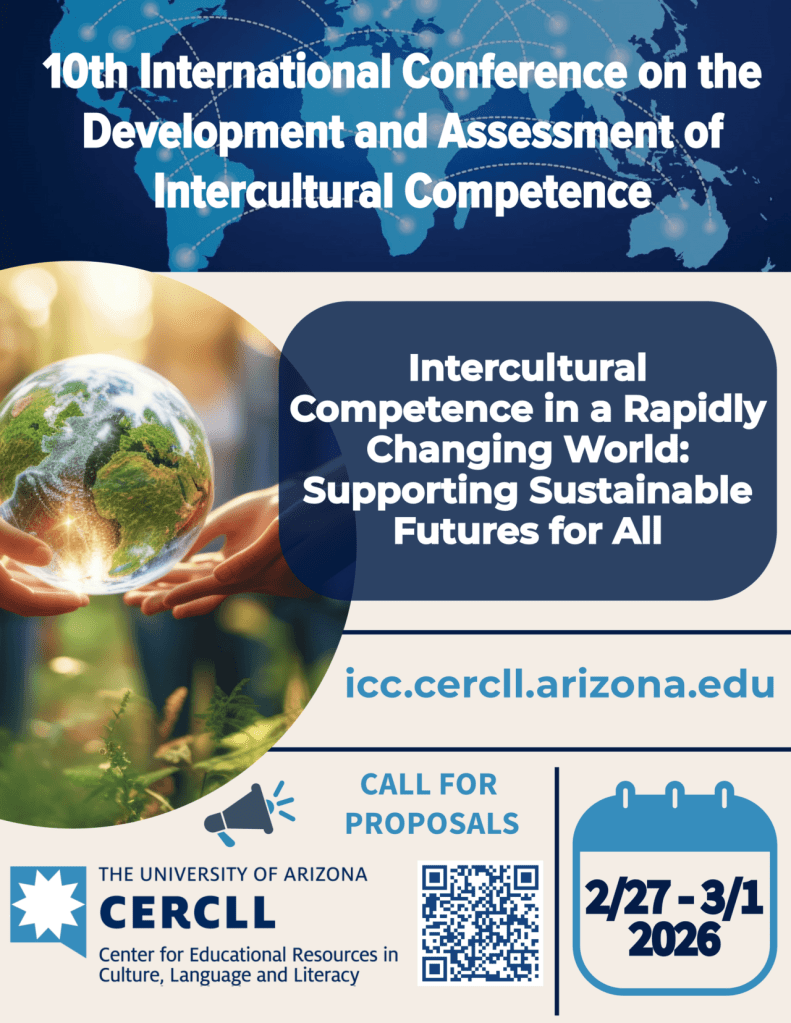
ConferencesCall for proposals: Supporting Sustainable Futures for All: Intercultural Competence in a Rapidly Changing World, 10th International Conference on the Development and Assessment of Intercultural Competence, University of Arizona, Tucson, AZ and Online hybrid, 27 February-1 March 2026. Deadline: 21 July 2025.

Intercultural Competence in a Rapidly Changing World

What role might intercultural communicative language education play in promoting a more sustainable world for all? What might an intercultural communicative language education for a more sustainable world look like? What might be the implications for teachers and learners of moving towards intercultural communicative language education for sustainability? With these issues and questions in mind, CERCLL invites language educators to reflect on how they could re-envision what they teach and how they teach it to meaningfully address these crises with the goal of building a sustainable world for all. The organizers of ICC 2026 seek presentation proposals that focus upon these questions.

NTNU PhD Studentship: Social Work, International Migration, Refugee Studies (Norway)

“Studentships“PhD Candidate in Social work, with a focus on international migration and refugee studies, Norwegian University of Science and Technology, Trondheim, Norway. Deadline: 29 June 2025.

This three-years position is a part of the ANCHOR: Advancing Neighborhood, Community, and HOusing for the integration of Refugee families, an inter-disciplinary project funded under the NTNU’s strategic research area: Community. ANCHOR focuses on how housing and neighborhood environments can support refugee families’ wellbeing, social integration, and sense of belonging. This position will focus on Norwegian municipal contexts, examining how physical and social aspects of housing intersect with the everyday lives of refugee families with children.

ANCHOR investigates how entangled social, political, and environmental processes shape the housing experiences, wellbeing, and sense of belonging among refugee families in Norway. By focusing on non-linear and sometimes unexpected outcomes of policy, planning, and community design, the project aims to reveal how conventional approaches can inadvertently deepen uncertainties or, conversely, foster more inclusive forms of community life.

Challenging the traditional separation of social from material and environmental factors, ANCHOR takes a holistic and interdisciplinary approach, drawing on social and architectural anthropology, urban planning, social work, childhood studies, and public health. Central to this endeavor is an emphasis on intersectionality, which recognizes that factors such age, gender, cultural background, and generational dynamics can shape different layers of vulnerability or resilience within refugee families. Methodologically, the project combines creative, participatory methods with established qualitative techniques. This multi-method strategy seeks to co-create knowledge with refugee families, local communities, NGOs, and municipal authorities.

This project is a collaboration among the Departments of Architecture and Planning, Social Work and Public Health and Nursing, and it includes two PhD positions. The successful PhD candidate will work closely with their counterpart in the Department of Architecture and Planning. Norwegian and English are the main languages in use at the Department.

KC116 Peace Education

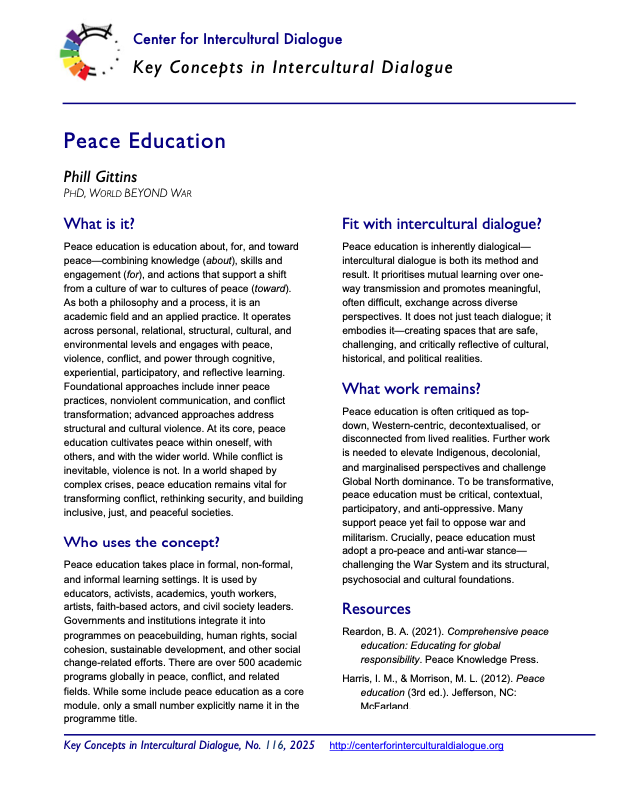
Key Concepts in ICDThe next issue of Key Concepts in intercultural Dialogue is now available. This is KC116: Peace education, by Phill Gittins. Click on the thumbnail to download the PDF. Lists organized chronologically by publication date and numberalphabetically by concept in English, and by languages into which they have been translated, are available, as is a page of acknowledgments with the names of all authors, translators, and reviewers.

KC116 Peace Education

Gittins, P. (2025). Peace education. Key Concepts in Intercultural Dialogue, 116. Available from: https://centerforinterculturaldialogue.org/wp-content/uploads/2025/06/kc116-peace-education.pdf

The Center for Intercultural Dialogue publishes a series of short briefs describing Key Concepts in Intercultural Dialogue. Different people, working in different countries and disciplines, use different vocabulary to describe their interests, yet these terms overlap. Our goal is to provide some of the assumptions and history attached to each concept for those unfamiliar with it. As there are other concepts you would like to see included, send an email to the series editor, Wendy Leeds-Hurwitz. If there are concepts you would like to prepare, provide a brief explanation of why you think the concept is central to the study of intercultural dialogue, and why you are the obvious person to write up that concept.


Creative Commons License
This work is licensed under a Creative Commons Attribution-NonCommercial-NoDerivatives 4.0 International License.
Royal Roads U: Canada Research Chair in Changemaking (Canada)

“JobTier 2 (Emerging Scholars) Canada Research Chair in Changemaking, Royal Roads University, Victoria, BC, Canada. Deadline: 9 July 2025.

As a Tier 2 CRC at Royal Roads, you will develop an exemplary scholarly and creative presence, complement, and enrich research and scholarship among faculty and graduate students, and participate in local and international research networks. While based in one faculty, you will collaborate with other units within RRU as appropriate.

As the Tier 2 CRC in Changemaking, you will have established relationships in both academic and non-academic communities and a portfolio demonstrating the application of applied and problem-based research methods. You will also have demonstrated success (or a high degree of promise) in obtaining research funding from diverse sources, leading collaborative research initiatives, establishing and maintaining community relationships, supervising student research, and mobilizing research. Royal Roads considers a broad range of contributions to research, training and mentoring as part of the merit review process, with a focus on the quality and impact of these contributions.

The successful applicant will be nominated by the University for a Tier 2 CRC and, upon approval by the CRC Secretariat, will be offered an initial five-year continuing-track appointment with the possibility of conversion into a continuing appointment, subject to performance and program needs. The Tier 2 Chairs include the possibility of a renewal for an additional five years.

This position is not currently linked to a particular school within the Faculty of Interdisciplinary Studies and is open to candidates from a wide variety of disciplinary backgrounds. The determination of school will be based on the successful candidate’s area of focus. The nominee’s research area, however, must be primarily in the social sciences and humanities (i.e., aligned with the legislated mandate of the Social Sciences and Humanities Research Council of Canada).

Tier 2 Chairs are intended for exceptional emerging scholars. Candidates must have been an active researcher in their field for fewer than 10 years at the time of nomination. Applicants who are more than 10 years from their highest degree may have their eligibility for a Tier 2 Chair assessed through the program’s Tier 2 justification process. This process considers career breaks such as parental leave, illness, administrative burden, clinical training, and others. For further information, see the Canada Research Chairs website.


U Dayton: Coordinator of Intercultural Student Engagement (USA)

“Job

Coordinator of Intercultural Student Engagement – Global and Intercultural Affairs Center, University of Dayton, Dayton, OH. Deadline: 20 June 2025.

“Are you passionate about creating transformative learning experiences that build connection, empathy, and global understanding across a university campus? Join the University of Dayton Global and Intercultural Affairs Center, as we help to shape a vibrant intercultural campus environment that celebrates diversity, fosters intercultural and global understanding, and empowers students to engage in ethical and socially responsible ways towards a more just and sustainable community.

We are looking for a creative and collaborative professional to lead existing and new co-curricular programming and events that promote student belonging, spark meaningful dialogue and deepen cultural awareness. In this role, the ideal candidate will play a key role in collaborating with campus partners to develop student leaders and helping to equip them with the intercultural and global skills essential for success in today’s interconnected world. Some remote/flexible work hours are possible.

The successful candidate, with guidance from the Senior Director, is responsible for the support and development of campus collaborative programming/events, dialogues, training and education, and delivery of marketing and communications efforts. Guided by frameworks of Internationalization at Home (IaH) and global citizenship, this individual will help to lead and support a portion of the Global Engagement student portfolio for the Center.”