KC94 Cross-Cultural Kids Translated into Indonesian

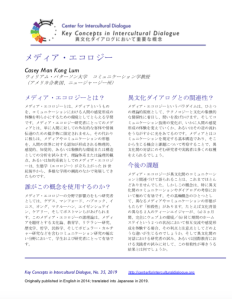
Key Concepts in ICDContinuing with translations of the Key Concepts in Intercultural Dialogue, today I am posting KC#94: Cross-Cultural Kids, by Ruth E. Van Reken, published in English earlier this year, and which Anastasia Aldelina Lijadi has now translated into Indonesian.

As always, all Key Concepts are available as free PDFs; just click on the thumbnail to download. Lists of Key Concepts organized alphabetically by conceptchronologically by publication date and number, and by languages into which they have been translated, are available, as is a page of acknowledgments with the names of all authors, translators, and reviewers.

KC94 CCK_IndonesianVan Reken, R. (2019). Taruna Lintas Budaya (A. A. Lijadi, Trans). Key Concepts in Intercultural Dialogue, 94. Available from:
https://centerforinterculturaldialogue.org/wp-content/uploads/2019/07/kc94-cck-indonesian.pdf

If you are interested in translating one of the Key Concepts, please contact me for approval first because dozens are currently in process. As always, if there is a concept you think should be written up as one of the Key Concepts, whether in English or any other language, propose it. If you are new to CID, please provide a brief resume. This opportunity is open to masters students and above, on the assumption that some familiarity with academic conventions generally, and discussion of intercultural dialogue specifically, are useful.

Wendy Leeds-Hurwitz, Director
Center for Intercultural Dialogue


Creative Commons License
This work is licensed under a Creative Commons Attribution-NonCommercial-NoDerivatives 4.0 International License.

Save

Save

U Auckland: Lecturer in Communication (New Zealand)

“Job

Lecturer in Communication, Faculty of Arts, University of Auckland, Auckland, New Zealand. Deadline: 18 August 2019.

This is a permanent (tenure track) position. The appointed candidate will join the Media and Communications team which offers three undergraduate majors (Media, Film and Television; Communication; and Screen Production) and two postgraduate programmes (Media and Communication and Screen Production). The university also has two PhD programmes: an academic PhD and a PhD with creative practice.

The ideal candidate will have an area of expertise which may include critical analyses of advertising, journalism, algorithm studies or other approaches to social media and digital platforms. But there is also interest in seeing applications from researchers who explore how gender, ethnicity, and indigeneity intersect with digital cultures. Applicants welcome who combine academic qualifications and research with prior work experience in professional or applied contexts. Candidates will be expected to have familiarity with both quantitative and qualitative research methods in the fields of Media Studies and Communication.

Northwestern U: Dean (Qatar)

“JobDean (Chief Executive Officer), Northwestern University in Qatar, Doha, Qatar. Deadline: November 1, 2019.

Northwestern University in Qatar (NU-Q) seeks a strong leader with accomplishments in journalism or communications to serve as its next dean. NU-Q offers a world-class program in media education with degree programs in journalism and in communication built on a strong foundation of liberal arts. NU-Q is one of six schools from leading American universities that have established campuses in Education City, Doha, as a result of collaborative agreements between the universities and the Qatar Foundation. Each of the American universities brings to Qatar educational programs for which those institutions are especially renowned. The agreement reflects Northwestern University’s commitment to global engagement and to supporting Qatar’s embrace of quality higher education, human development and growing media and communication capacities. Building on the strong foundation established when the school was launched in 2008, NU-Q now seeks a new dean to advance its institutional trajectory, achieve its academic mission and play an important role in the continued development and transformation of Qatar.

The dean must first and foremost embrace the mission of NU-Q, “to give students an education unique in the world and worthy of a great university.” The dean should also bring substantial experience and distinguished intellectual accomplishments in at least one of the two program areas; appreciation of liberal arts-based university education; strong leadership and management experience including a collaborative style and commitment to shared governance; and personal qualities including diplomacy, intercultural sensitivity and an entrepreneurial spirit. Some background in the cultures of the Middle East and the Muslim world are preferred. The new dean must meet the standards for tenure in one of Northwestern’s schools. Terminal degree preferred, though not required.

Molly of Denali

Applied ICDMolly of Denali is a new PBS cartoon (created by WGBH Kids, Atomic Cartoons, and CBC Kids) and the first nationally distributed children’s series with a Native American lead. Ten-year-old Molly embodies intercultural dialogue as she walks the line between her family’s traditions (her heritage is Gwich’in, Koyukon and Dena’ina Athabascan) and modern use of the internet, including creating a video blog about her life in rural Alaska.

Stories about this:
PBS
New York Times
NPR

Intercultural Learning Hub

Intercultural PedagogyIntercultural Learning Hub, public “science gateway” sponsored by Purdue University’s Center for Intercultural Learning, Mentorship, Assessment and Research.

Calling all interculturalists! Looking for resources to help others develop intercultural competence or engage them in equity and inclusion work? Need a venue to disseminate your latest scholarship? Searching for connection with others in the field? Visit the new Intercultural Learning Hub. Membership is free. Your contributions are welcome.

Learning from Intercultural Storytelling

Applied ICDLISTEN (Learning from Intercultural Storytelling) is a two year project (2016-18), co-funded by the Erasmus+ programme of the European Commission and the German Federal Ministry for Education and Research.

LISTEN uses “applied storytelling” as an educational approach for the work with refugees – be it to support language learning, to exchange about cultural differences, to create visions etc. In order to give refugees a voice in the receiving societies and to support their integration, LISTEN explores different approaches to storytelling and how radio and other forms of audio broadcasting (e.g. podcasting) can be used as medium to share those stories. LISTEN provides extensive resources on storytelling in multiple languages, in addition to presenting the stories themselves.

CFP Doing Women’s Film & TV History (Ireland)

ConferencesCall for papers: Doing Women’s Film and Television History V: Forming Histories/Histories in Formation, 20-22 May, 2020, Maynooth University, Maynooth, Co. Kildare, Ireland. Deadline: 11 October 2019.

The fifth biennial Doing Women’s Film & Television History conference invites proposals from researchers and practitioners engaged in the exploration, uncovering, archiving and dissemination of women’s roles in film and television, as well as wider media, both in the past and today. The theme of this conference – ‘Forming Histories/ Histories in Formation’ – aims to foreground issues pertaining to the production, curation and archiving of women’s histories in film and television as well as the methods for, and approaches to, producing and shaping these histories as they form. More particularly, much can be learned from the diversity of practices, experiences and narratives of women’s film and television history as they pertain to: national, transnational, world and global histories; neglected, peripheral or hidden histories; organisations such as museums, archives and universities; collectives, groups and movements such as #MeToo; local communities and community media; emergent forms and platforms; and historical approaches to women’s reception of film and television as well as historicising current practices and experiences of reception, fandom and consumption.

This three-day conference casts the net wide so that it can capture a range of experiences, practices, industries, nationalities and voices that are situated in relation to women and their histories. The conference provides a platform for those working in and researching film, television and media more generally as well as those invested in the production of these histories and narratives of the past and as they materialise.

Lisa Childress: Increasing Faculty Engagement in ICC & Internationalization on Campus

Guest Posts

Increasing Faculty Engagement in Intercultural Communication and Internationalization on Campus by Lisa K. Childress.

How can faculty members promote intercultural dialogue on campus? That is what those of us who are advocates for intercultural communication (ICC) and internationalization seek to encourage on a daily basis. Many faculty members on campus may already see interdisciplinary dialogue as an avenue through which to gain a more holistic understanding of their subject matter. In other words, many of our colleagues already believe in the value of looking at research and teaching through more than one disciplinary lens as a way to provide a more complex, comprehensive point of view. The question thus becomes: How can we use the already held value of interdisciplinarity as a springboard to promote the value of ICC and internationalization?

Let’s look at this conundrum through a series of questions:

As faculty members, we seek to develop our students’ global competencies.

(1) What is the foundation for developing our students’ global competencies?
Answer: The internationalization of our curricula.

(2) What is at the heart of internationalizing our curricula?
Answer: Our faculty.

(3) With what do faculty primarily concern themselves?
Answer: Their department’s goals and values and their individual teaching and research agendas.

(4) How can we shift our university’s academic departments towards a more intercultural and international focus?
Answer: Customizing ICC and internationalization to unique disciplinary priorities.

So, how can we move the ball forward? Since faculty members live within their academic disciplines, that is where the conversations and the impetus for increasing faculty engagement in ICC and internationalization need to begin.

Read the full discussion in order to learn the next steps.

CFP Brazil-US Colloquium 2020 (USA)

ConferencesCall for papers: 9th Brazil-US Colloquium on Communication Studies 2020: Present and Future Directions of Research on Brazil and the US –
Media, Communications, Literature, Culture, and History, March 24-25, 2020, University of Texas, Austin, TX. Deadline: October 15, 2019.

Research is welcome regarding the central theme and on any theme relevant to Brazil and the U.S., as well as other topics on history, literature, media, culture, and/or communication studies in the Americas. Comparative work Brazil-US is welcome but not required. Research may be in Portuguese or English. For selected Brazilian papers, presentations may be in Portuguese but with Powerpoint in English.

The event is co-sponsored by the Department of Portuguese and Brazilian Studies at Brown University and the Brazilian Association of Interdisciplinary Studies in Communication (Intercom).

Optional Publication Submission: Due: December 1, 2019.

An edited volume will be published with Emerald Studies in Media and Communications highlighting scholarship from the Colloquium. For consideration in the volume, full papers are due by December 1, 2019

EIUC Electoral Observers Training 2019 (Italy)

Applied ICDTraining seminar for International Electoral Observers, Global Campus of Human Rights, Venice, Italy, 25 -29 November 2019. Deadline: 21 October 2019.

The Global Campus of Human Rights has developed a course aiming at providing training to civilian staff in election observation missions at the first steps of their career (i.e. short term observers). Selected applicants will be allowed to become aware of the role, the tasks and the status of international observers, and will be given a theoretical and practical training on election observation and election observation missions functioning. The training will take place in Venice, at the Global Campus of Human Rights Headquarters, from 25 to 29 November 2019.