International Film Festival of Painted Birds (Spain)

Film Festivals

International Film Festival of Painted Birds, Organized by Meigas da rúa, Madrid, Spain. Deadline: 31 May 2020.


The International Film Festival of Painted Birds (Festival Internacional de los pájaros pintados) is devoted to short and feature-length films, fiction, documentaries and animation, with the aim of promoting intercultural dialogue, social cohesion and the defense of human rights, especially those of children, among children . We will disseminate quality cinematographic works that hardly reach Spain, trying not to fall into clichés. In this way, little by little the Festival intends to serve as a venue for meetings and discussions of projects of mutual interest. Organized by Meigas da rúa, member of The Global Alliance for Cultural Diversity and Anna Lindh Foundation, the festival will take place the second week of May, it is independent and awards will be granted by the jury and by the public.

COVID-19 versus ICD

Applied ICDCOVID-19 vs. Intercultural Dialogue: What Impact? An interview of Professor Fethi Mansouri (UNESCO Chairholder, Cultural Diversity and Social Justice, Deakin University, Melbourne, Australia) by Ann-Belinda Preis (Chief of UNESCO Intercultural Dialogue).

A good question. See the entire interview, but for an excerpt:

ABP: How does lack of contact and social interaction impact the broader Intercultural Dialogue (ICD) agenda, which is built on connectivity, contact and exchange?

FM: This is perhaps where COVID-19 presents a significant challenge to the ICD agenda. Intercultural dialogue has, as one of its core premises, contact between people. And the reason why we have contact as a core premise is because there is an assumption that when people get to know one another, prejudice might be reduced, and that issues of discrimination might disappear. So COVID-19 and its emphasis on social distancing means that a lot of what we would like to achieve through intercultural dialogue, in particular in bringing people together, bringing communities together, bringing diverse communities together (and diversity here means diversity of ethnic backgrounds, religious beliefs, nationalities etc.)…

Intercultural dialogue is in itself an essential tool that we will need in the post-COVID-19 environment.

We will need to renegotiate a new global compact, a new social contract, and I think dialogue will have to play a key role in that. So it is being perhaps compromised right now but it has a big role to play in the post-COVID-19 world that will emerge.

KC28 Postcolonialism Translated into German

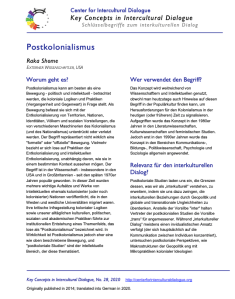
Key Concepts in ICDContinuing translations of Key Concepts in Intercultural Dialogue, today I am posting KC#28: Postcolonialism, which Raka Shome wrote for publication in English in 2014, and which Maria Faust has now translated into German.

As always, all Key Concepts are available as free PDFs; just click on the thumbnail to download. Lists of Key Concepts organized chronologically by publication date and number, alphabetically by concept, and by languages into which they have been translated, are available, as is a page of acknowledgments with the names of all authors, translators, and reviewers.

KC28 Postcolonialism_GermanShome, R. (2017). Postkolonialismus. (M. Faust, trans). Key Concepts in Intercultural Dialogue, 28. Available from:
https://centerforinterculturaldialogue.org/wp-content/uploads/2020/04/kc28-postcolonialism_german.pdf

If you are interested in translating one of the Key Concepts, please contact me for approval first because dozens are currently in process. As always, if there is a concept you think should be written up as one of the Key Concepts, whether in English or any other language, propose it. If you are new to CID, please provide a brief resume. This opportunity is open to masters students and above, on the assumption that some familiarity with academic conventions generally, and discussion of intercultural dialogue specifically, are useful.

Wendy Leeds-Hurwitz, Director
Center for Intercultural Dialogue


Creative Commons License
This work is licensed under a Creative Commons Attribution-NonCommercial-NoDerivatives 4.0 International License.

U Nottingham Ningbo: Literature/Applied Linguistics (China)

“JobTeaching Fellow in Literature or Applied Linguistics, Department of Translation, Interpreting and Intercultural Studies, University of Nottingham in Ningbo, China. Deadline: May 31, 2020.

The Department was first established as the “Translation Programme” in 1990, and was awarded full independent departmental status in 2019. During our 30-year history, we have built a reputation as one of the leading centres in the region for teaching and research in Translation, Interpreting and Intercultural Studies. The Department offers teaching at BA, MA and Research Postgraduate levels, and is among the most internationalized in the region, with an academic staff comprising members from Hong Kong, the Chinese Mainland, Taiwan, Spain, the UK and Australia. The Programme has particular strengths in literary translation, minority cultures in translation, and interpreting, and is also expanding its profile in the field of translation technology.

The successful candidate is expected to deliver lectures and seminars in topics within Literature and Applied Linguistics. Specifically, we are looking for someone who has some teaching experience in higher education, specializing in at least two of the following areas: Applied Linguistics, Sociolinguistics, Intercultural Communication, Business and Professional Communication, Discourse Analysis, English Literature, Drama, English Language Teaching Methods, and Academic Learning Skills. The candidate is required to deliver teaching to all levels of the undergraduate and possibly postgraduate programmes. Candidates who are interested in research and who will contribute to Research and Knowledge Exchange activities and undertake administrative duties are preferred. Candidates must have a PhD degree at or near completion in a relevant discipline, preferably in English Literature or Applied Linguistics, and excellent communication and presentation skills in English.

Hong Kong Baptist U: AI and Media Research Lab (China)

“Job2 positions, AI and Media Research Lab, Hong Kong Baptist University, Hong Kong, China. Deadline: May 30, 2020.

Post-doctoral Fellow in AI and Media Research Lab, Department of Journalism, School of Communication.

Senior Research Assistant in AI and Media Research Lab, Department of Journalism, School of Communication.

Both positions conduct research around social media, online incivility, and misinformation, with particular foci around the two topics of politics and COVID-19.

SIETAR Europa Cross-Cultural Coffee Breaks

Applied ICDCross-Cultural Coffee Break, offered by SIETAR Europa.

What is a cross-cultural coffee break (CCC Break)? Every participant grabs a cup of coffee (cappuccino, latte macchiato, espresso, you name it) and dives into a vivid exchange on an intercultural topic.

The Objectives of CCC Breaks: Sharing and Learning in an informal virtual setting. Every CCC Break is designed for the maximum number of 10 participants in order to allow the maximum of interaction between participants.

Team behind the scenes: Barbara Covarrubias Venegas, Joanna Sell, Gradiola Kapaj, Camilla Degerth.

Coursera MOOCs: Free Certificates for Learning

“MOOCs”Free Courses with Certificates, offered through Coursera. Deadline: July 31, 2020.

At the end of March, the world’s largest Massive Open Online Course provider Coursera announced that they are offering 100 free courses in response to the impact of the COVID-19 pandemic. Most recently, Coursera added another 35 new courses from its Latin American university partners and extended the deadline. See the entire list put together by Dhawal Shah. There are none on any intercultural or dialogue topics, but here are some that still may be of interest:

Language learning courses include: Chinese for Beginners, First Step Korean, and Tricky American English Pronunciation. Job skills include: How to Write a Resume, and How to Write and Publish a Scientific Paper. More general skills courses include: Creative Problem Solving, and Communication Strategies for a Virtual Age.

Be sure to follow the link above and read the directions for how to earn certificates for free. (MOOCs are always free, by definition, but many universities typically charge a fee to award a certificate proving success.)

Webinar: Comparing US and East Asian Primary Education

EventsWhy East Asian Students Beat U.S. Students on Every International Test, Society for Intercultural Education, Training and Research (SIETAR) Tri-State (NY-NJ-CT), Webinar on Wednesday, May 20, 2020, 1:00 PM – 2:30 PM EDT.

Years ago, Cornelius Grove grew curious about why, on every international comparative test since the early 1970s, East Asian students’ scores are among the highest while American students’ scores are somewhere in the middle…or lower. He discovered that the answer lies not only in how they are taught in school but also in how they are raised at home. He wrote two books about what he learned: The Drive to Learn (2017) and A Mirror for Americans (2020), both published by Rowman & Littlefield. Grove will share highlights of what he learned during this SIETAR Tri-State webinar.

The event is free – just follow the link above to register.

Lisle International: Global Seed Grant Program

GrantsGlobal Seed Grants, Lisle International, Leander, TX, USA. Deadlines: Request to apply: August 20, 2020; Completed application: September 1, 2020.

Do you have a project idea that will bring people of diverse backgrounds together for shared learning? Lisle International provides Global Seed Grants to support innovative projects which advance intercultural understanding through shared experiences, with the goal of creating a more just social order. Projects may seek to bridge a variety of community divides, including ethnic, cultural, religious, racial or gender perspectives, anywhere in the world.

Lisle International was an early pioneer in intercultural education programming, beginning with US projects in 1936 and expanding internationally in 1952. Since 2004, Lisle has focused on providing small “seed grants” to support programs fostering intercultural understanding.

Grants of $500 to $3,000 are available to innovative projects that match the mission of Lisle. Lisle awards between three and eight grants each year to projects in the Americas, Europe, Asia and Africa.

Maria Faust Profile

ProfilesDr. Maria Faust holds the position of a Research Associate at Chemnitz University of Technology, in Germany. She graduated from Leipzig University, Institute of Communication and Media Studies, Germany, with her thesis on “The Theoretical and Empirical Paradox of Temporal Change due to Digital Media in Germany and China” with highest distinction (summa cum laude). She was a Visiting Scholar at Renmin University, PRC, and the University of Bergen, Norway.
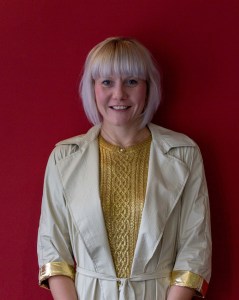
Maria FaustDr. Faust has worked for University of Leipzig, University of Technology Chemnitz, Stockholm University, University of Applied Sciences Mittweida, the Micro Census in Saxony, and the European Institute for Journalism and Communication Research.

In 2011 she presented her work at Oxford Internet Institute, in 2016 she won a Best Paper Award at IADIS Conference and presented at University of Sao Paulo, RANEPA, Sorbonne and Lomonosov University, amongst others. She served as CGCP Editor of Stanford Law School’s China Guiding Cases Project and held the position of an Associate Editor with the Postgraduate Journal Networking Knowledge of the British Media, Communication and Cultural Studies Association.

She has frequently published with China Media Research and guest-edited a special section on Visual Online Communication in BRICS countries with the same journal. In 2020 she edited a volume with Assoc. Prof. Thomas Herdin and Prof. Guo-Ming Chen on De-Westernization of Visual Communication and Cultures, embracing perspectives from the Global South with NOMOS publisher. Moreover, Dr. Faust’s articles have appeared in Kronoscope, East Asian Journal of Popular Culture, and Journal of Multicultural Discourses.

Since 2023, Dr. Faust has been investigating “The Epistemologies of Landscape in the Age of Deep Mediatization” from a transdisciplinary perspective in her postdoctoral project. First insights were presented at the Annual Conference of the Digital Geographies Research Group of the Royal Geographical Society, UK.


Work for CID:

Maria Faust has translated one of the Key Concepts in Intercultural Dialogue, KC28: Postcolonialism, and several of the CID Posters (#1: Intercultural Communication/Competence/Dialogue, #3: Intercultural Dialogue, #4: Types of Intercultural Communication, and #5: Kommunikation als Kulturdefinition) into German. She also has served as a reviewer of German translations by others.