CFP The Future of Educational Migration

“PublicationCall for papers: The Future of Educational Migration, as a special issue of Routed. Deadline: August 28, 2020.

University campuses have become unique cultural ecosystems where students from all over the world learn, socialise and live. However, over the past months, universities across the globe have been forced to abruptly shut down their campuses, move classes online and cancel study-abroad programmes causing disruption for students and institutions. As many prospective international students reconsider their plans to study abroad, governments have also discouraged and repatriated their citizens studying overseas.

The uncertainties caused by health concerns, border closures and travel limitations add to the ongoing geopolitical tensions and increasingly restrictive immigration regimes. Over the last few years, immigration policies such as the ‘hostile environment’ in the UK have also targeted international students, levying academic staff with border patrol responsibilities by pressuring them to monitor students’ immigration statuses. The current situation has intensified discrimination and visa restrictions; for instance, new international students will not be allowed to attend universities operating fully online in the US, while Chinese students in STEM fields claim to be increasingly regarded as a security threat in several countries. Meanwhile, Australia is implementing new policies to attract international students, such as allowing current students to continue their studies online while overseas. This edition will explore the future of educational migration through the lenses of COVID-19 and geopolitical changes.

CFP Multicultural Discourses (Romania but Online)

ConferencesCall for papers: 7th International Conference on Multicultural Discourses: Multicultural Discourses in a Turbulent World, Cluj-Napoca, Romania, October 24-26, 2020. Deadline: September 1, 2020.

UPDATE: Due to COVID-19, the submission deadline has been extended, and the conference will be held online.

The successful international conferences on Multicultural Discourses organized in China, Brazil, and the Netherlands, respectively, have reinforced the importance of Cultural Discourse Studies in contemporary social science and the humanities. The 7th International Conference on Multicultural Discourses, under auspices of the International Association of Multicultural Discourses, will be co-organized by the English Department of the Faculty of Letters, Babeş-Bolyai University, Cluj-Napoca, Romania and the School of Contemporary Chinese Communication Studies, Hangzhou Normal University, China. The event will be hosted at the Faculty of Letters, Babes-Bolyai University in Cluj-Napoca, Romania from October 24-26, 2020.

Mankind is witnessing yet again the centennial moment of global transformation and the world is ridden with grave challenges and great opportunities. To answer to these uncertain winds of change, scholars from various fields such as communication, media, language, literature, society, culture, international relations, etc. are encouraged to offer their insights into topics including, though not restricted to, the following:

  • Multicultural discourses of (anti)globalization, diversity, connectivity, globalism
  • Multicultural discourses of security, conflict, war, peace
  • Multicultural discourses of protectionism, (in)tangible borders, immigration, racism
  • Multicultural discourses of development, the Developing World, the Global South
  • Multicultural digital, multimodal, literary, cinematic discourses
  • Multidisciplinary, multicultural approaches to human discourses

In Dialogue: CID Occasional Papers, 1: ICD as the Elephant in the Room

Key Concepts in ICDIn Dialogue: CID Occasional Papers, 1: Intercultural Dialogue as the Elephant in the Room: Moving from Assumptions to Research Investigations by Wendy Leeds-Hurwitz.

In Dialogue

This is the first issue of a new publication series, In Dialogue: CID Occasional Papers. The goal of this first occasional paper is to synthesize the many publications using the term “intercultural dialogue” explicitly, summarize what has been learned, and outline what remains to be studied.

Intercultural dialogue might be called the elephant in the room, a metaphor referring to something obvious which is nonetheless ignored. Most often, practitioners and diplomats use the term intercultural dialogue, but they rarely define it, and conduct little to no research in order to discover how it works, but only hold it up as a desired end. Academics, who certainly conduct research, rarely use this term, thus have rarely studied it, although some research by other names sheds light on how it works.

Leeds-Hurwitz, W. (2020). Intercultural dialogue as the elephant in the room: Moving from assumptions to research investigations. In Dialogue: CID Occasional Papers, 1. Retrieved from:
https://centerforinterculturaldialogue.org/wp-content/uploads/2020/08/op1-leeds-hurwitz-final-1.pdf

As with prior publications, these will are available as free PDFs; just click on the thumbnail to download. As with prior publications, the Occasional Papers may be downloaded, printed, and shared as is, without changes, without cost, so long as there is acknowledgment of the source.

If you are  interested in publishing in this series, contact the series editor, Wendy Leeds-Hurwitz. If you are new to CID, please provide a brief resume.


Creative Commons License
This work is licensed under a Creative Commons Attribution-NonCommercial-NoDerivatives 4.0 International License.

Radcliffe Fellowships (USA)

FellowshipsRadcliffe Fellowships 2021-22, Harvard University, Cambridge, MA. Deadline: for humanities, social sciences, and creative arts, September 10, 2020; for science, engineering, and mathematics, October 1, 2020.

The Radcliffe Fellowship Program awards 50 fellowships each academic year. Applicants may apply as individuals or in a group of two to three people working on the same project. The goal is diversity along many dimensions, including discipline, career stage, race and ethnicity, country of origin, gender and sexual orientation, and ideological perspective. Although fellows come from many different backgrounds, they are united by their demonstrated excellence, collegiality, and creativity.

Radcliffe supports engaged scholarship. . .innovative work that confronts pressing social and policy issues and seeking to engage audiences beyond academia. The Institute’s focus areas include:

* Law, education, and justice
* Youth leadership and civic engagement
* Legacies of slavery

Reflecting Radcliffe’s unique history and institutional legacy, proposals that focus on women, gender, and society or draw on the Schlesinger Library’s rich collections are welcomed.

U Konstanz Institute for Advanced Study: Fellowships & Postdocs (Germany)

FellowshipsMultiple Fellowships and Postdocs, Zakunftskolleg, University of Konstanz, Konstanz, Germany. Deadline: 15 October 2020 or rolling (depending on opportunity).

The Zukunftskolleg is an Institute for Advanced Study (IAS) at the University of Konstanz. It offers 2-year and 5-year fellowships as well as a diverse support network to promote the independence of early career researchers. Researchers at the postdoctoral level perform research without administrative constraints and have the freedom to engage in meaningful exchange with other up-and-coming colleagues and with distinguished senior researchers.

2-year Postdoctoral Fellowships are for all those in the early stage of their career who plan to develop and implement an independent research project. Deadline: 15 October 2020.

5-year Research Fellowships promote researchers with significant work experience at the postdoctoral level aiming for a career in academia. Research Fellows build their own academic identity by leading an independent research group at the University of Konstanz. Deadline: 15 October 2020.

Senior Fellows are established guest scholars from the natural sciences, humanities or social sciences who join the Zukunftskolleg for a research stay and work with the fellows. Rolling deadline.

Zukunftskolleg Konnect Fellowships support early career researchers from Africa, Asia and Latin America related to one of the thirteen departments of the University of Konstanz, or to one of the Clusters of Excellence at the University of Konstanz: “Politics of Inequality”and the “Centre for the Advanced Study of Collective Behaviour”. Rolling deadline.

CFP Legacies of Black Lives Matter

“PublicationCall for Papers: The Legacies of Black Lives Matter: Language, Communication, and Social Psychological Perspectives toward Social Justice as a special issue of the Journal of Language and Social Psychology. Deadline: Letter of Intent at around 1500 words due at earliest convenience. Final deadline of accepted proposals: April 21, 2021.

Guest Editors: Howard Giles (University of California, Santa Barbara), Natasha Shrikant (University of Colorado, Boulder), and Shardé M. Davis (University of Connecticut).

JLSP is committed to understand, learn from, and enable change from our sub-disciplinary perspective. To this end, editors invite submissions that highlight how LSP approaches can reveal ways that racism, social justice, and social change appear in everyday language and communication and submissions that illustrate ways LSP approaches can be used to address and, most importantly, remedy these social problems. How do communities discuss, define, or ask for social change? How is language symbolically impacted in these processes as a tool to uphold structural racism or to promote social justice?

KC3 Intercultural Competence Translated into Macedonian

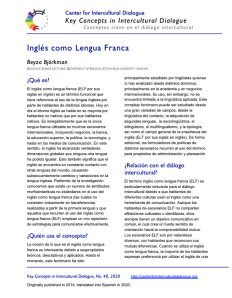
Key Concepts in ICDContinuing translations of Key Concepts in Intercultural Dialogue, today I am posting KC#3: Intercultural Competence, which Lily Arasaratnam wrote for publication in English in 2014, and which Emilija Jovanovska has now translated into Macedonian.

As always, all Key Concepts are available as free PDFs; just click on the thumbnail to download. Lists of Key Concepts organized alphabetically by conceptchronologically by publication date and number, and by languages into which they have been translated, are available, as is a page of acknowledgments with the names of all authors, translators, and reviewers.

KC3 Intercultural Competence_Macedonian

Arasaratnam, L. A. (2020). Intercultural competence [Macedonian]. (E. Jovanovska, trans). Key Concepts in Intercultural Dialogue, 3. Retrieved from:
https://centerforinterculturaldialogue.org/wp-content/uploads/2020/07/kc3-intercultural-competence_macedonian.pdf

If you are interested in translating one of the Key Concepts, please contact me for approval first because dozens are currently in process. As always, if there is a concept you think should be written up as one of the Key Concepts, whether in English or any other language, propose it. If you are new to CID, please provide a brief resume. This opportunity is open to masters students and above, on the assumption that some familiarity with academic conventions generally, and discussion of intercultural dialogue specifically, are useful.

Wendy Leeds-Hurwitz, Director
Center for Intercultural Dialogue


Creative Commons License
This work is licensed under a Creative Commons Attribution-NonCommercial-NoDerivatives 4.0 International License.

Migration and Integration Podcasts

PodcastsMatching the earlier list of podcasts relating to diversity and anti-racism, this is a list of podcasts on topics relating to migration and integration around the world.

The Migration Podcast from IMISCOE (International Migration, Integration and Social Cohesion in Europe, the EU network of 55 organizations)

The field of migration and mobility studies is vast and has grown exponentially over the past decades. At the same time, migration and fears of the foreign dominate public discourse around the world. To make sense of the movement of people, this podcast explores the latest in migration and mobility research globally. Providing a platform for migration scholars to speak about their projects, ideas and insights, The Migration Podcast aims to publicize and render more accessible what happens inside of universities around the world.

Migration Policy Institute Podcasts from MPI

The Migration Policy Institute is an independent, nonpartisan, nonprofit think tank in Washington, DC dedicated to analysis of the movement of people worldwide.

CMS Podcast from Center for Migration Studies

The Center for Migration Studies of New York (CMS) is a think tank and an educational institute devoted to the study of international migration, to the promotion of understanding between immigrants and receiving communities, and to public policies that safeguard the dignity and rights of migrants, refugees and newcomers.

Centre for Migration and Diaspora Studies Podcasts from SOAS, University of London

Lectures given as part of the Centre for Migration and Diaspora Studies joint seminar series are now available as podcasts through SOAS Radio. SOAS University of London is the leading Higher Education institution in Europe specialising in the study of Asia, Africa and the Near and Middle East.

For more ideas on podcasts, see also 5 Great Podcasts About Migration and Social Inclusion.

For related reading, see Key Concepts in Intercultural Dialogue,  #16: Migration, and #15: Cultural Pluralism.

Intercultural/Interracial Dialogue at Home

Resources in ICD“ width=Intercultural connections of all kinds (race, ethnicity, nationality, religion) happen at two levels – in public, and in private. Most research focuses on the former, but there is much to be gained by studying the latter. People who have intercultural friends have to discuss and face their differences, and find a way to manage them, and this is even more true for intercultural couples and families, who often are making a longer term commitment to an Other. There is a growing literature addressing the topic.

A few relevant sources follow.

Breger, R., & Hill, R. (Eds.). (1998). Cross-cultural marriage: Identity and choice. Oxford, UK: Berg.

Bystydzienski, J. (2011). Intercultural couples: Crossing boundaries, negotiating difference. New York NY: New York University Press.

Dervin, F. (2013). Do intercultural couples “see culture everywhere”? Case studies from couples who share a lingua franca in Finland and Hong Kong. Civilisations, 62, 1–15.

Gonçalves, K. (2013). Conversations of intercultural couples. Berlin, Germany: Akademie Verlag.

Inman, A. G., Altman, A., Kaduvettoor‐Davidson, A. N. J. U., Carr, A., & Walker, J. A. (2011). Cultural intersections: A qualitative inquiry into the experience of Asian Indian–White interracial couples. Family Process, 50(2), 248-266.

Johnson, E. D. (2020). Say I’m dead: A family memoir of race, secrets and love. Chicago, IL: Lawrence Hill Books.

Karris, T., & Killian, K. (Eds.). (2009). Intercultural couples: Exploring diversity in intimate relationships. London, UK: Routledge.

Lee, Pei-Wen. (2006). Bridging cultures: Understanding the construction of relational identity in intercultural friendship. Journal of Intercultural Communication Research, 35(1), 3-22.

Leeds-Hurwitz, W. (2002). Wedding as text: Communicating cultural identities through ritual. Mahwah, NJ: Erlbaum.

Leeds-Hurwitz, W. (Ed.). (2005). From generation to generation: Maintaining cultural identity over time. Cresskill, NJ: Hampton Press.

Martinez, L. V., Ting-Toomey, S., & Dorjee, T. (2016). Identity management and relational culture in interfaith marital communication in a United States context: A qualitative study. Journal of Intercultural Communication Research, 45(6), 503-525.

McFadden, J. (2001). Intercultural marriage and family: Beyond the racial divide. The Family Journal, 9(1), 39-42.

Moscato, G., Novara, C., Hombrados-Mendieta, I., Romano, F., & Lavanco, G. (2014). Cultural identification, perceived discrimination and sense of community as predictors of life satisfac- tion among foreign partners of intercultural families in Italy and Spain: A transnational study. International Journal of Intercultural Relations, 40, 22–33.

Piller, I. (2002). Bilingual couples talk: The discursive construction of hybridity. Amsterdam, Netherlands: John Benjamins.

Piller, I. (2007). Cross-cultural communication in intimate relationships. In H. Kotthoff & H. Spencer-Oatey (Eds.), Handbook of intercultural communication (pp. 341–359). Berlin, Germany: Mouton de Gruyter.

Romano, D. (2008). Intercultural marriage: Promises and pitfalls. Nicholas Brealey.

Sandel, T. L. (2015). Brides on sale: Taiwanese cross border marriages in a globalizing Asia. New York: Peter Lang.

Tili, T. R., & Barker, G. G. (2015). Communication in intercultural marriages: Managing cultural differences and conflicts. Southern Communication Journal, 80(3), 189-210.

Wilczek‐Watson, M. (2017). Intercultural intimate relationships. In Y. Y. Kim (Ed.), The international encyclopedia of intercultural communication. New York: Wiley. https://doi.org/10.1002/9781118783665.ieicc0058

See also Key Concepts in Intercultural Dialogue #1 on Intercultural Dialogue, #96 on Interreligious Dialogue, #12 on Third Culture Kids and #94 on Cross-Cultural Kids.


CFP In Dialogue: CID Occasional Papers

In Dialogue: Occasional PapersThe Center for Intercultural Dialogue is starting a new publication series, In Dialogue: CID Occasional Papers. The goal is to provide a place for longer discussions than are possible in any of the other publication series. There will likely be only one or two occasional papers published in any given year.

OP1, to be published next week, provides a broad overview of intercultural dialogue as it is studied and practiced today, summarizing a wide range of publications in a single place, in order that others can easily use this resource to learn what sources will be most relevant to their own needs, as well as showing what work already has been completed, and pointing out what remains to be done.

In Dialogue: CID Occasional Papers will be a good place to publish analyses of actual, naturally occurring intercultural dialogue, since this is what is most often missing from the literature. If you are  interested in publishing something of your own in this series, contact the series editor, Wendy Leeds-Hurwitz.

As with other series, the Occasional Papers will be made available for free on the site as printable PDFs. They may be downloaded, printed, and shared as is, without changes, without cost, so long as there is acknowledgment of the source.

My thanks to Donal Carbaugh, former CID Board Member, for suggesting the series title, and to Linda de Wit, former CID intern now serving as graphic design consultant, for creating the layout and design  of the new series.