KC37 Dialogic Listening Translated into Spanish

Key Concepts in ICDContinuing translations of Key Concepts in Intercultural Dialogue, today I am posting KC#37: Dialogic Listening, which Robyn Penman wrote for publication in English in 2014, and which Jhon Eduardo Mosquera Pérez has now translated into Spanish.

As always, all Key Concepts are available as free PDFs; just click on the thumbnail to download. Lists of Key Concepts organized chronologically by publication date and number, alphabetically by concept, and by languages into which they have been translated, are available, as is a page of acknowledgments with the names of all authors, translators, and reviewers.
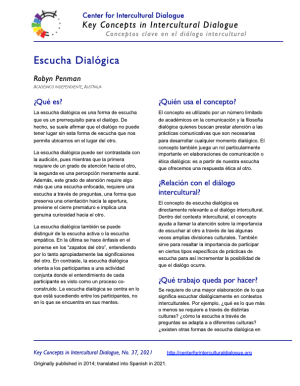
KC37 Dialogic Listening_SpanishPenman, R. (2021). Escucha dialógica. (J. E. Mosquera Pérez, trans). Key Concepts in Intercultural Dialogue, 37. Available from: https://centerforinterculturaldialogue.org/wp-content/uploads/2021/03/kc37_dialogic-listening_spanish.pdf

If you are interested in translating one of the Key Concepts, please contact me for approval first because dozens are currently in process. As always, if there is a concept you think should be written up as one of the Key Concepts, whether in English or any other language, propose it. If you are new to CID, please provide a brief resume. This opportunity is open to masters students and above, on the assumption that some familiarity with academic conventions generally, and discussion of intercultural dialogue specifically, are useful.

Wendy Leeds-Hurwitz, Director
Center for Intercultural Dialogue


Creative Commons License
This work is licensed under a Creative Commons Attribution-NonCommercial-NoDerivatives 4.0 International License.
CFP CMM Institute: 2021 Fellowship Program

FellowshipsCall for proposals, 2021 Fellowship program: When family, work and community merge: Learning and growing from the pandemic experience, Coordinated Management of Meaning (CMM) Institute, Oracle, AZ, USA. Deadline: May 1, 2021.

The CMM Institute is seeking innovative proposals for projects or studies which use CMM concepts to reflect on what we learned from the process of responding to a global pandemic, and how we might apply what we have learned to bridge fragmented social realities and identities that have been made more visible by this experience. Given this year’s CMMI focus on family systems, they have a particular interest in proposals which include circular questioning, cosmopolitan communication, and other uses of the CMM body of theory which engage structural change in thinking around patterns of social engagement.

Alternative Narratives and Intercultural Communication

Applied ICDAlternative Narratives and Intercultural Communication: Building Bridges Between Intercultural Policies and Communication, An Intercultural Cities Academy, Council of Europe, 12-21 April 2021, Online.

What story does your city tell? All cities have a history; a sequence of concrete facts that are known, and that have brought us to where we are today. However, how we tell the story of our city, how we choose to frame it, the narratives we choose, will impact how that story is perceived and understood. Our story is but a puzzle of many small, diverse and intertwined pieces with different shapes and forms. The story of our city is in fact not one, but many. Do you know what stories are told and listened to? How are they told, and by whom? Is the same story told by everyone, in the same way? Herein lies the art of narrative – while we cannot change facts, we have the power to choose how we communicate about them, ensuring all stories of our city are told. We understand we can enrich our communication with multiple perspectives, fill it with many voices and value the diversity of our city. Through this, we share our history while adding more pieces to the puzzle.

When to tell that story? For intercultural inclusion to occur, city authorities shall adopt a clear and well-publicised message emphasising their commitment to intercultural principles, on all occasions, in all their communication. Every story is intercultural in a diverse city and can contribute to achieving a climate of public opinion more conducive to positive intercultural relations.

Who should that story target? All residents, regardless of their nationalities, origins, languages, religions/beliefs, sexual orientation and age group. This is not to say that every communication needs to be intended for every resident, as the most effective communications are those that target audience segments defined by particular core values and daily concerns.

Target group? Communication staff, press officers, coordinators and other relevant city representatives of cities that are members of Intercultural Cities Programme.

KC100 Transcultural Communication

Key Concepts in ICDThe next issue of Key Concepts in intercultural Dialogue is now available. This is KC#100: Transcultural Communication, by Mohammed Guamguami. Click on the thumbnail to download the PDF. Lists organized chronologically by publication date and numberalphabetically by concept in English, and by languages into which they have been translated, are available, as is a page of acknowledgments with the names of all authors, translators, and reviewers.

KC100 Transcultural Communication

Guamguami, M. (2021). Transcultural communication. Key Concepts in Intercultural Dialogue, 100. Available from: https://centerforinterculturaldialogue.org/wp-content/uploads/2021/03/kc100-transcultural-communication.pdf

The Center for Intercultural Dialogue publishes a series of short briefs describing Key Concepts in Intercultural Dialogue. Different people, working in different countries and disciplines, use different vocabulary to describe their interests, yet these terms overlap. Our goal is to provide some of the assumptions and history attached to each concept for those unfamiliar with it. As there are other concepts you would like to see included, send an email to the series editor, Wendy Leeds-Hurwitz. If there are concepts you would like to prepare, provide a brief explanation of why you think the concept is central to the study of intercultural dialogue, and why you are the obvious person to write up that concept.


Creative Commons License
This work is licensed under a Creative Commons Attribution-NonCommercial-NoDerivatives 4.0 International License.
Dublin City U: Postdoc in Intercultural and Citizenship Education (Ireland)

PostdocsPost-doctoral Researcher in Intercultural and Citizenship Education, DCU Institute of Education, Dublin City University, Dublin, Ireland. Deadline: 26 March 2021.

The Centre for Human Rights and Citizenship Education (CHRCE) champions educational policy and practice promoting human rights, children’s rights, inclusion, global justice and environmental sustainability. The post-doctoral researcher will work on a funded project, INOVATE, concerned with representing and incorporating authentic minority ethnic young people’s voices within teacher education programmes at both pre-service and in-service levels. The successful individual will report directly to the project’s Principal Investigator and the Centre for Human Rights & Citizenship Education executive committee. The individual will coordinate the work of the project under the support and direction of the Principal Investigator and play a key role in achieving the project objectives and goals.

The individual will support the INOVATE project in order to contribute to the equal representation of young migrants within the education sector and an authentic and respectful public portrayal of individuals’ personal stories. Moreover, this authentic representation of ethnic minority voices and integration into teacher education programmes will enhance young migrants’ democratic and meaningful participation within the education sector and within wider society. The project will be delivered face to face and online and includes partnership between DCU and civil society groups who will work collectively to deliver the programme.

As part of this role the Researcher will be required to participate in the DCU Research Career Framework. This framework is designed to provide significant professional development opportunities to Researchers and offer the best opportunities in terms of a wider career path.

Lingnan U: Media & Creative Industries (Hong Kong)

“Job

Associate Professor of Media and Creative Industries,
Lingnan University,
Hong Kong. Deadline: Open until filled.

Lingnan University is seeking to hire a full-time Associate Professor in the area of Media and Creative Industries. Candidates should have (1) a strong PhD in film or media studies; (2) good track record in designing and teaching courses in media policy, media theory, media convergence and production studies (both undergraduate and postgraduate levels); (3) good track record in publication and successful grant application in the relevant areas; and (4) knowledge of local and regional media and creative industries.

There is a second position for Assistant Professor, Arts Administration and Management, as well.

Defiant Discourse

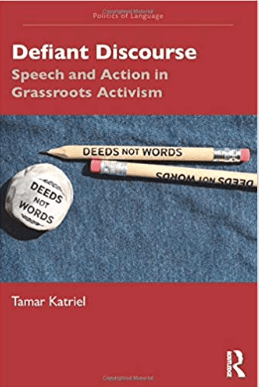
“Book NotesKatriel, Tamar. (2021). Defiant discourse: Speech and action in grassroots activism. New York: Routledge.

Defiant Discourse cover

Katriel examines multiple context of “defiant discourse” which cross the line between words and actions. Through participant observation, she documents activism in Israel. She asks questions about when talk itself serves as activism, and when action is called for. She examines activism “as a discursive formulation in which speech and action are defining features of the political realm,” pointing out that both speech and action are “world-making activities.”

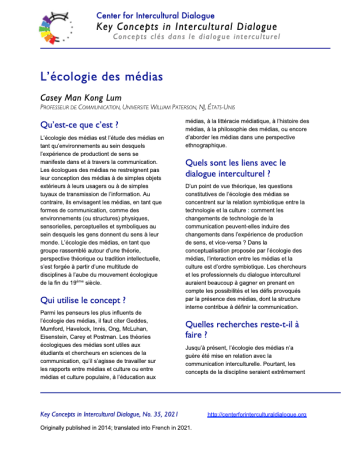
KC35 Media Ecology Translated into French

Key Concepts in ICDContinuing translations of Key Concepts in Intercultural Dialogue, today I am posting KC#35: Media Ecology, which Casey Man Kong Lum wrote for publication in English in 2014, and which Yves Winkin has now translated into French.

As always, all Key Concepts are available as free PDFs; just click on the thumbnail to download. Lists of Key Concepts organized alphabetically by conceptchronologically by publication date and number, and by languages into which they have been translated, are available, as is a page of acknowledgments with the names of all authors, translators, and reviewers.

KC35 Media Ecology-FrenchLum, C. M. K. (2020). L’écologie des médias. (Y. Winkin, trans). Key Concepts in Intercultural Dialogue, 35. Available from:
https://centerforinterculturaldialogue.org/wp-content/uploads/2021/05/kc35-media-ecology-french_v2.pdf

If you are interested in translating one of the Key Concepts, please contact me for approval first because dozens are currently in process. As always, if there is a concept you think should be written up as one of the Key Concepts, whether in English or any other language, propose it. If you are new to CID, please provide a brief resume. This opportunity is open to masters students and above, on the assumption that some familiarity with academic conventions generally, and discussion of intercultural dialogue specifically, are useful.

Wendy Leeds-Hurwitz, Director
Center for Intercultural Dialogue


Creative Commons License
This work is licensed under a Creative Commons Attribution-NonCommercial-NoDerivatives 4.0 International License.
MOOC Intercultural Communication 2021 (China)

“MOOCs”Intercultural Communication MOOC, Shanghai International Studies University (SISU), Shanghai, China. Opens March 15, 2021 with free access for 7 weeks from any start date between March-July 2021.

In a time when online learning helps those limited by COVID measures, the SISU-Future Learn “Intercultural Communication” course provides an important forum for cross-cultural exposure and interaction. To help connect people virtually world-wide again, a new run of the course opens March 15 until July 2021 and offers FREE access from the day of enrollment for 7 weeks of learning. Nearly 65,000 have enrolled in the SISU-FutureLearn “Intercultural Communication” MOOC course from nearly 200 global countries and regions since it was first launched in 2015.

The course invites participation on every “learning step”. Learners of all ages and backgrounds and our active team of Mentors comment on their questions, insights, “likes,” or responses to others. The “5 week” structure (which you can go through at your own pace) addresses topics like

  • Comprehending Intercultural Communication
  • Contextualizing Cultural Identities
  • Comparing Cultural Communication Styles
  • Clarifying and Contrasting Values
  • Cultivating Intercultural Adaptation
     
    to guide active participants toward greater awareness and practice of intercultural competence.


CFP Cyber Dystopia/Utopia? Digital Interculturality

“PublicationCall for Abstracts: Cyber Dystopia/Utopia? Digital Interculturality between Cosmopolitanism and Nationalism, Special Issue of Interculture Journal. Deadline: 1 April 2021.

While the cyber utopian thinkers of the early 1990s predicted the coming of a networked society in which the old hierarchical structures of business and culture would disappear, and the early 2010s, with the Arab Spring, the Occupy Movement and new ‘hacktivism’, appeared firstly as a progressive golden age of online political engagement, a more unpleasant type of Internet culture has gained traction within the past few years. As Angela Nagle has written: “The emergence of this new online right is the full coming to fruition of the transgressive anti-moral style, its final detachment from any egalitarian philosophy of the left or Christian morality of the right” (Kill All Normies, 2017, p. 39). Yet, the cyber utopian thinkers of the early 1990s were not wrong: The Internet does indeed have the potential to be a source of positive cosmopolitanism, whether understood in a philosophical- normative, descriptive or processual sense, and may facilitate both trans-local conversations on global matters and the decentring of discourse, allowing for the participation of a wider variety of agents and (sub)cultures in discussion.

For a special issue of the open-access Interculture Journal (spring, 2022), and within the framework of the research project “ReDICo: Researching Digital Interculturality Co-operatively,” funded by the German Federal Ministry for Education and Research, editors would like to interrogate the topic of “Cyber Utopia/Dystopia? Digital Interculturality between Cosmopolitanism and Nationalism” from a variety of angles. Issue editors will be Dr. Luisa Conti and PD Dr. Fergal Lenehan.