KC26 Global-Local Dialectic Translated into French

Key Concepts in ICDContinuing translations of Key Concepts in Intercultural Dialogue, today I am posting KC#26 Global-local dialectic, which Jana Simonis published in English in 2014, and  which Mohammed Guamguami has now translated into French.

As always, all Key Concepts are available as free PDFs; just click on the thumbnail to download. Lists of Key Concepts organized chronologically by publication date and number, alphabetically by concept, and by languages into which they have been translated, are available, as is a page of acknowledgments with the names of all authors, translators, and reviewers.
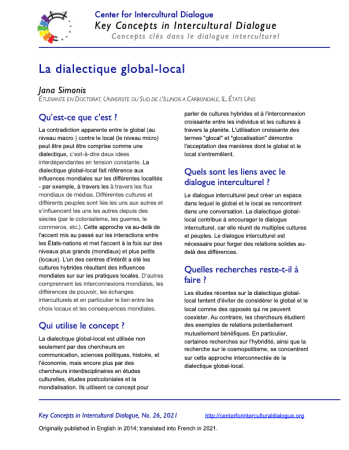
KC26 Global-local dialectic_French

Simonis, J. (2021). La dialectique global-local. (M. Guamguami, Trans.). Key Concepts in Intercultural Dialogue, 26. Available from: https://centerforinterculturaldialogue.org/wp-content/uploads/2021/07/kc26-global-local-dialectic_french.pdf

If you are interested in translating one of the Key Concepts, please contact me for approval first because dozens are currently in process. As always, if there is a concept you think should be written up as one of the Key Concepts, whether in English or any other language, propose it. If you are new to CID, please provide a brief resume. This opportunity is open to masters students and above, on the assumption that some familiarity with academic conventions generally, and discussion of intercultural dialogue specifically, are useful.

Wendy Leeds-Hurwitz, Director
Center for Intercultural Dialogue


Creative Commons License
This work is licensed under a Creative Commons Attribution-NonCommercial-NoDerivatives 4.0 International License.

CFP Migration Studies Special Issues

“Publication

Call for
Special Issue Proposals: Migration Studies
. Deadline: October 1, 2021.

The journal Migration Studies is now accepting Special Issue proposals. Migration Studies is a peer-reviewed journal that publishes high-quality papers in the broad field of migration, including gender, policies, transnationalism, diaspora, integration, development, and other migration-related issues around the world. They favor proposals engaging with current scholarly debates in the theories and/or methodologies of migration studies. And they welcome proposals by scholars from the South and non-anglophone areas exploring innovative streams of research.

A maximum of eight papers are expected for the published Special Issue, including an introduction laying out the importance and timeliness of the key themes, debates, and questions addressed by the Special Issue, as well as an overview of the key findings of the collection of articles.

KC49 Intersectionality Translated into French

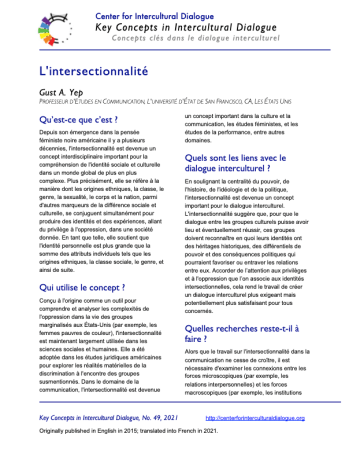
Key Concepts in ICDContinuing translations of Key Concepts in Intercultural Dialogue, today I am posting KC#49: Intersectionality, which Gust Yep published in English in 2015, and which Mohammed Guamguami has now translated into Spanish.

As always, all Key Concepts are available as free PDFs; just click on the thumbnail to download the PDF. Lists organized chronologically by publication date and numberalphabetically by concept in English, and by languages into which they have been translated, are available, as is a page of acknowledgments with the names of all authors, translators, and reviewers.

KC49 Intersectionality_French

Yep, G. (2021). L’intersectionnalité. (M. Guamguami, Trans.). Key Concepts in Intercultural Dialogue, 49. Available from:
https://centerforinterculturaldialogue.org/wp-content/uploads/2021/06/kc49-intersectionality_french.pdf

The Center for Intercultural Dialogue publishes a series of short briefs describing Key Concepts in Intercultural Dialogue. Different people, working in different countries and disciplines, use different vocabulary to describe their interests, yet these terms overlap. Our goal is to provide some of the assumptions and history attached to each concept for those unfamiliar with it. As there are other concepts you would like to see included, send an email to the series editor, Wendy Leeds-Hurwitz. If there are concepts you would like to prepare, provide a brief explanation of why you think the concept is central to the study of intercultural dialogue, and why you are the obvious person to write up that concept.


Creative Commons License
This work is licensed under a Creative Commons Attribution-NonCommercial-NoDerivatives 4.0 International License.

Musser Fund Grants for Intercultural Harmony 2021 (USA)

Intercultural Harmony Initiative, Laura Jane Musser Fund. Deadline:  October 15, 2021.


Through the Intercultural Harmony Initiative, the Laura Jane Musser Fund supports projects that promote mutual understanding and cooperation between groups of community members of different cultural backgrounds. Project planning grants up to $5,000 or implementation grants up to $25,000 will be considered.

Priority is placed on projects that include members of various cultural communities working together on projects with common goals; build positive relationships across cultural lines; engender intercultural harmony, tolerance, understanding, and respect; and enhance intercultural communication, rather than cultural isolation, while at the same time honoring the unique qualities of each culture.

NOTE: The geographic areas for this initiative are only Colorado, Hawaii, Minnesota, Wyoming, and limited counties in New York and Texas

U Penn: Global Communication (USA)

“JobProfessor of Global Communication Studies, Annenberg School for Communication, University of Pennsylvania, Philadelphia, PA, USA. Deadline: 30 September 2021.

The Annenberg School for Communication at the University of Pennsylvania is searching for an internationally recognized senior scholar to join our faculty and lead the School’s endowed Center for Advanced Research in Global Communication to begin the fall semester 2022. The School is looking for a productive researcher, engaged scholar, and committed teacher/mentor who studies cross-national, supranational, transnational and/or translocal theories and subjects, using qualitative and/or quantitative methods. Topics may include but are not limited to critical and/or comparative studies of media institutions, systems, and audiences as they relate to digital inequalities; diasporas; development; the uses and structural impacts of technologies; legal, economic and policy frameworks; journalism; the geopolitics of the popular; postcolonial and indigenous studies; and implications of communication infrastructures. Preference will be given to researchers whose work centers on the Global South. Candidates who add to the School and University diversity are strongly encouraged to apply.

Williams College: Asian American Studies (USA)

“Job

Assistant Professor in Asian American Studies, Department of American Studies, Williams College, Massachusetts, USA. Deadline: 11 October 2021.

The American Studies Program at Williams College seeks to make a tenure-track appointment in Asian American Studies, to start July 1, 2022, at the rank of Assistant Professor (in exceptional cases, a more advanced appointment may be considered). The program seeks to complement and expand the expertise of existing faculty who teach Asian American topics, at a time when the College is working towards building an Asian American Studies program. It is particularly interested in scholars doing comparative ethnic studies work, especially at the intersection of Asian American and African American/Black studies, but applications from  those working on other topics as well are also welcome.  There is a strong preference for interested candidates who demonstrate a commitment to the interdisciplinary nature and methodologies of American Studies in their research and teaching. The teaching load is two courses per semester and a three-week-long winter-study course every other January.

CFP Governance of Cultural Diversity (Italy but Online)

ConferencesCFP Theories and Practices of Governance of Cultural Diversity Workshop, Scuola Normale Superiore, Italy, September 28, 2021 (held online). Deadline: September 4, 2021.

Over the past decades, the traditional distinction between national and international spheres has experienced great pressure as conventional state-centric practices and state-sponsored international governance have been challenged or replaced by new forms of governance. The rise of diverse non-state actors and institutional arrangements has profoundly changed the dynamics and outcomes of global politics. This Workshop Series aims to foster debate on a range of topics related to different transnational policy arenas (such as economy, international mobility, security, sustainability) as well as issues cutting across several policy domains (including questions around the legitimacy, accountability and effectiveness of transnational actors and structures). This event will bring together PhD candidates, postdoctoral researchers, and senior scholars from different strands of research, to discuss key analytical issues and empirical research in progress on multi-level global and regional politics of today.

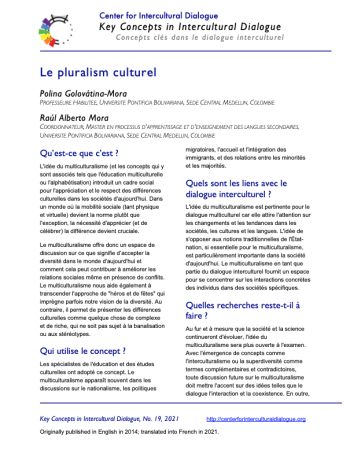
KC19 Multiculturalism Translated into French

Key Concepts in ICDContinuing translations of Key Concepts in Intercultural Dialogue, today I am posting KC#19: Multiculturalism, which Polina Golovátina-Mora and Raúl Alberto Mora wrote for publication in English in 2014, and which Mohammed Guamguami has now translated into French.

As always, all Key Concepts are available as free PDFs; just click on the thumbnail to download. Lists of Key Concepts organized chronologically by publication date and number, alphabetically by concept, and by languages into which they have been translated, are available, as is a page of acknowledgments with the names of all authors, translators, and reviewers.

KC19 Multiculturalism_FrenchGolovátina-Mora, P., & Mora, R. A. (2021). Le pluralism culturel. (M. Guamguami, Trans.). Key Concepts in Intercultural Dialogue, 19. Retrieved from: https://centerforinterculturaldialogue.org/wp-content/uploads/2021/06/kc19-multiculturalism_french.pdf

If you are interested in translating one of the Key Concepts, please contact me for approval first because dozens are currently in process. As always, if there is a concept you think should be written up as one of the Key Concepts, whether in English or any other language, propose it. If you are new to CID, please provide a brief resume. This opportunity is open to masters students and above, on the assumption that some familiarity with academic conventions generally, and discussion of intercultural dialogue specifically, are useful.

Wendy Leeds-Hurwitz, Director
Center for Intercultural Dialogue


Creative Commons License
This work is licensed under a Creative Commons Attribution-NonCommercial-NoDerivatives 4.0 International License.

Linköping U: Postdoc in Gender Studies (Sweden)

Postdocs

Postdoc in Gender Studies, Department of Thematic Studies, Linköping University, Linköping, Sweden. Deadline: 9 September 2021.

The Department of Thematic Studies (TEMA) invites applications for a Postdoc in Gender Studies. The successful candidate is expected to carry out research, while the position may also involve teaching, but during no more than a fifth of work time. The present position involves research in the fields of gender studies, science and technology studies, and migration studies. The position is part of the project: Calculating migration: A multi-sited ethnography of algorithmic governance and redistribution keys which is a collaboration between TEMA, Gender Studies (LiU), REMESO (LiU) and the European New School of Digital Studies (Viadrina U). Using ethnographic methods, the project examines the production, implementation, and consequences of algorithms in relation to migration management. The Department is seeking a candidate who can expand the scope of the project on one or more of these fields.

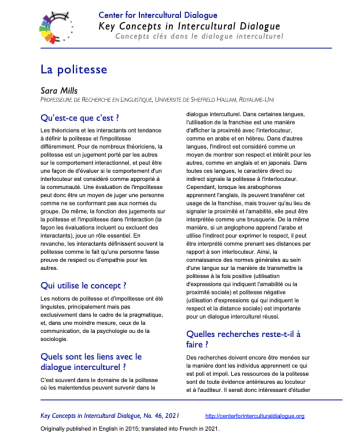
KC46 Politeness Translated into French

Key Concepts in ICDContinuing translations of Key Concepts in Intercultural Dialogue, today I am posting KC#46: Politeness, which Sara Mills wrote for publication in English in 2015, and which Mohammed Guamguami has now translated into French.

As always, all Key Concepts are available as free PDFs; just click on the thumbnail to download. Lists of Key Concepts organized chronologically by publication date and number, alphabetically by concept, and by languages into which they have been translated, are available, as is a page of acknowledgments with the names of all authors, translators, and reviewers.

KC46 Politeness_FrenchMills, S. (2021). La politesse. (M. Guamguami, Trans.). Key Concepts in Intercultural Dialogue, 46. Available from:
https://centerforinterculturaldialogue.org/wp-content/uploads/2021/06/kc46-politeness_french.pdf

If you are interested in translating one of the Key Concepts, please contact me for approval first because dozens are currently in process. As always, if there is a concept you think should be written up as one of the Key Concepts, whether in English or any other language, propose it. If you are new to CID, please provide a brief resume. This opportunity is open to masters students and above, on the assumption that some familiarity with academic conventions generally, and discussion of intercultural dialogue specifically, are useful.

Wendy Leeds-Hurwitz, Director
Center for Intercultural Dialogue


Creative Commons License
This work is licensed under a Creative Commons Attribution-NonCommercial-NoDerivatives 4.0 International License.