King’s College London: International Education (UK)

“Job

Postdoctoral Teaching Fellow in International Education, King’s College London, London, UK. Deadline: 24 October, 2021.


King’s College London is seeking to recruit a social science scholar with interests in the global dimensions of education to contribute to teaching and program administration on our BA Social Sciences and MA Education suite of programs. The successful candidate will have expertise in, or that can be applied to, international and comparative education, education in a global context, and education and international development, with a strong grounding in a foundation discipline. They will also have strong communication, organizational and teamworking skills, a commitment to inclusive and democratic ways of working, proven teaching ability and an interest in, and aptitude for, communication across disciplines. They will be a member of the friendly and vibrant Centre for Public Policy Research within the School of Education, Communication and Society, which is a School in the Faculty of Social Science and Public Policy. The school particularly welcomes candidates from Black, Asian and minority ethnic backgrounds. This full-time post post will be offered on an a fixed-term contract for 12 months.

CFP Families in Global Transition 2022 (Online)

Conferences

Call for proposals, Families in Global Transition 2022: Where do we go from here? March 21-22, 2022, USA but online. Deadline: 11 October 2021.

Over the last two years, the world has changed in ways that most of us could never have imagined. We are still living with the pandemic, but we are also experiencing a period of social, racial, economic and environmental reckoning that spans the world. Even if by some miracle, we were to all begin to return to a life without lockdown tomorrow, the aftershocks of all these realities combined will be felt for a long time to come. Whatever your personal situation or experience, this has had an impact on all of us. The world has changed. FIGT2022 is dedicated to reflecting on these changes and asking the big question: ‘Where do we go from here?’

Presenters are asked to address one of these three strands to help begin to answer this question.

  • Connecting: how can our individual, unique challenges and experiences bring us together as individuals and a community across cultures, borders and generations? How can we better hold space for each other’s unique experiences? This strand will look at how we can come together in ways that encourage mutual understanding, sharing and growth.

  • Innovating: can the challenges we face lead us to new research and/or new practices personally or professionally? This strand will look at whether our experiences can lead to growth, reconstruction and reimagining across all aspects of our globally mobile world.

  • Thriving: how can we develop skills to help us cope with the pain and discomfort that a globally mobile, cross-cultural life might bring in 2022? This strand is an opportunity to explore our own reflections as well as providing insights into best practices for support so that we can find ways to thrive, despite our challenges.


Dialogue for Intercultural Understanding

“Book NotesMaine, F., & Vrikki, M. (Eds.). (2021). Dialogue for intercultural understanding: Placing cultural literacy at the heart of learning. Springer Nature.

This book is a result of an extensive, ambitious and wide-ranging pan-European project focusing on the development of children and young people’s cultural literacy and what it means to be European in the twenty-first century, prioritizing intercultural dialogue and mutual understanding.

Maine and Vrikki have edited this collection resulting from a major EU funded project, DIALLS (Dialogue and Argumentation for cultural Literacy Learning in Schools), lasting 3 years, and involving 10 partners around Europe. The challenge “was to create a project that could address how children and young people might develop the knowledge, skills and competencies needed for intercultural dialogue and mutual understanding. The DIALLS project has met this challenge by working with teachers in different educational settings (pre-primary, primary and secondary) to create cross-curricular resources and activities…In a further innovation and to enable intercultural dialogue in action, the project developed an online platform as a tool for engagement across classes.” (p. 2).

CFP Sociolinguistics Symposium 2022 (Belgium + Online)

ConferencesCall for proposals, Sociolinguistics Symposium 24: Inside and Beyond Binaries, Ghent University, Ghent, Belgium (and online), 13-16 July 2022. Deadline: 25 October 2021.

Sociolinguistics Symposium is the world’s main gathering of sociolinguists internationally. This two-yearly event provides a unique opportunity and forum to develop and exchange ideas and research findings about language and society in its manifold connections and manifestations. From its beginnings as a small meeting in the UK in 1976, the tradition of Sociolinguistic Symposia has grown into the largest sociolinguistic networking event in the world. Attracting hundreds of participants and exhibitors, the Symposium is also a stimulating space for networking.

It is with much enthusiasm that organizers announce Sociolinguistics Symposium 24. SS24 will be held in Ghent in July 2022. In close consultation with previous symposium organizers and colleagues in Hong Kong, the tradition of a meeting in even years is upheld. SS24 in 2022 will mark the 20th anniversary of the first Sociolinguistics Symposium hosted on the European mainland (SS14 in Ghent in 2002). SS24 is organized by Ghent University in close collaboration with the Belgian sociolinguistic community. The dates of the conference are 13-16 July 2022.

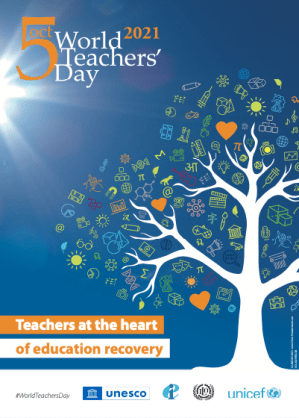
World Teachers’ Day Oct 5 2021

EventsWorld Teachers’ Day: Teachers at the Heart of Education Recovery, October 5, 2021. Sponsored by UNESCO, UNICEF, International Labour Organization, and Education International.

World Teachers' Day 2021

We honor all the teachers who follow the Center for Intercultural Dialogue. This has been a difficult year and a half for so many. Take a moment to pause, and appreciate all that has been accomplished despite the difficulties caused by the pandemic.

For those who have the time, World Teachers’ Day celebrations will take place from 4 to 8 October 2021.

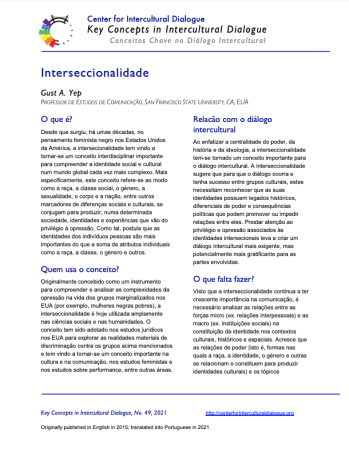
KC49 Intersectionality Translated into Portuguese

Key Concepts in ICDContinuing translations of Key Concepts in Intercultural Dialogue, today I am posting KC#49: Intersectionality, which Gust Yep published in English in 2015, and which Filipa Subtil has now translated into Portuguese.

As always, all Key Concepts are available as free PDFs; just click on the thumbnail to download the PDF. Lists organized chronologically by publication date and numberalphabetically by concept in English, and by languages into which they have been translated, are available, as is a page of acknowledgments with the names of all authors, translators, and reviewers.

KC49 Intersectionality_Portuguese

Yep, G. (2021). Interseccionalidade. (F. Subtil, Trans.). Key Concepts in Intercultural Dialogue, 49. Available from: https://centerforinterculturaldialogue.org/wp-content/uploads/2021/09/kc49-intersectionality_portuguese.pdf

The Center for Intercultural Dialogue publishes a series of short briefs describing Key Concepts in Intercultural Dialogue. Different people, working in different countries and disciplines, use different vocabulary to describe their interests, yet these terms overlap. Our goal is to provide some of the assumptions and history attached to each concept for those unfamiliar with it. As there are other concepts you would like to see included, send an email to the series editor, Wendy Leeds-Hurwitz. If there are concepts you would like to prepare, provide a brief explanation of why you think the concept is central to the study of intercultural dialogue, and why you are the obvious person to write up that concept.


Creative Commons License
This work is licensed under a Creative Commons Attribution-NonCommercial-NoDerivatives 4.0 International License.

SDSU: Asst Prof of Conflict Communication/Civil Discourse (USA)

“JobAssistant Professor of Conflict Communication / Civil Discourse, San Diego State University, CA, USA. Deadline: October 11, 2021 (or until filled).

The School of Communication at San Diego State University (SDSU) invites applications for a tenure-track faculty position in Conflict Communication/Civil Discourse, at the level of advanced assistant professor, to start August 2022.

Responsibilities: The successful candidate is expected to have a scholarly research agenda examining conflict communication or civil discourse from an interpersonal, organization, group, health, or intercultural, perspective. The faculty member will be able to teach curriculum at the undergraduate and graduate level. Courses include, but are not limited to, topics in communication theory, methodology, and conflict management. The candidate will also have the opportunity to create and teach classes aligned with their particular research interests, including upper division and graduate level courses. The successful candidate will also be expected to provide service to the School, College, University, and professional communication organizations. Faculty members are expected to serve on and chair master’s thesis and comprehensive examination committees, and mentor early career faculty members as appropriate.

Saint Louis U: Race & Media (USA)

“JobAssistant Professor of Race and Media, Department of Media and Cinema Studies, Saint Louis University, Missouri, USA. Deadline: Review to begin 18 October, 2021, until position is filled.

Saint Louis University is seeking applicants for a tenure-track position in the Department of Communication. We are seeking a candidate with expertise in race, media and social justice. The position is at the assistant professor level, to begin in Fall 2022. Duties include teaching courses such as media and society, stereotyping and bias in media and other courses in the Journalism and Media Studies concentration, along with courses in the department’s core curricula and in our graduate program. Candidates are expected to participate in service and maintain an active program of published research. Tenure-track faculty in our department teach two courses each semester. Earned doctorate by August 1, 2022, documented teaching experience and excellence and record or promise of published scholarly research. A successful candidate will demonstrate meaningful commitment to social justice, equity and inclusion in their teaching, research and service.

Michigan State U: Interethnic & Intercultural Communication (USA)

“JobTenure track open rank in Interethnic and Intercultural Communication, Department of Communication, Michigan State University,  East Lansing, MI USA. Deadline: September 8, 2023; posted September 8, 2021.

The College of Communication Arts and Sciences at Michigan State University invites applicants for a multi-position thematic hire with a focus on race, ethnicity, gender, and/or social inequality. They seek scholars whose research, teaching, outreach and/or service seek to address systemic inequities and who will advance the College’s commitment to diversity, equity, and inclusion. The goal of the thematic hire is to grow our collaborative network of scholars focused on communication and disparities across a broad range of subdisciplines, bringing together new hires and existing faculty experts. Successful candidates will be part of a community of scholars and practitioners working to enhance social justice through research in the fields of communication, journalism studies, advertising, public relations, information science, game studies, and communicative sciences and disorders. The hiring initiative will bring in five new faculty over two years.

One open rank tenure stream faculty position will be in the Department of Communication. The optimal candidate should be able to teach courses in interethnic and intercultural communication as well as a secondary area in organizational, interpersonal, or persuasive communication. They are particularly interested in scholars who contribute to and test communication theory in diversity and intercultural communication contexts. Qualified applicants should have a social scientific focus, a background in quantitative research methods, and expertise to teach both graduate and undergraduate courses. Candidates must have a commitment to mentoring graduate students, teaching, high-quality empirical research, and external grant activity. Applicants should have a Ph.D. in Communication or a related field.

NOTE: This is Posting #732271, once you get to the MSU site.

EIUC Electoral Observers Training 2021 (Italy)

Applied ICD

Training seminar for International Electoral Observers, Global Campus of Human Rights, Venice, Italy, 15-20 November 2021. Deadline: 29 October 2021.

The Global Campus of Human Rights has developed a course aiming at providing training to civilian staff in election observation missions at the first steps of their career (i.e. short term observers). Selected applicants will be allowed to become aware of the role, the tasks and the status of international observers, and will be given a theoretical and practical training on election observation and election observation missions functioning. The training will take place in Venice, at the Global Campus of Human Rights Headquarters, from 15-20 November 2021.

After the successful brand new online edition of February 2021, a second edition of the course will offer selected participants a new challenging experience in distance learning education.