CFP Investigating Intersectionality in Communication

“PublicationCall for articles: Special Issue of Howard Journal of Communications: Investigating Intersectionality in Communication.  Deadline: 30  September 2022.

Special Issue Editor: Chuka Onwumechili, Howard University

Kimberlé Crenshaw, a few decades ago, conceptualized the term intersectionality to vividly argue the impact of a person’s multiple and interacting social identities on how they are treated by others. For communication scholars, it exposed the insufficiency and inadequacy of work that focus on studying single variables and it alerted us to the need to incorporate the effects of multiple embedded variables during communication. For instance, the fact that one is a woman, African American, and lesbian and/or living with a disability may interactively impact her status within society and the effects of how others communicate with her. This complexity identifies the realism of life. Although, Crenshaw coined the term intersectionality in 1989 and it was added to the Oxford Dictionary in 2015. Although the concept is increasingly discussed in academic literature, it is not yet fully explored and understood.

Therefore, the Howard Journal of Communications calls on scholars to submit manuscript for a special issue intended to deeply explore intersectionality within the field of communication as it pertains to African American social conditions. This call provides a wide range of choices for exploring communication and social conditions with the central theme of intersectionality. Submissions should be, preferably, research-based, and no more than 10,000 characters (including references) long. Suggested themes are listed as follows.

  • Reconceptualizing identity in intersectionality
  • Intersectional rhetoric
  • Intersectionality: Theory or praxis?
  • Research methods for exploring intersectionality
  • Intersectionality critique
  • Re-examining historical scholarship in communication and intersectionality
  • Communication technologies and intersectional issues
  • Other possible topics

Call for New Editor: Comparative Education Review

Professional OpportunitiesCall for New Editor and Editorial Team of Comparative Education Review (a CIES journal). Deadline: 7 October 2022.

The Comparative and International Education Society (CIES), through the Standing Committee on Publications, calls for proposals for an editor(s) and editorial team for the Comparative Education Review. The new editor or coeditors will assume a five-year term, beginning on July 1 2023, and with responsibility for CER issues beginning in February 2024.

Proposals from the prospective editor/co-editors are encouraged to address: Their vision for the future of CER and its intellectual support of CIES membership and comparative and international research on education in general. A proposal should also present ideas for special issues, forums, debates, and innovative ways to disseminate the journal’s content including on social media platforms, create opportunities for mentorship of junior scholars as well as strategies further to increase CER’s scholarly impact. The proposal should include a description of the proposed editorial team and explain how it will ensure diversity of intellectual perspectives in the field, maintain the methodological strength of CIES scholarship, and support representation of current and emerging content areas and regions of the world.

U Greenwich: Refugee Student Integration (UK)

“Studentships“

PHD Studentship: A Linguistic Ethnography of Displaced and Refugee-Background Students’ Integration into Higher Education and University Life, Faculty of Health, Student Sciences, and Education, University of Greenwich, UK. Deadline: 2 September 2022.

The successful candidate will be expected to design and conduct a linguistic ethnography study focussed on refugee-background students’ language learning trajectories and lived experience of educational transitioning in the context of UK higher education. The work to be undertaken is expected to: contribute to the field of adult language learning, particularly at advanced levels of language proficiency required for university-level studies, and produce new insights into how to best foster general and academic language development in disadvantaged learners throughout their higher education journey.

The PhD student will be supervised by Professor Gordon Ade-Ojo and Dr Erika Kalocsányiová from the Centre for Thinking and Learning in the Institute for Lifecourse Development.

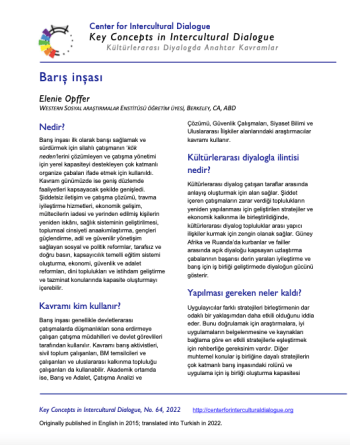
KC64: Peacebuilding Translated into Turkish

Key Concepts in ICDContinuing translations of Key Concepts in Intercultural Dialogue, today I am posting KC#64: Peacebuilding, which Elenie Opffer wrote for publication in English in 2015, and which Candost Aydın has now translated into Turkish.

As always, all Key Concepts are available as free PDFs; just click on the thumbnail to download. Lists of Key Concepts organized chronologically by publication date and number, alphabetically by concept, and by languages into which they have been translated, are available, as is a page of acknowledgments with the names of all authors, translators, and reviewers.

KC64 Peacebuilding_TurkishOpffer, E. (2022). Peacebuilding [Turkish]. (C. Aydın, trans). Key Concepts in Intercultural Dialogue, 64. Retrieved from: https://centerforinterculturaldialogue.org/wp-content/uploads/2022/08/kc64-peacebuilding_turkish.pdf

If you are interested in translating one of the Key Concepts, please contact me for approval first because dozens are currently in process. As always, if there is a concept you think should be written up as one of the Key Concepts, whether in English or any other language, propose it. If you are new to CID, please provide a brief resume. This opportunity is open to masters students and above, on the assumption that some familiarity with academic conventions generally, and discussion of intercultural dialogue specifically, are useful.

Wendy Leeds-Hurwitz, Director
Center for Intercultural Dialogue


Creative Commons License
This work is licensed under a Creative Commons Attribution-NonCommercial-NoDerivatives 4.0 International License.

Open U: Indigenous Religious Studies (UK)

“Job

Lecturer in Religious Studies, Faculty of Arts and Social Sciences, The Open University, Milton Keynes, UK. Deadline: 29 August 2022.

Applications are invited for a lecturer qualified to teach and research the indigenous religious cultures of any region(s) of Africa, the Americas, the Arctic, Asia, or Oceania. Completion of a PhD is essential. The role will involve contributing to the development of new Religious Studies curriculum within the School of Social Sciences and Global Studies. You will be joining an expanding subject area in terms of curriculum, student numbers and overall contribution to the School, Faculty and University.

U Vaasa: Manager of International Development (Finland)

“Job

Manager of International Development, University of Vaasa, Vaasa, Finland. Deadline: 7 September 2022.

As the International Development Manager you will work to achieve substantial growth in overseas recruitment and enhance institutional global partnerships and networks in the designated market (India and South Asia). Working closely with the Vice Rector and reporting to the Director of International Development, you lead the implementation of the University’s international student recruitment strategy as a part of the wider University strategic plan and in support of the University Schools’ objectives. In consultation with senior management and other internal stakeholders, you will set recruitment priorities and deliver appropriate international development for the dedicated market.

To be successful in this role, you will have a background in and experience of international student recruitment, and ideally excellent knowledge of India/South Asia and another major recruitment market. You have excellent collaborative skills and substantial experience of developing strong working relationships in an international setting.

In this role you should be prepared to undertake overseas visits which amount up to twelve weeks each year. The focus of this role will be India and South Asia. You may be expected to engage in other recruitment markets in line with the University’s development plans.


Threads on Threads: Cultural Heritage and Intercultural Dialogue (Sri Lanka)

Applied ICDThe European Union (EU) Delegation in Sri Lanka and the Maldives together with the Threads of History Museum presents ‘Threads on Threads: an exhibition on the textile heritage in Sri Lanka, South Asia and Europe’. The two-week exhibition is an initiative of the EU Cultural Heritage Series.

Because the exhibition showcases the longstanding trade relationship between Sri Lanka, South Asia, and Europe, it can be seen as a good way to encourage intercultural dialogue.

Cultural heritage can be an important vector for peace, reconciliation, mutual understanding, intercultural dialogue and sustainable development.

Denis Chaibi,
EU ambassador to Sri Lanka and the Maldives

See these articles for more information: 

European Union External Action. (2022, June 24). Threads on Threads: An exhibition and conference on textiles in Sri Lanka, South Asia and Europe.

(2022, July 17). Threads on Threads: An exhibition on textile heritage in Sri Lanka. The Sunday Times Magazine.

(2022, July 15). Threads on Threads: An exhibition on textile heritage in Sri Lanka. Lanka News Web.

COE: Intercultural Citizenship Test

Intercultural PedagogyThe Council of Europe’s Intercultural Cities Programme has created an Intercultural Citizenship Test, designed to spark discussion of what makes a good citizen in a multicultural context. It can be taken online, or offline, and is specifically intended to be a teaching tool. What’s particularly nice is that the focus is not on getting right or wrong answers, but sparking discussion.

“Interculturalism is about understanding that well managed diversity and positive interaction between different cultures can be an advantage. It moves beyond simply accepting different cultures and celebrates both the differences and similarities between them as something that can make communities stronger.

This of course does not mean that it is only about praising new or stranger cultures, but also about honouring traditional and local sides of culture. It is all about the relationship between these, and the many aspects that make up a community. These could be, but are not limited to, nationality, ethnic origin, language, gender identity and sexual orientation and religious beliefs.”

The Intercultural Citizenship Test is available in an impressive range of languages: Basque, English, French, German, Greek, Italian, Portuguese, Spanish, Turkish, and Ukrainian.

Royal Geographical Society: Journey of a Lifetime Award

Grants

Journey of a Lifetime Award, Royal Geographical Society, UK. Deadline: will be early autumn 2022.

For those with a passion for radio and storytelling, and a genuine curiosity about the world around them, the Journey of a Lifetime Award offers £5,000 to make an original and inspiring journey anywhere in the world. The recipient of the award will receive training in radio broadcasting from the BBC, support from a BBC documentary producer, and will record their journey for a BBC Radio 4 programme.

Established in 2001, the Journey of a Lifetime Award is a collaboration between the Society and the BBC, and is generously supported through a private donation. The award aims to support informed travel and learning, through experience rather than scientific research, and to discover new radio talent. The outcome of each of journey is a BBC Radio 4 travel documentary.

CFP Interdisciplinary Dialogues: Africa-Brazil

“PublicationCall for articles: Special Issue of Revista UNINTER de Comunicação: Diálogos interdisciplinares África – Brasil o lugar da Comunicação e das Humanidades [Interdisciplinary Dialogues Africa – Brazil: The place of communication and humanities].  Deadline: 25  August 2022.

O Brasil é um País “africanizado”, como bem definiu Lélia Gonzalez ao falar sobre a influência da África na língua portuguesa. E vai além, com a internalização da contribuição africana na cultura brasileira. Não é novidade constatar que os brasileiros, no entanto, sabem muito pouco sobre África, sobre os vários povos e países que compõe o continente. Conhecer melhor o continente africano é não só ampliar o olhar para muitas das origens do Brasil, mas é também aproximar-se da cultura da língua portuguesa que é idioma oficial de vários países, como Moçambique. O país já se tornou destino para muitos brasileiros, já que para além de uma boa relação entre os dois povos, existem muitos vínculos, dentre os quais, a Comunicação se destaca como dos mais fortes.

Desse modo, torna-se cada vez mais importante expandir o conhecimento sobre os países africanos, especialmente os de língua portuguesa. A Revista Uninter de Comunicação (RUC) quer contribuir ainda mais nesse sentido e por isso propõe o dossiê temático “Diálogos interdisciplinares Africa – Brasil: o lugar da Comunicação e das Humanidades”, organizado pelos pesquisadores Prof. Dr. Nelson Júlio Chacha, Reitor da Universidade Wutivi, Boane, Moçambique e o Prof. Dr. Toni André Scharlau Vieira, Universidade Federal do Paraná, Paraná, Brasil. Esse dossiê é dirigido para os pesquisadores que trabalham com o continente e que pesquisam aspectos da Comunicação e das Ciências Humanas, especialmente nas nações de língua portuguesa.

[The journal Revista UNINTER de Comunicação has extended the deadline for submitting works to the thematic issue “Interdisciplinary Dialogues Africa – Brazil the place of communication and humanities.” Organized by researchers Dr. Nelson Júlio Chacha, Dean of Wutivi University, Boane, Mozambique and Dr. Toni André Scharlau Vieira, Federal University of Paraná, Paraná, Brazil, this call is directed to researchers who work with the continent and research aspects of Communication and human sciences, especially in the Portuguese speaking nations.]

NOTE: Since the call was issued in Portuguese, articles should presumably be submitted in Portuguese.