Intercultural Communication Course in London (2015)

Intercultural Communication Course in London

An intercultural communication course will be taught for the tenth time this summer in London from June 25 to July 29. Students earn 6 hours of undergraduate or graduate credit.  Field trips to observe social interaction, public discourse, and language variations have taken students to Parliament, the criminal courts, ethnic communities, Speakers’ Corner, the British Museum, the British Library, the Museum of Welsh Folk Life, art museums, outdoor markets, public parks and plazas, a senior citizen daycare facility, and a comedy club. During past years students have also visited universities in Oxford, Cambridge, Portsmouth, Norwich, Bath, Bristol, and Cardiff. Similar activities are being planned for 2015, along with an extended excursion to Edinburgh, Scotland.  Students stay in a conveniently located central London residence hall and have ample opportunity for recreation, sightseeing and travel. Application deadline is February 27, 2015.

For information about the course, contact Dr. Charles H. Tardy.

Cyber-Conference on Dispute Resolution: Inter-Cultural Conflict

5th Annual Global Cyber-Conference on Dispute Resolution
April 15, 2015 @ 11 am to 1:30 pm Alaska time

Keynote Speaker:
The Honorable Raf Gangat, former South African Ambassador to United Arab Emirates, Former Consul General in Pakistan, and Former South African Ambassador to The Palestinian Territories.

Theme:
‘Inter-Cultural Conflict’ with a particular emphasis on Indigenous Conflict Resolution.

Sessions:
1. Therapeutic Jurisprudence and Inter-Cultural Conflict (facilitated by Mike Jones, Arizona Summit Law School and David Wexler, University of Puerto Rico School of Law, 40 min)
2. The Causes and Consequences of Inter-Cultural Conflict and the Value of Restorative Practices (facilitated by Bruce Barnes, Matsunaga Institute of Peace and Conflict Resolution, University of Hawaii, 40 min)
3. Circle Peace-Making, Indigenous Knowledge, and Dispute Resolution  (co-facilitated by Brett Shelton, Oglala Sioux, Native American Rights Fund, Boulder, Colorado and Polly Hylsop, Athabascan Dineh, University of Alaska Fairbanks, 40 min)

How to Participate:
If you would like to present a short piece under any of the three above headings, please contact Brian Jarrett and Polly Hyslop and we will slot your discussion piece in the appropriate session. We will maintain our informal town-hall style format as we have in previous Cyber-conferences, so we expect short presentations mixed with lively discussion.

Be sure to reserve a conference room and the Cyber-Conference video-conferencing support at your institution well in advance of the event. Kelly Gitter at UAF will once again help us test the connections, prior to the conference. Kelly will arrange and test the video-conferencing hook up for you and/or your local tech-support person.

Advertising and Promotion:
The inclusive philosophy of the Cyber-Conference is important. This conference does not belong to one organization or university. It is shared by all participating institutions and therefore relies on our all of our collective voices. Therefore, feel free to promote the event as your Cyber-conference at your institution, university, and/or center.

Paper Submissions:
We welcome papers for both the website and the peer-reviewed written journal, namely, the Alaska Journal of Dispute Resolution, now in its fifth year. We have received some paper submissions but we welcome more! Note: if you wish to submit a paper to the Alaska Journal of Dispute Resolution (AJDR, 2015) please use APA format.

Graduate Student Posters
We are also welcoming graduate and law student posters to promote the work of all interested students.

—
We invite you to get the word out about this important global event as we work together to build peace and promote civil society.  If you have any questions or comments, feel free to contact Brian Jarrett.

Radboud University job ad (The Netherlands)

RADBOUD UNIVERSITY
Faculty of Social Sciences
Professor of Communication Science

We are seeking a colleague who will extend or complement our existing areas of research and teaching in communication science, especially the domain of news and information. Candidates at the Associate Professor level who are ready for the next step in their career are encouraged to apply. Candidates with a background in domains other, or broader, than news and information are also encouraged to apply.

Your main responsibility will be to consolidate the domain of mediated news and information transfer in research and in teaching. Positioned within the program of Communication Science, this domain focuses on the production and content and, particularly, the reception of news and information. The leading question is how government, news organizations and other institutions can inform citizens in today’s media environment where information is around us, everywhere and all the time, and where the role of media users and their social networks is increasingly important.

Communication Science is part of the Faculty of Social Sciences, which is one of the largest faculties at Radboud University. The faculty’s ambition is to become one of the top social science institutes in Europe, providing high-quality research and study programs that rank among the best in the Netherlands.

For more information on the vacancy and on the application procedure, please visit our website. Application deadline: 9 February 2015

Key Concept #49: Intersectionality by Gust Yep

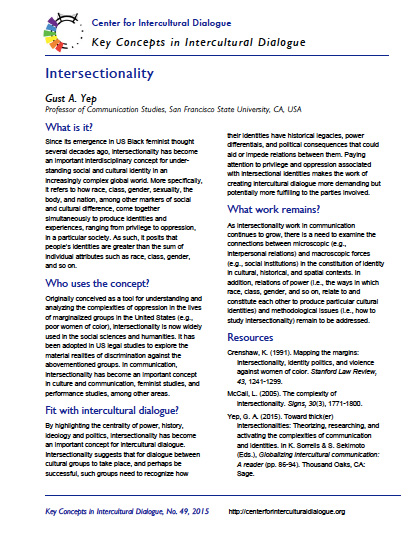
Key Concepts in ICDThe next issue of Key Concepts in intercultural Dialogue is now available. This is KC49: Intersectionality by Gust Yep. As always, all Key Concepts are available as free PDFs; just click on the thumbnail to download. Lists organized  chronologically by publication date and number, alphabetically by concept in English, and by languages into which they have been translated, are available, as is a page of acknowledgments with the names of all authors, translators, and reviewers.Key Concept #49: Intersectionality Yep, G. (2015). Intersectionality. Key Concepts in Intercultural Dialogue, 49. Available from:
https://centerforinterculturaldialogue.org/wp-content/uploads/2015/02/key-concept-intersectionality.pdf

The Center for Intercultural Dialogue publishes a series of short briefs describing Key Concepts in Intercultural Dialogue. Different people, working in different countries and disciplines, use different vocabulary to describe their interests, yet these terms overlap. Our goal is to provide some of the assumptions and history attached to each concept for those unfamiliar with it. As there are other concepts you would like to see included, send an email to the series editor, Wendy Leeds-Hurwitz. If there are concepts you would like to prepare, provide a brief explanation of why you think the concept is central to the study of intercultural dialogue, and why you are the obvious person to write up that concept.


Creative Commons License
This work is licensed under a Creative Commons Attribution-NonCommercial-NoDerivatives 4.0 International License.

CFP Communication Yearbook 40

Communication Yearbook 40
A Publication of the International Communication Association
Editor: Elisia L. Cohen
Deadline: February 15, 2015
NOTE: Deadline extended to March 1, 2015

CY 40 is a forum for the exchange of interdisciplinary and internationally diverse scholarship relating to communication in its many forms. Specifically, we are seeking state-of-the-discipline literature reviews, meta-analyses, and essays that advance knowledge and understanding of communication systems, processes, and impacts. Submitted manuscripts should provide a rigorous assessment of the status, critical issues and needed directions of a theory or body of research; offer new communication theory or additional insights into communication systems, processes, policies and impacts; and/or expand the boundaries of the discipline. In all cases, submissions should be comprehensive and thoughtful in their synthesis and analysis, and situate a body of scholarship within a larger intellectual context. For CY 40, the editorial board also welcomes essays that advance knowledge and understanding of communication research methodologies and applications.

Details
*Submit manuscripts electronically via a Word attachment to Elisia L. Cohen, Editor
*Submissions for CY 40 will be considered from January 1, 2015 through February 15, 2015
*Use APA style, 6th edition
*Include a cover letter indicating how the manuscript addresses the CY 40 call for papers
*Prepare manuscripts for blind review, removing all identifiers
*Include a title page as a separate document that includes contact information for all authors
*Following Communication Yearbook’s tradition of considering lengthier manuscripts, initial manuscript submissions may range from 6,500 to 13,000 words (including tables, endnotes, references).
*Incomplete submissions not adhering to the above journal guidelines will be returned to authors for revision.

For more information about CY 40 or this call for submissions, please contact Dr. Elisia L. Cohen, Editor, Communication Yearbook.

Guo-Ming Chen Profile

Profiles

Guo-Ming Chen is Professor of Communication Studies at the University of Rhode Island.

Guo-Ming ChenHe was the recipient of the 1987 outstanding dissertation award presented by the NCA International and Intercultural Communication Division. Chen is the founding president of the Association for Chinese Communication Studies. He served as Chair of the ECA Intercultural Communication Interest Group and at-large member of the SCA Legislative Council, and currently he is the President of the International Association for Intercultural Communication Studies. He is also the co-editor of Intercultural Communication Studies, China Media Research, and International and Intercultural Communication Annual, and serves on the editorial board of different professional journals.

Chen’s primary research interests are in intercultural/organizational/global communication. In addition to receiving various awards and honors, Chen has published over 150 papers, book chapters, and essays in Communication Yearbook, Journal of Cross-Cultural Psychology, China Media Research, Human Communication, Communication Research Reports, Intercultural Communication Studies, The Howard Journal of Communications, Journal of Psychology, etc.

Chen has (co)authored and (co)edited 35 books and journal special issues, including Foundations of Intercultural Communication, Communication and Global Society, A Study of Intercultural Communication Competence, Dialogue Among Diversities, Study of Chinese Communication Behaviors, Chinese Conflict Management and Resolution, Introduction to Intercultural Communication, Theories and Principles of Chinese Communication, Asian Perspective of Culture and communication, Communication Research Methods, Communication Theories, and others.

Chen continues to be active in teaching, scholarship and in professional, university, and community services.


Work for CID:
Guo-Ming Chen wrote KC52: Harmony.

Distinguished Scholarship Awards – IICD of NCA

Call For Nominations
Distinguished Scholarship Awards
International and Intercultural Communication Division
National Communication Association

Nominations are invited for the 2015 International and Intercultural Communication Division Distinguished Scholarship Awards for work copyrighted in 2014. Up to five awards will be given in the following categories:
·       Best Book (single-authored or co-authored)
·       Best Book (edited or co-edited)
·       Best Article (or Book Chapter)
·       Best Dissertation and/or Master’s Thesis

All nomination materials via electronic submission to Mark Hopson and must include the following:
(A) A nomination letter outlining justification for the award
(B)  For Article or Book Chapter submissions, send PDF copies only
(C)  For Book submissions, send three (3) copies of the complete work. (You may ask your publishers to send copies directly as part of their promo)
(D) For Dissertation or Thesis submissions, mail three (3) CD-Rom copies of the complete work

Mail hard copies (for C & D) to the following address:
Dr. Mark C. Hopson
Department of Communication
George Mason University
Robinson A #319
4400 University Dr.
Fairfax, VA, 22030

Awards will be presented at the International and Intercultural Communication Division Business Meeting in Las Vegas at the 2015 NCA Convention. Recipients of the awards will be notified by September 1, 2015 and are expected to be present for the award presentations. Self, peer, or advisor nominations are welcomed. The awards committee will not accept more than one submission of the same co-/author, whether they are nominated or self-nominated, regardless of category. Works must have been copyrighted during the 2014 calendar year.

Nomination packets must be received by April 25, 2015.

Communications and the State: Towards a New International History (Puerto Rico)

International Communication Association
Communication History Division Preconference
Communications and the State: Towards a New International History
May 21, 2015, 8:30 – 17:00, US$85
Condado Hilton Hotel, San Juan, Puerto Rico

This preconference puts a historical spotlight on the constitutive role of the state in the making of communications and the constitutive role of communications in the making and unmaking of states and empires. Twenty-four papers, ranging widely in time period, geographical region, and methodology, and addressing different problematics, consider the historical relationship between the state and communication under four main themes: the state as communicator, the state as a regulator of communication, the state as a creator and/or subsidizer of structures of communication, and the state as an object of critique by citizens and subjects.

The aim of the preconference is to bring together scholars studying diverse time periods and geographic areas with the goal of offering new interpretations about the state as an active element in the making of communications in general rather than in one particular nation or another. We are also interested in what happens when communication systems reach across state boundaries and in historical formations that have important commonalities with states, such as alliances, kingdoms, juntas, and more. A closing plenary with three highly respected scholars working in this area will provide an opportunity for wide-ranging discussion about themes raised in the sessions and the consideration of new research possibilities.

Schedule:

Communications and the state in the early modern era
*“The Cotswold Olimpick Games: Sport, Politics and Faith in early modern England,” Mark Brewin (The University of Tulsa, Oklahoma, United States)
*“Three thirteenth-century travel accounts of missions to the Far East,” Kathryn Montalbano (Columbia University, New York, United States)
*“A Republic Run as a Chamber of Commerce: The Role of the State in Structuring Communications in Renaissance Venice,” Juraj Kittler (St. Lawrence University, New York, United States)
*“The Post Office and State Formation in World Historical Time,” Lane Harris (Furman University, South Carolina, United States)

Communication networks – mail, telegraph, telephone
*
“Communications and the States: The Swiss Influence on the origins of ITU, 1855-1876,” Gabriele Balbi (Università della Svizzera italiana, Lugano, Switzerland), Simone Fari, Giuseppe Richeri.
*“Mail Order Fraud, Postal Inspectors, and the Remaking of Consumer Capitalism in the United States, 1850-1900,” Rick Popp (University of Wisconsin-Milwaukee, United States)
*“Media of Resistance: Organizing the Anti-Colonial Movements in the Dutch East Indies, 1920-1927,” Rianne Subijanto (University of Colorado Boulder, United States)
*“International Copyright and Access to Education: A History,” Sara Bannerman, (McMaster University, Hamilton, Canada)

International Dimensions of Broadcasting and the State
*“News and Propaganda in the Cold War: Associated Press and the Voice of America, 1945-1952,” Gene Allen (Ryerson University, Toronto, Canada)
*“Colonization through Broadcasting: Rádio Clube de Moçambique and the Promotion of Portuguese Colonial Policy,” Nelson Ribeiro (Catholic University of Portugal, Lisbon, Portugal)
*“A House Divided: The SABC during World War Two,” Ruth Teer-Tomaselli (University KwaZulu-Natal, Durban, South Africa)
*“Subsidizing Content and Conduit: Global Wireless Communications and the State,” Heidi Tworek (Harvard University, Massachusetts, United States)

Communications and the State: The Case of Germany
*
“A Story of Transition and Failure? The State and the East German Media Reform 1989-1991,” Mandy Tröger (University of Illinois at Urbana-Champaign, United States)
*“Presence and Absence: The Berlin Wall as a Strategic Platform,” Samantha Oliver (University of Pennsylvania, United States)
*“Heads of State as Communicators – A Comparative Analysis of State of the Union Addresses of American Presidents and “Regierungserklärungen” of German Chancellors since 1945/49,” Thomas Birkner (Westfälische Wilhelms-Universität Münster, Münster, Germany)
*“The Necessary Restraints of National Security”: Cold War U.S. Government-Journalism Negotiations and the Communist Reaction,” Mike Conway (Indiana University, United States) and Kevin Grieves (Ohio University, United States)

The State and Infrastructure
*“How the French State did not Construct Nicholas Schöffer’s Tour Lumière Cybernétique?”, Dominuque Trudel, New York University, United States)
*“The phantom of the phone booth: Toward a material and cultural history of the telephone in Israel,” Rivka Ribak, Michele Rosenthal and Sharon Ringel (University of Haifa, Israel)
*“Minitel and the State,” Julien Mailland (Indiana University, United States) and Kevin Driscoll (Microsoft Research, United States)
*”Connected and Divided: Satellite Networks as Infrastructures of Live Television” Christine Evans (University of Wisconsin-Milwaukee, United States) and Lars Lundgren (Södertörn University, Sweden)

The State and Communication Across Borders
*
“Media, Communications and the State in the Nordic Region: The History of the Media Welfare State” Trine Syvertsen and Gunn Enli (University of Oslo, Norway), Ole J. Mjøs and Hallvard Moe (University of Bergen, Norway)
*“‘Home Is Where Your Heart Is’: Mediated Longing for the State,” Ekaterina Kalinina (Södertörn University, Sweden) and Manuel Menke (Augsburg University, Germany)
*“Theorizing Political Communication Policies,” Tim Vos (University of Missouri, United States)
*“Commercial cross-border radio: Popular culture, advertising, and the erosion of state communication power in comparative perspective: Britain, India and America” John Jenks(Dominican University, United States)

Closing plenary: The State of the Field
Daniel Hallin (University of California, San Diego)
Richard John (Columbia University)
Adrian Johns (University of Chicago)

Mapping Cultural Diversity

London is one of the most linguistically diverse cities in the world. Almost two million people speak English as a second language, and across the city, Londoners speak about 300 different languages. A new map shows how those languages show up as you travel along local subway lines.

The map was created by Oliver O’Brien, a researcher at University College London, using new census data. It shows which language is most common after English at each station, with bigger circles for the most popular languages. It’s drawn using the same simple graphic style as the standard subway map.

Adapted from the original article:
Peters, Adele. (2014, December 17). This map shows which languages are most common at every subway stop In London. Co.Exist.

Save

CFP Technology, Knowledge and Society Conference (Buenos Aires)

Call for Papers
Twelfth International Conference on Technology and Society
The Technology and Society Conference will be held from 18-19 February 2016 at the Universidad de Buenos Aires in Buenos Aires, Argentina. We welcome submissions from a variety of disciplines and perspectives and encourage faculty and students to jointly submit proposals, discussing technology and society through one of the following themes:

Conference Themes
Technologies for Human Use
Technologies in Community
Technologies for Learning
Technologies for Common Knowledge

2016 Special Focus: Ideas, Objects, Waste: Critically Approaching The Life Cycle of Technologies in the Age of the Anthropocene
Technologies have life cycles. They begin as ideas reverberating within normative contexts of innovation and progress. These ideas then materialize as objects. This materiality connects the object to epochs of production and the natural world: metals, bio-matter and other natural resources. Finally, as their life cycle comes to a close, these objects become waste. In this final stage, another set of material impacts comes into view: their disposal as waste or our reuse of these objects for similar or different purposes. The increasing speed of this life cycle stimulates a ‘what is to be done?’ reflexivity that pervades the whole cycle. What does pace of this life cycle today reveal about us as individuals, communities or societies?

Parallel to our annual thematic streams, the Special Focus for the 12th Technology Knowledge and Society Conference – “Ideas, Objects, Waste: Critically Approaching The Life Cycle of Technologies in the Age of the Anthropocene” – will be to analyze the life cycle of technology in the context of our current ecological condition, in an era that has been coined the age of the Anthropocene. To be precise: how do we use findings of the impacts human action on the environment as an evaluative criterion assessing the ideas, objects and waste of technological developments? In turn, how can such questioning shape our understanding of the social impact of technologies, and the ideals of human needs and community interests manifest in the developmental direction and objects of technologies?

Proposal Submissions and Deadlines
The current review period closing date for the latest round of submissions to the Call for Papers (a title and short abstract) is 18 March 2015*. Please visit the conference website for more information on submitting your proposal, future deadlines, and registering for the conference.

If you are unable to attend the conference, you may still join the community and submit your article for peer review and possible publication, upload an online presentation, and enjoy subscriber access to The Technology Collection of Journals.

*Proposals are reviewed in rounds adhering to monthly deadlines. Check the website often to see the current review round.