Key Concept #59: Teng by Todd Sandel

Key Concepts in ICDThe next issue of Key Concepts in intercultural Dialogue is now available. This is KC59: Teng by Todd Sandel. As always, all Key Concepts are available as free PDFs; just click on the thumbnail to download. Lists organized  chronologically by publication date and numberalphabetically by concept in English, and by languages into which they have been translated, are available, as is a page of acknowledgments with the names of all authors, translators, and reviewers.

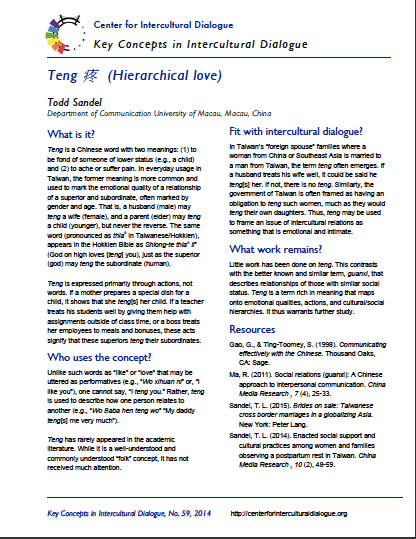
Key Concept #59 Teng by Todd Sandel

Sandel, T. (2015). Teng. Key Concepts in Intercultural Dialogue, 59. Available from: https://centerforinterculturaldialogue.org/wp-content/uploads/2015/04/key-concept-teng.pdf

The Center for Intercultural Dialogue publishes a series of short briefs describing Key Concepts in Intercultural Dialogue. Different people, working in different countries and disciplines, use different vocabulary to describe their interests, yet these terms overlap. Our goal is to provide some of the assumptions and history attached to each concept for those unfamiliar with it. As there are other concepts you would like to see included, send an email to the series editor, Wendy Leeds-Hurwitz. If there are concepts you would like to prepare, provide a brief explanation of why you think the concept is central to the study of intercultural dialogue, and why you are the obvious person to write up that concept.


Creative Commons License
This work is licensed under a Creative Commons Attribution-NonCommercial-NoDerivatives 4.0 International License.

Fulbright-Hays Dissertation Research Abroad Fellowships

The U.S. Department of Education (ED) is seeking applications for a new competition: Fulbright-Hays Doctoral Dissertation Research Abroad Fellowship Program. The program provides opportunities to doctoral candidates to engage in full-time doctoral research abroad in modern foreign languages and area studies. Only applications that propose research on the following geographic areas will be accepted: Africa, East Asia, Southeast Asia and the Pacific Islands, South Asia, the Near East, Central and Eastern Europe and Eurasia, and the Western Hemisphere (excluding the U.S.). Applications are due April 28, 2015.

UNESCO Links Cultural Diversity to Human Rights

© UNESCO

On 31 March, 2015, UNESCO Director-General Irina Bokova took part in a round table on the theme “Human Rights and the Protection of Cultural Diversity,” held at the University of Geneva, with the participation of the United Nations High Commissioner for Human Rights, Zeid Ra’ad Al Hussein, UNESCO Special Envoy for Intercultural Dialogue, Metin Arditi and author, psychoanalyst and university professor, Julia Kristeva.

Bokova emphasized that “cultural diversity is an expression of human rights – the persecution of minorities, religious and ethnic, and the looting and pillage of cultural heritage are part of a deliberate global strategy to eradicate history and memory, the identities and the existence of these peoples and communities, and, through them, the cultural diversity that is our common heritage.”

Arditi highlighted that “the destruction of cultural heritage is but a symptom of the destruction of the Other,” noting that “the West is living through an unprecedented intellectual crisis – we need to restore the humanities at the heart of our societies, as the cradle of ideas and intellectuals for the future. Universities have a historic responsibility here, to prepare society for its own transformation and to help people understand and live together.”

All speakers stressed the importance of teaching about religions through the humanities, as areas of knowledge and understanding, as well as debate and discussion — “in order for beliefs to not become the sole possession of fanatics and extremists.”

The General-Director concluded on the key role of education for global citizenship, as promoted by UNESCO, including education for human rights as the mainstay, stressing the need for cultural literacy and development of intercultural competences to make the most of contemporary multicultural societies and the challenges of living together.

See the original article for further details.

CFP Conference on Chinese Media and Chinese Civilization (Wuhan)

Call for Submissions
The Ninth International Conference on Chinese Media and Chinese Civilization:
The Image of China & Chinese Communication
August 2015, Wuhan, China

With intensified global communication and cultural exchange, China is paying more and more attention to having a voice in the world arena as it grows to become a world power. While China is molding its own image, it is making greater efforts in building its soft power and expanding its communication capacity.  Such efforts can be seen from the  national image video shown at Times Square, the internationally acclaimed TV documentary “A Bite of China”, and various platforms built by China’s Xinhua News Agency, CCTV and other national media. Considering the imbalances in global communication, China’s efforts to expand its capacity for international communication will contribute to building a more equitable and healthy new information and communication order in the world. To build a world with diversified voices, Chinese media professionals and communication scholars in and outside of China should not only closely monitor China’s process in building and communicating its image from historical, theoretical and practical perspectives, but also offer meaningful analysis and reflections of such a process within the context of globalization.

It is against such a backdrop that the Association of Journalism History (China), the School of Journalism and Communication of Huazhong University of Science and Technology (China), and the Wee Kim Wee School of Communication and Information of Nanyang Technological University (Singapore) will jointly hold the Ninth Conference on Chinese Media and Chinese Civilization. Since its launch in 1995, this conference series has been held eight times in China, Hong Kong, Taiwan and Singapore, receiving wide support from communication scholars and students in and outside of China. To mark the 20th anniversary of this conference series, the ninth conference will be hosted again by the School of Journalism and Communication of Huazhong University of Science and Technology, which was a co-founder of this conference series and the host of its first conference in 1995. We hereby invite communication scholars and media professionals from China and abroad to attend the conference to share your research findings and views about the theme of this conference.

Submissions should be relevant but not limited to the following topics:
1.       China’s national image building as a rising power
2.       History, theory and practice of China’s international communication
3.       Public diplomacy and national public relations
4.       Cultural industry and China’s national image communication
5.       Overseas Chinese media and China’s national image building
6.       Mainstream media and China’s national image communication
7.       Media system, ethnics, laws and China’s national image communication
8.       History and reality of Chinese Civilization
9.       Chinese communication and the Chinese identity
10.    Culture and politics of China’s national image communication
11.    New media and China’s national image communication
12.    and other topics related to the conference theme.

Venue:
Huazhong University of Science and Technology, Wuhan, China

Schedule:
Registration: 19 August, 2015
Conference: 20-21 August, 2015

Conference Fee:
600 RMB for registration (exempted for students)

Deadlines and Important Dates
Application reply deadline: 20 April, 2015
Abstract submission deadline: 30 April, 2015
Full paper submission deadline:  30 May, 2015

Paper acceptance notification and invitation letter to be issued  20 June, 2015

Submission of Full Papers
The length of full papers must not exceed 10,000 Chinese characters.
The paper can be written in either Chinese or English. Conference presentation should be in Chinese.
All papers should be in Word format.
All submissions should include author’s name, affiliation, and contact information.

Contact Information
Submissions should be emailed to the following contacts before deadline.
For submissions from China:
Xiuqing Yang
School of Journalism and Communication
Huazhong University of Science and Technology

For submissions from overseas:
Xiaodong Yang
Wee Kim Wee School of Communication and Information
Nanyang Technological University

For queries:
Haijiang Tang
School of Journalism and Communication
Huazhong University of Science and Technology

Miami University job ad

Miami University invites applications for Professor and Chair of a new Department of Global and Intercultural Studies.  The new unit will develop new curricular, research and public outreach initiatives in global and intercultural studies, as well as incorporate established undergraduate majors and minors in American Studies, Asian/Asian American Studies, Black World Studies, East Asian Studies, European Area Studies, International Studies, Jewish Studies, Latin American Studies, Middle Eastern and Islamic Studies, and Women’s, Gender and Sexuality Studies. The appointment start date is negotiable and may be as early as August 2015.

Specific duties and responsibilities include: teaching in area of expertise, leading new curriculum development and implementation; recruitment and professional development of faculty (including promotion and tenure recommendations); leading the development of governance and administration policies for the new unit; recommendations to the Dean for faculty teaching and workload assignments, and for faculty and unclassified staff merit-based salary increases; budget oversight; hiring and supervision of staff; management of departmental office operations; communication of University and College policies and practices to the department; representation of the department to the College, University, and broader publics.

Candidates should have a teaching and scholarly record commensurate with the appointment of a full professor and demonstrated administrative experience to lead the development of this new interdisciplinary department. We seek a leader with strong creative and collaborative skills, and a vision to develop new initiatives that may include new majors, graduate certificates or programs, and research institutes.  Candidates should have a Ph.D. and be nationally/internationally recognized scholars and excellent teachers in at least one of the following areas: global studies, transregional or transnational studies, area studies, identity studies, social equity, gender and sexuality studies. We seek a leader with a strong commitment to diversity, who will foster innovative teaching methods that promote engaged learning in the 21st century; a commitment to teaching undergraduate courses at all levels; and innovative scholarly and public outreach activities. Submit a letter of interest and curriculum vitae online.   Three letters of recommendation are required; should be sent directly to Associate Dean Renée Baernstein. Direct queries about the search to the search committee co-chairs: Prof. LuMing Mao or Associate Dean Renée Baernstein. Review of applications will begin on April 10, 2015 and continues until position is filled.  Miami University, an equal opportunity/affirmative action employer with smoke- and tobacco-free campuses, is committed to a multicultural environment and strongly encourages applications from minorities, females, veterans and individuals with disabilities. Miami’s Annual Security and Fire Safety Report with information on campus crime, fires, and safety is available online. Hard copy available upon request. Employment will require a criminal background check according to University guidelines.

EIUC Venice School of Human Rights (Venice)

European Inter-University Centre for Human Rights and Democratisation (EIUC) is ready to accept applications for the Venice School of Human Rights which will take place in Venice, Lido from 26 June to 4 July 2015. Candidatures will be accepted until 17 May 2015. The topic is “(Dis)Integration through Human Rights: Citizens, Courts, Communities”.

Since 2010 EIUC’s Venice School of Human Rights studies today’s challenges in the field of human rights examining their reasons and possible solutions to deploy. In 5 years more than 500 participants from all over the world have attended the Venice School in the beautiful surrounding of the Monastery of San Nicolò at the Lido of Venice.

The 2015 Venice School is structured in the following three thematic clusters, which will be chosen by the participants when applying:
*Business and Human Rights, 
*Human Rights and New Technologies and 
*Human Rights and Gender Issues.

This year the Venice School for Human Rights will be opened by two prestigious lecturers:
Maria Virginia Bras Gomes, member of the UN Committee on Economic, Social and Cultural Rights and Senior Social Policy Adviser in the Ministry of Solidarity and Social Security of Portugal.

Albie Sachs, South African activist and former judge on the Constitutional Court of South Africa under appointment by Nelson Mandela

Furthermore its international faculty includes prestigious lectures in human rights such as Stefano Rodotà, former President of the Italian Data Protection Commission and of the European Group on Data Protection and Emilio De Capitani, Executive Director of the Fundamental Rights European Experts Group. See full list of lecturers here.

The Venice School is designed for postgraduates from all areas of the social sciences and humanities and for practitioners who want to address the topics proposed from a multi-disciplinary approach that will be useful in further engagements in their respective field of work. The lectures will be held in English.

CFP RE-DO Conference on Culture’s Role in Sustainable Futures (Aarhus)

RE-DO, a conference on sustainability and culture’s role in sustainable futures takes place from 28-31 October 2015 in Aarhus, Denmark at MOMU (Moesgaard Museum – a splendid new museum in the middle of the woods around Aarhus).

RE-DO is the second of a series of conferences organised by Aarhus University in cooperation with Aarhus 2017 (Aarhus Capital of Culture in 2017). Cradle-to-cradle thinking and circular economies form a substantial part of the region’s “re-think economy” strategy, while renewable energy and fossil-free-zones are part of conference co-organizers´ – Energy Academy (Samsø) – agenda for a sustainable future.

It is within this setting that the RE-DO Conference, organized jointly between Aarhus University and Aarhus 2017 takes an interdisciplinary approach to the challenge of creating sustainable futures. The conference invites academics, practitioners, artists and activists to take part in the dialogue about sustainable cultures.

Theme and background
RE-DO indicates that sustainability has been, is and has to become something we do as part of our everyday practices and living in order to matter. In this sense we view cultural sustainability not just as an add-on to environmental agendas, but as the very precondition for their long-term success.

Sustainability is already put to practice in every-day life, in citizen-based initiatives against food waste, in enterprising initiatives to avoid depopulation of outskirt regions, in integration initiatives targeting minority groups, immigrants and political refugees, and in all sorts of “green” initiatives in which citizens show care for biodiversity and wildlife conservation issues. Moreover, cultural sustainability may also serve as a productive focal point for rethinking policies and practices in traditional public sectors such as healthcare, education, children and elder care.

The form of the conference
The conference aims at facilitating new dialogues between academics and practitioners in which knowledge-sharing, learning and development is at the center. As much as presenting answers and worked-through solutions, the conference aims at asking questions and stimulating discussion and reflection. Therefore the participation is open to a broad category of people, including international guests.

Confirmed keynote speakers
Nick Shepherd, University of Cape Town, South Africa
Nancy Duxbury Carreiro, University of Coimbra, Portugal
Noortje Marres, Goldsmiths, University of London, UK
Joel Outtes, Universidade Federal do Rio Grande do Sul, Brazil

Proposal deadline
First, read the call for proposals. Then, papers and panels should be submitted to impact2017@au.dk before June 1. 2015. Authors will be notified of acceptance or non-acceptance before July 1. 2015.

Key Concept #58: BELF by Anne Kankaanranta and Leena Louhiala-Salminen

Key Concepts in ICDThe next issue of Key Concepts in intercultural Dialogue is now available. This is KC58: English as Business Lingua Franca (BELF) by Anne Kankaanranta and Leena Louhiala-Salminen. As always, all Key Concepts are available as free PDFs; just click on the thumbnail to download. Lists organized  chronologically by publication date and numberalphabetically by concept in English, and by languages into which they have been translated, are available, as is a page of acknowledgments with the names of all authors, translators, and reviewers.

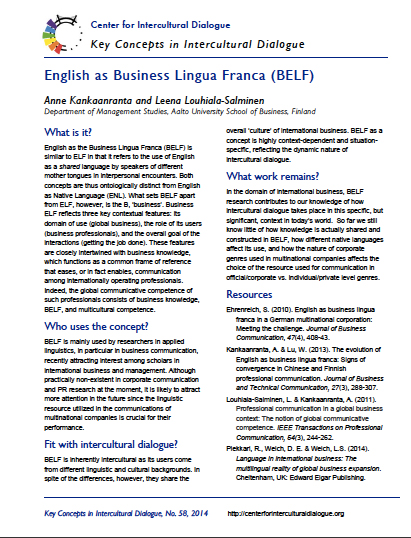
Key Concept #58: BELF by Kankaanranta & Louhiala-Salminen

Kankaanranta, A., &  Louhiala-Salminen, L. (2015). English as business lingua franca (BELF). Key Concepts in Intercultural Dialogue, 58. Available from: https://centerforinterculturaldialogue.org/wp-content/uploads/2017/01/key-concept-belf.pdf

The Center for Intercultural Dialogue publishes a series of short briefs describing Key Concepts in Intercultural Dialogue. Different people, working in different countries and disciplines, use different vocabulary to describe their interests, yet these terms overlap. Our goal is to provide some of the assumptions and history attached to each concept for those unfamiliar with it. As there are other concepts you would like to see included, send an email to the series editor, Wendy Leeds-Hurwitz. If there are concepts you would like to prepare, provide a brief explanation of why you think the concept is central to the study of intercultural dialogue, and why you are the obvious person to write up that concept.


Creative Commons License
This work is licensed under a Creative Commons Attribution-NonCommercial-NoDerivatives 4.0 International License.

CFP ICA Nordic Regional Conference (Copenhagen)

CALL FOR EXTENDED ABSTRACTS
The 2015 International Communication Association Nordic Regional Conference will take place 11-13 October 2015 at the Copenhagen Business School. The theme, Responsible Communication and Governance, reflects the communication field’s and the Nordic region’s research expertise in areas such as corporate social responsibility, sustainability, governance, and communication. The conference is sponsored by:
” Copenhagen Business School’s (CBS) Dept. of Intercultural Communication and Management (ICM)
” NordiCom (Nordic Information Centre for Media and Communication Research)
” University of Southern Denmark
” University of Oslo’s Dept. of Media and Communication
” DEMICOM at Mid Sweden University
” Arhus University’s Dept. of Business Communication
” Katholieke Universiteit Leuven
” Jiao Tong University School of Media and Design
” The Susan Bulkely Butler Center for Leadership Excellence at Purdue University

General theme: Responsible Communication and Governance
The goal of the ICA Regional Conference is to stimulate reflection on and discussion about how responsibility is organized and communicated across a variety of contexts and settings, including social, political, intercultural, corporate, health, and interpersonal communication, amongst other contexts. In particular, the conference focuses on how responsibility emerges in communication, how it shapes and is shaped by social and organizational practices, and how it develops as a social and political ideal at the intersection between governance, talk, and action.

The theme reflects the communication field’s ongoing commitment to examine, critique and shape the shifting roles and responsibilities that we face in regional and global contexts. We welcome extended abstracts for paper and panel submissions that discuss how responsibility is informed and shaped by communication and governance practices either within a particular context or setting (e.g., an organization, the media, a country, a political party) or as it plays out in various processes such as:
” Meaning and sense making
” Talk and action
” Policy making
” Power and control
” Materiality
” Transnational movements
” Sustainability and Corporate Social Responsibility
” Internet policies and infrastructures
” Freedom of information and privacy
” Crowdsourcing and open access to information
” Grassroots organizing
” Environmental sustainability
” Engaged scholarship

Keynote speakers will be:
Professor Linda Putnam, U of California, Santa Barbara
Professor Lilie Chouliaraki, London School of Economics
Professor Mette Morsing, Copenhagen Business School

Eligibility:
You do not need to be an ICA member to submit an abstract for the conference.

Extended Abstract Submission:
Abstracts: Abstracts will be subject to masked competitive review. Authors’ names and affiliations should be submitted in a separate document with full contact information. Extended Abstracts should not exceed 1,200 words, excluding references, tables, figures, and/or appendices.
Panel Submissions: We will also consider proposals for full panel sessions- in this case please include a brief panel description along with three paper abstracts. Authors’ names and full contact information should be included in the panel submission. Panel proposals should not exceed 1,200 words, excluding title page with contact information, references, tables, figures, and/or appendices.
“Research Escalator” Papers: Research Escalator Papers are in an extended panel session, which provides an opportunity for less experienced researchers to discuss and get feedback from more veteran scholars about a paper-in-progress (with the goal of making the paper ready for submission to a conference or journal). Those interested in the Research Escalator session should submit an extended abstract (2-3 double-spaced pages, plus references); if accepted, participants are expected to send the full paper to the scholar(s) assigned to their paper no later than 6 weeks before the convention. Anyone can submit an abstract for the Research Escalator session; however, we especially encourage graduate students and/or people inexperienced with the journal publishing process to submit. On the first page of the extended abstract, please make a note: CONSIDER FOR RESEARCH ESCALATOR SESSION. Please contact Sanne Frandsen for additional information.
Submission: Please send abstracts attached as a .doc, .docx, of pdf file . The deadline for submissions is 1 May 2015.
Abstract Decision Notifications: Decision notification will occur by 1 June 2015. If your paper is accepted for presentation at the 2015 ICA Nordic Regional Conference in Copenhagen, you will be notified and must then register for the conference and pay the conference fee. Payment of the conference fee confirms your intent to participate in this ICA Regional Conference. Submission of your abstract does not enroll you as an ICA member, or automatically register you for the conference itself.

Conference Language and Equipment for Presentations:
Conference presentations will be in English. Audiovisual equipment for presentations will be provided.

Location:
Copenhagen Business School campus. All events, with the exception of one dinner will occur on campus. Hotel, transportation, and local attraction information is available on the website.

Schedule:
The conference will begin Sunday, 11 October at 15:00 and end with lunch on Tuesday, 13 October. A more detailed schedule will be posted on the website as soon as the submissions are finalized.

Registration Costs:
Registration: DKK 2,500 (approx. EUR 330)
Student registration: DKK 1,500 (aprox. EUR 200)

The registration fees include all breakfasts, lunches, receptions, and special dinner at Carlsberg including beer menu with other beverages available.

This event is organized by the Department of Intercultural Communication and Management, in cooperation with the International Communication Association and regional and international co-organizers and co-sponsors listed on the website.

For further information please contact Robyn Remke.

Internet Policy Research Methods in the MENA region

Call for Applications: Internet Policy in the MENA Region: Research Methods for Advocates
September 1-4, Kadir Has University, Istanbul
Application Deadline:  May 15, 2015

As activists and researchers around the world endeavor to influence internet policymaking processes and raise awareness about the importance of protecting the open internet, the need for relevant, advanced internet policy research methods among advocates is brought into stark relief. This need is particularly great in the broader MENA (Middle East and North Africa) region, where observers are witnessing increasing levels of government control online, inadequate legislation supportive of a robust and secure cyberspace, as well as increasingly sophisticated security risks to journalists, researchers, and activists. These issues are further complicated by the political, economic, and cultural dynamics that are specific to the region.

Recognizing the importance of advocacy and policy efforts that make use of methodologically rigorous and contextually appropriate research as well as the need for a deeper engagement with the local environments that shape internet policy issues, the Annenberg School for Communication‘s  Internet Policy Observatory has teamed up with Citizen Lab, ASL19,  Ranking Digital Rights, and Kadir Has University‘s New Media Department to develop an Internet Policy Research Methods Workshop. This program will bring together young scholars and activists working in digital rights and the internet policy space in an intensive four day practicum that provides a survey of both qualitative and quantitative, online and offline research methods with the goal of enhancing and advancing their advocacy efforts.

The Internet Policy Research Methods program seeks applications from activists, advocates and those working at NGOs, and early career researchers working and studying in the Middle East and North Africa. Prospective applicants should have a particular area of interest related to internet governance and policymaking, censorship, surveillance, internet access, political engagement online, protection of human rights online, or corporate governance in the ICT sector. Applicants will be asked to bring a specific research question to the program to be developed and operationalized through trainings and one-on-one mentorship with top researchers and experts from around the world.

The program will provide skill-building tutorials on the following topics:
– defining the problems and framing research questions
– conducting desk and archival research
– policy mapping
– questionnaire/interview design and techniques
– conducting surveys and public opinion research
– network measurement
– social network analysis
– data visualization
– maximizing influence: research dissemination and promotional strategies
– developing proposals for funding, creating actionable research agendas and evaluating project impact

We encourage individuals from the MENA region in the academic (early career), NGO, and public policy sectors to apply. The course will be conducted in English and applicants should have high proficiency in English in order to interact with experts, lecturers and other participants who will come from diverse backgrounds. Apply for the 2015 Summer Research Institute online. A limited pool of funding in the form of travel support is available and will be allocated based on the strength of the application, fit with the workshop, and demonstrated need. If you require funding support, please indicate as such in the online form.

For more information about the program, please contact Emad Khazraee.