Yan Qiu Profile

ProfilesYan Qiu holds an M.A. in Intercultural and International Communication from Royal Roads University, and is currently a Ph.D. student in the Department of Sociology and Legal Studies at the University of Waterloo, both in Canada. She has a solid academic foundation in intercultural communication, media studies, and cultural theory.

Currently, Yan applies her expertise as a Graphic Design Consultant, creating visual content for academic dissemination. In addition, she works as an AI Writing Expert, providing linguistic and cultural insights to help develop AI language models.

Yan utilizes social media to craft engaging narratives that foster audience connection and enhance brand visibility, using digital platforms as a tool for meaningful interaction and community building. Yan is also a member of the Certified Management Accountant Association, leveraging her knowledge in financial management and analysis to bring an interdisciplinary perspective to her academic and professional work.

Previously, as a research assistant at Royal Roads University, Yan worked on projects related to Chinese media history, literature, and industry practices, her research has been integrated into academic course materials.

Yan has travelled extensively, exploring numerous countries and cities, and immersing herself in diverse cultures, languages, and cuisines. These journeys have enriched her academic research and helped her develop a deeper understanding of how media and communication intersect with cultural identities.


Work for CID:

Yan Qiu has translated KC1: Intercultural Dialogue, KC5: Intercultural Communication, KC10: Cross-Cultural Dialogue, KC11: Intercultural Discourse and Communication, KC17: Multilingualism, KC19: Multiculturalism, KC22: Cultural Identity, KC25: Metacommunication, KC95: Transnational Media, KC99: Translanguaging, and KC100: Transcultural Communication into Simplified Chinese. Starting in 2024, she took on a role as the Center’s graphic design consultant, and has done the necessary work to revise the original designs for the Catalan, French, German, Italian, and Spanish translations of the CID Posters.

New CID Series: CID Posters

CID PostersAcademics typically write a lot of words, and don’t worry much about how they are displayed, on the assumption that ideas stand on their own merits. One advantage in having a website is the ability to integrate images with words, and thus to change the ways in which words are shown and shared. This is important because research shows that images are shared far more often than just words. In recognition of these facts, CID will shortly be starting a new series, CID Posters, which will highlight a particular quote or concept by showing it visually.

The first set of posters is being created by Linda J. de Wit, as part of her internship with CID. However it will also be possible for others to submit posters, just as the regular publication series have been opened to a wide range of contributors. As with other series, please send an email before starting any work to receive approval, to minimize inadvertent duplication, and to learn about technical requirements.

As with other series, posters will be made available for free on the site; just click on the thumbnail to download a printable PDF. They may be downloaded, printed, and shared as is, without changes, without cost, so long as there is acknowledgment of the source.

Presumably most posters will display and then illustrate a quote or concept either about intercultural dialogue or on a closely related topic, although if anyone has other ideas, feel free to send in a note about what you would like to do.

As is the case with other CID Publications, posters should be created initially in English. Given that translations of the Key Concepts in Intercultural Dialogue have received so many views, anyone who wishes to translate their own poster into another language (or two) is invited to provide that as well. If you want to volunteer to translate someone else’s poster into a language in which you are fluent, send in a note before starting, to receive approval and to confirm no one else is working on the same one.

Wendy Leeds-Hurwitz
Director, Center for Intercultural Dialogue
intercult.dialogue AT gmail.com

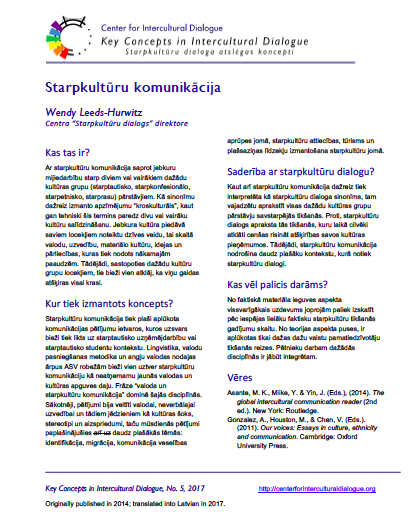
Key Concept #5: Intercultural Communication Translated into Latvian

Key Concepts in ICDContinuing translations of Key Concepts in Intercultural Dialogue, today I am posting KC#5: Intercultural Communication, which I wrote and first published in English in 2014, and which Inga Milēviča has now translated into Latvian.

As always, all Key Concepts are available as free PDFs; just click on the thumbnail to download. Lists of Key Concepts organized chronologically by publication date and number, alphabetically by concept, and by languages into which they have been translated, are available, as is a page of acknowledgments with the names of all authors, translators, and reviewers.

KC5 ICC_Latvian Leeds-Hurwitz, W. (2017). Starpkultūru komunikācija. (Inga Milēviča Trans). Key Concepts in Intercultural Dialogue, 5. Available from:
https://centerforinterculturaldialogue.org/wp-content/uploads/2017/06/kc5-icc_latvian.pdf

If you are interested in translating one of the Key Concepts, please contact me for approval first because dozens are currently in process. As always, if there is a concept you think should be written up as one of the Key Concepts, whether in English or any other language, propose it. If you are new to CID, please provide a brief resume. This opportunity is open to masters students and above, on the assumption that some familiarity with academic conventions generally, and discussion of intercultural dialogue specifically, are useful.

Wendy Leeds-Hurwitz, Director
Center for Intercultural Dialogue


Creative Commons License
This work is licensed under a Creative Commons Attribution-NonCommercial-NoDerivatives 4.0 International License.

Save

Save

Save

Save

Save

U Neuchâtel PHD Candidate Positions: CA/Interactional Linguistics (Switzerland)

FellowshipsThe Centre for Applied Linguistics at the University of Neuchâtel (Switzerland), member of the Competence Centre CRIS (Centre for Research on Social Interaction) is inviting applications for two PhD-candidate positions (= two 50% doctoral assistant positions) in Conversation Analysis / Interactional Linguistics.

Start date: October 1, 2017
Duration: 4 years

The successful candidate should hold an MA degree in Linguistics (or an equivalent degree), be trained in conversation analysis and/or interactional linguistics, and motivated to develop an original PhD thesis project in either one of these fields. He or she should show an interest in contributing to one of the Centre’s main research areas (interactional competence, second language talk, grammar-in-interaction). He or she should have an operational mastery of French (or develop such a mastery
within one year), allowing him or her to interact with students and colleagues and to participate in data sessions where French conversational data is being analyzed.

CFP Conference on Communication & Management (Greece)

ConferencesCall for Papers & Participation
The Communication Institute of Greece (COMinG) invites you to submit your paper at its 4th Annual International Conference on Communication and Management (ICCM2018), 23 -26 April 2018, Athens, Greece.

The aim of this cross-disciplinary conference is to bring together academics, students, researchers and professionals from different disciplines and cultural backgrounds, encourage them present their work, communicate, exchange and collaborate. You can participate to present a paper, chair a session, organise a panel, or even be an observer. Past conferences drew participants from different continents and countries (more than 50), presenting papers on diverse topics such as political communication, multicultural & cultural issues, Education and Management, Political Communication, European themes, Νew Media / artificial intelligence, Advertising, Branding, Marketing, New technology & Communication, Crisis Communication & Media, E-communication – Journalism, Management and Business Communication, cultural studies, public relations and advertising, among others.

Conference Topics
Papers can include topics on the areas of Communication, Management, and Marketing. Related disciplines will be considered, including papers on Education for the panel on Education. For more information please visit the call for papers.

The Communication Institute of Greece(COMinG) was established in 2003 in France. In Greece, since 2013, it appeared as an independent academic association that has for mission to become a forum, where academics and researchers – from all over the world – can meet in Greece to exchange ideas on their research and to discuss future developments in their disciplines.

Save

Inga Milēviča Profile

Profiles

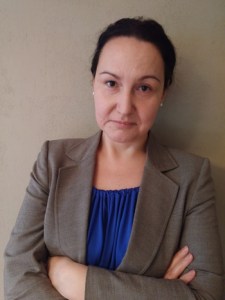
Inga Milēviča was born and lives in Latvia. She has a Ph.D. in contrastive and comparative linguistics.

Inga Milevica

She currently serves as Docent at Alberta College, The University College of Economics and Culture, and Riga Technical University (academic courses: Rhetoric and Presentation Skills, Introduction into Communication Theory, Business Ethics, Corporate Culture, Business Communication and professional Ethics, Stylistics, and Culture of Latvian Language), and has been Guest Lecturer at Comenius University (Bratislava, Slovakia); Eotvos Lorand University, Budapest (Hungary); Eurasian National University (Astana, Kazakhstan); Uniwersytet Łódzki, (Lodz, Poland); Universidade do Minho, (Braga, Portugal). Since 2014 she has been a member of the Association for Business Communication (ABC); since 2016 she has been a member of the Liaison Committee of ABC. In 2014 she received one of the CID Micro-grants funded by ABC, for travel to a conference in Japan.

Milevica is the author of 3 monographs and more than 100 articles in comparative linguistics, cinematic text and translation and gender journalism. Some of her published papers include:

Milevica, I. (2014). Cinematic text and translations: Film adaptations. British Journal of Science, Education and Culture, 1(5), 8-15.

Milēviča, I. (2017). American cinematic text and translation. European Journal of Literature and Linguistics, 38-44.

Milēviča, I. (2018). Study tours and generation Y: Opportunities and challenges. Евразийский Союз Ученых, 11 (56), 3-6.

Milēviča, I. (2018) Power point presentation and the image of high school teacher. Proceedings of Academics World International Conference, Tashkent, 1-7.


Work for CID:

Inga Milēviča wrote Constructing Intercultural Dialogues #8: A Flying Miracle. She has also translated KC5: Intercultural Communication and KC55: Stereotypes into Russian, and KC5: Intercultural Communication and KC55: Stereotypes into Latvian. She received a micro-grant for travel to Japan from CID, funded by the Association for Business Communication.

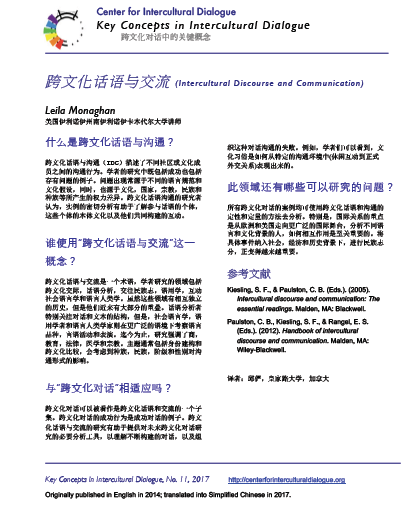
Key Concept #11: Intercultural Discourse and Communication Translated into Chinese

Key Concepts in ICDContinuing translations of Key Concepts in Intercultural Dialogue, today I am posting KC#11: Intercultural Discourse and Communication, which Leila Monaghan first published in English in 2014, and which Yan Qiu has now translated into Simplified Chinese.

As always, all Key Concepts are available as free PDFs; just click on the thumbnail to download. Lists of Key Concepts organized chronologically by publication date and number, alphabetically by concept, and by languages into which they have been translated, are available, as is a page of acknowledgments with the names of all authors, translators, and reviewers.

KC 11 Intercultural Discourse and Communication_Chinese-simMonaghan, L. (2017). Intercultural discourse and communication [Simplified Chinese]. (Y. Qiu, Trans). Key Concepts in Intercultural Dialogue, 11. Available from:
https://centerforinterculturaldialogue.org/wp-content/uploads/2017/06/kc11-intercultural-discourse-communication_chinese-sim1.pdf

If you are interested in translating one of the Key Concepts, please contact me for approval first because dozens are currently in process. As always, if there is a concept you think should be written up as one of the Key Concepts, whether in English or any other language, propose it. If you are new to CID, please provide a brief resume. This opportunity is open to masters students and above, on the assumption that some familiarity with academic conventions generally, and discussion of intercultural dialogue specifically, are useful.

Wendy Leeds-Hurwitz, Director
Center for Intercultural Dialogue


Creative Commons License
This work is licensed under a Creative Commons Attribution-NonCommercial-NoDerivatives 4.0 International License.

Save

Save

2018-19 Fulbright US Scholar Competition

FulbrightsThe 2018-19 Core Fulbright U.S. Scholar Program competition is now open, and this year there are many awards in the field of Communications. Opportunities are found in the newly redesigned Catalog of Awards and include:

  • Swaziland: Mass Communication and Broadcast Journalism
  • United Arab Emirates: All Disciplines (Teaching or Teaching/Research)
  • Jamaica: All Disciplines
  • India: Fulbright-Nehru Distinguished Chair (All Disciplines)
  • Norway: Digital Culture
  • Burma: All Disciplines
  • Zambia: Journalism and Broadcasting

Applicants must be U.S. citizens and the current competition will close on August 1, 2017.

Among the other Fulbright programs are those for Visiting (non-US) Scholars and Fulbright Specialists (short-term, US-based).


Save

Save

Marika Preziuso Profile

Profiles Marika Preziuso is Associate Professor of World Literature at the Massachusetts College of Art and Design. She holds a Ph.D. in Literature from the Caribbean Diaspora and an M.A. in Gender, Society and Culture, both from the University of London, UK.

Marika Preziuso

She writes: I teach 20th century and contemporary postcolonial literature, particularly by migrant and diasporic writers, and speculative fiction of the uncanny, magic realism and Afrofuturism.  The transnational scope of my classes actively invites students to cultivate the skill of intercultural understanding, specifically for visual artists and designers. In summer 2019 I designed and taught a graduate seminar titled “Intercultural Lab for Artists,” which focused on the intersections of craft, world, and self.

My working definition of Intercultural Understanding is: the orientation to any meaningful encounter across differences in which all parties involved recognize each other’s complexities, specificity, and dignity, and choose to engage with them from a self-reflective, dynamic and culturally responsive place.

At MassArt, I am the organizer of Creative Counterpoints,an annual series in its fourth year, devoted to the intersections of narratives of creativity and difference as investigated by visual artists, writers, public intellectuals, and other culture makers.

My academic research examines the intercultural pedagogies that result from transnational visual and literary narratives. These employ strategies of resistance and “opacity” to critique and expand Western imaginaries of “otherness” and create syncretic safe and radical spaces for their authors and their art.

My most recent publication is my conversation with artist Wangechi Mutu, titled “Is America Really Full?”, which is forthcoming in Transition, the magazine of the Hutchins Center for African and African-American Research at Harvard University.

I am a published poet and a RYT yoga instructor and meditation guide. My poetry stems from an intentional practice of “counterpoint”. As an immigrant woman, an academic of diaspora studies, a white “other” in a sea of American whiteness, I navigate layers of difference at times as a deficit, at times as an excess, a surplus. My poetry stems from this constant, exhausting and yet rewarding process of counterpoint, an alchemy, a (mis)translation. These qualities are both my curse and the lens through which I observe and make sense of the world, from the space of a sideway outsider, and suspicious insider space.

Outside Massart, I lead creative workshops in partnership with local communities in Boston to weave the practices of meditation, journaling, story-telling and verse in translation as gateways to explore our emotions and experiences as honorable and to practice holding space for them with curiosity, compassion, and a sense of humor. I particularly welcome the opportunity to work with creatives who straddle languages, cultures, and complex personal histories and support them in the (re)kindling of their creative light.

Academic website

Creative writing workshops


Work for CID:
Marika Preziuso offered her students credit if they would create potential CID Posters.

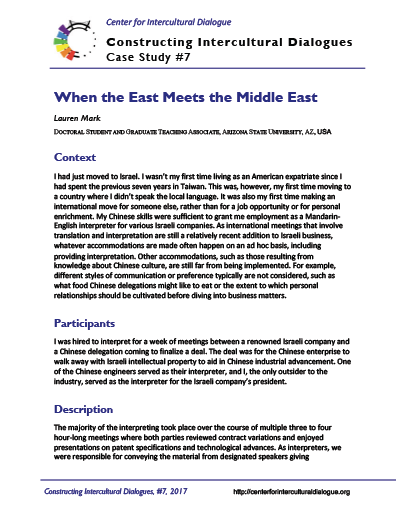
Constructing Intercultural Dialogue #7: When the East Meets the Middle East

Constructing ICD

The seventh issue of Constructing intercultural Dialogues is now available, “When the East meets the Middle East,” by Lauren Mark.

As a reminder, the goal of this series is to provide concrete examples of how actual people have managed to organize and hold intercultural dialogues, so that others may be inspired to do the same. As with Key Concepts in Intercultural Dialogue, these may be downloaded for free. Click on the thumbnail to download the PDF.

Constructing ICD #7Mark, L. (2017). When the East meets the Middle East. Constructing Intercultural Dialogues, 7. Available from: https://centerforinterculturaldialogue.org/wp-content/uploads/2017/06/constructing-icd-7.pdf

If you have a case study you would like to share, send an email to the series editor, Wendy Leeds-Hurwitz.


Creative Commons License
This work is licensed under a Creative Commons Attribution-NonCommercial-NoDerivatives 4.0 International License.