Osnabrück U: Postdoc in Futures of Migration (Germany)

Postdocs

Postdoc in Futures of Migration, Institute of Migration Research and Intercultural Studies, Osnabrück University, Germany. Deadline: 7 January 2025.

As part of the research area ‘Futures of Migration’ (FuturMig) funded by the Lower Saxony Ministry of Science and Culture, Osnabrück University is seeking to appoint a Postdoctoral Researcher.

The Institute for Migration Research and Intercultural Studies (IMIS) at Osnabrück University, the Center for Global Migration Research (CeMig) at the Georg August University Göttingen, the Center for Educational Integration (ZBI) at the University of Hildesheim, the Leibniz Institute for Educational Media, Georg Eckert Institute (GEI), Brunswig, and the Friedland Museum are cooperating in the Lower Saxony research area ‘FuturMig’ (2025–2029).

‘FuturMig’ deals with ideas and strategies for shaping the future of societies that are shaped by migration and diversity in political, media, and societal debates, fields of practice and migration research. ‘FuturMig’ is reviewing the academic state of the art, is planning the establishment of an international guest professorship and the development of a follow-up collaborative research initiative. ‘FuturMig’ focuses in particular on educational contexts – early childhood institutions, schools, universities, civil society initiatives, museums and memorials.

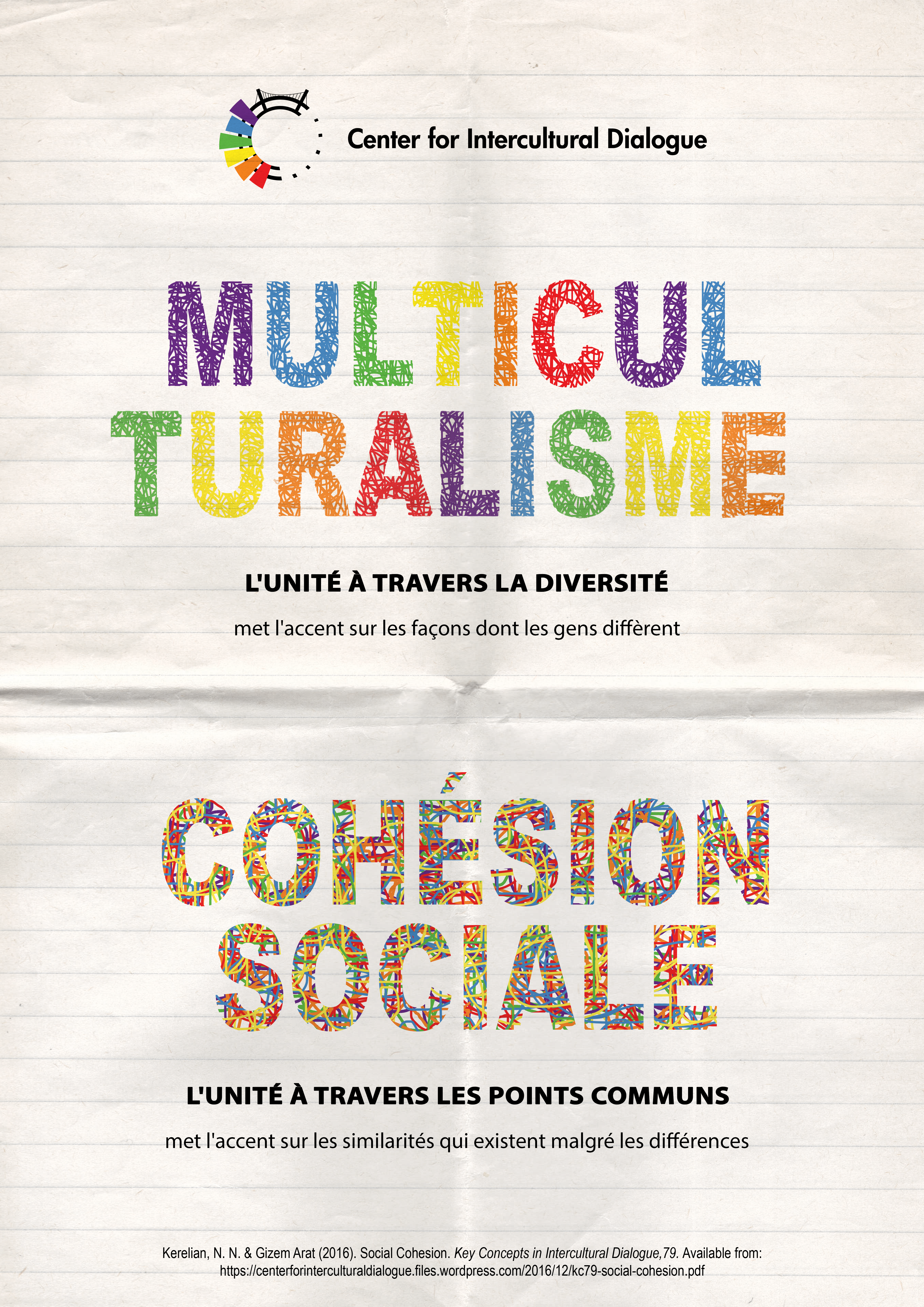
CID Poster 10: Multiculturalism vs. Social Cohesion Translated into French

CID PostersThis is another of the posters designed by Linda J. de Wit. The content here combines KC19: Multiculturalism by Polina Golovátina-Mora and Raúl Alberto Mora with KC79: Social Cohesion by Narine Nora Kerelian and Gizem Arat.

The French translation was provided by Léonie Potvin, and the graphic design work necessary to revise was by Yan Qiu. Here then is CID Poster 10: Le Multiculturalisme et la cohésion sociale.

CID Poster 10: Multiculturalism vs Social Cohesion Translated into FrenchJust in case anyone wants to cite this poster, the following would be the recommended format:

Center for Intercultural Dialogue. (2024). Le Multiculturalisme et la cohésion sociale [L. Potvin, trans.]. CID Posters, 10. Available from: https://centerforinterculturaldialogue.org/wp-content/uploads/2024/10/cid-poster-10-multiculturalism-french.png

As with other series, CID Posters are available for free on the site; just click on the thumbnail to download a printable PNG. They may be downloaded, printed, and shared as is, without changes, without cost, so long as there is acknowledgment of the source.

As with other CID Publications, if you wish to contribute an original contribution, please send an email before starting any work to receive approval, to minimize inadvertent duplication, and to learn about technical requirements. As is the case any series, posters should be created initially in English. If you want to volunteer to translate a poster into a language in which you are fluent, send in a note before starting, to receive approval and to confirm no one else is working on the same one.

Wendy Leeds-Hurwitz
Director, Center for Intercultural Dialogue
intercult.dialogue AT gmail.com


Creative Commons License
This work is licensed under a Creative Commons Attribution-NonCommercial-NoDerivatives 4.0 International License.

U Mass Lowell: Office of Multicultural Affairs Coordinator (USA)

“JobCoordinator, Office of Multicultural Affairs, University of Massachusetts, Lowell, MA, USA. Deadline: open until filled.

The Office of Multicultural Affairs (OMA) at University of Massachusetts Lowell serves as a central catalyst for intercultural advancement, diversity, community development, and inclusion. Dedicated to enhancing academic and student success, OMA employs holistic wrap-around services to address diverse student needs comprehensively. The office champions educational equity by providing robust support through educational programs, peer mentorship, and leadership training and plays a pivotal role in promoting student achievement and retention. The position provides the development and implementation of student success and support programs, enhancing access and retention for diverse student populations. Responsibilities include managing student caseload, success coaching, supporting research exposure and skills development through a STEM-based cohort. Additionally, the position collaborates closely with divisional partners, academic departments and various student services to implement a comprehensive educational program that equips students with a holistic support network, promoting wellbeing and fostering seamless pathways to degree attainment and overall undergraduate student success. The OMA Coordinator is a grant funded position (October 2024 to May 2026), with potential for continuation contingent on funding.

Trinity College Dublin: Applied Intercultural Communication & Latin American Studies (Ireland)

“JobAssistant Professor in Applied Intercultural Communication and Latin American Studies, Trinity College Dublin, Ireland. Deadline: 9 January 2025.

The School of Languages, Literatures and Cultural Studies welcomes applications from candidates with excellent research and teaching potential for the position of Assistant Professor in Applied Intercultural Communication and Latin American Studies.

Expertise will be required in contemporary Latin American cultures, histories and societies, and Spanish language, with specific expertise in applied intercultural communication, ideally for business, industry and enterprise purposes. Applications from candidates with a specialisation in one or more of the following will be particularly welcome: Cross-cultural management; Business Ethics and Latin American Resources (Environmental Humanities); EU-Latin America relations, with specific interest in developing Irish-Latin American networks and partnerships. Applicants with one or more regional specialisations including (but not limited to) any of the following are also particularly welcome: the Pacific Alliance (Mexico-Colombia-Chile and Peru), Mercosur (members and associates) and Caribbean, Latin American and Irish/EU relations, which could include CARICOM and Latin American/European connections. They particularly welcome regional expertise which is not limited to a single country, and not necessarily to a single language, but Spanish is a core requirement.

Transylvania U: Coordinator of Global & International Engagement (USA)

“JobCoordinator of Global and International Engagement, Transylvania University, Lexington, KY, USA. Deadline: 5 January 2025.

Transylvania University, a top-tier, independent, residential liberal arts college of 1,000 students in Lexington, Kentucky, invites applications for the position of Coordinator of Global and Intercultural Engagement. This is a full-time, on-campus position. The person selected will provide assistance and support in the Office of Global and Intercultural Engagement for tasks related to study abroad, international student services and retention, and campus-wide internationalization efforts. This includes conducting advising sessions for students interested and enrolled in study abroad programs, developing and implementing an online engagement strategy through social media, supporting the preparation of faculty-led study abroad programs, conducting outreach activities and events for students, and serving as a resource to current and prospective students, parents, and the university community. The person in this role will serve as a Designated School Official (DSO) as identified by the U.S. government to update and maintain the SEVIS records of nonimmigrant F-1 visa students, with the responsibility to ensure compliance with federal policy, interpret and implement policies and regulations, and maintain student immigration status and authorization. This person will also serve as the primary advisor and support contact to assist international students with their cultural adjustment and integration into campus and the Lexington, KY area. In support of that goal, the person in this role will organize and carry out new international student orientation, including pre-arrival communication, airport pickups, and select orientation sessions, including both online and in-person events. Responsibilities also include developing social, academic and career development infrastructures that promote international student success, including meaningful connections with faculty, staff, students, and local communities.

Durham U: Institute of Advanced Study Fellowships 2026-27 (UK)

Fellowships
Fellowships, Institute of Advanced Study: Call for major projects 2026-27, Durham University, Durham, UK. Deadline: 16 January 2025.

The Institute of Advanced Study supports, promotes and grows new and creative interdisciplinary ideas that transform our perspectives in challenging and provocative ways. We provide time, space, and resources to exchange and integrate ideas, knowledge and skills. We are a home to an inclusive, diverse and supportive community of scholars from Durham University and across the world.

The IAS is now launching its call for 2026/27 Major Projects. They are inviting applications for Major Projects which should be genuinely interdisciplinary, innovative and ambitious. They encourage projects that have the potential to build towards research of the scale and ambition suited to large programme or centre type funding. All projects must be led by two academics in two different faculties with a wider team ideally involving collaboration across a broad range of disciplines.

U Edinburgh: IASH Postdocs: Making A Nation (UK)

Postdocs

Postdocs and Early Career Fellowships: Making a Nation, Institute for Advanced Studies in the Humanities (IASH), University of Edinburgh, Edinburgh, UK. Deadline: 25 April 2025.

IASH is pleased to offer a range of postdoctoral and early-career Fellowships for recent graduates. Closing dates for application are late February and late April each year for visits in the following academic year. The theme for 2025-26 will be Making A Nation. This will be a year-long exploration of independence and nation-making, culminating in the 250th anniversary of the ratification of the US Declaration of Independence on 4 July 2026.

The theme of nation-building raises deeper, more critical questions about the nature of legitimacy and the politics of identity: for whom and by whom nationhood is claimed. It also raises questions of land use and (dis)possession and the intricate relationship between territoriality and (de)coloniality. In a world beset by conflict, what might we learn from past examples of nation-making that enable a more positive and just vision of what it means to belong?

It is important to note that they still welcome applications on all topics and in all areas of the arts, humanities and social sciences to continue IASH’s traditional interdisciplinary work across CAHSS schools, alongside Making A Nation.

AEJMC & AJHA Microgrants: Diversity and Media History

GrantsMicrogrants to support research related to diversity and media history, Association for Education in Journalism and Mass Communication and American Journalism Historians Association. Deadline: 31 January 2025.

Journalism History and American Journalism are offering a combined $4,800 in microgrant funding to encourage research relating to the intersection of diversity and media history. The microgrants are sponsored by the Association for Education in Journalism and Mass Communication’s History Division and the American Journalism Historians Association, respectively. Topics should incorporate any of the following or an intersection of the following with media history: race/ethnicity, gender/sexuality, class, religion, disability, mental health, and/or rural populations. Topics related to public relations and advertising diversity history are also welcome.

To apply, write a one- to two-page description of your research project proposal that includes a brief description of your budget and how the grant money will be used. The maximum grant request is $1,200. Please also include a brief curriculum vitae (no more than three pages).

The firm deadline for submission is January 31, 2025. Decisions will be announced by February 31. Research must be completed by June 1, 2026, and submitted in publishable journal format to either Journalism History or American Journalism. Publication is not guaranteed and is subject to peer-review acceptance. Awardees must also submit a brief one-page report on how the grant money was spent by June 1, 2026.

CRASSH: Fellowships for Scholars from the Global South 2026 (UK)

FellowshipsScience, Politics and Justice Visiting Fellowships for Scholars from the Global South: Science, Politics and Justice, CRASSH, University of Cambridge, UK. Deadline: 24 February 2025.

The Centre for Research in the Arts, Humanities and Social Sciences (CRASSH) at the University of Cambridge is inviting applications for funded Visiting Fellowships for scholars from the Global South. The purpose of these Fellowships is to provide opportunities for scholars working at higher education institutions in the Global South to exchange ideas with other researchers based at CRASSH and elsewhere in the University of Cambridge and to draw benefit from access to the University’s collections and resources. It is hoped that these visits will lead on to future collaborations and exchanges.

For 2026, CRASSH will partner with the Department of History and Philosophy of Science. Applications are invited from scholars whose research is connected to the theme of science, politics and justice. This invites projects that study the ethics, politics and history of scientific, medical and technical knowledge-making and the multiple ways in which science has been leveraged by various groups in pursuit of justice. This may include proposals that focus on the participation of scientific and medical experts and activists in projects of anticolonialism, antiracism, climate and environmental justice, disarmament, gender equity, indigenous rights, reproductive rights, the repatriation of heritage and ancestors, or scientific and medical literacy. The call also welcomes projects that examine moral, ethical, and historical questions of science and engineering as contributors to crime prevention, policing, prosecution, and war. Equally, it includes projects that investigate the moral responsibility of scientific experts, as well as objectivity, neutrality, and value judgements in socially engaged science.

They invite applications from any discipline, including anthropology, archaeology, art history, digital humanities, ecology and environmental studies, history, philosophy, medical humanities, museum studies, science and technology studies, and sociology. Projects should aim to advance current understandings of science, politics, and justice through concrete case studies of science in action.

All Fellows selected under this scheme will be asked to work together to design an event related to the theme of this call, to take place during the term they are resident in Cambridge, and to present their own research at this event. This event will be co-hosted by CRASSH and the Department of History and Philosophy of Science. Fellows will also be invited to give a separate presentation on their research, if they wish, at the Department of History and Philosophy of Science.

KC113 Assimilation

Key Concepts in ICDThe next issue of Key Concepts in intercultural Dialogue is now available. This is KC113: Assimilation, by Fatemeh Hippler. Click on the thumbnail to download the PDF. Lists organized chronologically by publication date and numberalphabetically by concept in English, and by languages into which they have been translated, are available, as is a page of acknowledgments with the names of all authors, translators, and reviewers.

Key Concepts in Intercultural Dialogue 113: Assimilation

Hippler, F. (2024). Assimilation. Key Concepts in Intercultural Dialogue, 113. Available from: https://centerforinterculturaldialogue.org/wp-content/uploads/2024/11/kc113-assimilation.pdf

The Center for Intercultural Dialogue publishes a series of short briefs describing Key Concepts in Intercultural Dialogue. Different people, working in different countries and disciplines, use different vocabulary to describe their interests, yet these terms overlap. Our goal is to provide some of the assumptions and history attached to each concept for those unfamiliar with it. As there are other concepts you would like to see included, send an email to the series editor, Wendy Leeds-Hurwitz. If there are concepts you would like to prepare, provide a brief explanation of why you think the concept is central to the study of intercultural dialogue, and why you are the obvious person to write up that concept.


Creative Commons License
This work is licensed under a Creative Commons Attribution-NonCommercial-NoDerivatives 4.0 International License.