NUS: International Relations (Singapore)

“JobAssociate Professor/Professor of International Relations, Department of Political Science, National University of Singapore, Singapore. Deadline: 1 October 2024.

The Department of Political Science at the National University of Singapore invites application for one full-time tenure-track or tenured position in International Relations at the rank of full Professor or Associate Professor. They welcome applications from candidates working in all areas of the subfield, including but not limited to non-traditional security, human security, and gender and international relations. They especially encourage applications from candidates with research experience relating to Asia and whose backgrounds are traditionally underrepresented in the discipline. Successful candidates are expected to teach graduate and undergraduate classes and take a leading role in developing new departmental initiatives.

UNESCO: Programme Specialist Education (France)

“JobProgramme Specialist (Education), Education Sector, UNESCO, Paris, France. Deadline: 5 August 2024.

Under the overall authority of the Assistant Director-General for Education (ADG/ED), the guidance from the Director of the Division for Peace and Sustainable Development and the direct supervision from the Chief of Section of Global Citizenship and Peace Education, the incumbent will serve as Programme Specialist for UNESCO’s activities on global citizenship, peace and human rights education. Further, s/he will ensure the development and delivery of a wide spectrum of activities and projects in line with the established priorities of the Section. S/he will coordinate UNESCO’s follow-up efforts to the adoption of the Recommendation on Education for Peace, Human Rights and Sustainable Development (2023), oversee the reporting process on the Recommendation and related monitoring activities, and advise and support countries in their implementation efforts, notably as concerns educational planning. This can include designing and coordinating research and developing policy guidance documents and briefs with a variety of internal and external partners, individual experts and institutions. S/he will mobilize resources to support the Section’s work plan through the preparation of project proposals (draft and budget), cooperation frameworks, and negotiation with funding entities. S/He will develop and sustain productive partnerships that expand the visibility and reach of UNESCO’s work in this area.

Collegium de Lyon Fellowships 2025-26 (France)

Fellowships

Collegium de Lyon Fulbright fellowships, Lyon, France. Deadline: 16 September 2024.

Through a new partnership between the Franco-American Fulbright Commission and the Collegium de Lyon, applicants to one of the three national Fulbright scholarship programs (All Disciplines, French Studies, Fulbright-Tocqueville) who wish to be hosted in a research unit in Lyon or Saint-Etienne are now eligible for a Collegium fellowship. This includes all-inclusive housing in the Collegium residence on the ENS de Lyon campus, assistance with administrative formalities, and integration into the 2025-2026 interdisciplinary cohort of international fellows.

Scholars interested in the Collegium fellowship program are asked to include a letter of support from the director of the targeted research unit at the University of Lyon with their Fulbright application.

NCA: Communication Pedagogy Grants 2024

GrantsCommunication Pedagogy Grants, National Communication Association, Washington, DC, USA. Deadline: 1 September 2024.

The Teaching and Learning Council supports and promotes disciplinary pedagogy. The Communication Pedagogy Grant (CPG) envisions a space for communication educators to explore innovative pedagogical practices, assessment design, and learning environments. The CPG will fund proposals that are most likely to (a) have a long-term impact on faculty, students, or community environments through the development of learning opportunities; (b) that support, challenge, experiment with, and/or advocate for impactful and enduring change in marginalized spaces inside or outside the classroom, such as (but not limited to) grants that foster critical thinking and deliberative engagement with social discourses; and (c) that support exploration of transferable instructional communication methodologies, practices, content, or models, that if adopted by others will create a meaningful teaching experience.

The CPG seeks to benefit instructors at any career stage and to address a gap in pedagogical funding to support:

  • instructors who seek to translate research findings into practice related to instructional communication methodologies, practices, models, or variables (immediacy, clarity, teacher authenticity, etc.);

  • instructors who seek to explore innovative instructional communication pedagogical methodologies, practices or models focusing on inclusivity;

  • instructors who seek to explore innovative instructional communication pedagogical methodologies, practices, or models to teach fundamental communication theories and concepts; and

  • creation of pedagogical materials that could be used by others.

    Applicants may seek support up to $15,000. Applications are due September 1 for awards given in the following calendar year.

Other NCA Grant opportunities available here.

CFP ICA 2025: Disrupting and Consolidating Communication Research (USA)

ConferencesCall for papers: ICA@75: Disrupting and Consolidating Communication Research, Denver, Colorado, USA, 12-16 June 2025. Deadline: 1 November 2024.

Addressing the International Communication Association’s 75th anniversary, the 2025 conference theme is an invitation to critically reflect on communication studies as a discipline and ICA as an agent and site of disciplinary development. Theme sessions will take stock of our past, critically review present developments, and chart out future avenues for communication research. Organizers particularly welcome contributions speaking to three important aspects of the theme: communication scholarship as a transformative and stabilizing force in society, as a research practice that can be both revolutionary and consolidating, and communication studies as a disrupted and resilient discipline. In all these contexts, elements of disruption and consolidation are not necessarily antithetical but may productively be framed as a dialectical relationship.

ICA has made significant strides in amplifying the visibility of communication scholarship beyond academia. From democratic backsliding to climate change and conflict transformation, our discipline is poised to provide relevant answers to many burning questions of our time. Through public scholarship, communication scholars can make themselves useful by addressing the problems of the world’s current polycrisis. They may act as a transformative voice in society (by advocating social change) and as a stabilizing force (by maintaining democracy or social justice). A key issue in this context is the sometimes troubled relationship between scholarship and advocacy.

The public impact of scholarship is typically connected to a discipline’s ability to generate original knowledge. During the past 75 years, communication research has exponentially grown in terms of quantity. However, across a variety of disciplines and academic fields, such expansion is mostly attributed to the growth in studies that consolidate existing knowledge, pushing aside disruptive and revolutionary scholarship that forges new directions and breaks existing paradigms. The progressive fragmentation of the discipline may have contributed to this trend, along with persisting social and global inequalities in academia as well as a publication and review culture that tends to disadvantage certain types of research and scholarly communities, including those from the Global South.

Communication research is facing these issues while itself being disrupted on multiple fronts and, perhaps, with unprecedented consequences. AI-based technologies have started revolutionizing scholarly practice with vast implications for the way we conduct and evaluate scholarship. In addition to high levels of insecurity and precarity, researchers face growing demands to publish in prestigious venues, obtain large grants, and participate in reviewing and evaluations, all putting heavy mental strain on scholars. Through this call, we encourage the discipline to think about possible ways to consolidate our research environment by growing resilience and developing effective coping strategies.

In this spirit, organizers invite submissions for papers and panel proposals that address the conference theme along the lines of the outlined three areas. Submissions may address, but are not limited to, the following issues and topics:

  • Strategies to increase the visibility and impact of communication scholarship addressing the problems of our time
  • The relationship between scholarship and advocacy as well as obstacles to public scholarship and ways to overcome them
  • Research-based disruptions of dominant theories guiding communication inquiry
  • Historical trajectories of communication scholarship that have disrupted other fields of research and where communication studies has been disrupted by other disciplines
  • The cross-fertilization of communication research through disruptions originating from within
  • Research-based disruptions of dominant modes of communication inquiry from the Global South
  • The impact of AI on the conduct and evaluation of communication scholarship
  • The political economy of scholarship for the discipline’s ability to generate original knowledge
  • Assessments of growing academic demands and the resulting mental toll
  • Strategies to grow resilience and cultivate solidarity networks among various academic communities


CFP: Capacity Strengthening Training on Transitional Justice and Reconciliation (Kenya)

Professional OpportunitiesCall for Applications – Capacity Strengthening Training on Transitional Justice & Reconciliation and the African Union Transitional Justice Policy (AUTJP), Nairobi, Kenya, 21-25 October 2024. Deadline: 26 July 2024.

Capacity strengthening training on Transitional Justice and Reconciliation (TJ & R) and the AUTJP for women from national and sub-national civil society organisations in the Horn of Africa Region (focusing solely on Ethiopia, Somalia, Sudan, and Kenya) and the Great Lakes Region (focusing solely on Democratic Republic of Congo, Burundi, Rwanda, and Uganda). Sponsored by Life & Peace Institute (LPI), Center for the Study of Violence and Reconciliation (CSVR), and Institute for Justice and Reconciliation (IJR).

The primary objective of the capacity- strengthening training is to empower African women from national and sub-national CSOs in the Horn of Africa and Great Lakes regions by providing them with comprehensive knowledge on TJ&R, specifically focusing on the AUTJP. This is intended to assist in developing, implementing, and monitoring TJ&R and dialogue initiatives in their respective countries. The aim is to enable these women to incorporate this knowledge into their work and actively promote TJ&R, dialogue, and social cohesion processes within their local communities.

KC 102: Inclusive Communication Translated into German

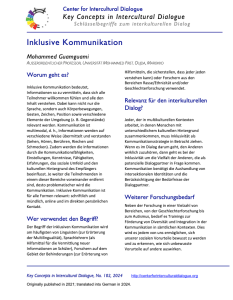
Key Concepts in ICDContinuing translations of Key Concepts in Intercultural Dialogue, today I am posting KC#102: Inclusive Communication, originally written by Mohammed Guamguami for publication in 2021, and now translated by Marlena Pompino into German.

As always, all Key Concepts are available as free PDFs; just click on the thumbnail to download. Lists organized chronologically by publication date and numberalphabetically by concept in English, and by languages into which they have been translated, are available, as is a page of acknowledgments with the names of all authors, translators, and reviewers.

KC102 Inclusive communication in GermanGuamguami, M. (2024). Inklusive Kommunikation. (M. Pompino, trans.). Key Concepts in Intercultural Dialogue, 102. Available from: https://centerforinterculturaldialogue.org/wp-content/uploads/2024/06/kc102-inclusive-communication_german.pdf

If you are interested in translating one of the Key Concepts, please contact me for approval first because dozens are currently in process. As always, if there is a concept you think should be written up as one of the Key Concepts, whether in English or any other language, propose it. If you are new to CID, please provide a brief resume. This opportunity is open to masters students and above, on the assumption that some familiarity with academic conventions generally, and discussion of intercultural dialogue specifically, are useful.

Wendy Leeds-Hurwitz, Director
Center for Intercultural Dialogue


Creative Commons License
This work is licensed under a Creative Commons Attribution-NonCommercial-NoDerivatives 4.0 International License.

Save

Assoc of International Education Administrators: CEO (USA but Remote)

“JobChief Executive Officer, Association of International Education Administrators, Durham, NC, USA Deadline: 2 August 2024.

The Association of International Education Administrators (AIEA) seeks a mission-aligned and visionary leader to join the organization as the next Chief Executive Officer (CEO). AIEA, a membership organization formed in November 1982, is the only association dedicated exclusively to senior leaders in the field of international education, equipping them to shape the future of higher education in a global context. With more than 600 members from around the world, AIEA brings international education leaders into dialogue with each other, their counterparts around the world, organizations that promote international education, and groups concerned with the shaping and management of international higher education. Reporting directly to the Executive Committee of the Board of Directors, the CEO is the key leader responsible for overseeing the operations of the Association which includes the administration, staff, programming, strategic vision and plan implementation while representing the Association in external relations.

Stanford U: Berlin Overseas Studies Director (Germany)

“JobBing Overseas Studies Program Director, Stanford University, Berlin, Germany. Deadline: 2 August 2024.

The Bing Overseas Studies Program (BOSP) at Stanford University is seeking qualified candidates for the Director position at their center in Berlin, Germany. The Stanford in Berlin program is comprised of 6 employees who serve an average of 35 students for each of three academic quarters annually, in addition to a summer internship program. The Director of the Stanford Program in Berlin is charged with nourishing an intellectual and social environment that is supportive of excellence and high academic standards for Stanford undergraduates. The Director is responsible for the academic and administrative management and day to day operation of the Bing Overseas Studies Program (BOSP) center and for making decisions on local resource allocations and priorities, recognizing both local practice and Stanford University operating principles. The Director represents the Stanford Program in Berlin in collaboration with partner German academic institutions, sponsors, donors, foundations and alumni organization

ALF: Euro-Mediterranean Young Professionals Programme 2024 (Egypt)

Professional OpportunitiesEuro-Mediterranean Young Professionals Programme, Anna Lindh Foundation, Alexandria, Egypt. Deadline: 24 July 2024.

The ALF Euro-Mediterranean Young Professionals Programme is a full-time professional experience designed for young professionals at the beginning of their careers who are eager to expand their intercultural expertise through dedicated work.

The programme aims to empower talented graduates under the age of 30 from the 43 countries in the Euro-Mediterranean region by providing them with firsthand professional experience in intercultural dialogue. Professionals also benefit by contributing to the Foundation’s mission to foster youth inclusion through empowerment and engagement, enforcing their competitiveness on the job market.

Successful applicants will begin their professional journey of up to 12 months at the ALF Secretariat in Alexandria, Egypt.