KC3 Intercultural Competence Translated into Macedonian

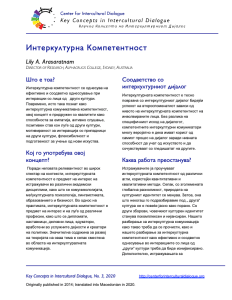
Key Concepts in ICDContinuing translations of Key Concepts in Intercultural Dialogue, today I am posting KC#3: Intercultural Competence, which Lily Arasaratnam wrote for publication in English in 2014, and which Emilija Jovanovska has now translated into Macedonian.

As always, all Key Concepts are available as free PDFs; just click on the thumbnail to download. Lists of Key Concepts organized alphabetically by conceptchronologically by publication date and number, and by languages into which they have been translated, are available, as is a page of acknowledgments with the names of all authors, translators, and reviewers.

KC3 Intercultural Competence_Macedonian

Arasaratnam, L. A. (2020). Intercultural competence [Macedonian]. (E. Jovanovska, trans). Key Concepts in Intercultural Dialogue, 3. Retrieved from:
https://centerforinterculturaldialogue.org/wp-content/uploads/2020/07/kc3-intercultural-competence_macedonian.pdf

If you are interested in translating one of the Key Concepts, please contact me for approval first because dozens are currently in process. As always, if there is a concept you think should be written up as one of the Key Concepts, whether in English or any other language, propose it. If you are new to CID, please provide a brief resume. This opportunity is open to masters students and above, on the assumption that some familiarity with academic conventions generally, and discussion of intercultural dialogue specifically, are useful.

Wendy Leeds-Hurwitz, Director
Center for Intercultural Dialogue


Creative Commons License
This work is licensed under a Creative Commons Attribution-NonCommercial-NoDerivatives 4.0 International License.

Migration and Integration Podcasts

PodcastsMatching the earlier list of podcasts relating to diversity and anti-racism, this is a list of podcasts on topics relating to migration and integration around the world.

The Migration Podcast from IMISCOE (International Migration, Integration and Social Cohesion in Europe, the EU network of 55 organizations)

The field of migration and mobility studies is vast and has grown exponentially over the past decades. At the same time, migration and fears of the foreign dominate public discourse around the world. To make sense of the movement of people, this podcast explores the latest in migration and mobility research globally. Providing a platform for migration scholars to speak about their projects, ideas and insights, The Migration Podcast aims to publicize and render more accessible what happens inside of universities around the world.

Migration Policy Institute Podcasts from MPI

The Migration Policy Institute is an independent, nonpartisan, nonprofit think tank in Washington, DC dedicated to analysis of the movement of people worldwide.

CMS Podcast from Center for Migration Studies

The Center for Migration Studies of New York (CMS) is a think tank and an educational institute devoted to the study of international migration, to the promotion of understanding between immigrants and receiving communities, and to public policies that safeguard the dignity and rights of migrants, refugees and newcomers.

Centre for Migration and Diaspora Studies Podcasts from SOAS, University of London

Lectures given as part of the Centre for Migration and Diaspora Studies joint seminar series are now available as podcasts through SOAS Radio. SOAS University of London is the leading Higher Education institution in Europe specialising in the study of Asia, Africa and the Near and Middle East.

For more ideas on podcasts, see also 5 Great Podcasts About Migration and Social Inclusion.

For related reading, see Key Concepts in Intercultural Dialogue,  #16: Migration, and #15: Cultural Pluralism.

Intercultural/Interracial Dialogue at Home

Resources in ICD“ width=Intercultural connections of all kinds (race, ethnicity, nationality, religion) happen at two levels – in public, and in private. Most research focuses on the former, but there is much to be gained by studying the latter. People who have intercultural friends have to discuss and face their differences, and find a way to manage them, and this is even more true for intercultural couples and families, who often are making a longer term commitment to an Other. There is a growing literature addressing the topic.

A few relevant sources follow.

Breger, R., & Hill, R. (Eds.). (1998). Cross-cultural marriage: Identity and choice. Oxford, UK: Berg.

Bystydzienski, J. (2011). Intercultural couples: Crossing boundaries, negotiating difference. New York NY: New York University Press.

Dervin, F. (2013). Do intercultural couples “see culture everywhere”? Case studies from couples who share a lingua franca in Finland and Hong Kong. Civilisations, 62, 1–15.

Gonçalves, K. (2013). Conversations of intercultural couples. Berlin, Germany: Akademie Verlag.

Inman, A. G., Altman, A., Kaduvettoor‐Davidson, A. N. J. U., Carr, A., & Walker, J. A. (2011). Cultural intersections: A qualitative inquiry into the experience of Asian Indian–White interracial couples. Family Process, 50(2), 248-266.

Johnson, E. D. (2020). Say I’m dead: A family memoir of race, secrets and love. Chicago, IL: Lawrence Hill Books.

Karris, T., & Killian, K. (Eds.). (2009). Intercultural couples: Exploring diversity in intimate relationships. London, UK: Routledge.

Lee, Pei-Wen. (2006). Bridging cultures: Understanding the construction of relational identity in intercultural friendship. Journal of Intercultural Communication Research, 35(1), 3-22.

Leeds-Hurwitz, W. (2002). Wedding as text: Communicating cultural identities through ritual. Mahwah, NJ: Erlbaum.

Leeds-Hurwitz, W. (Ed.). (2005). From generation to generation: Maintaining cultural identity over time. Cresskill, NJ: Hampton Press.

Martinez, L. V., Ting-Toomey, S., & Dorjee, T. (2016). Identity management and relational culture in interfaith marital communication in a United States context: A qualitative study. Journal of Intercultural Communication Research, 45(6), 503-525.

McFadden, J. (2001). Intercultural marriage and family: Beyond the racial divide. The Family Journal, 9(1), 39-42.

Moscato, G., Novara, C., Hombrados-Mendieta, I., Romano, F., & Lavanco, G. (2014). Cultural identification, perceived discrimination and sense of community as predictors of life satisfac- tion among foreign partners of intercultural families in Italy and Spain: A transnational study. International Journal of Intercultural Relations, 40, 22–33.

Piller, I. (2002). Bilingual couples talk: The discursive construction of hybridity. Amsterdam, Netherlands: John Benjamins.

Piller, I. (2007). Cross-cultural communication in intimate relationships. In H. Kotthoff & H. Spencer-Oatey (Eds.), Handbook of intercultural communication (pp. 341–359). Berlin, Germany: Mouton de Gruyter.

Romano, D. (2008). Intercultural marriage: Promises and pitfalls. Nicholas Brealey.

Sandel, T. L. (2015). Brides on sale: Taiwanese cross border marriages in a globalizing Asia. New York: Peter Lang.

Tili, T. R., & Barker, G. G. (2015). Communication in intercultural marriages: Managing cultural differences and conflicts. Southern Communication Journal, 80(3), 189-210.

Wilczek‐Watson, M. (2017). Intercultural intimate relationships. In Y. Y. Kim (Ed.), The international encyclopedia of intercultural communication. New York: Wiley. https://doi.org/10.1002/9781118783665.ieicc0058

See also Key Concepts in Intercultural Dialogue #1 on Intercultural Dialogue, #96 on Interreligious Dialogue, #12 on Third Culture Kids and #94 on Cross-Cultural Kids.

 

CFP In Dialogue: CID Occasional Papers

In Dialogue: Occasional PapersThe Center for Intercultural Dialogue is starting a new publication series, In Dialogue: CID Occasional Papers. The goal is to provide a place for longer discussions than are possible in any of the other publication series. There will likely be only one or two occasional papers published in any given year.

OP1, to be published next week, provides a broad overview of intercultural dialogue as it is studied and practiced today, summarizing a wide range of publications in a single place, in order that others can easily use this resource to learn what sources will be most relevant to their own needs, as well as showing what work already has been completed, and pointing out what remains to be done.

In Dialogue: CID Occasional Papers will be a good place to publish analyses of actual, naturally occurring intercultural dialogue, since this is what is most often missing from the literature. If you are  interested in publishing something of your own in this series, contact the series editor, Wendy Leeds-Hurwitz.

As with other series, the Occasional Papers will be made available for free on the site as printable PDFs. They may be downloaded, printed, and shared as is, without changes, without cost, so long as there is acknowledgment of the source.

My thanks to Donal Carbaugh, former CID Board Member, for suggesting the series title, and to Linda de Wit, former CID intern now serving as graphic design consultant, for creating the layout and design  of the new series.

NTNU: PhD Studentship WorldViews (Norway)

“Studentships“PHD Studentship in Interdisciplinary Child Research, Department of Education and Lifelong Learning, Norwegian University of Science and Technology, Trondheim, Norway. Deadline: 31 August, 2020.

The PhD candidate will be part of the interdisciplinary research group WorldViews. WorldViews consists of researchers with backgrounds in education, sociology, anthropology, and interdisciplinary child and youth research. What we have in common is a genuine interest for social justice as well as a desire to understand and reveal power structures and marginalisation processes in formal and informal contexts. WorldViews seeks to contribute to increased knowledge and critical reflection surrounding socio-cultural discourses about childhood, youth, upbringing and family life. In our research, we explore children’s, youths’ and families’ encounters with hegemonic, normative and taken-for-granted sets of values, worldviews and knowledge systems. Through our research we aim to disclose how children and young people’s everyday lives are shaped by diverse understandings connected to class, ethnicity, gender, and generation, and examine processes and relations that create, preserve or reduce ‘othering’.

The PhD candidate will conduct research in the project Visualizing youth narratives: Empower Youth, Broaden horizons, Enhance intercultural encounters (ViYouth). ViYouth is an international and interdisciplinary project. The primary objective of ViYouth is to enhance transformative learning and critical reflection among diverse youth populations (aged 15 to 16) in Norway, the Netherlands, Chile and Brazil. The secondary objective is to develop a model of inclusive education, focusing on a sense of belonging, global citizenship and interconnectedness. The three overall aims are: 1) To empower youth by enhancing a sense of autonomy and protagonist participation in the creation of self-representations. 2) To foster transformative learning through intercultural understanding, appreciation and dialogue among youth. 3) To reduce the potentiality of ignorance, discrimination, racism and xenophobia among youth.

Lancaster U: Postdoc on Biases in AI (UK)

PostdocsPost-doctoral Research Associate, Lancaster University Management School, Lancaster University, Lancaster, UK. Deadline: 20 August 2020.

BIAS is an interdisciplinary research project funded as part of the Canada-UK Artificial Intelligence Initiative (UKRI and multiple Canadian Funding Agencies) to improve scientific understanding of gender and ethnic biases in the increasingly digitalised and AI-driven labour market processes of job advertising, hiring and professional networking; and developing insights into how such biases and attendant inequalities may be mitigated. Through collaboration with academics from the disciplines of Organisational Management, Sociology, Computer Science and Data Science, and with industry partners in the area of AI protocol development, these insights will drive the development of a new Responsible AI Development Protocol. The post is advertised for 24 months. The academic partners in the project are Lancaster University (lead institution), Essex University (UK), and Alberta University (Canada). You should have a PhD in a topic related to information systems management, the development of socio-technical systems, labour relations, and/or human resources management.

Cornell U: Society for the Humanities Fellowships (USA)

FellowshipsSociety for the Humanities Fellowships 2021-22, Cornell University, Ithaca, NY. Deadline: October 1, 2020.

The Society for the Humanities at Cornell University invites applications for residential fellowships from scholars whose research projects reflect on the 2021-22 theme of Afterlives. Up to six Fellows will be appointed. The fellowships are held for one academic year. Each Society Fellow will receive $55,000.

Fellows include scholars and practitioners from other universities and members of the Cornell faculty released from regular duties. Fellows at the Society for the Humanities are “residential,” and will collaborate with one another and the Taylor Family Director of the Society for the Humanities, Paul Fleming, Professor of Comparative Literature and German Studies. Fellows spend their time in research and writing during the residential fellowship, and are required to participate in a weekly Fellows Seminar workshopping each other’s projects and participating in lively discussions on readings based on the yearly theme.

Fellows teach one small seminar during their fellowship year appropriate for graduate students and advanced undergraduates. Though courses are designed to fit the focal theme, there are no additional restrictions on what or how the course should be taught. Fellows are encouraged to experiment with both the content and the method of their seminar particularly as it relates to their current research.

Fulbright Scholar Awards

FulbrightsThe Fulbright U.S. Scholar Program offers opportunities for scholars, professionals, and postdocs to advance their research and teaching interests, promote mutual understanding, and collaborate with scholars abroad. The program is accepting applications for the 2021-2022 academic year through September 15, 2020.

There are over 450 awards available in more than 125 countries and many are open to all disciplines. The complete list of opportunities is located in the Fulbright U.S. Scholar Catalog of Awards. Opportunities range from 2 to 12 months in length and include flexible options for multiple shorter visits to many host countries. There are also programs for non-US residents to visit the US.

For further information:

See a series of personal narratives about Fulbrights previously posted to this website, and also the chapter The value of a Fulbright: Internationalizing education one person at a time, published in Internationalizing the communication curriculum in an age of globalization.

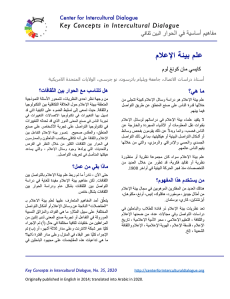
KC35 Media Ecology Translated into Arabic

Key Concepts in ICDContinuing translations of Key Concepts in Intercultural Dialogue, today I am posting KC#35: Media Ecology, which Casey Man Kong Lum wrote for publication in English in 2014, and which Salma Tariq Shukri has now translated into Arabic.

As always, all Key Concepts are available as free PDFs; just click on the thumbnail to download. Lists of Key Concepts organized alphabetically by conceptchronologically by publication date and number, and by languages into which they have been translated, are available, as is a page of acknowledgments with the names of all authors, translators, and reviewers.

KC35 Media Ecology_Arabic

Lum, C. M. K. (2020). Media ecology [Arabic]. (S. T. Shukri, trans). Key Concepts in Intercultural Dialogue, 35. Available from:
https://centerforinterculturaldialogue.org/wp-content/uploads/2021/11/kc35-media-ecology_arabic-v2.pdf

If you are interested in translating one of the Key Concepts, please contact me for approval first because dozens are currently in process. As always, if there is a concept you think should be written up as one of the Key Concepts, whether in English or any other language, propose it. If you are new to CID, please provide a brief resume. This opportunity is open to masters students and above, on the assumption that some familiarity with academic conventions generally, and discussion of intercultural dialogue specifically, are useful.

Wendy Leeds-Hurwitz, Director
Center for Intercultural Dialogue


Creative Commons License
This work is licensed under a Creative Commons Attribution-NonCommercial-NoDerivatives 4.0 International License.

GC Human Rights Preparedness Initiative (Italy)

“CollaborativeEach pandemic is different. At the same time, each is also the latest in a long line, which means there are lessons to be learned from the past, and preparations that can be made for the future. The Global Campus of Human Rights is proud to present its new open initiative GC Human Rights Preparedness, a space for collaboration on the role that human rights must play in addressing the persistent challenges of pandemics and other emergencies.

By identifying good practices in a variety of areas related to human rights and democratisation, GC Human Rights Preparednesswill shape significant knowledge with relevance to the post COVID-19 world. The initiative is curated by an editorial team supported by a multiregional and multidisciplinary group of reviewers and advisors whose knowledge and expertise are best suited to discuss complex issues.

If you want to know more about the project, or if you wish to submit your contribution, please visit  the site or contact the GC Team via email.