2020 Video Competition: Deep Listening

CID Video Competition

Kasriel, Emily. (2020, March 4). Deep listening: Finding common ground with opponents. BBC.

BBC is running a series on Crossing Divides, “the power and possibilities of encountering people with conflicting opinions, across divisions of race, class, faith, politics and generation.” One of their stories is about deep listening.

Deep listening involves being genuinely curious about someone else’s story, with a strong desire to understand them. It’s about connecting to them as an individual and establishing trust.

Deep listening can serve as a resource to students preparing a video for entry in the CID Video Competition this year, given that the theme this year is listening.

Crossing Divides is one of BBC’s efforts in line with Solutions-focused journalism.

CFP Exhibitions of Impact: Social Force of Museums

“PublicationCall for papers: American Behavioral Scientist invites submissions for a special issue: Exhibitions of Impact: The Social Force of Museums. Deadline extended to June 20, 2020.

Museums are “democratising, inclusive and polyphonic,” addressing “the conflicts and challenges of the present,” and aiming to advance “human dignity and social justice, global equality and planetary wellbeing,” according to a recently proposed definition from The International Council of Museums (ICOM, “Museum definition” 2019). With this definition in mind, this special issue invites scholarship about museums as a social force.

Continue reading “CFP Exhibitions of Impact: Social Force of Museums”

European MA in Human Rights & Democratisation (Italy)

Graduate StudyEuropean Master’s Programme in Human Rights and Democratisation for 2020/21, Global Campus of Human Rights, Venice, Italy. Application deadline: 12 May 2020.

The Global Campus of Human Rights has announced that the call for applications for the European Master’s Programme in Human Rights and Democratisation (EMA) has been extended until 12 May 2020.
EMA is an intensive one-year course aimed at educating 90 professionals annually in the field of human rights and democratisation. The Master’s Programme offers a practice and policy-oriented approach to learning that combines legal, political, historical, anthropological, and philosophical perspectives of Human Rights and Democratisation with skill building activities and a field trip exercise.

EMA is both a residential and an exchange programme. The first semester from September 2020 to January 2021 is organised at the Global Campus of Human Rights premises in Venice and the second semester from February to July 2021 takes place in one of the 41 participating universities within the member states of the European Union. The multidisciplinary EMA Programme includes lectures, seminars, workshops, tutorials, skill-building sessions and individual research.

The Global Campus of Human Rights is an inter-disciplinary centre of excellence supported by the EU.

CFP Beyond & Besides Language(s): ICC and Creative Practice

“PublicationCall for contributions: CFP Intercultural Communication and Creative Practice; Special Issue of Language and Intercultural Communication. Abstract Deadline: 4 May 2020.

Guest Editors: Lou Harvey (University of Leeds) and Gameli Tordzro (University of Glasgow).

This special issue explores the relationship between creative practice and the teaching, research and understanding of communication in intercultural settings. In recent years an emerging body of intercultural work engaging arts-based methodology has problematised the role of language in communicating, knowing and being (e.g. Bradley et al. 2018; Frimberger et al. 2018; Harvey, McCormick and Vanden 2019), its relationships with other modes of communication and other human and non-human actors (Thurlow 2016; Pennycook 2018), and analysed artistic research and production processes as communication (Andrews et al. 2020; Harvey 2018, 2020; Tordzro 2018, 2019). This research has engaged innovatively and productively with ongoing and urgent concerns in the field relating to de-essentialising (MacDonald and O’Regan 2013; Ferri 2018; MacDonald 2019); decolonising (Phipps 2013, 2019); and research methodology, relationships and ethics (Holliday and MacDonald 2019; Bradley and Harvey 2019). This special issue invites contributors to consider the role of communication in relation to creative practice in intercultural settings (broadly defined), to further engage with these concerns at the levels of ontology and epistemology, and to consider the implications for social justice and knowledge democracy.

KC97 Anti-Racist Education

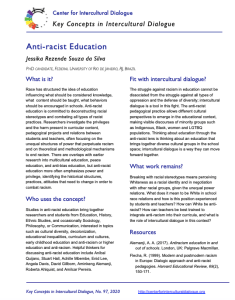
Key Concepts in ICDThe next issue of Key Concepts in intercultural Dialogue is now available. This is KC#97: Anti-racist education, by Jessika Rezende Souza da Silva. Click on the thumbnail to download the PDF. Lists organized chronologically by publication date and numberalphabetically by concept in English, and by languages into which they have been translated, are available, as is a page of acknowledgments with the names of all authors, translators, and reviewers.

KC97 Anti-racist education

Souza da Silva, J. R. (2020). Anti-racist education. Key Concepts in Intercultural Dialogue, 97. Available from:
https://centerforinterculturaldialogue.org/wp-content/uploads/2020/03/kc97-anti-racist-education.pdf

The Center for Intercultural Dialogue publishes a series of short briefs describing Key Concepts in Intercultural Dialogue. Different people, working in different countries and disciplines, use different vocabulary to describe their interests, yet these terms overlap. Our goal is to provide some of the assumptions and history attached to each concept for those unfamiliar with it. As there are other concepts you would like to see included, send an email to the series editor, Wendy Leeds-Hurwitz. If there are concepts you would like to prepare, provide a brief explanation of why you think the concept is central to the study of intercultural dialogue, and why you are the obvious person to write up that concept.


Creative Commons License
This work is licensed under a Creative Commons Attribution-NonCommercial-NoDerivatives 4.0 International License.

City U of Hong Kong: Media & Communication (China)

“JobChair Professor / Professor / Associate Professor, Department of Media and Communication, City University of Hong Kong, China. Deadline: 31 May 2020 or until filled.

The Department of Media and Communication invites applications for faculty appointment at the rank of Chair Professor/Professor/Associate Professor beginning in January 2021. Specialization sought is open, with preferred areas including Mass Communication, Digital and Social Media, Visual Communication, and Marketing and Strategic Communication.

A PhD in Communication or a closely related field from a globally accredited institution. The appointees for Chair Professor/Professor should command a superb record of scholarly achievements and exert leadership in the field of media and communication. The appointees for Associate Professor should have an outstanding record of scholarly achievements in both teaching and research, a strong record in research grant and/or academic management expertise.


2020 Video Competition, Listening, and Collaboration

CID Video CompetitionPlaying for Change. (2011, May 26). Gimme Shelter. YouTube.

In these days of instructions to “shelter in place,” this video seems a particularly appropriate fit, and a reminder that none of us is facing the COVID-19 pandemic alone.

It is in the shelter of each other that the people live
Irish proverb

Playing for Change has produced many videos, among them The Weight. For that, they also produced a first and second video describing what they did and how they made it work. All of these videos were produced long before Coronavirus, but they seem particularly appropriate today. It’s especially the two “behind the scenes” videos that may be of interest to any students working on a video for the CID Video Competition,  in these times when the simple act of getting together for a group project becomes impossible.

Playing for Change is a movement created to inspire and connect the world through music. The idea for this project came from a common belief that music has the power to break down boundaries and overcome distances between people.”

Ilse Herath-Schugsties Profile

ProfilesIlse Herath-Schugsties is a Psychologist (Friedrich Alexander Universität, Erlangen, Germany) and Psychoanalytical Psychotherapist (Alfred Adler Institut, DGIP) who focuses on Children and Youth.
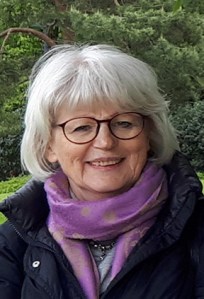
Ilse Herath-Schugsties

Herath-Schugsties spent her whole working life in Munich. After working in a Social Psychiatric Ambulance and ten years at a Children’s Home for Remedial Education as psychologist and manager, she moved to an institution of Educational Guidance and Counseling in a socially disadvantaged district where she cooperated with different educational institutions, e.g. crèches, kindergartens or schools for more than 25 years.

The rate of migrants is especially high in this part of the city. Very often they are refugees and their families, in part traumatised by war, with different residence status. Due to this it is not unusual to have children from up to thirty different nations in kindergartens and schools, and classes without native speaking Germans. Herath-Schugsties started a successful project in cooperation with some kindergartens to empower the migrant parents, e.g. by reflecting cultural differences in bringing up children and in family life.

Through individual psychological counselling and open courses for intercultural dialogue she spread information using handouts or visual material as the basis, encouraging confidence in intercultural learning and communication to help them adapt to a different way of living.
Media and communication have been important “ingredients” for this project as well as in the rest of her work. Although retired she still works as case supervisor or speaks at parents’ evenings for those multicultural crèches and kindergartens .


Work for CID:
Ilse Herath-Schugsties translated KC35: Media Ecology into German.

Mother Tongue Film Festival

Intercultural PedagogyThe Smithsonian Institution’s Mother Tongue Film Festival celebrates cultural and linguistic diversity by showcasing films and filmmakers from around the world in Washington, DC.

Through digital storytelling, the festival amplifies the work of diverse practitioners who explore the power of language to connect the past, present, and future. Since 2016, the annual festival has celebrated International Mother Language Day on February 21. The fifth annual festival took place February 20–23, 2020. Many of the shorter films are available to stream in full on their website.

Many of these films would be valuable in teaching about cultural differences, if not intercultural dialogue explicitly. Just the easily accessible short films range from Pire, a music video with lyrics in Mapuzugun, the Mapuche language of Argentina, to Grá & Eagla, following an Irish bilingual comedian using Gaeilge [Gaelic], to Puhi Toprao / To Be Happy, telling the creation story of the Yanomami in Venezuela in their own language.