Intercultural Communication MOOC (China)

“MOOCs”
MOOC (Massive Open Online Course): Intercultural Communication. Starts: October 14, 2019 (may be joined late)

Learn to appreciate, adjust to, and work or study in different cultures, with this free online intercultural communication course. This course assumes no prior knowledge and is suitable for pre-university, undergraduate and post-experience students. It does require high school-level English or above, an interest in international issues, and curiosity about, exposure to or experience with other cultures.

Taught by Steve Kulich, Hongling Zhang, and Ruobing Chi, all at the Intercultural Institute of Shanghai International Studies University, China, on the FutureLearn platform. Among the intercultural offerings now online, the SISU course encourages non-western perspectives and focuses on clarifying learner’s identities, preferences and approaches to interaction in intercultural contexts.

Other relevant MOOCs on this platform include Cultures and Identities in Europe by the European University Institute, Italy; Introduction to Intercultural Studies: The Concept of Culture, Introduction to Intercultural Studies: Intercultural Contact by the University of Leeds, England, and Multilingual Practices: Tackling Challenges and Creating Opportunities (by the University of Groningen, The Netherlands). Joining all of these courses is free, but students pay a fee if they want a Certificate of Achievement documenting participation.

SIETAR Italia Call for Events Proposals 2020 (Italy)

EventsCall for Events Proposals for 2020, SIETAR Italia, Milan, Italy. Deadline: 30 October 2019.

Organizers at SIETAR Italia are currently working on the 2020 Programme of Events. Every year they ask members and non-members to deliver workshops, seminars, webinars or talks following their guidelines.

Are you interested in presenting an event in 2020?

The areas of greatest interest are:
•    Companies and organizational challenges
•    Intercultural and multicultural socio-political contexts
•    Development of competencies and training of intercultural professionals
•    Intercultural communication in language education
•    Intercultural education in the European context


If you have any interesting contribution to offer (in English or Italian) on one of these subjects, please complete the Form for Events Proposals – 2020 Calendar, and send it to SIETAR Italia by the 30th of October 2019. Notices about what has been accepted will be sent by end of November 2019.

In Milan, most of the events are hosted for free by ChiAmaMilano, via Laghetto, 2 (near Duomo – Università Statale) which is run by the Milan Council. If you know of other venues in Milan or other cities, please mention them.

The 2020 Calendar of Events, as well as the one-off events, will be posted on the following channels: the SIETAR Italia website; the GLOBAL SIETAR calendar of events; Eventbrite, through the Newsletter (with a mailing list of 2500 contacts), the SIETAR Italia Facebook page, LinkedIn, Twitter and Instagram, as well as through partners’ communication channels.

Center for a Public Anthropology Competition for Book Publication

“PublicationPublic Anthropology: Competition to publish an open access book in a new series. Deadline: November 4, 2019.

Drawing on the example of the California Series in Public Anthropology, the Center for a Public Anthropology announces a New Open-Access Book Series that addresses important public issues.  It embraces the hope that anthropology has value to those beyond the discipline, beyond the university.  The focus is on publications that matter to other people – by the power of their ideas and by how, with the help of others, they transform peoples’ lives for the better. It is one thing to write a thoughtful book. It is another to do so in a manner that attracts the attention and collaboration needed to help address a problem.

Each year the Center holds an international competition seeking out prospective manuscripts that align with this vision.  The Series reviews proposals independent of whether the manuscripts themselves have been completed.  The proposals submitted should be 3-4,000 words long and describe both the overall work as well as a general summary of what is (or will be) in each chapter. The Center expects to select, through the competition, one to two books each year for open-acess publication.  The selected manuscripts will then go through a “sighted peer review” process.  Rather than being “blind”, the review process will be an open, collaborative endeavor between an author and reviewers.

CFP Tourism & Sustainable Development Goals (Portugal)

ConferencesCall for papers: Tourism and the Sustainable Development Goals: From theory to practice, University of Aveiro, Portugal, May 13  – 15,  2020. Deadline: 31 October 2019.

Tourism has become one of the main sectors of activity. According to the World Tourism Organization (WTO), it represents almost 10% of world GDP and 30% of service exports, emphasizing their essential contribution to economic growth and the development of nations. The expansion of global tourism has propelled several countries affected by the recession towards economic recovery, such as Portugal. In 2015, the United Nations (UN) launched the 2030 Agenda for Sustainable Development, adopted by all member countries. This new agenda has the fundamental mission of permanently eradicating poverty in the world. In this context, they launched 17 Sustainable Development Goals (SDGs) and 169 targets, which should drive the efforts of countries, societies and the private sector.

It is undeniable that tourism stimulates growth, having a strong capacity to expand the socioeconomic dynamics of destinations. In recent years, the tourism development process is no longer based on a limited set of products such as sun and beach. Tourism has expanded from seaside destinations to cultural sites and has flourished in several small and medium-sized cities, boosting a renewed phase of urban tourism. Several emerging forms of tourism are responsible for generating pressures in some urban areas, including overtourism . However, these dynamics open opportunities to shape and create new growth poles in cities, with ‘ spillovers ”to the territory. Tourism, as a multidisciplinary, multisectoral, holistic and systemic industry, has enormous potential to contribute to sustainable development, firmly supported by the WTO. Despite the existence of several studies addressing the relationship between tourism, sustainability and sustainable tourism, a comprehensive discussion is needed on how tourism can contribute positively and directly to each of the SDGs.

INVTUR 2020 is an interactive, dynamic and international platform on which academics and practitioners can discuss best practices and strategies in research and knowledge management through partnerships. In the previous edition, it attracted more than 700 participants from over 30 countries on five continents. It has become a forum for discussion and scientific interaction that offers an unforgettable experience for all participants: in scientific and networking potential as well as in social terms. INVTUR, an international tourism conference of recognized value, has been organized by the University of Aveiro since 2010, in collaboration with several partner universities from different countries. Located in the modern and tourist city of Aveiro, The University of Aveiro boasts its reputation as an international higher education institution and one of the most dynamic and innovative universities in Portugal. Being among the best in the country in scientific and architectural terms, the University is also proud to be a Center of Excellence in Tourism.

KC51 Critical Discourse Analysis Translated into Greek

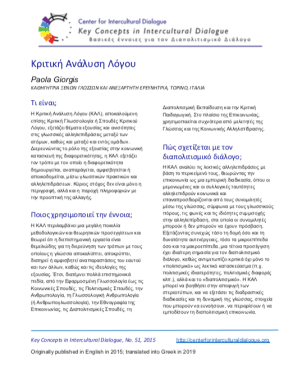
Key Concepts in ICDContinuing translations of Key Concepts in Intercultural Dialogue, today I am posting KC#51: Critical Discourse Analysis, which Paola Giorgis wrote for publication in English in 2015, and which Anastasia Karakitsou has now translated into Greek.

As always, all Key Concepts are available as free PDFs; just click on the thumbnail to download. Lists of Key Concepts organized alphabetically by conceptchronologically by publication date and number, and by languages into which they have been translated, are available, as is a page of acknowledgments with the names of all authors, translators, and reviewers.

KC51 CDA GreekGiorgis, P. (2019). Critical discourse analysis [Greek]. (A. Karakitsou, trans). Key Concepts in Intercultural Dialogue, 51. Available from:
https://centerforinterculturaldialogue.org/wp-content/uploads/2019/10/kc51-cda_greek.pdf

If you are interested in translating one of the Key Concepts, please contact me for approval first because dozens are currently in process. As always, if there is a concept you think should be written up as one of the Key Concepts, whether in English or any other language, propose it. If you are new to CID, please provide a brief resume. This opportunity is open to masters students and above, on the assumption that some familiarity with academic conventions generally, and discussion of intercultural dialogue specifically, are useful.

Wendy Leeds-Hurwitz, Director
Center for Intercultural Dialogue


Creative Commons License
This work is licensed under a Creative Commons Attribution-NonCommercial-NoDerivatives 4.0 International License.

Florida Atlantic U: Intercultural Communication (USA)

“JobAssistant Professor of Intercultural Communication, Florida Atlantic University, Boca Raton, FL. Deadline: January 10, 2020 or until filled (posted October 10, 2019).

The School of Communication and Multimedia Studies at Florida Atlantic University (FAU) seeks a tenure track, Assistant Professor to teach and develop courses at the undergraduate and graduate levels, and to perform research in the area of Intercultural Communication in the Communication Studies degree program. The tenure track position requires solid research/scholarship, excellent instruction, and service for advancement. The teaching load is five courses per year (a 3/2 or 2/3 load).

Candidates must have a distinctive, scholarly agenda focused on intercultural communication, and be prepared to teach both B.A. and M.A. students. The strongest candidates will explore issues related to support/privilege in health and environmental contexts, civic engagement, and/or communication practices in national and international contexts. Interdisciplinary approaches are encouraged, and we are open to all methodologies. There are opportunities to participate in one of the college-wide doctoral programs, as well as the M.S. program in Data Science.

Dependent on specialty, teaching may include undergraduate courses such as: Intercultural Communication, International Communication, Ethnicity and Communication, American Multicultural Discourse, Minorities in the Media, Introduction to Communication and Civic Life, Conflict and Communication, Nonverbal Communication in a Diverse Society, Gender, Race and Communication, Leadership and Communication, Democracy and Civic Engagement or other courses in the Communication Studies BA or MA degree sequences.  There is also support for developing curriculum in health and environmental communication and/or the candidate’s area of specialty.

Middle Tennessee State U: Intercultural Comm (USA)

“JobAssistant Professor of Intercultural Communication, Department of Communication Studies, Middle Tennessee State University, Murfreesboro, TN. Deadline: October 30, 2019.

Seeking a colleague who is prepared to teach courses in the Culture and Social Influence concentration including Intercultural Communication and Diversity in Communication, as well as major core courses including Communication Theory, Introduction to Human Communication, Quantitative or Critical Methods, and Fundamentals of Communication (GE public speaking course). Secondarily, candidates who could also contribute to the Organizational Communication concentration, engage in social media research, and/or are familiar with digital and new media pedagogies are especially encouraged to apply.

Johns Hopkins U: Institutions of Democracy Under Stress (USA)

“JobOpen Rank Faculty, Institutions of Democracy Under Stress, Stavros Niarchos Foundation (SNF) Agora Institute, Johns Hopkins University, Baltimore, MD. Deadline: November 15, 2019, or until filled.

The Stavros Niarchos Foundation (SNF) Agora Institute at Johns Hopkins University seeks faculty (or nominations of faculty) for endowed professorships at the rank of Associate or Full Professor (soon-to-be-tenured Assistant Professors with exceptional records of scholarship can also be considered) in any discipline who focus on the institutional and organizational dimensions of democracy under stress, particularly as related to questions of civic engagement and inclusive discourse. We define these terms broadly and seek scholars from a range of disciplines, including but not limited to scholars who study the dynamics of states; state contexts; political, civic, social, and economic organizations and institutions; social movements; and social networks, as well as their role in shaping, interacting with, constraining, making possible, and challenging the realization of democracy in global contexts or the U.S.

The SNF Agora Institute is a new, $150M multi-disciplinary initiative that integrates research, teaching, and practice to strengthen global democracy by improving and expanding civic engagement and inclusive dialogue, and by supporting inquiry that leads to real-world change. Housed in the university’s Krieger School of Arts and Sciences, the SNF Agora Institute at JHU will serve as a leading forum bringing together experts from a range of fields—including but not limited to political science, sociology, history, neuroscience, psychology, philosophy, and ethics. All SNF Agora faculty will be full members in a department at Johns Hopkins University and at the SNF Agora Institute.

NOTE: There are also current openings for faculty in Challenges of Multi-Ethnic Democracy, Race, Inequality and Social Cognition/Political Psychology

Monash U: Dialogue Research (Australia)

“JobMultiple positions for faculty, postdocs, and PHD students in Dialogue Research, The Laboratory for Dialogue Research, Faculty of Information Technology, Monash University, Melbourne, Australia. Deadline: October 31, 2019.

The Faculty of Information Technology is establishing a new research group, The Laboratory for Dialogue Research (LDR) led by Professor Phil Cohen. The LDR has close partnerships with Monash’s new HCI Group, its renowned Centre for Data Science, the Engineering School, and with numerous universities in Australia and worldwide. Importantly, the plan is to engage with interested industry, philanthropic, and government partners on problem, data, and tool selection and development of scalable approaches. LDR’s Director is Professor Phil Cohen, an AAAI Fellow and internationally known pioneer in natural language dialogue, multi-agent systems, and multimodal interaction.

They cordially invite the interest of outstanding academics who want to join this world-class team to deliver the highest quality teaching and research that will shape the future of AI for conversational assistants, human-robot interaction, customer service, and many other application domains.

Multiple Faculty Openings in LDR are available at a Level B Lecturer (equivalent to Assistant Professor in North America), Level C Senior Lecturer (equivalent to Associate Professor in North America), and Level D Associate Professor (equivalent to Professor in North America) with a preference for expertise in the area of natural language processing (semantic parsing, generation).

Applications of interest from other areas of natural language processing or multimodal interaction that could contribute to dialogue research are also strongly encouraged. The successful candidate will join a rapidly expanding multidisciplinary group in the above areas. When applying, please indicate your area of specialisation.

For details, please download the Laboratory for Dialogue Research Flyer.

CFP Global Studies Conference 2020 (Canada)

ConferencesCall for Papers: 13th Global Studies Conference: Globalization and Social Movements: Familiar Patterns, New Constellations? Concordia University, Montreal, Canada, 4-5 June 2020. Deadline: 4 November 2019.

The last decade saw an intensification of social movement activism across the world. In the Global North, widespread discontent with austerity following the 2008 financial collapse gave rise to the Occupy and Indignados movements. In the Global South, political struggles against neoliberalism have been articulated primarily as protests against its institutional embodiments, especially the World Bank and the IMF and their policies of structural adjustment. Other campaigns mobilized against political oppression (e.g., the Arab Spring), racism (e.g., Black Lives Matter), and sexism (e.g., Me Too). Meanwhile, the Tea Party Movement and now Alt Right have shaped activism on the political right. In some mobilizations, such as Gilets Jaunes in France, left and right-wing influences criss-crossed in often contradictory ways. The fact that all these groups are both manifestations of and responses to various aspects of globalization is nothing new. Earlier mobilizations, such as the global justice movement, epitomized by the Zapatistas in Mexico, also expressed global identities and used the technologies of globalization while challenging the dominant version of the process. As a matter of fact, social movements and international non-governmental organizations worked across borders even in the era when state sovereignty was rarely questioned and politics seemed to make sense almost exclusively in national terms. INGOs, whose number has increased exponentially from a few in the nineteenth century to tens of thousands today, are often viewed as indicators of the state of globalization, expanding rapidly when the global system is on an upward trajectory and declining in significance when globalization is on the defensive. This conference aims to explore those and other manifold and often contradictory relationships between social movements and global processes.