CFP Communicating Prejudice

Call for Chapters for Edited Book
Communicating Prejudice: An Appreciative Inquiry Approach
Proposal Submission Deadline:  October 10, 2014
Editors: Camara, S. K., Drummond, D. K., & Hoey, D. M.
Publisher: Nova Publishing, Inc.

Objective:
In the conclusion of his edited book Communicating Prejudice, Michael Hecht called for an intellectual movement beyond understanding prejudice and its personal and social effects on individuals to a more proactive approach that inquires about appreciation as a serious subject of investigation.

Our edited book, Communicating Prejudice: An Appreciative Inquiry Approach, will blend direct unsettling lived experiences with a deep exploration of appreciation, respect and empowerment. We seek contributions which will speak boldly about personal experiences with prejudice with reflections on practical emancipatory frameworks that generate new directions and tools for dialogue. These meta-narratives should display the potential for creating opportunities for inclusivity, transformation, growth and social justice. We hope to draw on key concepts from a variety of disciplines, including Communication, Sociology, Education, Psychology, and Gender Studies.

Recommended topics include, but are not limited to, the following:
*Meta-analyses of Prejudice: Pre and Post racial America
*Autoethnographic Accounts of Prejudice and Transformation
*Examining Historical and Present initiatives to reduce prejudice
*Exploring Varying Contexts of Prejudice (e.g., Gender, Sexual Orientation, Race, Disability)
*Approaches to Appreciative Structures and Prejudicial Experiences
*Theoretical insights to opening dialogue with others
*Fostering appreciative conversations to defeat exclusion
*Co-creating Business and Organizational transformation
*Dealing with difficult situations and reframing conflict
*Contributions to Social Justice

Submission Procedure:
To have an original chapter considered for inclusion in this peer-reviewed volume, submit it with a 100-word abstract. Please include a separate title page with the author(s) and complete contact information, with brief author bio(s) to the editors by October 10, 2014. Indicate in your email cover letter which of the aforementioned topics your chapter best fits. Quantitative and qualitative research articles are limited to a maximum of 25 pages of text excluding references. Personal narratives or essays are limited to 10 pages.

Important Dates:
October 10, 2014– Chapter Submission Deadline
January 15 1, 2015- Notification of Acceptance
June 1, 2015– Chapter Feedback to Authors
October 15, 2015– Final Edited Submission Due

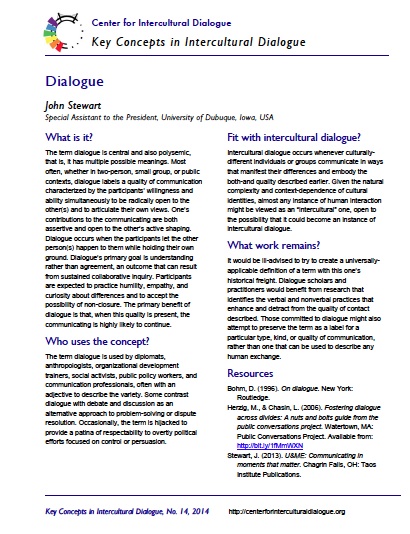
Key Concepts #14: Dialogue by John Stewart

Key Concepts in ICDThe next issue of Key Concepts in intercultural Dialogue is now available. This is KC14: Dialogue by John Stewart. As always, all Key Concepts are available as free PDFs; just click on the thumbnail to download.Lists organized  chronologically by publication date and numberalphabetically by concept in English, and by languages into which they have been translated, are available, as is a page of acknowledgments with the names of all authors, translators, and reviewers.

kc14-smStewart, J. (2014). Dialogue. Key Concepts in Intercultural Dialogue, 14. Available from:
https://centerforinterculturaldialogue.org/wp-content/uploads/2014/05/key-concept-dialogue.pdf

The Center for Intercultural Dialogue publishes a series of short briefs describing Key Concepts in intercultural Dialogue. Different people, working in different countries and disciplines, use different vocabulary to describe their interests, yet these terms overlap. Our goal is to provide some of the assumptions and history attached to each concept for those unfamiliar with it. As there are other concepts you would like to see included, send an email to the series editor, Wendy Leeds-Hurwitz. If there are concepts you would like to prepare, provide a brief explanation of why you think the concept is central to the study of intercultural dialogue, and why you are the obvious person to write up that concept.


Creative Commons License

This work is licensed under a Creative Commons Attribution-NonCommercial-NoDerivatives 4.0 International License.

John Stewart Profile

Profiles

John Stewart serves as Special Assistant to the President at the University of Dubuque in Dubuque, Iowa.

John Stewart

He was Vice President for Academic Affairs at UD from 2001-2010, and on the Communication faculty at the University of Washington in Seattle from 1969-2001. He also taught full-time at the University of Wisconsin-Stout and filled visiting professor/ lecturer positions at a number of institutions, including the University of Hawaii-Manoa, Texas A&M, Gonzaga, California State University-Fresno, Wake Forest, Hebrew University, and the Universities of Tel Aviv and Haifa.

John’s primary research interests have been the philosophy of language, the philosophy and practice of dialogue, and the philosophy and practice of interpretive research. He articulated a relational view of language in Language as Articulate Contact: Toward a Post-Semiotic Philosophy of Communication (1995) and the edited volume, Beyond the Symbol Model: Reflections on the Representational Nature of Language (1996), both published by SUNY Press. His approach to dialogue has been developed in several articles and chapters, including “Foundations of Dialogic Communication,” Quarterly Journal of Speech, 65 (1978), 183-201; “Dialogue as Tensional, Ethical Practice,” with Karen Zediker, Southern Communication Journal, 65 (2000), 224-242; and “Relationships Among Philosophies of dialogue,” with K. E. Zediker and L. L. Black, in Dialogic Approaches to Communication, R. Anderson, L. A. Baxter, & K. N. Cissna (Eds.) (Sage, 2003).

John’s edited textbook, Bridges Not Walls: A Book About Interpersonal Communication is currently in its 11th edition with McGraw Hill, and his co-authored Together: Communicating Interpersonally is in its 6th edition with Oxford.

He is currently focused on revising his communication self-help book, U&ME: Communicating in Moments that Matter (Taos Institute Publications, 2013), which is available in print and e-book versions. Excerpts from, and news about U&ME are available on its Facebook site, and John’s biography, interpersonal communication blog, and information about his other publications are can be found at www.johnstewart.org.


Work for CID:
John Stewart wrote KC14: Dialogue.

Building bridges from theory to practice

I’m currently teaching a course on communication theory.  It’s an undergraduate class, one of those that’s designed to recruit majors.  Recently, one of my students, Joel, raised his hand in class.  You know the type:  he’s talkative, friendly and bright, a bit overbearing, and trying to figure out ‘what does it all mean’.  And that is precisely what he asked in the middle of a lecture/discussion on the importance of communication theory:  “But Miriam, what’s the point?  How does this stuff work in the real world?  Why should I care?”

It’s an age-old question, and one that students and teachers alike often struggle with, particularly in the social sciences and the humanities:  what is the connection between abstract, above-the-clouds theory and the pragmatic, day-to-day life we lead in the world?  But the question is, really, neither mundane nor naïve.  Indeed, I would argue that, in intercultural communication, this question is particularly important and yet woefully under-addressed.  We come up with all of these amazing theories to describe alienation, assimilation, identity processes, cultural difference—but we publish them in reputable journals and exorbitantly-priced textbooks and provide ‘in real life’ examples primarily at the undergraduate level.  Meanwhile, interculturalists who work in the world (outside of academic research), in such areas as refugee counseling, immigration, study abroad, international business, etc., are often working with little-to-no theoretical training, or with outdated approaches to difference such as the U-Curve or Iceberg models.

Where is the dialogue between theorists and practitioners?  What’s the point of doing such great and important work, on theories such as cosmopolitanism, hybridity, critical race theory, and others, if they are only accessible to other academics?  Those of us who identify as critical intercultural scholars are constantly talking about teaching others that difference should be embraced rather than feared, and yet here we are, talking in a language that is only accessible (literally, in terms of access to academic articles; and figuratively, in terms of being able to translate the academese we learn in graduate school) to a small portion of the population: those most like us.

In a discussion of intercultural dialogue, we would do well to listen to questions like Joel’s—the “how does this work” and “why should I care” questions.  If we are the idealists that the field really demands, then shouldn’t we be taking our work outside of the academy and applying it to those who need it, such as those who work with migrant populations, underserved urban youth, patients without health insurance, and on and on?  How can we build bridges between the important work that is done by university researchers and the communities we intend to serve?

I don’t propose that we stop building intercultural theory.  I think the work we do in intercultural research, particularly with today’s critical and postcolonial turns, is imperative to thriving in a world in which difference is coming closer to our doors rather than farther away.  However, with this divide between town and gown, between theory and practice, particularly in intercultural communication research, too much is lost in the translation.  I’d like to call for creative ways of applying academic theory to real world contexts, in ways that get our students jazzed about life beyond college, to see futures for their intercultural understandings of the world they learn in the classroom.  Programs such as Dr. Amy Stornaiuolo’s work with adolescent literacy, called Space2cre8, are heeding such calls, but there is room for so much more.  Students like Joel, those who understand that there could be more to theory than just memorization and regurgitation on an exam, can start to build these bridges, but only once we realize that our work needs to go further.  Let’s get this conversation moving outward, starting by answering Joel’s question:  “You should care because this work is essential to living in a multicultural world.”  This is the opening of our dialogue.

————————————————————–
Miriam S. Sobre-Denton
Assistant Professor | Intercultural Communication
Southern Illinois University Carbondale

msd

Transformative Power of Dialogue

Review of:
Stephen W. Littlejohn & Sheila McNamee (Eds.). (2014). The coordinated management of meaning: A festschrift in honor of W. Barnett Pearce. Madison, NJ: Fairleigh Dickinson University Press.

by Robyn Penman

In 1980, Barnett Pearce and his colleague, Vern Cronen, published Communication, Action and Meaning, a seminal work introducing scholars to the theory of the coordinated management of meaning (CMM). Over the ensuing decades, CMM theory has continued to grow, reaching a wider and wider audience as the practical and theoretical relevance of Barnett’s work became increasingly acknowledged.

In recognition of Barnett’s outstanding scholarship, a conference, entitled the Transformative Power of Dialogue, was held in his honour in January 2011. The essays in this book collection emerged from that conference. I am one of the contributors to this volume and, as such, this review is more of a commendation than any conventional critical review.

The book opens with an essay written by Barnett shortly before his death, reflecting on what it could take for personal and social revolution to be brought about. As he put it, he has “bet my professional life” on following the risky, high stake path that this evolution “could be promoted by explicit attention to what we are making together in the forms of communication in which we engage” (p. 44).

Barnett’s bet has reaped its rewards, not the least of which is the extent to which he has inspired, encouraged and collaborated with an extraordinary range of scholars and practitioners, a sample of which is contained in the current volume. The very breadth, scholarship and wide-ranging practical import captured in the 15 essays bear witness to the rich offerings to be found in CMM and its broader communication perspective.

For those interested in intercultural dialogue, the central importance placed on dialogue in Barnett’s work, and in the essays in this volume, makes the book especially pertinent. One part of this volume is specifically devoted to the theme of dialogue. The topics include the role of systemic questioning (Victoria Chen), moral conflict and managing difference (Stephen Littlejohn), framing and conflict transformation (Linda Putnam), and generative community dialogue (Stanley Deetz).

Dialogue also emerges as a powerful theme throughout the other parts in the book. For example, I (Penman) consider the core relationship between dialogue and presence and what this means for understanding participation in mediated life. John Lannamann explores the key role of dialogue and its practice in cosmopolitan communication in making better social worlds. And Kim Pearce sums up the volume by talking about the pathway to personal and social evolution in terms of the “life of dialogue…that holds in tension, and compassion, the various stories, actions and people who loves us, or don’t, who are like us. . . . , or aren’t and who may challenge us to the core to remain civil and open” (p. 328).

For anyone interested in dialogue and its role in making better social worlds, this book should be a rewarding read.

CFP (Inter)faces of Dialogue 2014 Romania

(Inter)faces of Dialogue: Constructing Identity through Language Use

5 – 8 June 2014
Transilvania University of Braşov (Romania)
International Association for Dialogue Analysis (IADA) Workshop

The way people talk, dress or behave are types of social codes, important ways of displaying who we are; in other words, they indicate our social identity. Each individual wants to build (him)herself a certain identity. There are multiple identities – some of them are wanted, while some others are unwanted – and a speaker faces a dilemma to choose the best identity for a certain situation and this “browsing” of identities may be achieved through dialogue. In approaching the topic of this workshop, we start from the premise that humans are dialogic beings, users and learners of language in various contexts. While acting and reacting in ever-changing environments (interpersonal or institutional), people try “to achieve more or less effectively certain purposes in dialogic interaction” (Weigand 2008: 3).

The academic interest for social relationships and the way they are organized in dialogues can be traced back to the beginning of the 20th century, once Malinowski first suggested in 1923 that humans share “phatic communion”. Scholars in interpersonal communication, social psychology and sociology have ever since highlighted that the concept of ‘identity’ is important for studying the organization of social life.

Individuals use language to construct an identity (or a set of identities) for themselves, while communities use language as a means of identifying their members and of establishing boundaries. Once an individual adheres to a group or a community of practice, (s)he will adopt (and sometimes adapt) the existing linguistic conventions of that group.

The workshop aims at looking the ways in which identity is created and reflected in dialogic action games. We are particularly interested in studying the (inter)faces of dialogue from different perspectives and in different – European and non European – languages. The workshop aims to be interdisciplinary and therefore welcomes proposals from scholars from different areas.

We welcome individual paper presentations, panels and posters that explore topics in the following areas, but are not limited to:
*Construction of personal and group identity
*Names and naming practices
*Identity construction and humour
*Identity and representation
*Linguistic variation and the construction of identity
*Construction of  cultural identity in minority languages
*Identity construction and power
*Construction of identity in computer-mediated communication
*Construction of identity through mass-media

Deadline
The abstract submission deadline (including panel proposals) is January 25, 2014 (Extended) and the notification of acceptance will be received by January 20, 2014 (for submissions sent before 15 december 2013).

For more information or to submit your abstract, please contact the organizing committee at this email address or visit the workshop website.

CSU Monterey Bay job ad

ASSISTANT PROFESSOR
COMMUNICATION AND TRANSFORMATIVE CONFLICT RESOLUTION
CSU Monterey Bay

The Division of Humanities and Communication (HCOM) at CSUMB seeks an Assistant Professor in Communication and Transformative Conflict Resolution to begin Fall 2013.  The successful candidate will be prepared to facilitate student abilities to integrate applied philosophy and communication studies in the pursuit of a meaningful and successful life; to develop skills associated with non-violent conflict resolution and community building; and to engage in ethical and effective argumentation, reasoning,  and decision making. Students earn a degree in Human Communication, framed within an interdisciplinary HCOM curriculum of multicultural literature; ethnic studies; history; race, class and gender studies; relational ethics; oral history and new media studies and cross-cultural communication. For more information regarding the Division of Humanities and Communication and the HCOM Major, please visit our website.

Duties will include the following responsibilities:
*  Teach and be prepared to develop innovative lower and upper division courses in communication ethics, dialogue and deliberation, conflict resolution and transformation, democratic participation and related coursework at the upper and lower divisions
*  Teach and be prepared to develop courses in oral and written communication to serve the University’s General Education curriculum
*  Teach Major Proseminar and Senior Capstone
*  Sustain innovative scholarly research, publication and professional services
*  Apply new scholarship and pedagogies to teaching
*  Participate in the shared governance of the Division, College and University
*  Serve on Division, College and University-wide committees
*  Provide support for one or more departmental programs and contribute to reciprocal community partnerships

Minimum Qualifications:  Earned doctorate in Communication Studies, Religious or Spirituality Studies, or allied discipline.  Ability to teach courses in conflict resolution, communication ethics, dialogue and deliberation, and oral and written communication. Ability to teach and mentor students from nontraditional, working class, and diverse ethnic and racial backgrounds.

Desired Qualifications:  Ability to apply new media technologies in teaching; Preparation for interdisciplinary teaching in Peace Studies, Gender Studies and Pre-Law; Knowledge of second language and experience in bilingual/bicultural, multilingual-multicultural contexts; Ability to teach and coordinate Service Learning (SL) Courses;  Skill in cross-cultural, experiential and assets-based pedagogy and teaching; Ability to team-teach and develop cross-disciplinary conversations; Knowledge of outcomes-based or other innovative assessment models; Collaborative curricular decision making and advising of students.

To apply, go to this site. Open until filled. Application Screening Begins: 11/16/2012

U South Florida job ad

The Department of Communication at the University of South Florida invites applications for a tenure-track position at the rank of Assistant or Associate Professor to begin August 2013.  Applicants must have been awarded a doctorate in Communication by September 1, 2012. We seek a candidate whose central focus is interpersonal and relational communication and who can also offer courses and research supervision in one or more of the following areas: dialogue, applied communication, and ethics. Applicants should have a research and teaching profile that fits with our department’s qualitative, critical, and interpretive orientation, and our integration of social science with humanistic, narrative, and performative approaches to inquiry. The successful candidate will have a record of published scholarship and successful teaching experience commensurate with the length of time since earning the Ph.D. and appropriate for appointment in a doctoral degree granting department at a Research I university. The ideal candidate will have a record of (or potential for) securing external funding for research, mentoring graduate students, and building productive connections with local and/or global research sites.  Salary is negotiable and will be commensurate with the candidate’s credentials and experience.

According to Florida law, applications and meetings regarding the search are open to the public. For disability accommodations, please notify the search chair at least five working days in advance of need. USF is an Equal Opportunity, Affirmative Action, and Equal Access employer. The department strongly encourages applications from scholars of color.

Application materials (hard copy and online) must be received by November 19, 2012.

A completed application file includes a letter of application, curriculum vitae, three letters of recommendation, documentation of successful teaching and research productivity (include up to three published works). Paper copies of these must be received by November 19, 2012. Send paper copies to:
Dr. Ambar Basu
Chair, Search Committee
Department of Communication
University of South Florida
4202 East Fowler Avenue CIS1040
Tampa, FL 33620-7800

In addition, copies of your application materials, excluding the reference letters, must be submitted online via the following link.

The University of South Florida is one of only three Florida public universities classified by the Carnegie Foundation for the Advancement of Teaching in the top tier of research universities (RU/VH), a distinction attained by only 2.3% of all U.S. universities. USF is ranked 50th in the nation in total research expenditures and 27th in federal research expenditures for public universities by the National Science Foundation.  The university is authorized to provide 237 degrees at the undergraduate, graduate, specialist and doctoral levels, including the doctor of medicine. USF ranks 10th among all universities granted U.S. patents in 2011 according to the Intellectual Property Owners Association, an increase of more than 3 percent from 2010. The University has a $1.5 billion annual budget, an annual economic impact of $3.2 billion, and serves more than 47,000 students on campuses in Tampa, St. Petersburg, and Sarasota-Manatee. USF is a member of the Big East Athletic Conference

Further information about the department, its students, and faculty is available at our website. Inquiries can be addressed to Dr. Ambar Basu (abasu AT usf.edu).

CMM Institute Fellows Award

Applications for the 2012-2013 CMM Institute Fellows Program are due by September 30, 2012.

The three Institutions listed below are proud to announce the second annual Fellows Program for 2012-2013. We will be honoring and supporting the work of two Fellows who are engaged in research and/or practice in the broad area of taking the communication perspective. The 2013 Fellows will receive $5,000.00 and have their work featured on the websites and newsletters of the three sponsoring institutions.

If you would like to explore the 2011-2012 Fellows’ final presentations, please visit: http://www.cmminstitute.net/priorities-and-campaigns.html.

The information below provides the details of the program and the application process.

The CMM Institute for Personal and Social Evolution, Fielding Graduate University’s Institute for Social Innovation, and The Waterhouse Family Institute for the Study of Communication and Society at Villanova University Invite you to apply for the 2012/2013 Fellows Program

The CMM Institute for Personal and Social Evolution advances compassion, empathy, and civility by cultivating traditions of thinking and action based on the communication theory the Coordinated Management of Meaning (CMM). The non-profit Institute provides intellectual leadership and sponsors activities in research, theory-development, and education; the development of practice; world-wide networking and project and information sharing; and fresh insights regarding CMM’s capacity to overcome contemporary social issues and intractable conflicts.

One of the Institute’s greatest priorities is to promote research and interventions that take “a communication perspective” and contribute to the common good. By “taking a communication perspective” we mean projects that treat communication as substantive (an object in itself, not just a means of transmitting information about other things) and constitutive (its characteristics generate the social worlds in which we live).

In partnership with Fielding Graduate University’s Institute for Social Innovation and the Waterhouse Family Institute at Villanova University, we will recognize two Fellows for 2012/2013.

Fellows Program Description
A Fellow is a distinguished scholar and/or practitioner who is recognized for 1) demonstrating a unique understanding of what it means to take and apply a communication perspective; and, 2) finding creative and impactful ways of using a communication perspective to address real-world challenges.

The focus for the 2012-2013 Fellows program is “Transforming Communication.”

As we all know, social worlds are not all alike. Some support lives of compassion, love, dignity and joy better than others. Several taxonomies for naming these distinctions have been developed by theorist such as Robert Kegan and Ken Wilbur.

Communication is the generative force in the production of social worlds. The “communication perspective” directs attention to those patterns of communication. Once we look “at” communication, then we can ask the follow-up question: How can we change patterns of communication that produce less desirable social worlds in our families, schools, workplaces, and communities into those that produce more desirable social worlds?

Barnett Pearce describes this as an “upward” move (as distinguished from the “backward” and “forward” moves) in the first chapter of Making Social Worlds: A Communication Perspective (2007, Wiley-Blackwell).

We are interested in research projects that help us better understand the “upward” move. Relevant questions might include:
•     How can we identify patterns of communication that make better social worlds (or higher levels of personal and social development)?
•     How can we change patterns of communication in order to produce more desirable social worlds in our families, schools, workplaces, and communities?
Proposals that focus on innovation in dialogue and deliberation are also welcome. In this approach, new types of dialogue work would be seen as one of the methods needed to transform communication. For example, research in this area might focus on intergenerational dialogue, new tools for large-scale dialogue, and assessing the impacts of dialogic work on social issues.

Application Process
Your desire to become a Fellow is formalized by submitting a Letter of Intent (LOI) form to the CMM Institute by September 30, 2012. The letter should include a 3-page single spaced description of your proposed project, your rationale for this project, your methodology and the anticipated outcomes. The LOI can be found on the CMM Institute’s website, subcategory Fellows Program, by clicking here: http://www.cmminstitute.net/practice.html.

If you are invited to become a Fellow we will inform you by January 1, 2013 and ask that your project be completed by July, 2013. Both Fellows will present their work at a half-day seminar hosted by Fielding Graduate University in July, 2013.

Each Fellow will receive a cash award of $5,000.00 and have their work featured in the newsletters, websites, and other publications of the collaborating Institutes.

For more information, contact Kim Pearce at kimpearce AT aol.com

Peacebuilding Through Dialogue in Northern Ireland

Peacebuilding Through Dialogue in Northern Ireland

COML 513: Advanced Topics in Communication
Derry, Northern Ireland

Residency in Derry, Ireland: January 2-12, 2013
Entire course pre- and post- via Blackboard December 26, 2012 – January 26, 2013
Program Cost: Appx. $3850 plus airfare
Learn more about Derry, Ireland
Program Highlights
*       Meet with peace practitioners, former combatants and local leaders from both the Nationalist and Unioninst communities in Northern Ireland
*       Walk the famous 17th century wall of Derry with an experience local guide
*       Visit the Shankhill and Falls Road areas of Belfast, their murals, and “peace walls” with former combatants from the Nationalist and Unionist communities as guides
*       Hear first hand how local peace leaders have created projects to work toward understanding and healing
*       Learn interviewing and facilitation skills for building dialogic practices.

Course Description
The aim of this course is to introduce concepts from the field of communication that enable an understanding of how local peacebuilding can build bridges across conflicting groups in deeply divided societies.  Communication and dialogue are closely intertwined and together act at the heart of establishing shared space and creating a common future.

The course will reflect on the causes and history of The Troubles (1969-1998) as well as the tortuous peace process following the Belfast Agreement in 1998.  Based on that agreement, Northern Ireland’s devolved government finally became a reality in 2008.  Local peacebuilding through dialogue is central to understanding how peach has been maintained.

Dialogue requires responsiveness which is made possible by qualities of thought and talk allowing transformation to take place: transformation in how people understand the self, the other and the societies they inhabit.  These qualities of thought and talk include a willingness to risk change in one’s own perspective and a commitment to embracing others whose worldwide views may be different from and threatening to one’s own.

Faculty
John Caputo is Professor and Chair of the Master’s Program in Communication and Leadership Studies at Gonzaga University and the Walter Ong S.J. Scholar.  He founded the MA Program in 2004.  Dr. Caputo earned his Ph.D. from the Claremont Graduate School and University Center. His areas of expertise include communication theory, intercultural and interpersonal communication and media and social values.  He is the author of seven books and more than 25 articles in professional scholarly journals.  He has been honored as a Visiting Scholar In-Residence at the University of Kent at Canterbury, England.  Dr. Caputo directs the Gonzaga-in-Cagli Project, a cultural Immersion multi-media program in Italy each summer and has previously directed programs in Armagh, Northern Ireland.  He has been honored with Master Teacher Awards  by Western States Communication Association and the University of Texas at Austin and most recently received an Exemplary Faculty Award from Gonzaga University.

Ann Kelleher, Interim Executive Director of Gonzaga University’s Center for Global Engagement, earned a Ph.D. in International Studies.  In her over 30 years of university teaching, Dr. Kelleher has taught courses relevant to analyzing international violent conflicts including international relations, international conflict resolution, local peacebuilding in Northern Ireland and war and peace: theoretical and historical analyses.  In 2011 she received the Faculty Excellence Award in Teaching from Pacific Lutheran University. In addition, Dr. Kelleher has taught faculty-led study abroad courses in Albania, Namibia and Northern Ireland as well as facilitated groups to Jamaica, Thailand and Egypt.  In addition, she has developed programs in Ecuador and the United Kingdom. Dr. Kelleher’s relevant publications include “Religious Communities as Peacemakers: A Comparison of Grassroots Peace Processes in Sudan and Northern Ireland,” with Meggan Johnson, Civil Wars Vol. 10, No. 2, June 2008, 148-172.

Application Process
APPLICATION DEADLINE: October 29, 2012
Early Application is encouraged.  Applications will be reviewed on a rolling basis up to the application deadline or until the program is filled.  Operation of this program is subject to administrative approval and is dependent upon meeting the minimum enrollment. Click here to download application.
1.      Submit your completed Application Form along with $400 non-refundable deposit that is applied to the cost of the program.
2.      Provide an official copy of your Graduate Program standing; Gonzaga students do not need to submit a transcript.
3.      Upon receipt of these materials, your application will be reviewed by the Graduate Professional Studies Committee.  Upon notification of acceptance to participate in the course you will be sent a Financial Contract.  This Financial Contract needs to be signed and returned for your application to be considered.

Send all Application Materials to:
Shannon Zaranski
Gonzaga University
School of Professional Studies
502 E. Boone Ave., MSC 2616
Spokane, WA 99258-2616
509.313.3569 phone
509.313.3587 fax
zaranski@gonzaga.edu
www.gonzaga.edu/comlireland
Program Cost
ESTIMATED PROGRAM COST: $3,850
Cost includes: Tuition for three credits, accommodations, some group meals, local group transportation, AirMed, and International Student Identity Card.
Passport must be valid for six months after the end of the study abroad program.