The Faculty of Social Sciences seeks to appoint an internationally accomplished scholar to lead the Department of Communication. The appointment will be made at the rank of Professor, Distinguished Professor or Chair Professor. The candidate should have strong credentials including an international research profile, a distinguished record of academic achievements, exceptional leadership and management skills, and strategic vision. While the post is open to all areas and methodological approaches of media and communication studies, we are especially interested in candidates with an established international reputation and whose academic expertise is relevant to the concerns of Macao and the Greater China region. The successful candidate will possess:
A PhD degree in communication, mass communication, media studies, or related fields;
Expertise and knowledge in one or more sub-disciplines such as research methodology, journalism, advertising, public relations, new media, and/or international/intercultural communication;
An outstanding record of internationally-recognized research and scholarship;
A proven record of excellent teaching;
Demonstrable competence in management, planning, and communication;
Ability to play a leadership role in the Department;
Proficiency in English is required as it is the working language, while knowledge in Chinese or Portuguese will be an advantage.
An ethnographic study of ethnic minority students’ multilingualism in rural China: A conversation with Yizhe Jiang.
I have had the good fortune of sharing a conversation recently with Professor Yizhe Jiang (at the University of Macau) about her doctoral dissertation research in Guizhou Province, China. Her research on some important aspects of multilingualism of young ethnic minority students in Rural China involved extensive ethnographic fieldwork and, in my views, its outcome can help shed light on some important aspects of our work in intercultural communication and dialogue. This is the second installment of a series of conversations with colleagues in various disciplines for their insights and perspectives on matters and practices in this regard.
Yizhe, thank you very much for sharing your research work and reflections with us. To better contextualize our conversation for our readers, what is the general focus or thesis of your Ph.D. dissertation research? How is the research focus relevant to intercultural communication or dialogue?
The title of my Ph.D. dissertation is The Nature of Multilingualism of Ethnic Miao and Dong Liushou Ertong in Rural China. This research is based on an ethnographic study of a unique group of children in Guizhou Province (貴州省), China. These children belong to the Miao (or Hmong) and Dong (or Kam) ethnic groups and live in the multiethnic and multilingual Jinping County (錦屏縣), which is part of Qiandongnan Miao and Dong Autonomous Prefecture (黔東南苗族侗族自治州) in Guizhou. They speak their ethnic languages (Miao or Dong), a regional Han Chinese dialect (Jinpinghua), standard Mandarin (Putonghua), and learn English in junior middle school. My study investigated their daily language use and functions at school, as well as their ideologies regarding these different language varieties.
Through many intercultural dialogues, the research highlighted how these children navigated various cultural contexts—Miao, Dong, and Han (the majority ethnic group in China), as well as modern and traditional, formal and informal, urban and rural dynamics.
What motivated you to pursue the subject matter? Why was researching the subject matter important to you, say, professionally and personally?
Due to significant economic disparities between major cities in eastern China and rural areas in the west, my study participants are ethnic minorities and Liushou Ertong (留守兒童), a unique group of children whose parents work in large cities for better incomes. Consequently, these children are often cared for by their grandparents and see their parents only a few times a year. Unlike their urban counterparts raised by their parents, these students show stronger proficiency in their ethnic languages, namely Miao or Dong, as they have to communicate with older relatives in their traditional villages. At school, they naturally switch between ethnic languages, Jinpinghua, and Putonghua for different communicative purposes. Intrigued by their linguistic repertoires and concerned about their living conditions, I am eager to explore their stories and share them with the outside world.
Please briefly describe your project’s field research sites and their relevance to address your questions.
A glimpse of the center of Jinping County (錦屏縣), Guizhou, China, September 2021
I took the above picture in the center of Jinping County, where two large rivers merge—part of the upper reaches of the Yangtze River. The government has implemented strict environmental protection laws and regulations. As a result, there are few large companies and factories in the area, causing most young adults to work outside the county. Consequently, many children here are Liushou Ertong, especially those living in remote villages.
All of my participants were enrolled in a suburban boarding middle school, featuring an equal representation of Miao and Dong students. Due to the accelerating pace of urbanization, fewer children remain in villages in Jinping, resulting in the closure of middle schools in remote areas. After graduating from village elementary schools in six Miao and Dong towns, these students enter the central middle school in suburban Jinping, where they spend five days a week and take a bus home on weekends.
Who were the main human subjects of your project’s field research, such as students, their families, teachers, school administrators, etc.)?
At the center of my study are four ethnic minority Liushou Ertong: Ling, Xian, Min, and Fei (pseudonyms). Ling and Xian are Miao girls from different villages in the same town, while Min is a Dong girl living half an hour away from Fei, a Dong boy from the same mountain range.
To understand the students’ language use at home, I interviewed their grandparents. I also interviewed four teachers: Mr. W, a Dong male history teacher who occasionally uses Dong in formal classes; Mr. W, the vice principal and English teacher who knows the school language policy well; Mr. P, a Dong female who served as their Chinese teacher and frequently communicated with the students’ families; and Mr. L, a Miao female English teacher who taught these students for one year. All are fluent in their ethnic languages and familiar with the students’ language habits.
What have been some of the biggest challenges facing you over the course of your fieldwork and how did you address these challenges?
First, my unfamiliarity with Guizhou Province presented a challenge, as I had never visited it before. To acclimate, I worked as an English teacher for a year, teaching 266 hours to build rapport with students and teachers while learning the local languages.
Second, transportation was an issue since many participants lived in remote villages, with some Dong students residing up to an hour and a half from downtown. The winding mountain roads often made me carsick, so I sometimes invited friends or family to drive with me. I also hosted students in my apartment for TV or homework sessions, fostering communication among diverse linguistic backgrounds.
Another challenge involved language barriers. While I gradually learned the local dialect, Jinpinghua, I struggled with Miao and Dong, which belong to different language families. This often required me to rely on student translations during interviews, necessitating repeated confirmations for clarity.
What were the most memorable moments, events, encounters, etc., that you experienced over the course of your fieldwork? Why were they memorable to you?
While reading this question, many memorable moments came to mind. One afternoon, when I was walking in the mountains with two girls, I discovered a beautiful crystal stone. A girl told me it was a flint, and they introduced me to various herbs along the path. Despite being their teacher, I learned a great deal about nature from these students.
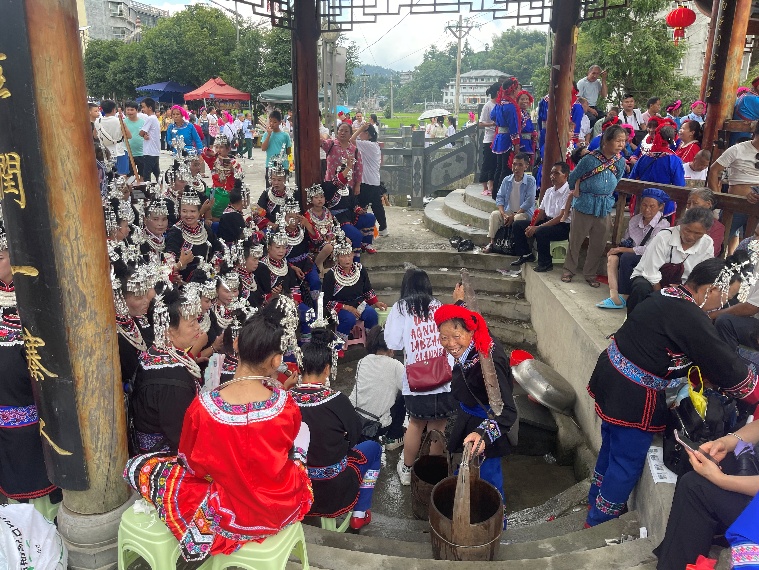
Another highlight was participating in the Miao Tasting Festival, which celebrates rice growing. Jinping is sea of folk songs, with singing competitions and activities during every traditional festival. People dressed in their ethnic attire came from various villages and even neighboring provinces. I captured a photo of some Dong and Miao people in different styles of costumes, resting and chatting by a well.
A Miao tasting festival underway in Ouli Town (偶里鄉), July 2023
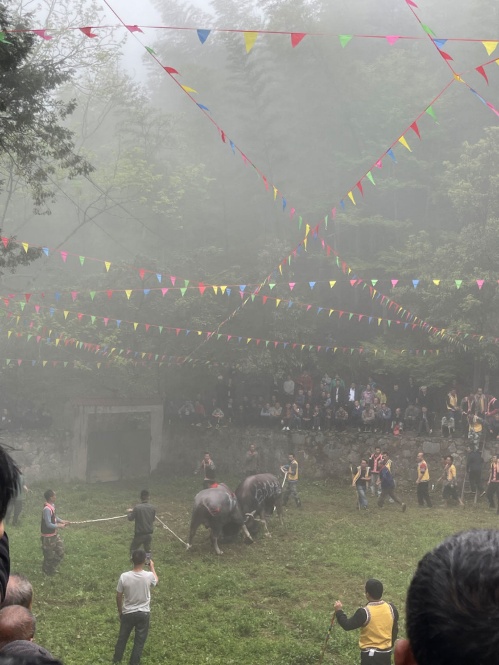
I also attended a bullfighting competition, a favorite among the Dong people, which caused traffic jams even in the mountains.
A bullfighting competition in action in Yandong Town (彥洞鄉), April 2023
The most touching moments were those spent in nature, truly experiencing “field” work. Observing students in rice fields, villages, and forests, I recorded the beautiful sounds of cicadas, birds, barking dogs, crowing roosters, and the sound of fish tails hitting the water in the rice fields, along with the elders singing Dong songs. I dedicated my thesis to this generous, poetic, and mysterious land of Guizhou Province.
What was the one most important lesson that you think you have walked away with from your ethnographic fieldwork?
I believe the most important lesson is to be patient. During my initial round of interviews with the children, they were uncertain about their use of and feelings toward different languages. I felt disappointed, fearing I might not uncover many interesting aspects.
However, as I grew more familiar with them, I discovered numerous intriguing moments. For example, Jinpinghua is commonly spoken in Miao villages near the downtown area, but it was almost inaudible in Dong towns. After spending a year at school, Dong students picked up this dialect from their Miao peers and those from downtown, eventually speaking it fluently.
What advice would you give to colleagues in the field who are interested in conducting ethnographic research in China (especially in rural China), such as things they must consider doing or preparing for and things they should avoid?
I believe the first step is to be patient, as people from these areas may be unfamiliar with being observed and interviewed. Most of them have never been interviewed before and often associate it with something serious and formal. It’s crucial to spend time with them, building close relationships that help them relax, trust you, and understand that your study is not an exam.
You also need to respect local culture and customs. For example, my students’ grandparents always cooked and waited for me to share a meal during my visits. Initially, I felt guilty, but I soon realized this was their custom. They feel sad if guests don’t join them for a meal. So, throughout the rest of my study, I always brought food or cooked with them, which provided many opportunities to observe their conversations in the kitchen.
Additionally, attending their traditional festivals and activities is always fascinating, as it allows you to witness people from different backgrounds gathering and engaging in intercultural communication.
In summary, reflecting upon my learning from Yizhe’s experience and insight, I would like to offer four Key Takeaways, as follows:
First, it is not uncommon that students in China of ethnic minority heritages are bilingual or multilingual, thus presenting unique challenges and opportunities to language or intercultural educators.
Second, rural education in China, especially in regard to world language education in rural China, remains a subject that has yet to receive an extent of academic attention it rightfully deserves.
Third, due to diverse and complex inter-regional or intra-cultural differences, conducting ethnographic research in China requires a great deal of preparation and patience even as the researchers may have come from a Chinese heritage.
Fourth, immersing oneself in ethnographic research, in the manner in which Dr. Jiang has endeavored, can be, and often is, a transformative experience for the researcher.
From traditional wet markets to food delivery by drone, by Casey Man Kong Lum.
I have been traveling and conducting fieldwork in China, Hong Kong, and Taiwan quite extensively recently. In particular, I spent several months on two separate trips to Shenzhen. A stone’s throw away from Hong Kong, Shenzhen is one of the special economic zones and industrial metropolises in China. It was during my months-long stay in Shenzhen that I first witnessed food delivery by drone, something I had earlier read about in food or lifestyle blogs. Incidentally, the experience has also raised some questions that are useful to my ongoing research in urban foodways, communication, and intangible cultural heritage (Lum & de Ferriere le Vayer, 2016).
One of my first drone food delivery encounters took place on a Saturday inside Huanggang Park, which is an easy 20-minute walk from the Futian’s China border crossing to Hong Kong. Covering about 17.3 hectares of land, Huanggang Park is a recreational facility very popular among residents in the neighboring communities (e.g., exercising, family picnic, group activities). The park is full of all kinds of activities over the weekend, especially on clear days.
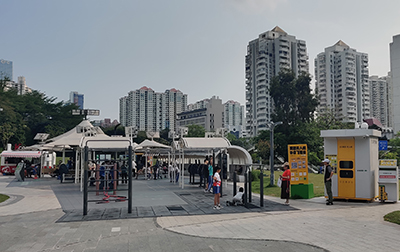
Photo 1: The drone pickup station, with yellow signs on the right
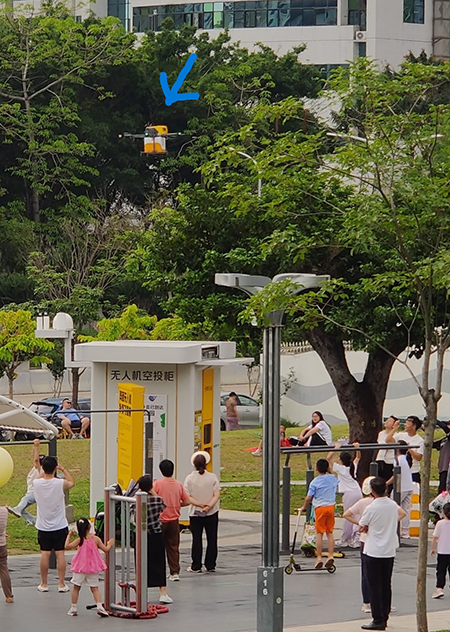
A relatively nondescript structure, the drone drop-off or pick-up station in Huanggang Park is located next to an area equipped with a number of digital exercise machines (see photo 1). The operation is run by Meituan (美团), a big food delivery platform in China with an estimated 65% of the market share. To order their take-out, the park goers use a dedicated app on their phone to scan in their account ID and food choices from an online menu. Their order would be delivered in a box to that station via a drone (see photo 2). After the box is dropped down a channel from the top of the station, the customers then use a QR code on the phone specific to their paid order to retrieve the delivery.
Photo 2: While increasingly popular, drone food delivery in Shenzhen continues to attract curious onlookers
While the e-commerce giant JD.com (Jing Dong or 京东) made China’s first drone delivery in a rural destination outside of Xi’an in November 2016 (Parmar, 2016), Meituan started its drone food delivery program in Shenzhen in 2021, four years after its own initial experimentation with the delivery method in 2017 (Yang, 2023). My initial archival research indicates that drone delivery is gaining acceptance from consumers across China. In addition to the kind of food delivery in urban settings described above, drone service can also deliver a variety of other goods, such as medical or other daily supplies; such services are especially useful to people living in hard-to-reach areas in the countryside.
Indeed, food delivery by drone is gaining popularity among consumers in China, such as those ordering take-out for a picnic in the park. However, my participant observation over more than six months seemed to suggest that drone food delivery has yet to become an everyday foodways practice as deeply ingrained as in-person food delivery. For example, currently drones cannot make delivery directly to individual apartment units in the thousands upon thousands of high-rise residential or office buildings in Shenzhen. (As a safety measure, all the balconies in the residential buildings in the community are sealed off with metal mesh.) Instead, such drone deliveries are made in pick-up venues (which may resemble vending machines) put in place by the delivery platform in a residential or office building nearby. For prompt food delivery that one can pick up at their own apartment’s doorstep, in-person delivery continues to be ubiquitous.
In fact, during our months-long stay at our hosts’ apartment in a residential high-rise across the street from Huanggang Park, I observed that the bulk of groceries were purchased from a selection of online delivery platforms. Our hosts consist of a young professional couple with their infant child and the latter’s live-in nanny and family cook. The family typically places grocery orders twice daily, once for lunch and the other for dinner. They also order cooked breakfast on some occasions if they need not go to the office early. Their orders typically consist of fresh produce and some form of protein, while in my experience in Shenzhen, customers have the option of ordering live seafood (e.g., as in shrimp are still swimming upon delivery in a sealed plastic bag). To avoid a delivery charge, a minimum purchase of about RMB38 (approx. $5.29) or RMB58 ($8.07) is required on popular grocery delivery platforms such as Xiaoxiang (小象) or Hema (河马), respectively. Otherwise, a delivery charge can be as low as RMB5 (app. $0.70).
Of course, none of the above is meant to suggest that more traditional forms of food shopping are becoming obsolete. In fact, it does not take much effort for visitors to witness and experience a multitude of food shopping practices throughout China, such as independent street vendors, small family grocers, traditional wet markets, supermarkets of all sizes having diverse corporate ownership, specialty stores that sell international products in high-end shopping malls, and so on. In fact, as house guests we often contributed various food items we acquired in traditional venues, such as neighborhood supermarkets, street vendors, shopping malls, etc.
But the proliferation and increasing presence of online food shopping and delivery platforms gives rise to some very interesting possibilities for research, such as examining the role of technological innovation in the transformation of foodways; the changing relationship or dynamic between people and their food, as well as the places or sellers in their neighborhood from which they acquire their food; issues related to class and gender in the evolving foodways; the rise of a convenience economy and changing consumer behavior in foodways; how, and the extent to which, traditional food vendors adjust to the changing food retail landscape; and so on.
Photo credit: Casey Man Kong Lum
References
Lum, C. M. K., & de Ferriere le Vayer, Marc. (Eds.). (2016). Urban foodways and communication: Ethnographic studies in intangible culture food heritages around the world. Lanham, MD: Rowman and Littlefield.
Director for Residence Life, Schwartzman Scholars, Tsinghua University, Beijing, China. Deadline: 31 May 2025.
Schwarzman Scholars is a one-year, fully-funded master’s program at Tsinghua University in Beijing, designed to build a global community of future leaders who will strengthen understanding between China and the rest of the world. Schwarzman Scholars is the first scholarship program created to respond to the geopolitical landscape of the 21st century. As China’s role in global trends continues to grow, the success of future leaders in any sector depends upon an immersive understanding of the country and its culture. Schwarzman Scholars supports up 150 graduate students annually from the U.S. (40%), China (20%), and around the world (40% from 43 countries) for a Master’s Degree in Global Affairs program at Tsinghua University in Beijing. Scholars chosen for this highly selective program will live in Beijing for one year of study, experiential learning, cultural immersion, traveling in China to develop a better understanding of China.
They are seeking highly qualified person to join Schwarzman College at Tsinghua University in Beijing, China to facilitate a dynamic, safe, and meaningful residential experience for Scholars. The ideal candidate is a self-starter, team player, culturally competent, passionate about international education, and adept at navigating global perspectives/ideologies. Must be willing to relocate to Beijing, China for this position.
The Director for Residence Life is employed by Tsinghua University and is a 12-month live-in professional position in the Office of Student Life at Schwarzman College located in Beijing, China. Supervised by the Chief Student Affairs Office, the Director for Residence Life is responsible for the residential experience at Schwarzman College, a state-of-the-art university college model facility housing 150 graduate students from 43 countries. Responsibilities include leading and managing all aspects of the residential/communal experience for Scholars
The Executive Director of China Programs oversees the University of Detroit Mercy’s academic programs with partner institutions in China. The director also negotiates and implements agreements with partner institutions and works to expand programs in those and other Chinese universities. The position reports to the Provost and Vice President for Academic Affairs. The Vice President of Joint Programs and Initiatives will direct this individual.
Essential Duties and Responsibilities include, among others:
Serve as an academic Vice-Dean of the Hubei University of Technology/UDM joint institute, also known as Detroit Green Technology Institute (DGTI).
Travel to China regularly, depending on need, for a minimum of 1-2 months, once or twice a year, with opportunities to teach in China.
Manage recruitment, hiring, and orientation of instructors for the China programs and work with the Colleges to coordinate teaching assignments.
Work closely with the University’s Vice President for Joint Programs and Initiatives.
Work with the University’s Vice President for Joint Programs and Initiatives on negotiating and implementing agreements with Chinese universities.
Support the success of courses taught for China programs through regular review, support of instructors, and addressing concerns.
Develop and distribute a faculty handbook for faculty teaching in the China programs.
Paying close attention to the development of contemporary China and conduct in-depth academic and policy research on international relations, economics, politics, public policy, global affairs, global politics, economics or related issues;
Participating in the strategic consulting of think tanks, provide decision-making consulting services for government departments, and write government policy reports;
Independently undertaking key project work in relevant professional fields and writing relevant reports or papers;
Participating in or leading related activities of the Institute, including academic forums, round table discussions and public lectures;
Participating in the exchange and cooperation between the Institute and other research institutions around the world, and completing the special construction work of the Institute and other work related to the Institute.
Issue editors: Saif Shahin, Mingyi Hou, and Sagnik Dutta (all at Tilburg University, the Netherlands)
This special issue of the Chinese Journal of Communication aims to expand our understanding of transnational migration in the digital age, especially as it relates to platforms, publics, and policies. It explores how digital platforms (Chinese and non-Chinese), their sociotechnical affordances, and the discourses they produce (or censor) bear upon transnational migration between China and various parts of the world, including Southeast Asia, Oceania, Africa, and Latin America, as well as North America, Europe and the rest of Asia. Editors are particularly interested in submissions that draw attention to the implications of digital technologies for migrant communities and the relations of power they (re)produce, user practices that work with or around digital affordances to achieve individual or collective goals, and national or supranational laws and regulations that shape digital industries and ecosystems and their impact on transnational migration.
The Government of China offers scholarships for African students for the academic year 2022. The scholarships are intended for studies leading to the award of master and doctoral degrees China Scholarships for African Students. The Commission of the African Union acts as the executive/administrative branch or secretariat of the AU (and is somewhat analogous to the European Commission) for China Scholarships for African Students. If English is not your first language, then you will need to show that your English language skills are at a high enough level to succeed in your studies China Scholarships for African Students. Scholarships are available for pursuing master’s and doctoral degrees. The scholarships are open to all qualified African nationals.
Scholarships are awarded to study Public Policy, Public Administration of National Development, Public Administration, Public Administration in International Development and Governance, Public Administration, Chinese Economy, Management of Rural Development and Management Studies, Public Health, International Communication, Transportation Engineering of Railway Operation and Management, Transportation Engineering, Professional Accounting Program, Auditing, Program in Environmental Management and Sustainable Development, Information and Communication Engineering, Electrical Engineering, Electrification & Information Technology in Rail Transit, International Law and Chinese Law, Public Diplomacy, International Relations and Theoretical Economics in National Development.
Assist the senior management in steering the development of the University in global affairs (mainland and international) systematically according to its vision & mission;
Responsible for the University’s global strategies, global education, study abroad and exchange programs, and the University’s institutional development and partnerships;
Liaise collaborations and partnerships with international universities and corporations;
Responsible for the management of University regulations, guidelines and procedures for establishing global partnerships, exchange programs, academic research collaborations;
Responsible for the coordination of the university’s external exchange resources, effectively implement and manage agreements and MOUs, dual/joint programs, student or academic exchanges, alliances and activities with external entities;
Managing University’s “Global Consortium of Metropolitan Universities”;
Responsible for international visits by university delegations;
Responsible for other University affairs as assigned.
In 2006 Xi’an Jiaotong-Liverpool University (XJTLU) was created by the University of Liverpool and Xi’an Jiaotong University – a top ten university in China. Offering a unique international education experience, XJTLU brings together excellent research practice and expertise from both institutions and gives students the skills and knowledge they need to secure careers in a global marketplace.
The Department of Applied Linguistics is a research-intensive environment with two MA programmes: the MA in TESOL and MA in Applied Linguistics (with a Specialisation in Multilingualism), which also contributes a Linguistics pathway on four UG programmes. The appointee will be expected to contribute to the department’s research profile and should have an excellent track record of publication in their research area, appropriate to their stage of career. An ability and willingness to contribute to or lead collaborative and interdisciplinary research projects would be a strong advantage.
In terms of teaching, the successful candidate must be able to contribute widely to the Undergraduate or Postgraduate curricula, including at least three from the following (either PG or UG):
UG: Introduction to Linguistics: Grammar, Introduction to Linguistics: Discourse, English as a Global Language, History of English, Sounds of English, Language and Society, Semantics and Pragmatics, Syntax, Psycholinguistics, and Language and Gender.
PG: Introduction to Multilingualism, Multilingualism in Society, Linguistics for Language Teachers, Methods in English Language Teaching, Principles of Course and Materials Design, Second Language Acquisition, Language Testing and Assessment, Speaking and Listening, and Research Methods. MA Dissertation (TESOL or MA Applied Linguistics).
In addition, the ability to contribute a new module in either Forensic Linguistics or Computational Linguistics would be an advantage. Staff typically teach 1-1.5module(s) per semester, depending on student numbers. The typical contact hours are around 6 hours per week. A contribution to academic administration will also be expected.