What Can and Should We Learn From These Dark and Tragic Histories?

“Associate

I spent about three months between January and April 2024 traveling in several countries in Asia, including Singapore, Malaysia, Cambodia, Vietnam, China, Hong Kong, and Taiwan.

While the trip entailed a field research project about the use of visual media as a form of multicultural communication in Southeast Asia, I took advantage of the occasion to explore many local cultures or heritages in the vast region. For example, I visited some UNESCO World Heritage sites, such as Angkor Wat in Cambodia, the Singapore Botanic Gardens in Singapore, George Town in Malaysia, and Hoi An Ancient Town in Vietnam.
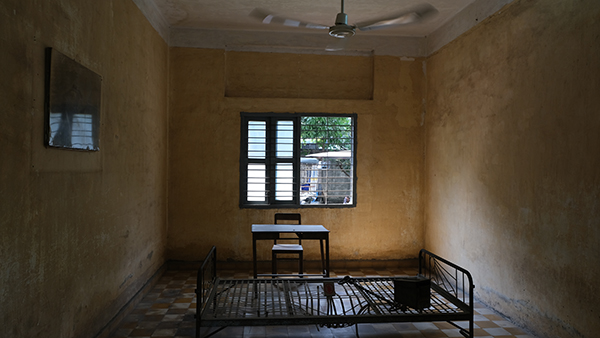
Some classrooms were repurposed as interrogation rooms at Tuol Sleng

But while the above heritage sites and many other such cultural resources were truly very remarkable, my visits of the Tuol Sleng Prison and the Choeung Ek Genocidal Center in Phnom Penh, Cambodia, have left a long-lasting impression on me. Both sites, and many other sites such as these that have been collectively called the Killing Fields, came from an extremely dark and bloody history that was the genocide (with up to three million people murdered) committed by the Khmer Rouge government under Pol Pot between 1976 and 1978.

I have read about the Cambodian genocide by the Pol Pot regime in media reports through the years since college, although I have never seen the 1984 British film The Killing Fields. But none of what I have read about this tragic history could have prepared me for the shock and sadness I experienced during my visits there.

Tuol Sleng, or S-21 Prison, was one of about 189 interrogation (read torture) centers during those tumultuous years under Pol Pot’s Khmer Rouge regime. It was inaugurated on April 17, 1980, as a memorial museum and has been open to the public since. According to the United States Holocaust Memorial Museum, “Between 14,000 and 17,000 prisoners were detained there, often in primitive brick cells built in former classrooms. Only 12 prisoners are believed to have survived.”

Located approximately 11 miles south of Phnom Penh’s city center, the Choeung Ek Genocidal Center is perhaps the most well-known among about 300 Killing Fields. Tuol Sleng was directly tied to the Choeung Ek site in that (“confessed”) prisoners from S-21 were sent to Choeung Ek for their summary execution. Close to 9,000 bodies were exhumed from the mass graves after they were initially discovered. When I was there, sections of the open-air fields were still cordoned off to prevent visitors from accidentally disturbing any human remains that were still buried there. Perhaps one of the most iconic symbols of Choeung Ek is the Buddhist stupa, which houses more than 5,000 human skulls that are encased behind acrylic glass.

My attendance at the various exhibits in both the Tuol Sleng and the Choeung Ek sites was nothing short of being surreal and, at times, bone-chilling. One of the most unforgettable parts of the visits has been our close proximity to the objects being on display. For example, in Tuol Sleng, which was housed in a repurposed school, we were standing right in front of the bed in the middle of several of the former classrooms where the prisoners were tied and tortured for their confession. In the extremely tight space inside the Buddhist stupa at Choeung Ek, we were literally inches away from the human skulls on display. I overheard a fellow traveler who refused to go inside the stupa precisely because they felt uncomfortable getting so close to the skulls.

Indeed, the visit to Tuol Sleng and Choeung Ek was by no means a positively pleasant experience, regardless of how educational it may have been. It certainly reminded me of my visit to Auschwitz I and Auschwitz II-Birkenau outside of Krakow, Poland, in 2018. In both cases, I walked away with more questions than I had answers. What can and should we learn from these dark and tragic histories?

Casey Man Kong Lum, Associate Director
Center for Intercultural Dialogue

Photo credit: Casey Man Kong Lum

UNESCO: Programme Specialist (France)

“JobProgramme Specialist, Social and Human Sciences Sector, UNESCO, Paris, France. Deadline: 13 June 2024.

Under the overall authority of the Assistant Director-General for Social and Human Sciences Sector (ADG/SHS), strategic guidance from the Director for Research, Ethics and Inclusion and direct supervision of the Chief of Inclusion, Rights, and Intercultural Dialogue Section, the Programme Specialist is responsible for analyzing, implementing and monitoring projects and activities within the inclusion, rights and intercultural dialogue Section, leading work to promote dialogue for social cohesion, resilience, accountability, civic empowerment and conflict transformation; and contributing to work to enhance social and gender inclusion through the empowerment of vulnerable and marginalised communities and the fight against racism and discrimination.

The incumbent, working within the frameworks of UNESCO’s Medium Term Strategy (C/4), the approved Programme and Budget (C/5) and global development plans such as the 2030 Agenda for Sustainable Development, will guide the technical development of sectional, cross-sectional and divisional projects and activities, financed by core and voluntary funding; provide recommendations on project feasibility and possible collaborations; engage with substantive developments in relevant technical fields; and manage relationships with key internal and external stakeholders to provide expert technical advice.

U Liverpool: Lecturer in World Cinema (UK)

“JobLecturer in World Cinema, University of Liverpool, Liverpool, UK. Deadline: 7 June 2024.

The Department of Languages, Cultures & Film wishes to appoint to a fixed-term Lectureship (Teaching and Scholarship) in World Cinema to provide cover for a colleague on a Leverhulme Fellowship. The successful candidate will be a key member of the Film Studies team, working with colleagues to maintain and enhance a thriving undergraduate programme, which has experienced significant growth and over recent years, and to help develop and deliver a new MA in Film Studies.

Applicants should have a PhD in Film Studies or a relevant related discipline and provide clear evidence of teaching experience in World Cinema (understood broadly, i.e. encompassing streaming and other platforms). Candidates should also be able to demonstrate sensitivity to diverse cultural contexts; a focus on transnational and intercultural approaches to Film Studies is what makes our degree programme in Liverpool unique and attractive, and the department actively encourages comparative, global, transnational, and transcultural approaches. Active engagement with scholarship in the field of Film Studies and/or World Cinema is expected, as is the demonstration of leadership in high-quality teaching innovations. The post is available from 1 September 2024 until 31 August 2025 working on a 0.9fte basis.

SOAS U of London: Multiple Positions (UK)

“JobMultiple positions available at SOAS University of London, London, UK. Deadline: 15 July 2024.

SOAS (School of Oriental and African Studies) is currently advertising multiple positions that may be of interest to followers of this Center:

ReDICo Hub on Digital Interculturality

Resources in ICD“ width=

ReDICo Hub on Digital Interculturality has now opened. Germany, but online.

ReDICo stands for Researching Digital Interculturality Co-operatively. They have just sent a note to share:

“Finally our Hub on Digital Interculturality is ready! Here you will find resources, calls, job and collaboration opportunities and publications. Our aim with this Hub is to provide a non-commercial space in which individuals, who are passionate about research and praxis in relation to digital interculturality, can come together to share and to forge meaningful collaborations that transcend geographical boundaries. It would be great if you could take just a few minutes of your time to create a profile, free of charge, on our Hub here. By doing so, you’ll be contributing to the growth of our community.

You know, beginnings are always hard! As part of your profile setup, we encourage you to include your Zip Code if you wish to appear on the platform’s World map. This will allow others to locate and connect with you based on your location. Thank you for considering our invitation. We look forward to welcoming you to our growing community!”

U Idaho: Postdoc in International Relations (USA)

Postdocs
Postdoctoral Fellowship in International Relations, University of Idaho, Moscow, ID, USA. Deadlines: Open until filled; posted 16 May 2024.

The Martin Institute and Program in International Studies, and the Idaho Society of Fellows, are now accepting applications for a two-year postdoctoral fellowship in International Relations to begin July 1, 2024. Fellows will pursue their own research and teach one course per semester. The unit is particularly interested in recruiting candidates whose work complements existing unit initiatives in area studies, international organizations, conflict/peace, and/or human rights.

Queen Mary U: PhD Studentship in Linguistic Integration in Quebec (UK)

“Studentships“
Funded PhD Studentship: Linguistic Integration in Quebec, Queen Mary University, London, UK. Deadline: 24 June 2024.

Forming an independent project in its own right, this PhD studentship in applied linguistics or French (applied/sociolinguistics) will contribute to a broader Leverhulme-funded project on the ethics of linguistic integration in England, Quebec and Wales, by providing the empirical data on Quebec and contributing to the development of an innovative interdisciplinary approach that combines insight from applied/sociolinguistics and political theory/philosophy. Informed by theoretical debates on linguistic integration from these and other disciplines, your project will focus on the following specific research questions: a) How is linguistic integration conceived, practised and experienced by different parties in Quebec? b) What language-related expectations result from these conceptions and experiences? c) What is the relative legitimacy of these expectations when assessed against core liberal democratic values and principles (e.g. justice, equality, inclusivity, solidarity)? To address these questions, you will undertake a qualitative analysis of a broad sample of documentary materials in Quebec (e.g. legislation, policy documents, media debates, speeches, campaign pamphlets) and conduct (in French) semi-structured interviews and/or focus groups with policymakers, second-language teachers and adult immigrant language learners during a fieldtrip.

You will be based at Queen Mary University of London and supervised primarily by Professor Leigh Oakes of the School of Languages, Linguistics and Film. You will also benefit from input from political philosophy/theory through additional supervision by Professor Yael Peled of the Max Planck Institute for the Study of Religious and Ethnic Diversity and the Inland Norway University of Applied Sciences, and from participation in a rich set of group activities (e.g. four meetings per year, reading groups, conference participation, joint publications) involving the other members of the research team: Dr Huw Lewis (Aberystwyth), Dr Gwennan Higham (Swansea) and another PhD student based in Aberystwyth. This is a unique opportunity to be part of an innovative, collaborative research project and a new generation of scholars committed to interdisciplinary approaches to the politics of language.

NOTE: The studentship is funded by the Leverhulme Trust and will cover 100% of home tuition fees and an annual tax-free maintenance allowance at the UKRI London rate for three years. Due to funding restrictions, this scholarship is unfortunately only open to applicants eligible to pay tuition fees at the UK home rate.

World Day for Cultural Diversity for Dialogue and Development 2024

EventsWorld Day for Cultural Diversity for Dialogue and Development, as established by the United Nations in December 2002, occurs on 21 May every year.

It “celebrates not only the richness of the world’s cultures, but also the essential role of intercultural dialogue for achieving peace and sustainable development.”

On this Day, UNESCO would like to call upon everyone to celebrate cultural diversity, through which we will be able to build the intellectual and moral solidarity of humankind.

Audrey Azoulay
Director-General of UNESCO

UNESCO Youth Eyes on the Silk Roads Photo Contest 2024

Photo ContestYouth Eyes on the Silk Roads Photo Contest, UNESCO, Paris, France. Deadline: 14 July 2024.

The annual Youth Eyes on the Silk Roads International Photo Contest offers an exciting opportunity for young people from all over the world to capture their understanding of the shared heritage of the Silk Roads through the lens of their camera. As the visual arts, and in particular photography, are so often used by today’s youth as a powerful tool for communication and self-expression, images have the potential to play a significant role in raising awareness of the key issues facing our contemporary world and help promote peace and understanding. The photo contest provides an opportunity for young people to connect with one another in a digital space and share their creativity and vision for our future.

Organized within the framework of the UNESCO Silk Roads Programme, and in line with the objectives of the UNESCO Youth Programme, by UNESCO’s Social and Human Sciences Sector, the 2024 edition of the Youth Eyes on the Silk Roads photo contest is open for entries from 2 May to 14 July 2024. The Silk Roads are an expansive region composed of a network of maritime and land routes. Originating in East Asia, South Asia, and Southeast Asia the Silk Roads cross the Central Asian sub-continent, the Russian steppe, the Iranian and Anatolian plateaus, and the Arabian Peninsula. They also stretch through North Africa and Northeast Africa, from Tanzania to Morocco. Additionally, they pass through Eastern and Southern Europe, before reaching France and the Iberian Peninsula.

The Youth Eyes on the Silk Roads Photo Contest is an opportunity for young people who live or have travelled within these regions to share their perceptions and further their understanding of the common cultural heritage and pluralistic identities emerging from the interactions and exchanges taking place along the Silk Roads. The contest encourages the use of photography to extend these cultural interactions and encounters in the contemporary world, to foster mutual understanding and promote peace amongst the diverse populations encompassed by the Silk Roads.

The contest is divided into two age categories: 14-17 year olds, and 18-25 year olds. For the 6th edition of the contest this year participants are invited to submit their photographs that best encapsulate the shared heritage of the Silk Roads the theme of “Life Celebrations”. The Selection Committee members will then examine these submissions and select the winners from each of the age categories. Examples of some of the very best photographs from the previous contests can be found here.

First place winners will receive a professional camera. Second place winners will receive a semi-professional camera, and the prize for third place will be a standard-model digital camera. Around 60 of the best photos from the contest will appear in a professional photo album “Youth Lens on the Silk Roads” and might be showcased in exhibitions held worldwide.

Friedrich Schiller U Jena: Intercultural Communication, Migration Studies (Germany)

“Job

Professorship in Intercultural Communication with a Focus on Migration Studies, Friedrich Schiller University, Jena, Germany. Deadline: 9 June 2024.

The applicant (m/f/d) should have an excellent, relevant doctorate in the field of intercultural communication, in particular from a social or cultural science perspective or in related disciplines (e.g. sociology, political science, social or cultural geography). He/she should be able to represent the field of migration research/migration studies with a focus on intercultural communication in an outstanding manner, both in terms of expertise and methodology. The fundamental willingness to develop a second focus in the area of diversity and social diversification processes in research and teaching compatible with intercultural research is expected and is a prerequisite for the tenure track procedure. He/she/they should show potential for successful international publication activities as well as for highquality teaching in our Bachelor’s degree programmes “Intercultural Business Communication” and “Intercultural Music and Event Management” as well as in the Master’s degree programme “Intercultural Human Resources Development and Communication Management”, including its international doubledegree variants. The language of instruction is primarily German.