CFP NCA IICD graduate seminar

NCA IICD HONORS GRADUATE STUDENT SEMINAR

The International and Intercultural Communication Division (IICD) of the National Communication Association, in partnership with Sage Publications, proudly announces the first IICD Honors Graduate Student Seminar to be held at the 2014 NCA conference in Chicago.  The theme of the seminar is Intercultural Communication and New Media and will feature competitively selected papers of currently enrolled MA and Ph.D  students in communication and allied fields.  Intercultural new media research is an emerging and important new area of intercultural communication  and  consists of multiple dimensions including ( but not limited to) how new media impact intercultural communication theory (i.e acculturation/dialogue/competence/identity), how culture influences the social uses of new media, and  in what ways new media affect culture.  Papers will be reviewed and selected by top scholars who will also serve as research respondents during the honors seminar.  The honors seminar will be conducted on Saturday, November 22. 2014 from 3:30-7:00 PM at the NCA conference in the Conrad Hilton, Chicago.  The seminar will be followed by an IICD reception honoring the  participants.  Graduate students selected for participation will receive a monetary award as well as IICD honors graduate student certificates.  To be considered, full papers (APA including 200 word abstract) are due no later than June 9, 2015.  Finalists will be contacted and announced by  August 29, 2014.  

Papers should be sent electronically to the Coordinator of the IICD Honors Graduate Student Seminar: Robert Shuter, Professor, Marquette University, Diederich College of Communication and Visiting Professor, Arizona State University, Hugh Downs School of Communication.

CFP Interactional Competences conference (Switzerland)

Interactional competences in institutional practices
International Conference ICIP2014
University of Neuchâtel (Switzerland), November 21-22, 2014

Plenary speakers: Janet Holmes, Timothy Koschmann, Hanh thi Nguyen, Richard F. Young

Submission deadline: May 1st 2014

Institutionally appropriate communication is a major issue in organizations today. The ability to interact within institutional contexts represents a set of practices society members have available for sharing information and communicating, complaining, negotiating, solving problems, bringing off specific tasks, transmitting knowledge and learning. Responsive to context-specific motivations and at the same time transcending any specific interaction, interactional competences are not abstract abilities but are constructed within rich interactional environments, assessed and interpreted according to collectively shared and valid principles.

The International conference Interactional competences in institutional practices is intended to convene the state of the art in research on interactional competences within institutional contexts (professional interactions; teaching-learning interactions in school and/or in the workplace; professional-non professional interactions). The conference will be held at the University of Neuchâtel in Neuchâtel, Switzerland, from November 21 through November 22 2014.

We envision this to be a series of presentations, with peer-reviewed contributions and invited speakers, focussing on interactional competences in institutional settings and promoting research from the broad range of institutional interactions researchers. We welcome contributions on both theoretical and applied research based on naturalistic observations.

Topics may include, but are not limited to, the following:
*Competence and multimodality
*Competence and learning
*Competence and assessments
*Competence and identity
*Competence and knowledge
*Legitimate competence and mechanisms of institutional legitimization
*Competence, intervention and change

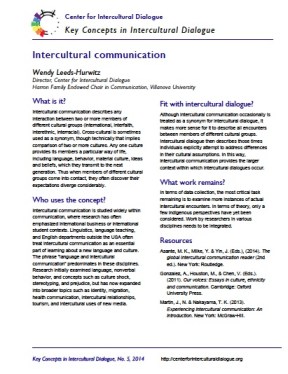
Key Concepts in Intercultural Dialogue #5: Intercultural Communication by Wendy Leeds-Hurwitz

Key Concepts in ICDThe fifth issue of Key Concepts in intercultural Dialogue is now available. This is KC5: Intercultural Communication by Wendy Leeds-Hurwitz. As always, all Key Concepts are available as free PDFs; just click on the thumbnail to download. Lists organized  chronologically by publication date and numberalphabetically by concept in English, and by languages into which they have been translated, are available, as is a page of acknowledgments with the names of all authors, translators, and reviewers.

KC4-sm

Leeds-Hurwitz, W. (2014). Intercultural communication. Key Concepts in Intercultural Dialogue, 5. Available from:
https://centerforinterculturaldialogue.org/wp-content/uploads/2014/03/key-concept-intercultural-comm.pdf

The Center for Intercultural Dialogue is publishing a series of short briefs describing Key Concepts in intercultural Dialogue. The logic is that different people, working in different countries and disciplines, use different vocabulary to describe their interests, yet these terms overlap. Our goal is to provide some of the assumptions and history attached to each concept for those unfamiliar with it. As there are other concepts you would like to see included, send an email to the series editor, Wendy Leeds-Hurwitz. If there are concepts you would like to prepare, provide a brief explanation of why you think the concept is central to the study of intercultural dialogue, and why you are the obvious person to write up that concept.


Creative Commons License
This work is licensed under a Creative Commons Attribution-NonCommercial-NoDerivatives 4.0 International License.

Study abroad England 2014

Graduate Study in England, Summer 2014

CCOM 7070 International Corporate Communication and Culture
Fairleigh Dickinson University’s Wroxton College, Oxfordshire, England
May 20 – June 2, 2014
3 credits, graduate level, Communication

The course consists of invited speakers, case studies, site visits, and trips to London, Stratford-upon-Avon, and Oxford. The main objective of the course is make students familiar with the cultural, historical, and political contexts in which international business transactions take place. Students will have two full-day opportunities to work with students from the MA in Corporate Communication offered by the University of West London. Students will also attend a day of seminars at the Harris-Manchester College of Oxford University ending with High Dinner with the Oxford students.

Wroxton College is the British campus of Fairleigh Dickinson University, situated in the ancestral home of Lord North in Oxfordshire. The main College building is Wroxton Abbey, a fully modernized Jacobean mansion on 56 acres of its own lawns, lakes and woodlands. Originally constructed as an Augustinian priory in 1215, Wroxton Abbey has accommodated several British monarchs and statespeople such as Theodore Roosevelt. It now houses the College’s classrooms and seminar rooms, the library, fully modernized student lodging facilities, and computer laboratories.

At Fairleigh Dickinson University, participating students are drawn from the MA in Corporate and Organizational Communication and the MA in Organizational Behavior.Students from other universities and colleges are warmly invited to register with permission of the course leader, Dr. Gary Radford.

Save

Postdoc U Utah in critical comm pedagogy

Postdoctoral Fellow in Critical Communication Pedagogy
University of Utah, Department of Communication

The Department of Communication at the University of Utah seeks to appoint a postdoctoral fellow for the 2014-2015 academic year, with possibility for renewal. The fellow’s primary obligation will be to conduct research in the fellow’s area of expertise and to pursue publication of that research. Possible research areas in which successful candidates might work include: critical pedagogy, critical race theory, postcolonial studies, and race and media. In addition, the fellow would be expected to provide instructional mentoring of current graduate instructors and teach two existing courses. Possible courses include: Teaching Speech and Communication, Teaching Mentorship, and Media and Diversity. Applicants must have a Ph.D. in hand by the time the appointment begins. Applicants should have a degree in communication or a related field (e.g., education). In order to ensure full consideration, complete applications should be received by March 15, 2014. Application materials include a cover letter, a CV, a teaching statement, teaching evaluations, and three letters of recommendation. To apply click on this link. Please direct any and all questions to Kent A. Ono, Department Chair, Department of Communication, University of Utah.

The University of Utah is a member of the Pac 12. The Department of Communication has a long and distinguished tradition of excellence in graduate education. Our nationally acclaimed graduate program is the driving force of our department. As an integrated communication department, we provide training across a range of areas, with particular strengths in the following areas: Media and Communication Technology; Communicating Science, Health, Environment and Risk; Rhetoric; Critical/Cultural Studies; and Organizational/Interpersonal Communication.

The Department is committed to removing barriers individuals from underrepresented groups have traditionally encountered; strives to recruit faculty who will further enhance our diversity; and makes every attempt to support their academic, professional, and personal success.  The University of Utahrecognizes that a diverse faculty benefits and enriches the educational experiences of the entire campus and greater community. The University of Utah is an Equal Opportunity/Affirmative Action employer and educator.  Minorities, women, and persons with disabilities are encouraged to apply. Veteran’s preference. Reasonable accommodations provided.  The University of Utah values candidates who have experience working in settings with students from diverse backgrounds and who possess a demonstrated commitment to improving access to higher education for historically underrepresented students. Full benefits are available to same-sex and opposite-sex domestic partners.

Jeddah College of Advertising (Saudi Arabia) job ads

Assistant, Associate, or Full Professors in Advertising at Jeddah College of Advertising

The Jeddah College of Advertising is a member of The University of Business and Technology (UBT), located in the dynamic and vibrant city of Jeddah.  It works within the general objectives and guidelines of the University, and strives to make the motto “Education for Job Opportunities” real.  This college is the result of an inter-institutional cooperation agreement between Buckinghamshire New University, UK, and the University of Business and Technology. The general purpose of this college is to provide students in Saudi Arabia and her surrounding countries an exciting opportunity to study Advertising and its related fields in truly international ways that focus on hands-on applications and training, rather than pure theoretical study.

The rigorous study programs in the college of advertising are international in scope and non-traditional.  All classroom instruction is conducted in the English language.  Newly purchased production technologies and Mac-based creativity labs in the college are considered to be state-of-the art.  There is a women’s and a men’s campus, and all professionals are encouraged to apply, accordingly.  Currently, students can select from one of three specializations in the Advertising curriculum: (1) Advertising Management, (2) Advertising Communication, and (3) Advertising creative design.

Responsibilities:
Teach courses in the undergraduate curriculum, such as: advertising management, introduction to advertising, digital technologies in marketing, integrated marketing communication, advertising communication, and advertising creative design. Undergraduate advising is also part of the overall teaching responsibilities.  Scholarly research productivity and service to the department, college, and university are likewise expected, since UBT is a research-intensive institution.

Qualifications:
Earned Ph.D. in the field of advertising or communication.  Should be able to demonstrate success or potential success as a modern classroom teacher and researcher – preferably with professional experience in advertising.  Expertise in teaching advertising in the new media environment is also highly desirable, since all of our classrooms are “smart.”

Remuneration Package:
UBT offers a highly competitive tax-free compensation package commensurate with rank and experience – including 12-month salary distribution, paid annual summer vacation (60 work days), housing allowance, furnishing allowance, annual round-trip airfare to home country for applicant, spouse and two (2) children under the age of 18, excellent medical insurance, and an end of contract completion bonus.

To apply:
To assure full consideration, a letter of application along with a curriculum vita, and a copy of unofficial graduate transcripts must be submitted to:
Prof. Ty Adams
Vice Dean, College of Advertising
University of Business and Technology
P.O.Box 21361
Jeddah,Saudi Arabia
The application may be submitted via email.

This institution does not offer benefits to domestic partners.

CFP Case Studies in Volunteering & NGOs

CFP – chapters for a case study book exploring communication and organizational issues in nonprofit and volunteer contexts

Book Editors:
Jennifer Mize Smith, Western Kentucky University, Department of Communication
Michael W. Kramer, University of Oklahoma, Department of Communication

Publisher:
This book proposal has been accepted by Peter Lang Publishing

Objective of the Book:
The purpose of this book is to provide empirically-based case studies that will compliment any number of other course materials, such as nonprofit textbooks or journal articles, used by teachers and scholars of nonprofit and volunteer studies.  Few of our current resources (books, texts, handbooks) address the micro-level, data-based analysis of communication and other organizational issues in nonprofit, volunteer, and philanthropic contexts.  Each chapter will present a case that illustrates one or more issues related to nonprofit organizations and their stakeholders (i.e., managers, staff, boards, volunteers, donors, and service recipients).  Cases should also address a broader conceptual or theoretical issue/framework of organizational studies.

Each case should have an open ending, followed by a series of 6-8 discussion questions proposed from at least two different theoretical/conceptual frameworks to encourage students to explore the case from multiple perspectives.  Questions should be designed to help students critically think about the particular nonprofit context, the organizational issues presented, the ways in which those issues could be addressed, whose interests are served, and potential consequences for the organization and its various stakeholders.

Contributors should consider a range of communication and organizational issues that address one or more nonprofit stakeholder groups, including NPO managers, staff, boards, volunteers, donors, and service recipients.  Topics may include but are not limited to the following:

Identity and Identification
Recruitment, Training, and Retention
Employee/Volunteer relations
Stress, Burnout, and Turnover
NPO Relationships and Collaborations
Marketing and Fundraising
Technology
Marketization and Professionalism
Newcomers and Socialization
Conflict, Voice, and Dissent
Supervision and Leadership
Role Negotiation, Uncertainty, and Expectations
Board Development
Corporate Partnerships, and Strategic Philanthropy
Staffing and Career Development
Mission, Mission Drift, and Founders Syndrome

Submission Process:
This edited book will present contributed case study chapters focusing on communication and other organizational issues in a nonprofit and volunteer context.  We seek case studies that are research based, focused on nonprofit-related issues, and open ended to allow for critical discussion. We invite interdisciplinary work that seeks to combine communication perspectives with other disciplinary knowledge.

For consideration, authors should submit an open-ended case study based on empirical research that is 2000-2500 words in length (not including title page).  In the initial draft, authors should also propose 6-8 discussion questions employing at least two different theoretical/conceptual frameworks.  In the submission email, authors should include a brief description of the research conducted that formed the basis of the case study.  The deadline for submissions has been extended to March 14, 2014.

Submissions will be peer reviewed and decisions about inclusion in the book will be made in early April.  Selected authors will be expected to produce a final draft with any requested revisions by June 1, 2014.

Inquiries may be addressed to either editor.  Submissions should be forwarded electronically (Microsoft Word document) to: Jennifer Mize Smith.

CFP Sociolinguistics of Immigration (Italy)

First International Conference on the Sociolinguistics of Immigration
25th -26th September 2014
Villa Queirolo, Rapallo (Genova), Italy

The First International Conference on the Sociolinguistics of Immigration is a two-day international conference which aims at bringing together scholars working on both the empirical and theoretical challenges posed to sociolinguistics by recent global migratory phenomena. The sociolinguistics of immigration is a relevant multidisciplinary field of language investigation. The focus of attention is, on the one hand, on how immigration can contribute to phenomena of language spread and/or diaspora, language contact, language variation and change, and on the other hand the development of mixed, hybrid patterns of language use and identities.The topics above will be mainly (though not exclusively) examined from the following perspectives of analysis: contact linguistics, bilingualism/ multilingualism, language variation and change and language/ dialect development. The conference is organized by the Department of Foreign Languages and Literatures and Modern Cultures of the University of Turin (Italy), and it will take place in Rapallo (Genoa) from 25th to 26th September 2014.The languages of the conference are: English, French and Italian. We are delighted to announce that the plenary speakers will be: Christian Mair (University of Freiburg), Marinette Matthey (University of Grenoble3) and Hans Van de Velde (University of Utrecht).

Abstract deadline: March 10, 2014

CFP Comm and Law in Russia

Call for Contributions:
Russian Journal of Communication
Special Issue: “Communication and Law in Russia
Editors:
Igor Klyukanov (Editor-in-Chief)
Alexander Kozin (Guest Editor)

The focus on law selected for the upcoming special issue of the Russian Journal of Communication seeks to address yet another facet of Russian society that has undergone a deep transition in recent years. Despite its paramount importance for the emergent civic society, in comparison to politics, economics, entertainment and media, which have been at the forefront of public and academic discussion for some time, Russian law, particularly and crucially in its communication dimension, remains in the shadow and outside the purview not only of the public eye but also of specialised academic research. Yet at every level – for example, those of juridical language and discourse, of legal codes and conventions and of ritualised legal acts and practices – law draws attention to its communication strategies.

Most commonly, law in Russia expresses itself through mass media, focusing on such high-profile and tendentious cases, such as the Vasilyeva corruption case, the Khodorkovsky quasi-political case, or the Polonsky extradition case. However, behind the scenes too the country’s population has been deeply immersed in civil litigation, suing and countersuing relatives, neighbours, co-workers and businesses. Speedy criminal prosecution fuelled by the creation of the Federal Investigative Committee also creates an impression of a busy legal life in the new Russia. Yet, turning into a law-abiding society has proven to be harder than expected. Although the country moved well beyond the ‘lawless’ 1990s, new challenges have emerged, revealing the lack of independence, impartiality and competence of the judiciary; the collusion of law and bureaucracy; the corruption of the police and other law-enforcement agencies; procedural uncertainty; professional ineffectiveness and poor legal education of both defence and prosecution attorneys. These problems, some apparent and some dormant, have developed a persistent impression both in Russia and in the West that law in Russia is not an independent entity but services a higher political authority and that justice there is arbitrary and harsh in the extreme.

In order to examine these and other problems and developments, we invite submissions which would address Russian law vis-à-vis language, discourse, and communication. We welcome both humanistic and social scientific scholarly approaches to communication, including philosophy of communication, traditional and new media, film, literature, rhetoric, journalism, information-communication technologies, cultural practices, organizational and group dynamics, interpersonal communication, communication in instructional contexts, advertising, public relations, political campaigns, legal proceedings, environmental and health matters, and communication policy. All methodological perspectives—theoretical, empirical, critical, comparative, historical, and interdisciplinary studies—will be considered.

Articles might address one or more of the following, non-exhaustive list of topics:
*        Legal processes and their mass mediation
*        Russian law enforcement, its communication means and patterns
*        Pre-trial, examination, sentencing and other stages of criminal trial
*        Defamation and other types of ‘personal honour’ cases
*        International law and current lawsuits against and by Russia
*        Russian public and its communication in court
*        Court interpreting
*        Law and technology
*        Legal rhetoric
*        Russian courtroom’s interior and exterior
*        Communication education of legal professionals
*        Legal communication education of the general public
*        Issues concerning copyright
*        Law and pornography
*        Moral aspects of law
*        Main legal actors and their interactions inside and outside of the Russian court
*        Reality TV trial shows
*        Obscenity laws
*        Penitentiary laws and regulations
*        Examples of legal pluralism
*        Communication and Internet law
*        Communication and immigration law
*        Russian legal history and its communication dimension
*        Communication analyses of specific laws
*        Law and cultural values
*        Legal forensics

Please submit complete manuscripts (between 6,000 and 8,000 words, including tables, references, captions, footnotes and endnotes) with a brief biographical statement and contact information via email attachment to both Igor Klyukanov  and Alexander Kozin no later than September 15, 2014. Prospective date of the special issue’s publication is May 2015. Notice of disposition will be sent within two months from the date of submission.

Russian Journal of Communication (RJC) is an international peer-reviewed academic publication devoted to studies of communication in, with, and about Russia and Russian-speaking communities around the world. RJC is published by Routledge and follows a double-blind peer review process to maintain its high standard of scholarship.  All research materials published in RJC have undergone rigorous evaluation, based on initial editor screening and review by at least two anonymous referees.

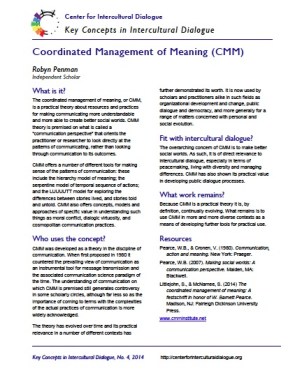
Key Concepts in Intercultural Dialogue #4: CMM by Robyn Penman

Key Concepts in ICDThe next issue of Key Concepts in intercultural Dialogue is now available. This is KC4: Coordinated Management of Meaning (CMM) by Robyn Penman. As always, all Key Concepts are available as free PDFs; just click on the thumbnail to download. Lists organized  chronologically by publication date and numberalphabetically by concept in English, and by languages into which they have been translated, are available, as is a page of acknowledgments with the names of all authors, translators, and reviewers.

Key Concept-CMM

Penman, R. (2014). Coordinated management of meaning. Key Concepts in Intercultural Dialogue, 4. Available from:
https://centerforinterculturaldialogue.org/wp-content/uploads/2014/02/key-concept-cmm.pdf

The Center for Intercultural Dialogue is publishing a series of short briefs describing Key Concepts in intercultural Dialogue. The logic is that different people, working in different countries and disciplines, use different vocabulary to describe their interests, yet these terms overlap. Our goal is to provide some of the assumptions and history attached to each concept for those unfamiliar with it. As there are other concepts you would like to see included, send an email to the series editor, Wendy Leeds-Hurwitz. If there are concepts you would like to prepare, provide a brief explanation of why you think the concept is central to the study of intercultural dialogue, and why you are the obvious person to write up that concept.


Creative Commons License
This work is licensed under a Creative Commons Attribution-NonCommercial-NoDerivatives 4.0 International License.