CFP Translation and International Professional Communication

CFP Special issue of Connexions
Translation and International Professional Communication: Building Bridges and Strengthening Skills

Guest editors:
Bruce Maylath (USA)
Ricardo Muñoz Martín (Spain)
Marta Pacheco Pinto (Portugal)

Deadline for submissions: April 10, 2015. See the complete call for papers for additional details.

The globalization and the fast mobility of today’s markets—aiming to serve as many heterogeneous settings and audiences as possible—have posited a growing need for high quality products and optimal performance in nearly all areas of everyday life. Specialists in communication play an important, albeit often hidden, role in these processes. Translators and other international professional communicators operate as mediators to facilitate understanding across global, international, national and local contexts through diverse communication channels. Translating today often involves several agents with different roles, responsibilities and skills. This entails creative work, various innovative procedures, and collaborative networks in highly technological, distributed environments. All these agents can be seen as text producers with an increasing expertise in the tools and skills of their trades to find, manage, process, and adapt information to target audiences.

Despite disperse attempts at acknowledging the importance of approaching professional communication as translation or as involving translation-related skills, translation often remains invisible both in the literature and in the training of (international) professional communicators. The extant literature in Communication Studies that actually addresses translation usually tends to emphasize, and concentrate on, localization issues, and it often draws from functional approaches to translation as production of a communicative message or instrument.

In Translation Studies, on the other hand, there is an increasing awareness of the need to tend bridges to Communication Studies in research. However, more dialogue seems necessary to fully grasp the implications and commonalities in all areas of multilingual professional communication, not the least that they are usually ascribed peripheral roles in business, technical, and scientific endeavors.

The emerging figure of the multitasked professional communicator has brought translation as part of the document production process to a different level of discussion. It is drawing increasing attention to translators’ profiles and training as competent communicators and vice versa, thus showing that the role translation plays in international professional communication, and the role of international professional communication in translator training cannot be downplayed. This issue of the connexions journal seeks to build bridges of cross-disciplinary understanding between international professional communication scholars and practitioners and translation scholars and practitioners. It aims to foster debate around the role of translation as a special kind of international professional communication and also as an integral part of other (international) professional communication instances.

CFP Joy and Sorrow of Food

Call for papers
The Joy and Sorrow of Food: An American Story

Food sustains life. We eat to satisfy hunger, but hunger often reaches beyond the physical realm to emotional, ethnic, and cultural dimensions. Not only do we eat to fuel our bodies, we eat to celebrate, entertain, and to fill voids in our lives. We eat to comfort, to occupy time, and to experience variety. Since food is fundamental to all forms of life, it is a compelling, central point for investigations of issues ranging from privilege, identity, ritual, tradition, memory, and the body across time and place.

For this issue we seek diverse perspectives that investigate the joys and sorrows of food within United States populations that have been influenced and/or impacted Europe. We are particularly interested in interdisciplinary papers that draw from cinema, music, document, visual and material culture, history, literature, philosophy, and mass media.

The European Journal of American Culture (EJAC) is an academic, refereed journal for scholars, academics and students from many disciplines with a common involvement in the interdisciplinary study of America and American culture, drawing on a variety of approaches and encompassing the whole evolution of the country.

Articles should be 6,000 to 8,000 words, inclusive of endnotes. EJAC uses Harvard style. We can include unlimited black-and-white images and figures. If it is essential that your image or images be in color, please notify us. Please submit an abstract by January 1, 2015 to the editors below.  Manuscripts will be due on March 31, 2015.

Guest Editors for the Food Issue
Caryn E. Neumann, Miami University, 4200 North University Blvd, Middletown, OH 45042
Lori L. Parks, Miami University, 1600 University Boulevard, Hamilton, OH 45011
Jennifer P. Yamashiro, Miami University, 1600 University Boulevard, Hamilton, OH 45011

CFP Research Visits to France

Associate Research Directors (DEA) | Call for proposals 2015
Deadline: Applications must be sent before November 30th of 2014

Created in 1975 upon the initiative de Fernand Braudel, in collaboration with the French Secretary of State for Universities, Department for Higher Education and Research, the DEA Programme (Directeurs d’Études Associés, or Associate Research Directors) is the oldest international mobility programme at Fondation Maison des sciences de l’homme. It provides funding to invite international scientific experts from across the globe for one or two months and enables them to carry out work in France (field enquiries, library work and archives).

Participation requirements
The programme is intended solely for experienced scientists with a PhD or equivalent, working in institutions of higher education and research. Applicants must be no older than 68 at the time of their stay.

Benefits
A monthly allowance of 3 300 € is awarded for transport and stay expenses. In addition, FMSH provides support for visa applications and logistics (accommodation and access to libraries).

Applications and deadline
Applications must be sent before November 30th of 2014.

Content of the application
*A curriculum vitae
*A list of scientific publications
*A research project (4 pages minimum) and a bibliography
*A letter of support by a French researcher is welcome

Applications should be sent to the head of programme, Dominique Richard.

After a scientific expertise of the research projects, decisions regarding invitations are made by a commission made up of the administrator, scientific directors of the FMSH, as well as various specialists.

Results will be communicated directly to applicants by the end of January 2015.

The research stay must start no later than November 1st 2015.

Case Studies in Intercultural Dialogue

Case Studies in ICD
The book Case Studies in Intercultural Dialogue has just been published by Kendall-Hunt. It is edited by Nazan Haydari and Prue Holmes. The book focuses on the important and under-investigated concept of intercultural dialogue. It draws on cases of intercultural communication in which there is a dialogue, conflict or misunderstanding, and presents approaches, theories, and analytical tools that can be used to productively understand and/or resolve the issues presented in each case study.

This edited collection covers a wide range of research topics drawn from peace building, arts and media, education, anthropology, new communication technologies organizational communication, and more. The format of Case Studies in Intercultural Dialogue encourages readers to engage in discussion from different perspectives through various methodological and theoretical approaches to problems, opportunities, and ethical issues of intercultural communication.

The collection had its genesis in the NCA Summer Conference on Intercultural Dialogue, held in Istanbul in 2009, with half the chapters resulting from that event, and the other half the result of an international call for proposals. The table of contents follows:

Introduction: Contextualizing ‘Intercultural Dialogue’ and the ‘Case Study’ by Nazan Haydari & Prue Holmes

Part I: Building Spaces for Dialogue
Facilitating Intercultural Dialogue Through Innovative Conference Design by Wendy Leeds-Hurwitz

Part II: Dialogue for Peace Building and Reconciliation
Community Driven Peacebuilding Approaches: The Case of Postgenocide Rwanda by Eddah Mbula Mutua
Dialogue across the Divide: Bridging the Separation in Cyprus by Benjamin Broome

Part III: Building Dialogue in / for Education
Multiculturalism, Contact Zones and the Political Core of Intercultural Education by Susana Gonçalves
Dialogue as a Common Ground between, across and beyond Cultures and Disciplines: A Case Study of Transcultural and Transdisciplinary Communication Lectures for Graduate and Undergraduate Students by Maria Flora Mangano
Developing Cosmopolitan Professional Identities: Engaging Australian and Hong Kong Trainee Teachers in Intercultural Conversations by Erika Hepple
Challenges in International Baccalaureate Students’ Intercultural Dialogue by Gertrud Tarp

Part IV: Building Dialogue through Arts and Media
Bollywood in the City: Can the Consumption of Bollywood Cinema Serve as a Conduit/ Site for Intercultural Discovery and Dialogue? by Ruma Sen
Storms, Lies & Silence: Beyond Dialogue-Based Models of Intercultural Contact by David Gunn

Part V: Building Dialogue in/ through Research
Anthropology as Intercultural Critique: Challenging the Singularity of Islamic Identity by Tabassum “Ruhi” Khan.
Community Autoethnography: A Critical Visceral Way of “Doing” Intercultural Relationships by Sandra L. Pensoneau-Conway, Satoshi Toyosaki, Sachiko Tankei-Aminian & Farshad Aminian-Tankei

Part VI: Building Dialogue in Everyday
The Voices of Hispanic Emerging Adults in New Mexico and Oklahoma by David Duty

Part VII: Building Dialogue at the Institutional / Organizational Level
“Why did it All Go so Horribly Wrong?”: Intercultural Conflict in an NGO in New Zealand by Prue Holmes
Leadership in Intercultural Dialogue: A Discursive Approach by Jolanta Aritz & Robyn C. Walker

Part VIII: Building Dialogue through New Information Technologies
Le Francais en (premiere) Ligne: Creating Contexts for Intercultural Dialogue in the Classroom by Christine Develotte & Wendy Leeds-Hurwitz
The Potential of Diasporic Discussion Forums for Intercultural Dialogue and Transcultural Communication: Case Studies in Moroccan and Turkish Diasporas in Germany by Çigdem Bozdağ

CFP Culture, Migration & Health Communication in Global Context

CALL FOR BOOK CHAPTER PROPOSALS
Culture, Migration, and Health Communication in the Global Context

Editors:
Dr. Yuping Mao, Assistant Professor
Department of Media and Communication, Erasmus University Rotterdam, the Netherlands
Dr. Rukhsana Ahmed, Associate Professor
Department of Communication, University of Ottawa, Ottawa, ON, Canada

Proposal Submission Deadline: January 15, 2015

Overview of the Book:
With the globalization of the world, there is increasing migration happening across geographic regions within a country or across different countries. The migrant populations keep some of their original cultures with them that influence their communication about health outcomes. Meanwhile, migrant populations are constantly exposed to and adopting cultural values and practices in their host countries or regions, which gradually alter their health related communication and behaviors. On the one hand, migrants’ health communication and behaviors have become an important social topic in many countries especially in North America and some European countries with a relatively long history of having immigrants from other countries. On the other hand, in countries like China, urbanization accelerates migration within the country, primarily with economically and socially disadvantaged population migrating from rural to urban areas. Both international and internal migration bring new challenges to public health systems. Our edited book aims to critically review theoretical frameworks and literature, as well as discuss new practices and lessons related to culture, migration, and health communication in different countries.

Scope and Recommended Topics:
We invite chapters that critically review the strengths and limitations of widely applied theoretical frameworks such as assimilation, acculturation, cultural adaptation, culture-centered approach, cultural safety, cultural competency, and intercultural sensitivity. The review of those theoretical frameworks should be embedded in public health and health communication contexts.

Taking a communication perspective, this edited book will examine how differences among different cultural communities relate to health communication at interpersonal, group, and societal levels. We are interested but not limited to chapters on the following topics:
* Health communication disparities among immigrant groups
* Health information diffusion among migrant groups
* Social support and migrant groups’ health communication

This edited book will also discuss how content and format of media in combination with other social factors such as social capital and social networks influence individuals’ health beliefs and behaviors. For instance, we are interested in receiving book chapters on the following topics:
* Comprehensive literature on media effects on migrants’ health behaviors
* Media coverage and public discourse on migrants’ health
* Media campaigns and migrant population

Health communication is always situated in certain social, political, historical, and cultural contexts. This book addresses a few important contextual factors that practitioners and researchers need to be aware of in research, practice, and policy making. As such we also solicit stimulating health communication cases on immigrants’ health to be included with in-depth analysis of their unique contexts.

Target Audience:
The target audience for this book will consist of upper-level undergraduate students, graduate students, and faculty members and practitioners in both communication studies and health sciences, as well as their respective allied fields such as media studies, telecommunications, journalism, sociology, anthropology, cultural studies, medical science, nursing, public health, psychology/psychiatry, and medical informatics. In addition to speaking to an academic audience, authors are encouraged to write so as to provide valuable information and resources to practitioners, administrators, and policy makers working in the health sector.

Submission Guidelines:
Chapter proposals should include the following components:
1.  A title page with contact information for all authors;
2.  A 750-1200 word (including references), single-spaced  extended abstract clearly explaining:
*  The purpose and the contents of the proposed chapter; and
*  How the proposed chapter relates to the overall objectives of the book;
3.  A working bibliography – a list of potential resources for your chapter done in APA style (6th edition); and,
4.  A brief biographical statement (maximum 200 words) written in the third person containing the following information:
*  Current position and affiliation;
*  Highest degree held, field, and institution granting that degree; and,
*  Current area of research and/or current research project.

Submission Format and Procedures:
Please e-mail your title page, 750-1200 word extended abstract, working bibliography, and brief biographical statement (maximum 200 words) as a Word attachment (combine all files) to Dr. Yuping Mao and Dr. Rukhsana Ahmed no later than January 15, 2015. Full chapters should be between 6,000-8,000 words, including references.

Important Dates:
Chapter Proposal Due: January 15, 2015
Notification of Acceptance, and Chapter Submission Guidelines: March 15, 2015
First Draft of Full Chapters Due: July 15, 2015
Review Result Returned: September 15, 5
Revised Draft of Final Chapters (as needed) Due: November 1, 2015

NOTE: All written work should be prepared in English and conform to APA style (6th edition). Submitted work must not have been previously published or be under consideration for publication elsewhere. The editors will review all complete chapter proposals; however, there is no guarantee of eventual publication.

U New Mexico job ad: Interpersonal/Conflict Management

Communication Lecturer III Search Announcement: Interpersonal/Conflict Management/ Mediation
University of New Mexico

The Department of Communication & Journalism at the University of New Mexico invites applications for a full time, 9-month appointment at the rank of Lecturer III to begin August 1, 2015. The department seeks to hire a lecturer with knowledge and experience teaching interpersonal communication, conflict management, and mediation. The successful candidate will coordinate the teaching assistants and part-time instructors who teach sections of CJ 221 (Interpersonal Communication) and CJ 320 (Mediation). In addition, this lecturer will teach other courses at the undergraduate level that meet teaching needs in the department’s concentrations (interpersonal, organizational, intercultural, environmental, media studies, and public communication). Graduate teaching is a possibility, depending on the lecturer’s areas of specialty and department need.

This is a renewable teaching appointment based on the lecturer’s performance. The position involves 70% teaching and 30% service, and the teaching load involves 7 courses each year.

Minimum Qualifications: Ph.D. in Communication or related field completed by August 1, 2015, and three years post-secondary teaching experience.

Preferred Qualifications: (a) A strong record of effective teaching across the communication curriculum; (b) Experience teaching interpersonal communication, communication and conflict, and mediation; (c) Experience directing/coordinating teaching assistants and/or part-time instructors; (d) Experience/interest in developing and teaching courses in on-line or condensed formats; (e) A demonstrated commitment to diversity, equity, inclusion, student success, and working with broadly diverse communities, as well as a desire to mentor students from diverse backgrounds; and (f) Evidence of participation in professional and/or communication associations.

Application Process: A complete application consists of: (1) letter of interest identifying qualifications related to the position announcement; (2) a complete academic resume, including current position; (3) evidence of teaching effectiveness, including course syllabi and teaching evaluations; (4) a statement of teaching philosophy; and (5) letters of recommendation sent from three academic sources. The letters of recommendation should be sent by the authors in a PDF attachment to Nancy C. Montoya, department administrator, Communication & Journalism.

Incomplete applications will not be considered.

To apply, please go to the UNM website and reference Posting Number: 0827867. For best consideration, please apply by December 8, 2014. The position will remain open until filled.

The University of New Mexico is an Equal Opportunity Affirmative Action employer and educator.

For more information contact Dr. Judith Hendry, Search Chair. The departmental website provides additional information about the goals, mission, courses, and the student population.

Key Concept #41: Yuan by Hui-Ching Chang

Key Concepts in ICDToday’s issue of Key Concepts in intercultural Dialogue is now available, and it does something different. This is the first word in a language other than English, and there are several other non-English words in process; this one is for KC41: Yuan by Hui-Ching Chang. The goal is to expand the concepts available to discussions of intercultural dialogue. As always, all Key Concepts are available as free PDFs; just click on the thumbnail to download. Lists organized  chronologically by publication date and numberalphabetically by concept in English, and by languages into which they have been translated, are available, as is a page of acknowledgments with the names of all authors, translators, and reviewers.
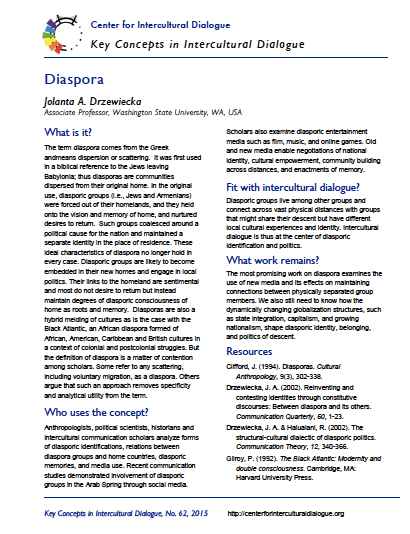
KC41 Yuan v2 Chang, H.-C. (2014). Yuan. Key Concepts in Intercultural Dialogue, 41. Available from: https://centerforinterculturaldialogue.org/wp-content/uploads/2021/09/kc41-yuan-v2.pdf

The Center for Intercultural Dialogue publishes a series of short briefs describing Key Concepts in Intercultural Dialogue. Different people, working in different countries and disciplines, use different vocabulary to describe their interests, yet these terms overlap. Our goal is to provide some of the assumptions and history attached to each concept for those unfamiliar with it. As there are other concepts you would like to see included, send an email to the series editor, Wendy Leeds-Hurwitz. If there are concepts you would like to prepare, provide a brief explanation of why you think the concept is central to the study of intercultural dialogue, and why you are the obvious person to write up that concept. And starting today, feel free to propose terms in any language, especially if they expand our ability to discuss an aspect of intercultural dialogue that is not easy to translate into English.


Creative Commons License
This work is licensed under a Creative Commons Attribution-NonCommercial-NoDerivatives 4.0 International License.

Hui-Ching Chang Profile

ProfilesAs Dean of the Honors College and Professor of Communication at the University at Albany, Dr. Hui-Ching Chang sees knowledge as intimately connected with everyday practices. After completing her law degree from National Taiwan University, she pursued advanced degrees in speech communication from the University of Illinois at Urbana-Champaign.

Hui-Ching Chang

Dr. Chang has studied Chinese language patterns, specifically Taiwanese national identity as constituted through discursive practices. Her book, Clever, Creative, Modest: The Chinese Language Practice (2010), examines Chinese language behavior from three distinctive yet overlapping dimensions: the manipulative speaker, the artistic speaker, and the humble speaker. Her most recent book, Language, Politics and Identity in Taiwan: Naming China (2015), explores how Taiwanese fashion their identities in the shifting and intertwined paths of five names Taiwan used to name China: “Communist bandits”; “Chinese Communists”; “mainland”; “opposite shore”; and the “People’s Republic of China.”

Prof. Chang has received many grants and top paper awards for her research and has been an invited keynote speaker at numerous international conferences. Her publications have appeared in Journal of Language and Politics; Discourse Studies; Research on Language and Social Interaction; Journal of Language and Social Psychology; Nationalism and Ethnic Studies; and Journal of Asian Pacific Communication, among others. Very recently she was principal editor of the special issue, “Explored but not Assumed: Revisiting Commonalities in Asian Pacific Communication” (2015), in the Journal of Asian Pacific Communication.

Prof. Chang enjoys putting theories into practice: “I firmly believe that it is adventure and personal engagement that brings intercultural communication to life, an inspiring perspective I learned while on ‘Semester at Sea’.” She was a Fulbright Scholar, Ukraine (2010-2011, 2012); Chair Professor of the College of Journalism at Xiamen University, China (2009-2012); Visiting Scholar to Hong Kong Baptist University (2007) and Visiting Scholar to National Taiwan University (2003-2004).

Prior to coming to UAlbany, Prof. Chang was Associate Dean for Academic Affairs of the Honors College, the University of Illinois at Chicago, and Faculty-in-Residence, where she pioneered innovative programs like “Cutie’s Office Hours” to promote a vibrant living-learning community. She served as Director of Undergraduate Studies and Director of Graduate Studies in her department, and was also a trained mediator for UIC’s Dispute Resolution Service. For her, being an Honors College administrator requires the same curiosity and urge to learn as it does for research and teaching—it is exciting, energizing, and fulfilling.


Work for CID:

Hui-Ching Chang wrote KC41: Yuan, and translated it into Chinese (both Simplified and Traditional).

CFP Critical Thinking in Multilingual/Intercultural Education

Call for chapters
Abstracts by 15th Dec. 2014
Demystifying Critical Thinking in Multilingual and Intercultural Education

Edited by Fred Dervin (University of Helsinki, Finland) & Julie Byrd Clark (Western University, Canada)
To be published by Info Age Publishing in 2016
BOOK SERIES: Contemporary Language Education

Following a very successful volume on reflexivity in multilingual and intercultural language education (Routledge, 2014), the editors of this new volume wish to tackle the burning issue of Critical Thinking (CT). CT is often said to be a key skill of 21st century education and is very much used as a mantra by educational institutions without always defining it. The literature contains hundreds of definitions of CT but there is no consensus on a single definition. Thus ‘my CT’ does not always correspond to ‘your CT’.

One of the most basic definitions of CT could be: “The ability to interpret, analyse and evaluate ideas and arguments” (Fisher, 2011). In a study on views held by academics about CT, T. Moore (2013) found six definitional strands: CT (i) as judgment; (ii) as skepticism; (iii) as a simple originality; (iv) as sensitive readings; (v) as rationality; (vi) as an activist engagement with knowledge; and (vii) as self-reflexivity. One thing is for sure: CT involves developing certain dispositions (probing), skills (cognitive and meta-cognitive) and habits of mind (Costa & Kallick, 2009). Some scholars are interested in the reasoning process behind CT, others the outcomes. Yet again there is no agreement in global scholarship and practice about its components or simply its definition.

Recently the idea of CT has been criticized for at least two reasons. First CT can feel too negative for some, leading to equating CT with mere adversely criticizing others. According to Fisher (2011) some scholars have thus proposed to call it ‘critico-creative thinking’ to insist on its positive, imaginative aspects. Second CT has often been criticized for being too Western, to contain too many Western norms. In their 2011 article entitled Critical thinking and Chinese university students: a review of the evidence, Jing Tian and Graham David Low discuss the apparent lack of Chinese students’ CT skills. They question the usual argument that Chinese culture does not allow ‘criticality’ and show that the students’ previous learning experiences have an influence on their level of CT. CT is often used as a way of comparing educational ‘cultures’ – some have more of it than others – thus leading to unfair ethnocentric and homogenizing judgments (Holliday, 2010).

How do we then define this contested disposition, skill and habit of mind in order to make it useful? Is it possible? Can we work from definitions of CT that avoid creating hierarchies between learners and their ‘cultures’? Whose conceptions of critical thinking could we use to do so? Can we once and for all avoid falling into the trap of giving the privilege of CT to the ‘Western world’? In other words can CT be demystified?

This volume concentrates on the context of multilingual and intercultural education. Potential authors are welcome to consider the following questions:
–       What constitutes a critical thinker in multilingual and intercultural education in the 2010s? What dispositions, skills and habits of mind are needed? (Students, teachers, teacher educators and researchers)
–       How can CT contribute to renewing multilingual and intercultural education? What alternative models of CT can be used to enrich multilingual and intercultural education?
–       Can CT be taught and learnt? If so, how and in what ways and under what kinds of conditions?
–       If CT exists then what is uncritical thinking in multilingual and intercultural education?
–       Can digital technologies help to promote CT in multilingual and intercultural education?
–       The issue of assessing CT is problematic. Yet can CT be assessed summatively or formatively in multilingual and intercultural education?

Interested authors please send a 300-word abstract to the editors Fred Dervin & Julie Byrd Clark by 15th Dec. 2014. Full chapters should be ready by 1st Sept. 2015.

CFP 8th Central/Eastern European Media & Communication Conference

CEECOM2015
The Digital Media Challenge
8th Central and Eastern European Media and Communication Conference
Zagreb, 12-14 June 2015

Conference organized by the University of Zagreb in cooperation with the ECREA CEE Network and cosponsored by ICA

The transition of communication media to digital is a worldwide phenomenon. In Central and Eastern Europe the term “transition” is naturally assumed to mean democratic transition in the postsocialist period starting in 1990. For the past 25 years, many in these countries struggled to establish independent media industries with new democratic expectations and in a capitalist market environment. The focus was very much on the political and economic postsocialist transition, including in research in media and communication studies.

In this years’ CEECOM we wish to refocus on the challenges to media industries, media audiences, and media regulators posed by the digital transition in the Central and Eastern European region and beyond. Since today’s media have an increasingly global dimension that is manifesting together with the digital technology, we aim to discuss the manifestations of these global developments and their challenges in a regional setting.

The journalistic profession is having a hard time facing the challenges of the digital revolution and global economy, but also the pressures of commercial interests and the need for new competences of young journalists. As a result of that process, the trust citizens have in state institutions and mass media has been significantly declining. Some warn that the corruption of basic journalistic values – through infotainment, the imperative of speed and the use of digital technologies to raise the popularity instead of quality – has been undermining the very foundations of democracy. The citizens, paradoxically, are surrounded with media offer that has never been wider, while they have never been less involved. New possibilities for participation in the digital public sphere are being used in different ways by different people, are there patterns here that we can uncover?

While digital technology defines today’s media, the key to their understanding is beyond a technological utopia or dystopia, in the new social practices that media afford – in media production and use, in changing public communication, media organization and production, journalism practice and the role of audiences. Social media, user-generated content, crowdsourcing, rise of alternative media, networked distribution and promotion of content and participatory agenda setting characterize today’s media landscapes that comprise both the legacy and the digital media. Today’s mediatized cultures can no longer be observed outside of the media that facilitate them, but need to be investigated in their articulations of everyday lifeworlds.

In our attempt to understand the present manifestations of digital mediascapes, we might also examine how the socialist economic and political settings and normative assumptions of the role of media influence contemporary post-socialist institutional settings and the development of digital media cultures.

Some of the topics for which we invite contributions include, but are not limited to:
*Mediatized cultures – production, audiences and social practices
*Self-construction and self-expression, identity performance and experimentation
*Education, knowledge and learning, play and entertainment
*Sociality – social spaces created around and through use of communication technology, belonging – foundation of social bonds and social integration, communities they create, how they engage in politics or civic activities
*Privacy, security, control and surveillance (interveillance)
*Digital democracy – mediatized political communication, digital citizenship, participation and the digital public sphere
*Redefining the legacy journalism paradigm
*At the organizational level: the role of newsroom in digital media environment; newsroom adjustments to media convergence.
*At the professional level: changing practice of journalists; multi-platform reporting; role of social media in daily reporting, especially in stories and sources identification and interaction; new relations with audiences, participatory and collaborative journalism.
*At the media output level: pluralism and quality of content, its availability and usability and, in general, public interest
*Digital Skills for the New Approach to Journalism Education
*Development of the new digital skills and the basis for the new journalism education curricula – new forms of reporting, new genres in digital media, data analysis and storytelling
*Children in the mediatized world
*media literacy – privacy and young media consumers,
*role of family in media literacy & media use
*digital generation and media
*Media and information literacy – libraries, copyright issues and open access, education for media and information literacy, regulation for media and information literacy, media literacy and social inclusion
*The past and present of media and communication studies in CEE – comparing socialist and post-socialist disciplinary developments

The conference will work in plenary (keynote and special panels) and parallel/paper sessions. Abstracts will be double blind reviewed by members of the Scientific Committee.

Conference Participants
The conference aims to promote academic cooperation in the field of media and communication studies, broadly defined in a way to include trans-disciplinary and inter-disciplinary approaches to media and communication, within the Central and Eastern European region and beyond. While the primary focus of the conference is on sharing and discussing new research, the conference takes a multi-stakeholder approach to underline the importance of dialogue between scholars of media, political science, sociology, regulators and policy makers, international and national experts, practitioners, as well as representatives of regulatory authorities and civil society organizations.

Co-authored proposals are accepted, including those written by master students and their academic supervisors. The participants are invited to register and to submit original papers and panels. No more than two submissions by one author can be accepted (including combinations of panels and individual papers).

Participants do not need to be members of any of the sponsoring academic associations. The event is also open to participants who do not plan to submit research proposals. All accepted attendees are asked to register for the Conference.

Submission, Registration and Important Dates
Conference language: English. Individual paper proposals addressed to one of the proposed topics should mention this in the proposal (other topics on CEE issues are welcome as well). Abstracts (of max. 300 words) will be evaluated by at least two members of the Scientific Committee. Panel proposals of 300 – 500 words should include the rationale and title of proposed panel, and name & affiliation of the Chair/Moderator and up to five members of the panel, and brief abstracts (150 words) for each participant’s contribution. Abstract & panel submission site will open on November 20, and individual paper and panel proposal can be uploaded until 20 December, 23:59 CET. The reviews will be completed and notifications sent by 31 January 2015.

Please contact the conference organizers if you have any questions!
Conference registration will open on 1 February 2015. Early bird registration ends 1 April 2015.

Summary of important dates:
20 November 2014: Abstract Submission Site Opens
20 December 2014: Deadline for submissions of abstracts and panel proposals
31 January 2015: Notification of acceptance
1 February 2015: Registration & fee site opens
1 April 2015: Early bird registration ends
1 May 2015: Deadline for full papers to be delivered to Chair of the working group
12 June 2015: Opening ceremony of CEECOM 2015 conference

Conference Book
Full papers should be sent to the panel chairs by 1 May 2015. An edited collection of the most successful papers will be published with an international publisher.

Conference Fee
150 EUR conference participants
100 EUR doctoral students
Early bird: until 1 April 2015
100 EUR conference participants
75 EUR doctoral students
The fee covers lunches & coffe & refreshments breakes, and conference materials.

Conference Organizers
CONFERENCE CHAIR: Zrinjka Peruško, University of Zagreb, Croatia

SCIENTIFIC COMMITTEE (MEMBERS OF CEECOM CONSORTIUM):
Auks? Bal?ytien? (Vytautas Magnus University in Kaunas, Lithuania)
Boguslawa Dobek-Ostrowska (University of Wroclaw, Poland)
Micha? G?owacki (University of Warsaw, Poland)
Epp Lauk (University of Jyväskylä, Finland)
Zrinjka Peruško (University of Zagreb, Croatia)
Irena Reifova (Charles University in Prague, Czech Republic)
Ilija Tomani?-Trivundža (Ljubljana University, Slovenia)
Tomáš Trampota (Charles University in Prague, Czech Republic)

LOCAL ORGANIZING COMMITTEE
Mihaela Banek Zorica (University of Zagreb, Croatia)
Domagoj Bebi? (University of Zagreb, Croatia)
Antonija ?uvalo (University of Zagreb, Croatia)
Hrvoje Jakopovi? (University of Zagreb, Croatia) Iva Nenadi? (University of J.J. Strossmayer, Osijek, Croatia)
Krešimir Pavlina (University of Zagreb, Croatia)
Tena Perišin (University of Zagreb, Croatia)
Sonja Špiranec (University of Zagreb, Croatia)
Dina Vozab (University of Zagreb, Croatia)
Nada Zagrablji? Rotar (University of Zagreb, Croatia)

CONTACT/CONFERENCE SECRETARIAT:
Centre for Media and Communication Research
Faculty of Political Science
University of Zagreb
Lepuši?eva 6, 10 000 Zagreb, Croatia
www.cim.fpzg.unizg.hr
E-mail: ceecom2015@gmail.com
Website: www.ceecom.org
Facebook: http://www.facebook.com/ceecom2015
Twitter: @ceecom2015 #ceecom2015