NEH Summer Programs on International Topics

NEH Summer Programs in the Humanities for School and College Educators

Each year, NEH offers tuition-free opportunities for school, college, and university educators to study a variety of humanities topics. Stipends of $1,200-$3,900 help cover expenses for these one- to five-week programs.

Some of the more obvious topics are listed below, but be sure to check the main website for other opportunities as well as further details.

Summer Seminars for College and University Teachers

America and China: 150 Years of Aspirations and Encounters
Deadline: March 2, 2015
Dates: July 12-31 (3 weeks)
Project Director(s): Daniel Bays, Dong Wang
Visiting Faculty: Chas W. Freeman, Jr., Larry Herzberg, Terrill Lautz, Richard Madsen, Diane Obenchain, Grant Wacker
Location: Grand Rapids, MI
For more information: dan.bays327@gmail.com (816) 943-6588 http://www.calvin.edu/scs/neh2015/.

The Cross-Border Connection: Immigrants, Emigrants, and their Homelands
Deadline: March 2, 2015
Dates: June 15-July 17 (5 weeks)
Project Director(s): Roger Waldinger
Visiting Faculty: Jose Moya, Laurie Brand
Location: Los Angeles, CA
For more information: waldinge@soc.ucla.edu (310) 206-9233 http://international.ucla.edu/migration/summerseminars.

The Irish Sea Cultural Province: Crossroads of Medieval Literature and Languages
Deadline: March 2, 2015
Dates: June 8-July 12 (5 weeks)
Project Director(s): Charles MacQuarrie, Joseph Nagy
Visiting Faculty: Thomas Clancy, Peter Davey, Sioned Davies, Jennifer Kewley-Draskau, Katherine Lowe, J.P. Mallory, Gillian Rudd, Sir David Wilson
Location: Douglas, Isle of Man and Glasgow, Scotland
For more information: (661) 654-2144 http://www.csub.edu/~cmacquarrie/isle_of_man/.

Latin American Theater Today: Aesthetics and Performance
Deadline: March 2, 2015
Dates: June 15-July 10 (4 weeks)
Project Director(s): Gustavo Geirola, Lola Proaño-Gómez
Visiting Faculty: Adhemar Bianch, Norman Briski, Cristina Escofet, Ricardo Gómez, Agustina Ruiz Barrea, Ricardo Talento
Location: Buenos Aires, Argentina
For more information: ggeirola@whittier.edu (562) 907-4200 x43 http://www.nehsummerseminar2015.com/.

Summer Institutes for College and University Teachers

The Alhambra and Spain’s Islamic Past
Deadline: March 2, 2015
Dates: June 15-July 10 (4 weeks)
Project Director(s): D. Fairchild Ruggles, Oscar Vázquez
Visiting Faculty: Antonio Almagro Gorbea, Jerrilynn D. Dodds, Lara Eggleton; José Antonio González Alcantud, Richard Kagan, Mariam Rosser-Owen
Location: Granada, Spain
For more information: neh.alhambra@gmail.com (217) 333-0176 http://neh-alhambra.squarespace.com.

American Material Culture: Nineteenth-Century New York
Deadline: March 2, 2015
Dates: July 5-31 (4 weeks)
Project Director(s): David Jaffee
Visiting Faculty: Kenneth L. Ames, Debra Schmidt Bach, Joshua Brown, Edward S. Cooke Jr., Cynthia Copeland, Ivan Gaskell, Katherine C. Grier, Bernard L. Herman, Kimon Keramidas, Cindy Lobel, Amelia Peck, Jack (John Kuo Wei) Tchen, Catherine Whalen
Location: New York, NY
For more information: nehinstitute@bgc.bard.edu (212) 501-3047 http://bgc.bard.edu/neh-institute.

American Muslims: History, Culture, and Politics
Deadline: March 2, 2015
Dates: July 13-31 (3 weeks)
Project Director(s): Irene Oh Koukios, Sohail Hashmi
Visiting Faculty: Zain Abdullah, Youssef Aboul-Enein, Terry Alford, Sylvia Chan-Malik, Sylviane Diouf, Carl Ernst, Kambiz GhaneaBassiri, Yvonne Haddad, Juliane Hammer, Muqtedar Khan, Felicia Miyakawa, Besheer Mohamed, Kathleen Moore, Lucinda Mosher, Andrew Shryock, Gregory Smith, Richard Brent Turner
Location: Washington, DC
For more information: ireneoh@gwu.edu (202) 994-1675 http://go.gwu.edu/nehinstituteamericanmuslims.

Buddhist Asia: Traditions, Transmissions, and Transformations
Deadline: March 2, 2015
Dates: May 25-June 26 (5 weeks)
Project Director(s): Peter Hershock
Visiting Faculty: Anne Blackburn, David Germano, Rupert Gethin, Thomas Kasulis, John Kieschnick, Keller Kimbraugh, Paul Lavy, Kate Lingley, Fabio Rambelli, Juliane Schober, James Mark Shields, Tansen Sen, John Szostak, Paola Zamperini
Location: Honolulu, HI
For more information: MineiA@eastwestcenter.org (808) 944-7337 http://www.eastwestcenter.org/ASDP-NEH2015.

Development Ethics and Global Justice: Gender, Economics and Environment
Deadline: March 2, 2015
Dates: June 22-July 17 (4 weeks)
Project Director(s): Fred Gifford, Eric Palmer
Visiting Faculty: Bina Agarwal, Alison Jaggar, Naila Kabeer, Serene Khader, Christine Koggel, Henry Shue, Asunción Lera St. Clair
Location: East Lansing, MI
For more information: gifford@msu.edu (517) 355-4492 http://ethicsanddevelopment.org.

The Legacy of Ancient Italy: the Etruscans and Early Rome
Deadline: March 2, 2015
Dates: June 2-26 (3 weeks)
Project Director(s): Gregory Warden, Gretchen Meyers
Visiting Faculty: Claudio Bizzarri, Luca Fedeli, Alba Frascarelli, Mario Iozzo, Stephan Steingräber, Nicola Terrenato, Anthony Tuck
Location: : Lugano, Bologna, Orvieto, and Rome, Italy
For more information: berry@essex.edu (973) 877-3577 http://www.etruscansnehccha.org.

Negotiating Identities in the Christian-Jewish-Muslim Mediterranean
Deadline: March 2, 2015
Dates: July 5-August 1 (4 weeks)
Project Director(s): Sharon Kinoshita, Brian Catlos
Visiting Faculty: Thomas Burman, Cecily J. Hilsdale, Marcus Milwright, John Tolan
Location: Barcelona, Spain
For more information: mailbox@mediterraneanseminar.org http://www.barcelonaneh2015.com.

What is Gained in Translation?
Deadline: March 2, 2015
Dates: June 7-27 (3 weeks)
Project Director(s): Brian James Baer, Françoise Massardier-Kenney
Visiting Faculty: Rosemary Arrojo, M. R. Ghanoonparvar, Carol Maier, Ibrahim Muhawi, Michelle Yeh
Location: Kent, OH
For more information: fkenney@kent.edu (330) 672-2150 http://appling.kent.edu/neh-translation-institute.cfm.

Northwestern U in Qatar job ad: Global Media Studies

NORTHWESTERN UNIVERSITY IN QATAR
Global Media Studies/Technology Policy

Northwestern University’s first international campus, Northwestern University in Qatar (NU-Q), invites applications for a full-time faculty appointment in Global Media Studies/Technology Policy to join the school’s Program in Communication.

Candidates will hold appropriate advanced degrees and will be prepared to teach undergraduate students in the field noted above.

NU-Q’s programs in Journalism, Communication and Liberal Arts aim to prepare students for careers in media industries and other fields and are committed to the advancement of the understanding and practice of freedom of expression. The university aspires to build a legacy of education and discovery in a dynamic area of the world in which excellence in cultural development, science, technology, health care and the information economy are fundamental goals of the host nation, Qatar. Many faculty find this to be a geographic area rich in research opportunities and NU-Q has partnerships with Al Jazeera and the Doha Film Institute.

We seek individuals engaged in visionary lines of teaching, research and creative activity who will appreciate a culturally diverse community of students, faculty and staff comprised of women and men drawn from Qatar, the Middle East, Asia, Europe, Africa, North America and elsewhere. The successful candidate will join colleagues whose teaching experience includes Northwestern, Stanford, Cambridge, Columbia, Minnesota and other highly ranked schools. Located in Education City in Doha, Qatar, NU-Q collaborates with sister institutions that include Carnegie Mellon, Cornell, Georgetown, Texas A&M, and Virginia Commonwealth.

The ideal candidate will be able to examine media industries globally and in the Arab world from the perspective of communication policy and institutions. Candidates demonstrate interest in the economic, historical, legal, social, and cultural forces shaping the direction and organization of media implementation, use, and regulation, especially in the Middle East. Other areas of expertise might include, but are not limited to: global media history; media economics and industry study, communication technology and society; big data; social media; media, gender, and culture in the Arab world. Earned Ph.D. preferred.

NU-Q faculty-in-residence receive a highly competitive salary and benefits including overseas allowances and travel as well as funds for research and faculty development. Candidates should be available to begin August 1, 2015. Rank for these non-tenured positions is based upon qualifications and experience. All NU-Q faculty are employees of Northwestern University in Evanston, Illinois.

Applications received by December 15, 2014 will receive the highest priority. The search will continue and applications will be accepted until the position is filled.

To apply, please send a letter of application, a CV, a sample of research, writing or creative work, a statement of teaching philosophy, evidence of teaching effectiveness, and the names of three references.

Northwestern University is an Equal Opportunity, Affirmative Action Employer of all protected classes including veterans and individuals with disabilities. Women and minorities are encouraged to apply. Hiring is contingent upon eligibility to work in Qatar.

CFP Protest Participation in Variable Communication Ecologies (Italy)

Protest Participation in Variable Communication Ecologies: Meanings, Modalities and Implications

Call for papers to the upcoming Information, Communication and Society Symposium (24-26 June 2014, Sardinia, Italy) titled ‘Protest Participation in Variable Communication Ecologies’. Deadline for abstracts: 30 January 2015.

For more information please visit the conference website or get in touch via social media (@protesteco; Facebook).

Contemporary collective action, social movements, civic and political protests are characterized by a growing complexity of actors, contents, repertories, contexts, and effects. Grappling with the implications of late modernity, scholars worldwide have reflected on the cross-fertilization of individual practices and collective mobilizations. They have foregrounded unconventional forms of engagement, through reflexive, expressive and embodied acts of dissent cutting across the cultural, political, and social domains, in persistent as well as increasingly transient modes of  organisation and belonging. Within this field,  some accounts graft social  media as an independent variable that would mitigate the democratic deficits of mass-mediated and institutionalised politics. Others would warn of the power imbalances and the inequalities in participation particularly social media reinforce or heighten.

Keynote speakers
Lance Bennett (University of Washington, USA)
Natalie Fenton (Goldsmith College, University of London, UK)
Zizi Papacharissi (University of Illinois at Chicago, USA)
Bev Skeggs (Goldsmith College, University of London, UK)

Seeking to kindle an imagination that situates social media in lived experience and practice, this conference intends to unpick the history and the present of linkages but also of any signs of a conscious uncoupling of network technologies, broadcasting media and physical places where protest participation is enacted. In doing so, we aim to tackle the significant challenges posed to democratic politics, social theory and research by resultant variable communication ecologies.

The organizers invite theoretical reflections and empirical analyses tracking continuities and changes in protest participation arising in the blurred lines between social media, broadcasting media and physical places. In particular, the conference welcomes contributions that address the following questions:

*What forms of civic/uncivic protest participation are (de)activated in contemporary communication ecologies?
*What are the effects of these different forms of participation on institutional politics, political culture, civic education, collective identities and the media?
*Which structural – both societal and technological – elements of contemporary communication ecologies enable, accentuate or discourage protest participation?
*Which type of content converges and is hybridized in the practices of protest participants, of protest-covering media or of the organizations that are targets of protest?
*Which forms of exclusion are being overcome or heightened in the communication ecologies where protest participation is instantiated?
*What are the conceptual challenges ahead of us? As we query communication ecologies, do concepts old and new, e.g. “mediatization”, “convergence”, “remediation”, “boundary publics”, “connective action” continue to be analytically informing for mapping the nature and meaning of participation in protest as well as in the civic life beyond it?
*Which methodological obstacles arise for research oriented towards analysing protest participation in variable communication ecologies? And how do we overcome them?

We invite 500 word abstracts that outline the envisaged potential to tackle such questions in innovative ways. Abstracts should be accompanied by a 100-word biography of the presenter(s) together with contact details. Abstracts/biographies/contact details should be sent to protest_ecologies@uniss.it.

Proposals will be reviewed on a rolling basis by the scientific committee. The final deadline for submission is 30th January 2015. Without compromising scientific standards, the Conference aims for a wide geographical representation of scientists. Notifications of acceptance will be sent out at the earliest opportunity and no later than March 2015.

Following the conference, participants will be invited to submit their papers for consideration by the journal iCS – Information, Communication & Society  which will dedicate a special issue to the conference proceedings. At that time, contributions will also be invited to an edited collection.

CFP Social Networking in Cyber Spaces by European Muslims

Call for Papers: Social Networking in Cyber Spaces: European Muslims’ Participation in (New) Media
29 May 2015
KU Leuven University, Belgium

Keynote Speakers:
*Vít Šisler – Assistant Professor at the Faculty of Arts at Charles University in Prague, Member of the Editorial Board of the Journal of Religion, Media and Digital Culture, Managing Editor of CyberOrient, a peer reviewed journal of the virtual Middle East.
*Heidi Campbell – Associate Professor at the Department of Communication  and an Affiliate Faculty in the Religious Studies Interdisciplinary Program at Texas A&M University. She studies religion and new media and the influence of digital and mobile technologies on religious communities.[5] Her work has covered a range of topics from the rise of religious community online, religious blogging and religious mobile culture within Christianity, Judaism and Islam, to exploring technology practice and fandom as implicit religion and religious framings within in digital games.

Key words: Social Networks and Media, Social Movements, Networking, European Muslims, Transnationalism, Cyber Communities, iMuslims

The increasing growth of the Internet is reshaping Islamic communities worldwide. Non-conventional media and social networks such as Facebook and Twitter are becoming more popular among the Muslim youth as among all parts of the society. The new channels of information and news attract new Muslim publics in Europe. The profile of the people using these networks range from college students to Islamic intellectual authorities. Such an easy and speedy way of connecting to millions of people across the globe also attracts the attention of social movements, which utilize these networks to spread their message to a wider public. Many Muslim networks and social movements, political leaders, Islamic institutions and authorities use these new media spaces to address wider Muslim and also non-Muslim communities, it is not uncommon that they also address and reach certain so-called radical groups.

Much attention also has been given to the use of social media technologies and their ability to spark massive social change. Some commentators have remarked that these connection technologies, ranging from smartphones to Facebook, can cause revolutionary digital disruptions, while others have even gone so far as to suggest that social media platforms such as Facebook and Twitter may have incited the Arab Spring. During the Arab Spring or Revolutions, the role of social media as an important and effective tool that had a political force to mobilize people, has been commonly acknowledged. Zeynep Tüfekçi of the University of North Carolina quotes that, “Social media in general, and Facebook in particular, provided new sources of information the regime could not easily control and were crucial in shaping how citizens made individual decisions about participating in protests, the logistics of protest, and the likelihood of success.” However, many scholars argue today that the reason of the revolutions were not social media, they also commonly agree that information dispersion, whether by text or image, was pre-dominantly managed through social media. Hence similar arguments were made in part of the Gezi Protests that took place in Turkey, in the late spring of 2013, where the protesters declared themselves journalists as they spread images and information through social media; such information they claim was censored by the mainstream media.

While many researches have focused primarily on the Internet that has played a role in Muslim radicalization, there is less emphasis on the Internet that is also being utilized to encourage Muslims to advocate for gender equality, citizenship and human rights within an Islamic framework, more generally. The social, political and cultural participation of Muslims via Internet open new discussions topics and research areas on Muslims living in Europe. Discussions groups, Facebook communities and all other cyber activism are interlinked with the debates on public sphere and citizenship. The never ending space of cyber activism transform the old debates on Islamic knowledge, authority, citizenship, Muslim communities and networks. The way that this transformation comes out is that young Muslims who are familiar with online platforms, use these spaces to enter debates and get a be-it informal space to present and represent their identities, ideologies, aspirations and even solutions. These platforms can offer the periphery voices to raise their experiences with stereotypes and marginalization. According to some scholars, bloggers and internet forums challenge the traditional media landscape by contributing to public constructions of Islam. The cyber space not only offers internet-natives platforms to argue about social problems but it also allows them to ask questions and find immediate and updated answers to problems concerning their own religious obligations and ethical concerns. Social media provides information accessible to Muslims all over the world, who can connect. It also provides them spaces to argue about belonging to a minority religion of a country they are a citizen of, and how to balance their cultural-religious sensibilities with their citizenship duties.

During this workshop we want to address the politics of identity construction and representations of Muslims in Europe through having a look at the updated mediascape based on but not limited by following headlines:
1. Muslim networks and movements in Western Europe : Formation of transnational communities
There are current debates about the links Muslims in Europe have with Muslims around the globe, and whether these links create a separate global Muslim identity in contrast to an integrated European identity. There is also the debate as to whether such links create a passage to radicalism. This section focuses on how Muslims in Europe “link” with other Muslims and Muslim groups across the globe. It looks into how Muslim networks across the globe influence Muslims in the West in terms of integration, social-political participation, education, etc. It also looks into how these groups influence each other, and how they reflect on issues concerning Muslim in Europe and across the globe.

On a second level it ask the following questions; how do communication technologies create a new transnational Muslim community? How are transnational Muslim communities regardless of ethnic differences created through the use of mass media and social media? How is Islamic discourse spread through mass media, how is an Islamic thought developed and dispersed through social (mass) media? How do virtual communities bring about social change? What are the dynamics between Muslim intellectuals, mass media, and knowledge dispersion? What are the relationships between diaspora’s and online networking?

2. Social networking and Muslims in the West
This section focuses on how Muslims connect online to learn more about their religion, for online dating/marriage, to share experiences of stereotyping/victimization/racism/islamophobia, to present/represent their ideology. It also looks into how through social media, Muslims create a space of debate, construct and share aspirations-imaginaries-products. How is consumerism among Muslims affected by shared images on these networks? How does the common sharing of certain video’s and texts, create a global common culture among Muslim youth?

3. (Social) Media and Participation: Muslims in Europe
This section focuses on how social media and the press influences political tendencies of Muslims in Europe. How do Muslims construct a sense of belonging and political responsibility in Western Europe, and does social media and the press have an effect on these phenomena? How does media create a common sense of awareness and how does this awareness in the global and local scene have an impact on their social participation? How do Muslim charity organizations function within the sphere of media and social media?

Tuition Fees
Presenters and participants are expected to pay the costs of their travel and accommodation. The organizers have a reduced prize from hotel ‘La Royale’ in Leuven.
The tuition fees to attend the workshop will be arranged as follows:
Speakers and delegates: 50€. The registration fee includes a conference dinner and refreshments.

Outcome
*A proceedings book of the workshop with ISBN code will be printed and distributed in advance of the workshop itself.
*Within six months or a maximum 1 year of the event, an edited book will be produced and published by the GCIS with Leuven University Press, comprising some or all of the papers presented at the Workshop, at the condition that they pass a peer review organized by the publisher. The papers will be arranged and introduced, and to the extent appropriate, edited, by scholar(s) to be appointed by the Editorial Board. Copyright of the papers accepted to the Workshop will be vested in the GCIS.

Selection Criteria
The workshop will accept up to 20 participants, each of whom must meet the following requirements:
– have a professional and/or research background in related topics of the workshop
– be able to attend the entire programme

Since the Workshop expects to address a broad range of topics while the number of participants has to be limited, writers submitting abstracts are requested to bear in mind the need to ensure that their language is technical only where it is absolutely necessary and the language should be intelligible to non-specialists and specialists in disciplines other than their own; and present clear, coherent arguments in a rational way and in accordance with the usual standards and format for publishable work.

Timetable
1. Abstracts (300–500 words maximum) and CVs (maximum 1 page) to be received by 10th January 2015.
2. Abstracts to be short-listed by the Editorial Board and papers invited by 20th January 2015.
3. Papers (3,000 words minimum – 5,500 words maximum, excluding bibliography) to be received by 10th March 2015.
4. Papers reviewed by the Editorial Board and classed as: Accepted – No Recommendations; Accepted – See Recommendations; Conditional Acceptance – See Recommendations; Not Accepted, by 20th March 2015.
5. Final papers to be received by 15th April 2015.

Workshop Editorial Board
Leen D’Haenens, KU Leuven
Johan Leman, KU Leuven
Merve Reyhan Kayikci, KU Leuven
Saliha Özdemir, KU Leuven

Workshop Co-ordinators
Merve Reyhan Kayikci, KU Leuven
Saliha Özdemir, KU Leuven
Mieke Groeninck, KU Leuven

Venue
KU Leuven University

The international workshop is organized by KU Leuven Gülen Chair for Intercultural Studies. It will be entirely conducted in English and will be hosted by KU Leuven Gülen Chair in Leuven.

Papers and abstract should be sent to Merve Reyhan Kayikci.

For more information please contact:
Merve Reyhan Kayikci
KU Leuven Gülen Chair for Intercultural Studies
Parkstraat 45 – box 3615
3000 Leuven

U San Francisco Ethnic Minority Dissertation Fellowship

UNIVERSITY OF SAN FRANCISCO
USF Ethnic Minority Dissertation Fellowship

The University of San Francisco invites applications from underrepresented ethnic minority scholars for the USF Dissertation Fellowship Program for academic year 2015-2016.

Job Responsibilities:
Scholars complete their dissertation and initiate an ongoing program of scholarly or creative work, while becoming familiar with the usual service responsibilities of a university faculty member. Scholars teach one course in their discipline each semester and serve the University in various capacities. The program provides compensation of $36,000 and limited support for relocation and research-related expenses. Additional support includes office space, computer and library privileges.

Minimum Qualifications:
Scholars are members of one of the following groups: African-Americans, Asian-Americans, Pacific Islanders, Hispanics/Latino/as, or American Indians, and are U.S. citizens or Permanent Residents. Candidates must have completed all course work leading to their doctorate by Summer 2015, and must be considering a career in college teaching in one of the following fields:
*Arts & Sciences:Economics, Media Studies, Communication Studies, Politics, Environmental Studies, Critical Diversity Studies, International Studies (BAIS) Program, English, History, Philosophy, Rhetoric and Language, Theology and Religious Studies.
*Education: Counseling Psychology, Leadership Studies, Learning and Instruction, International and Multicultural Education, Teacher Education.

To be considered for this position please visit the web site and apply online.

EEO Policy
The University of San Francisco is an equal opportunity institution of higher education. As a matter of policy, the University does not discriminate in employment, educational services and academic programs on the basis of an individual’s race, color, religion, religious creed, ancestry, national origin, age (except minors), sex, gender identity, sexual orientation, marital status, medical condition (cancer-related and genetic-related) and disability, and the other bases prohibited by law. The University reasonably accommodates qualified individuals with disabilities under the law.

Post-doctoral Fellowships in Intercultural Dialogue (Switzerland)

Call for Candidates: Post-doctoral Fellowships in Interreligious and Intercultural Dialogue 2015-2016

In the framework of an agreement signed in 2006 between the University of Geneva (UNIGE) and the Foundation for Interreligious and Intercultural Research and Dialogue (FIIRD), the Foundation will grant at least three post-doctoral fellowships for the academic year 2015-2016. They are intended for a research programme set up at the UNIGE, particularly in the Autonomous Department of Protestant Theology and the Humanities Department.

Funded by FIIRD, the fellowships (from 33,800 to 36,566 Swiss Francs maximum for each one) will be granted to young researchers having a doctorate when sending this application, a background in one of the three monotheistic religions (Judaism, Christianity and Islam) and wishing to specialize in the field of interreligious and intercultural dialogue.

The programme aims to set up a research group to deepen the understanding among persons of different religions and to bring forth leaders to respond to Intercultural and Interreligious challenges. Besides the attendance of course and seminars, the program consists of participation in a common bi-monthly seminar organized by FIIRD as well as the carrying out of independent research.

Period of allocation: beginning in September 2015 and continuing until August 2016 (twelve months).

Application deadline: 19 December 2014 for submission of complete files.
UPDATE as of January 7, 2015: Deadline extended to January 31, 2015

For further information about program and eligibility criteria, see the full calls in English and French.

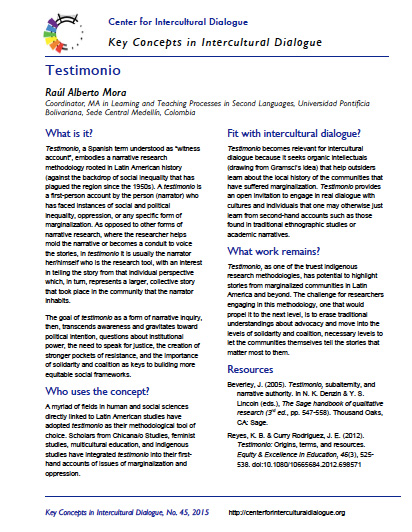
Key Concept #43: Uchi-Soto by Eric Cattelain

Key Concepts in ICDThe next issue of Key Concepts in intercultural Dialogue is now available. This is KC43: Uchi-Soto by Eric Cattelain. As always, all Key Concepts are available as free PDFs; just click on the thumbnail to download.Lists organized  chronologically by publication date and numberalphabetically by concept in English, and by languages into which they have been translated, are available, as is a page of acknowledgments with the names of all authors, translators, and reviewers.

kc43-sm

Cattelain, E. (2014). Uchi-soto. Key Concepts in Intercultural Dialogue, 43. Available from: https://centerforinterculturaldialogue.org/wp-content/uploads/2014/11/key-concept-uchi-soto.pdf

The Center for Intercultural Dialogue publishes a series of short briefs describing Key Concepts in Intercultural Dialogue. Different people, working in different countries and disciplines, use different vocabulary to describe their interests, yet these terms overlap. Our goal is to provide some of the assumptions and history attached to each concept for those unfamiliar with it. As there are other concepts you would like to see included, send an email to the series editor, Wendy Leeds-Hurwitz. If there are concepts you would like to prepare, provide a brief explanation of why you think the concept is central to the study of intercultural dialogue, and why you are the obvious person to write up that concept. And starting today, feel free to propose terms in any language, especially if they expand our ability to discuss an aspect of intercultural dialogue that is not easy to translate into English.


Creative Commons License
This work is licensed under a Creative Commons Attribution-NonCommercial-NoDerivatives 4.0 International License.

NCA 2014 in Chicago

This slideshow requires JavaScript.

The National Communication Association 100th convention was held in Chicago November 20-23, 2014. I organized a panel entitled “Intellectual Genealogy: Documenting Invisible Colleges in the Age of Digital Communication” with Theresa Castor, Robert Craig, Jay Leighter, Jefferson Pooley, Michelle Scollo and Leah Wingard. In addition, I presented two papers. “Taking a (Meta)Communication Perspective to Intercultural Dialogue” (discussing the Key Concepts in Intercultural Dialogue) was part of the panel organized by Richard Buttny resulting from the Macau conference in spring, with Todd Sandel and Sunny Lie (from that event) and the added participation of Don Ellis; Cynthia Gordon was chair. “Bringing Intercultural Dialogue to the Center” was part of a panel of past chairs of the International and Intercultural Communication Division, organized by Alberto Gonzalez, and titled “Past Challenges, Present Victories.” A photo from that event is attached; the participants were (bottom row, from left): Mary Jane Collier, Wendy Leeds-Hurwitz, Young Yun Kim, Yolanta Drzewiecka, and (top row, from left): Benjamin Broome, Carley Dodd, Donal Carbaugh, and Alberto Gonzalez.

In addition, I met with several of the CID advisory board members (Donal Carbaugh, Todd Sandel, and Charles Self). And, as is always the great benefit of large conventions such as this, I caught up with literally dozens of people I know. Far too many to name, this group included not only everyone on any of my panels, but graduate school peers and former colleagues; large numbers of professional colleagues from various contexts, including prior conferences large and small; NCA officers past, present, and future; and even a colleague met in China attending his first NCA. I also caught up with my Villanova University colleagues from  last year, this year’s Harron Chair (Raymie McKerrow), several people considering applying for next year, and a former graduate student who was presenting a paper prepared for my seminar in Social Construction Theory. Perhaps my favorite part of going to such conventions is that I also always meet lots of new people. Unfortunately, only one other photo will have to represent all these connections: the second photo above shows me with Jing Yin  and Yoshitaka Miike.

Wendy Leeds-Hurwitz, Director
Center for Intercultural Dialogue

CID in The Washington Post

About CIDI was contacted a few days ago by a reporter at the The Washington Post, who asked me to discuss the comments made by Airbnb about their impact on intercultural relations. She did a fair job of representing what I said. See for yourself:

Dewey, Caitlin. (2014, November 24). How Airbnb promotes world peace. The Washington Post.

If you’ve stayed in Airbnb yourself and want to join the conversation, add a comment below.

Wendy Leeds-Hurwitz, Director
Center for Intercultural Dialogue

CFP IMéRA residencies (France)

IMéRA : Call for applications 2015-2016
Application deadline: Wednesday, 7 January, 2015 – 23:59
IMéRA: Laboratory for Cross-disciplinary Exploration
A foundation of Aix-Marseille University, IMéRA is an Institute for Advanced Study, a unique research centre where both emerging and top-level scientists can take advantage of residence schemes to carry out innovative research projects.

IMéRA is specifically aimed at fostering cross-disciplinary projects. It receives scientists and artists of all disciplines (in residence between 3 and 12 months), as well as a few cross-disciplinary teams with joint projects for short stays (2 to 4 weeks). Research undertaken at the Institute is meant to develop interaction within social science, within science, between social science and hard, experimental and health sciences, and links between art and science. The Institute thus contributes to the emergence and development of world-class cross-disciplinary research approaches on Aix-Marseille University ground and grooms young researchers for such approaches. IMéRA also enthusiastically welcomes projects bearing on Mediterranean territories or submitted by researchers from the Mediterranean rim.

In their applications, candidates should clearly demonstrate their interest in cross-disciplinary projects on the basis of their research or itineraries, by:
*providing a list of already experienced cross-disciplinary collaborations or of publications calling for such collaboration schemes; or
*proposing to start one such collaboration and specifying its characteristics; or
*detailing expected contributions from cross-fertilisation of their own research program with perspectives and intellectual resources of other disciplines.
IMéRA gives preference to high-aspiring research projects conducive to inter-disciplinary collaboration on complex science issues or major society challenges. 

Residents carry out their research in connection with Aix-Marseille University (AMU) teams and laboratories or with partner bodies. It is advisable to include a letter of interest by an Aix-Marseille University researcher to the application.

A – SCHEDULE
Deadline: 7 January 2015 (this date included)
Duration of residences: 5 or 10 months
Residence periods (to be chosen by the candidates, several choices are possible):
*14 Sept 2015 to 12 Feb 2016 (5 months)
*22 Feb 2016 to 13 July 2016 (5 months)
*14 Sept 2015 to 13 July 2016 (10 months)

B – WHO CAN QUALIFY
This call is open to scientists and artists of all disciplines, both junior and senior, with or without official status.

To be eligible, scientist applicants must meet the following 3 conditions:
*Not to have lived in France more than 12 months during the three years preceding this call for applications;*
*Hold a Doctorate or PhD;
*Have at least two years’ post-doctoral experience in full-time research as at the call for applications deadline.

To be eligible, artist applicants must meet the following 2 conditions:
*Not to have lived in France more than 12 months during the three years preceding this call for applications;*
Carry out a research project in connection with science.

C – SELECTION CRITERIA
Application assessment criteria include, but are not limited to:
*The candidate’s quality;
*Project and researcher’s value and potential;
*Connection of project with IMéRA’s cross-disciplinary framework (capacity to link with other disciplinary domains);
*Relevance of the research project in terms of its connection with the Aix-Marseille area (potential interaction with local facilities, teams and research centres; use of local resources – field, archives, etc.).

D – LIVING CONDITIONS
1- REMUNERATION
IMéRA will pay an allowance or a salary to residents depending on their candidate status.
Scientist remuneration
Scientists fall into two classes:
*Junior: €2,300 net monthly allowance or salary;
*Senior: €3,500 net monthly allowance or salary.

Junior class: Researchers who have 2 to 9 years of  full-time research experience after obtaining the PhD (PhD training is not considered in the calculation of experience) as at the closing date of the call for applications.
Senior class: Top-level researchers with minimum 10 years’ experience in full-time research after obtaining the PhD (PhD is not considered in the calculation of experience) as at the closing date of the call for applications, and university professors.
Artist remuneration
Artists will receive a €2,300 net monthly allowance.

2. ACCOMMODATION
IMéRA provides free accommodation to residents  in a flat within the Institute premises.

3. TRANSPORT
IMéRA will pay for the residents’ ticket from their usual place of residence to Marseille and back.

4. RESEARCH MEANS
IMéRA invites residents to organise an international research seminar on a theme related to their project during their stay, with the possibility of asking several external specialists to participate.
IMéRA does not finance production means for resident artists planning to make pieces of work.

E –CANDIDATURE
Deadline: 7 January 2015 (this date included)
Applications must be in English or French.
Candidates must submit their applications EXCLUSIVELY on IMéRA’s website. Applications sent by e-mail or by post will NOT be considered.

Online applications must include
*Duly completed application form (mandatory fields);
*One sole file (to be downloaded) including:
– Curriculum Vitae with a list of publications and/or creations/exhibitions;
– Presentation of research project (maximum 5 pages) with selective bibliography;
– For junior researchers: one to three letters of recommendation;
– A letter of interest by an Aix-Marseille researcher (not compulsory).

Period of residence:
14 Sept 2015 to 12 Feb 2016 (5 months)
22 Feb 2016 to 13 July 2016 (5 months)
14 Sept 2015 to13 July 2016 (10 months)