CFP Waterhouse Family Institute 2015-16 Research Grants

Villanova University‘s Waterhouse Family Institute for the Study of Communication and Society (WFI) is pleased to both CALL FOR GRANT APPLICATIONS for 2015/16 and to celebrate the recipients of the WFI 2014/15 Research Grants.

The WFI-endowed by Mr. Lawrence Waterhouse, Jr., and housed within Villanova University’s Department of Communication-was founded on the principle that scholars, activists, and practitioners of communication have an important role to play in the creation of a socially just world. One of the ways that we enact this mission is through the annual funding of research grants. These grants support the scholarly work of Communication scholars across the world, work examining communication, its impact on the world around us, and its ability to create social change and social justice.

OUR 2014/15 WFI RESEARCH GRANT RECIPIENTS:
For 2014/15, the WFI awarded 7 research grants, totaling roughly $60,000, to support a strong and diverse collection of projects linking communication and social change/social justice.

CALL FOR 2015/16 WFI RESEARCH GRANT APPLICATIONS Our next application deadline for WFI Research Grants is now in place! Applications for 2015/16 WFI Research Grants will be due Tuesday, May 5, 2015.

Communication scholars across the nation, and across the world, are invited to apply for funds to support initial or ongoing phases of scholarly research aimed at presentation and publication. Although we do not limit our grants to a specific methodological orientation or subdisciplinary focus, all projects supported by the WFI have two things in common: they make communication the primary, and not secondary, focus, and they engage communication in terms of its impact on the world around us, its ability to create social change. WFI Research Grants are available to faculty at any institution of higher education, postdoctoral researchers, doctoral candidates, and other doctoral-level scholars. However, eligibility to apply for the WFI grant program is limited to those in Communication or a closely related discipline. Awards are typically in the range of $5,000-10,000, and may be applied to the hiring of graduate assistants, acquisition of resources or equipment, travel, and/or any other appropriate research related expenses. However, these funds may not be used to provide or supplement salaries. For more details on the WFI and this research grant process-including specific information on the grant application requirements, see the WFI website.

Questions concerning eligibility, or the nature of projects supported, please contact the Director of the WFI, Dr. Bryan Crable.

Communication of Scientific Research (Summer School, Czech Republic)

Summer School for Communication of Scientific Research

CRS Summer School 2015

The first Summer School for Communication of Scientific Research (CSR) will be offered at the University of West Bohemia, in Pilsen, Czech Republic. [Click on the image above to download the flyer.]

Location: The Institute of Applied Language Studies of the University of West Bohemia
Term: 7 – 11 July 2015 (daily from 10.00 a.m.to 6.00 p.m.)
Programme: 7 hours per day of theoretical and practical lessons on the basics of theory of communication applied to scientific research; construction of written and oral texts, analyses of written and oral texts prepared by participants, small groups work session and class discussion

CSR: Communication of Scientific Research is different from the general communication of science, which implies the explanation of scientific matters to people who have not a scientific background (public and not specialized media). “CSR” is a discipline dedicated to the professionals of science, people who do know the matter, as they study, do research and work in this context. It does not depend on the disciplines, as it is not based on the contents of science, but on the tools used to communicate. “CSR” courses aim to start to fill a gap: a need for a more formal education on communication among young scientists.

Target audience: PhD students, post-doctoral fellows of different countries and disciplines (natural, social and human sciences)
Number of participants: maximum 20
Structure of the course: an intensive course of 5 days, with 7 hours per day, of theoretical and practical lessons dedicated to written and oral communication of scientific research.
Language: English
Application form due May 31, 2015
Registration Fee: 350 euro per person

Lecturer:
Maria Flora Mangano earned her PhD in biochemistry in Italy, at the University of Milan, in 1999; then she left the research laboratory to study science communication. In 2003 she started to teach communication through meetings and courses dedicated to trainees at scientific faculties of Italian universities. In 2014 she began a second PhD in humanities and intercultural studies at the University of Bergamo (Italy). Her website and the articles she publishes are attempting to start filling a gap: the need for more formal education of communication among scientists. It is a challenge for scientific disciplines, where so much research is done with such a little communication. She has published a handbook of communication of scientific research. It has been written both in Italian (1st ed. 2008; 2nd ed. 2013) and Spanish (2009). It is 100 pages long, and designed for science professionals: young scientists, including PhD students and postdoctoral fellows. It is offered to scientists as a tool to understand how to communicate their research, either written or oral, better. The handbook specifically deals with various forms including a scientific paper, poster, PhD thesis and scientific presentation. Maria Flora Mangano teaches communication of scientific research at Italian universities and organizes regular “schools.” Three courses dedicated to the communication of scientific research have already been held in Pilsen, at the University of West Bohemia, in 2014 and 2015. July 2015 will be the first summer school.

History and more details, including the complete Schedule are available. For further information about the course, please send an email.


E.MA. in Human Rights and Democratisation

Deadline for applications for E.MA. 2015/2016 offered by EIUC has been extended to 30 April 2015. Check the admission requirements to apply for this European Master’s Programme in Human Rights and Democratisation to enhance knowledge, gain practical skills, develop competences and boost career in these fields. This E.MA offers a unique learning and human experience through this intensive one-year Master’s programme articulated in two semesters: a First Semester from September to January in Venice (Italy) and a Second Semester from February to July in one of the 41 E.MA universities in the EU.

The historic and peaceful location of the Monastery of San Nicolò in Venice Lido will be the setting where you will meet, learn, study and debate with our international network of academics, field practitioners and experts in human rights, development and institution building. Join the community of more than 1300 human rights professionals and defenders holding the E.MA Joint Degree and now working in national, international, governmental, inter- and non-governmental organisations, as well as academic institutions, dealing with human rights and democratisation.

Watch what Prof. Manfred NowakE.MA Director from University of Vienna, says about the European Master’s Programme in Human Rights and Democratisation!

CFP EURIAS Fellowship Programme (16 institutes in EU)

The European Institutes for Advanced Study (EURIAS) Fellowship Programme is an international researcher mobility programme offering 10-month residencies in one of the 16 participating Institutes: Berlin, Bologna, Budapest, Cambridge, Delmenhorst, Edinburgh, Freiburg, Helsinki, Jerusalem, Lyon, Marseille, Paris, Uppsala, Vienna, Wassenaar, Zürich. The Institutes for Advanced Study support the focused, self-directed work of outstanding researchers. The fellows benefit from the finest intellectual and research conditions and from the stimulating environment of a multi-disciplinary and international community of first-rate scholars.

EURIAS Fellowships are mainly offered in the fields of the humanities and social sciences but may also be granted to scholars in life and exact sciences, provided that their proposed research project does not require laboratory facilities and that it interfaces with humanities and social sciences. The diversity of the 16 participating IAS offers a wide range of possible research contexts in Europe for worldwide scholars. Applicants may select up to three IAS outside their country of nationality or residence as possible host institutions.

The Programme welcomes applications worldwide from promising young scholars as well as from leading senior researchers. The EURIAS selection process has proven to be highly competitive. To match the Programme standards, applicants have to submit a solid and innovative research proposal, to demonstrate the ability to forge beyond disciplinary specialisation, to show an international commitment as well as quality publications in high-impact venues.

For the 2016-2017 academic year, EURIAS offers 43 fellowships (21 junior and 22 senior positions).

All IAS have agreed on common standards, including the provision of a living allowance (in the range of € 26,000 for a junior fellow and € 38,000 for a senior fellow), accommodation (or a mobility allowance), a research budget, plus coverage of travel expenses.

APPLICATION
– Applications are submitted online, where you will find detailed information regarding the content of the application, eligibility criteria, selection procedure.
– Applications period April 9th → June 5th, 2015, 12 pm (noon) GMT. Late applications will not be considered.

SELECTION PROCEDURE
– Scientific assessment by two international referees
– Pre-selection by the EURIAS international Scientific Committee
– Final selection by the IAS Academic Boards
– Publication of results: January 2016

For further information on the IAS and their specific working conditions: www.eurias-fp.eu/ias

CFP Human Communication Studies International Conference (Trinidad)

The Human Communication Studies (HCS) International Conference, 2015 September 2425, the University of the West Indies, St. Augustine, Trinidad
Theme: Identity, Context and Interdisciplinarity in Human Communication Studies in the Caribbean and Beyond
Submission deadline: April 30 2015 (full papers and/or 1500 word extended abstracts)

Human communication studies research in the Caribbean has evolved from the pioneering work in mass communication by CARIMAC and media and communication, and communication for social and behavioural change at UWI, Mona, Jamaica; subsequent developments in communication studies at UWI, St. Augustine, Trinidad between 1999 and the present, and human communication studies since 2009; the introduction of a minor in Communication Studies at UWI Cave Hill since 2011. These developments in the Caribbean reflect, in part, the international and national trends in the burgeoning discipline of human communication which is home to more than two dozen sub-fields. Issues of identity, interdisciplinary links and discussions about the focus and study of human communication studies in the Caribbean and beyond arise quite naturally, especially in multidisciplinary academic departments and contexts.

Human communication studies developments in the Caribbean have also been accompanied by the design and delivery and growth of successful undergraduate and graduate programmes and research days and seminars. This period of development in Caribbean human communication studies has also witnessed the initiation and growth of faculty research in communication and interdisciplinary research collaboration in areas and subthemes such as communication studies education; communication, culture and gender; communication, culture and conflict; health communication; intercultural and/or multilingual communication; media, culture and society; organizational and corporate communications/business communication; performance, popular culture and critical theory; newer media and digital technology; telecommunications policy, information use and technology convergence. These areas of academic (faculty) research in the Caribbean and beyond reflect issues of identity, context and interdisciplinarity.

As we explore Identity, Context and Interdisciplinarity in Human Communication Studies in the Caribbean and Beyond, please consider submitting your full conference papers to an international panel for peer review for acceptance at the conference and possible publication in the Journal of Human Communication Studies in the Caribbean (JHCSC).The inaugural conference on Human Communication Studies: Celebrating the Caribbean in Communication, Culture and Community 2013 took place at UWI, St Augustine, Trinidad and Tobago.

Submissions should be sent as abstract and full paper attachments and uploaded at the conference website.

The full papers should propose topics, posters, panels or innovative sessions based on the areas or sub-themes listed above. All papers should provide a paper title, names of author(s), names of presenter(s), institutional affiliation, email address and telephone contacts, identify a conference sub-theme from the areas listed in the call for papers, provide 5 keywords and the abstract should not exceed 200 words.

Notice of Acceptance: by June 15 2015. Commitment to Present: by June 30 2015. Early Conference and Accommodation Registration April 15-August 15 2015. Programme and/or abstracts online: August 15 2015.

Manuscripts should not exceed 25 double-spaced pages, excluding tables and References. Extended abstracts of 1500 words will be considered up to April 30, but to receive full consideration prospective submitters of extended abstracts should send full papers by May 15 2015.

Manuscripts submitted to this conference should include “human communication studies conference” in the subject line of the email, a separate abstract not to exceed 200 words, and a list of five suggested keywords. Manuscripts must conform to the conventions of the 6th edition of the Publication Manual of the American Psychological Association; otherwise, they will not be reviewed.

Research involving human participants must be approved by an institutional review board (IRB) in order to be considered for publication in a proposed collection of papers in a journal or book or other form. Manuscripts must not be under consideration in other outlets or have appeared in any other published form at the time of submission.

Presentations should not exceed twenty (20) minutes for papers and one hour for panels or innovative sessions. Poster specifications will be issued with the notice of acceptance by June 15 2015. Conference information, travel and accommodation, registration, and programming will be posted and updated regularly. PowerPoint/multimedia presentations will be received during a period to be announced.

Inquiries may be sent to Godfrey Steele

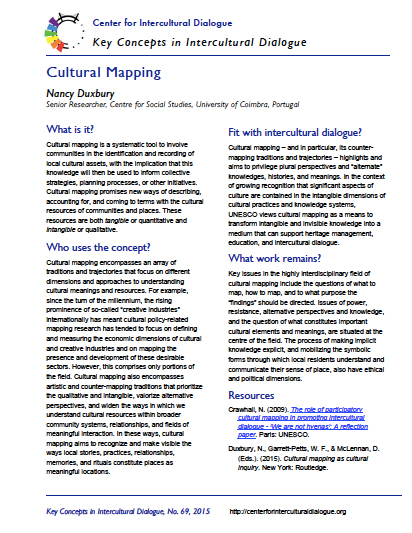
Key Concept #59: Teng by Todd Sandel

Key Concepts in ICDThe next issue of Key Concepts in intercultural Dialogue is now available. This is KC59: Teng by Todd Sandel. As always, all Key Concepts are available as free PDFs; just click on the thumbnail to download. Lists organized  chronologically by publication date and numberalphabetically by concept in English, and by languages into which they have been translated, are available, as is a page of acknowledgments with the names of all authors, translators, and reviewers.

Key Concept #59 Teng by Todd Sandel

Sandel, T. (2015). Teng. Key Concepts in Intercultural Dialogue, 59. Available from: https://centerforinterculturaldialogue.org/wp-content/uploads/2015/04/key-concept-teng.pdf

The Center for Intercultural Dialogue publishes a series of short briefs describing Key Concepts in Intercultural Dialogue. Different people, working in different countries and disciplines, use different vocabulary to describe their interests, yet these terms overlap. Our goal is to provide some of the assumptions and history attached to each concept for those unfamiliar with it. As there are other concepts you would like to see included, send an email to the series editor, Wendy Leeds-Hurwitz. If there are concepts you would like to prepare, provide a brief explanation of why you think the concept is central to the study of intercultural dialogue, and why you are the obvious person to write up that concept.


Creative Commons License
This work is licensed under a Creative Commons Attribution-NonCommercial-NoDerivatives 4.0 International License.

Fulbright-Hays Dissertation Research Abroad Fellowships

The U.S. Department of Education (ED) is seeking applications for a new competition: Fulbright-Hays Doctoral Dissertation Research Abroad Fellowship Program. The program provides opportunities to doctoral candidates to engage in full-time doctoral research abroad in modern foreign languages and area studies. Only applications that propose research on the following geographic areas will be accepted: Africa, East Asia, Southeast Asia and the Pacific Islands, South Asia, the Near East, Central and Eastern Europe and Eurasia, and the Western Hemisphere (excluding the U.S.). Applications are due April 28, 2015.

UNESCO Links Cultural Diversity to Human Rights

© UNESCO

On 31 March, 2015, UNESCO Director-General Irina Bokova took part in a round table on the theme “Human Rights and the Protection of Cultural Diversity,” held at the University of Geneva, with the participation of the United Nations High Commissioner for Human Rights, Zeid Ra’ad Al Hussein, UNESCO Special Envoy for Intercultural Dialogue, Metin Arditi and author, psychoanalyst and university professor, Julia Kristeva.

Bokova emphasized that “cultural diversity is an expression of human rights – the persecution of minorities, religious and ethnic, and the looting and pillage of cultural heritage are part of a deliberate global strategy to eradicate history and memory, the identities and the existence of these peoples and communities, and, through them, the cultural diversity that is our common heritage.”

Arditi highlighted that “the destruction of cultural heritage is but a symptom of the destruction of the Other,” noting that “the West is living through an unprecedented intellectual crisis – we need to restore the humanities at the heart of our societies, as the cradle of ideas and intellectuals for the future. Universities have a historic responsibility here, to prepare society for its own transformation and to help people understand and live together.”

All speakers stressed the importance of teaching about religions through the humanities, as areas of knowledge and understanding, as well as debate and discussion — “in order for beliefs to not become the sole possession of fanatics and extremists.”

The General-Director concluded on the key role of education for global citizenship, as promoted by UNESCO, including education for human rights as the mainstay, stressing the need for cultural literacy and development of intercultural competences to make the most of contemporary multicultural societies and the challenges of living together.

See the original article for further details.

CFP Conference on Chinese Media and Chinese Civilization (Wuhan)

Call for Submissions
The Ninth International Conference on Chinese Media and Chinese Civilization:
The Image of China & Chinese Communication
August 2015, Wuhan, China

With intensified global communication and cultural exchange, China is paying more and more attention to having a voice in the world arena as it grows to become a world power. While China is molding its own image, it is making greater efforts in building its soft power and expanding its communication capacity.  Such efforts can be seen from the  national image video shown at Times Square, the internationally acclaimed TV documentary “A Bite of China”, and various platforms built by China’s Xinhua News Agency, CCTV and other national media. Considering the imbalances in global communication, China’s efforts to expand its capacity for international communication will contribute to building a more equitable and healthy new information and communication order in the world. To build a world with diversified voices, Chinese media professionals and communication scholars in and outside of China should not only closely monitor China’s process in building and communicating its image from historical, theoretical and practical perspectives, but also offer meaningful analysis and reflections of such a process within the context of globalization.

It is against such a backdrop that the Association of Journalism History (China), the School of Journalism and Communication of Huazhong University of Science and Technology (China), and the Wee Kim Wee School of Communication and Information of Nanyang Technological University (Singapore) will jointly hold the Ninth Conference on Chinese Media and Chinese Civilization. Since its launch in 1995, this conference series has been held eight times in China, Hong Kong, Taiwan and Singapore, receiving wide support from communication scholars and students in and outside of China. To mark the 20th anniversary of this conference series, the ninth conference will be hosted again by the School of Journalism and Communication of Huazhong University of Science and Technology, which was a co-founder of this conference series and the host of its first conference in 1995. We hereby invite communication scholars and media professionals from China and abroad to attend the conference to share your research findings and views about the theme of this conference.

Submissions should be relevant but not limited to the following topics:
1.       China’s national image building as a rising power
2.       History, theory and practice of China’s international communication
3.       Public diplomacy and national public relations
4.       Cultural industry and China’s national image communication
5.       Overseas Chinese media and China’s national image building
6.       Mainstream media and China’s national image communication
7.       Media system, ethnics, laws and China’s national image communication
8.       History and reality of Chinese Civilization
9.       Chinese communication and the Chinese identity
10.    Culture and politics of China’s national image communication
11.    New media and China’s national image communication
12.    and other topics related to the conference theme.

Venue:
Huazhong University of Science and Technology, Wuhan, China

Schedule:
Registration: 19 August, 2015
Conference: 20-21 August, 2015

Conference Fee:
600 RMB for registration (exempted for students)

Deadlines and Important Dates
Application reply deadline: 20 April, 2015
Abstract submission deadline: 30 April, 2015
Full paper submission deadline:  30 May, 2015

Paper acceptance notification and invitation letter to be issued  20 June, 2015

Submission of Full Papers
The length of full papers must not exceed 10,000 Chinese characters.
The paper can be written in either Chinese or English. Conference presentation should be in Chinese.
All papers should be in Word format.
All submissions should include author’s name, affiliation, and contact information.

Contact Information
Submissions should be emailed to the following contacts before deadline.
For submissions from China:
Xiuqing Yang
School of Journalism and Communication
Huazhong University of Science and Technology

For submissions from overseas:
Xiaodong Yang
Wee Kim Wee School of Communication and Information
Nanyang Technological University

For queries:
Haijiang Tang
School of Journalism and Communication
Huazhong University of Science and Technology

Miami University job ad

Miami University invites applications for Professor and Chair of a new Department of Global and Intercultural Studies.  The new unit will develop new curricular, research and public outreach initiatives in global and intercultural studies, as well as incorporate established undergraduate majors and minors in American Studies, Asian/Asian American Studies, Black World Studies, East Asian Studies, European Area Studies, International Studies, Jewish Studies, Latin American Studies, Middle Eastern and Islamic Studies, and Women’s, Gender and Sexuality Studies. The appointment start date is negotiable and may be as early as August 2015.

Specific duties and responsibilities include: teaching in area of expertise, leading new curriculum development and implementation; recruitment and professional development of faculty (including promotion and tenure recommendations); leading the development of governance and administration policies for the new unit; recommendations to the Dean for faculty teaching and workload assignments, and for faculty and unclassified staff merit-based salary increases; budget oversight; hiring and supervision of staff; management of departmental office operations; communication of University and College policies and practices to the department; representation of the department to the College, University, and broader publics.

Candidates should have a teaching and scholarly record commensurate with the appointment of a full professor and demonstrated administrative experience to lead the development of this new interdisciplinary department. We seek a leader with strong creative and collaborative skills, and a vision to develop new initiatives that may include new majors, graduate certificates or programs, and research institutes.  Candidates should have a Ph.D. and be nationally/internationally recognized scholars and excellent teachers in at least one of the following areas: global studies, transregional or transnational studies, area studies, identity studies, social equity, gender and sexuality studies. We seek a leader with a strong commitment to diversity, who will foster innovative teaching methods that promote engaged learning in the 21st century; a commitment to teaching undergraduate courses at all levels; and innovative scholarly and public outreach activities. Submit a letter of interest and curriculum vitae online.   Three letters of recommendation are required; should be sent directly to Associate Dean Renée Baernstein. Direct queries about the search to the search committee co-chairs: Prof. LuMing Mao or Associate Dean Renée Baernstein. Review of applications will begin on April 10, 2015 and continues until position is filled.  Miami University, an equal opportunity/affirmative action employer with smoke- and tobacco-free campuses, is committed to a multicultural environment and strongly encourages applications from minorities, females, veterans and individuals with disabilities. Miami’s Annual Security and Fire Safety Report with information on campus crime, fires, and safety is available online. Hard copy available upon request. Employment will require a criminal background check according to University guidelines.