Job Ad Hebrew University (Israel)

HEBREW UNIVERSITY OF JERUSALEM
Noah Mozes Department of Communication and Journalism
Tenure-Track Position

The Noah Mozes Department of Communication and Journalism at The Hebrew University of Jerusalem invites outstanding candidates to apply for a tenure-track position starting July, 2017.

Applicants must hold a Ph.D. degree at the time of hire, and demonstrate an active research program, indicating the potential for outstanding scholarship. Ability to teach in Hebrew is required.

Deadline for applications: September 22, 2016.

Please see our website for additional information on the application process.

Job ad Hellenic Open University: Sociolinguistics (Greece)

Call for applications for three (3) full-time research positions in Sociolinguistics (Project PRESS, Hellenic Open University)

Description of the position
Project PRESS: Provision of Refugee Education and Support Scheme, an initiative of the Hellenic Open University which aims to address the educational and integration needs of refugees currently residing in Greece, is offering three (3) full-time research positions in the subject: fieldwork on the educational (communication and linguistic) needs of refugees. The positional involves at least 6 months fieldwork in refugee camps in Greece (Lesvos, Thessaloniki or Athens). Contract duration: 9 months.

Required qualifications
Candidates should possess the following qualifications: a) PhD in sociolinguistics or PhD candidates in the same field; and b) fieldwork experience of conducting research on a refugee/ immigrant community.

How to apply
Applicants are invited to submit the form provided on the website and a detailed CV to: project_press[at]eap.gr. Closing date for applications: 14 August 2016.

For further information on the Project, please visit send an email at project_press[at]eap.gr.

Save

Save

Save

CASBS at Stanford Seeks Fellows

Stanford’s Center for Advanced Study in the Behavioral Sciences Seeks Fellows

The Center for Advanced Study in the Behavioral Sciences (CASBS) at Stanford University, is now accepting applications for its residential fellowships for the 2017- 2018 academic year. Online applications will be accepted at the Center’s website through November 4, 2016 for the 2017-2018 fellowship year.

“The Center offers a residential fellowship program for scholars working in a diverse range of disciplines that contribute to advancing research and thinking in social science. Fellows represent the core social and behavioral sciences (anthropology, economics, history, political science, psychology, and sociology) but also the humanities, education, linguistics, communications, and the biological, natural, health, and computer sciences. We are pleased to partner with several entities to provide funding for some residential fellowships whose research projects focus on certain topics.  Our newest partner fellowship programs are the Presence-CASBS and Stanford-Taiwan Social Science fellowships, which join the Berggruen, Mindset Scholars Network, and Stanford Cyber Initiative fellowships offered through CASBS.

CASBS is a collaborative environment that fosters the serendipity arising from unexpected intellectual encounters. We believe that cross-disciplinary interactions lead to beneficial transformations in thinking and research. We seek fellows who will be influential with, and open to influence by, their colleagues in the diverse multidisciplinary cohort we assemble for a given year.”

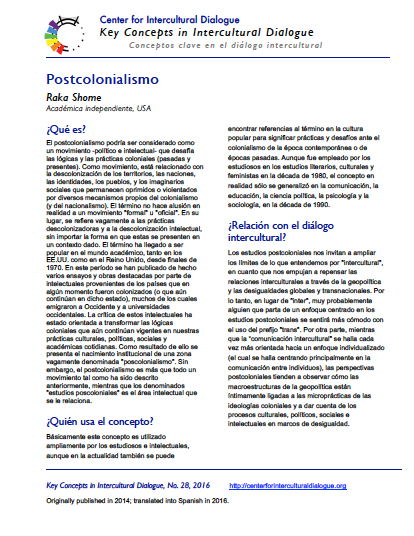
Key Concept #28: Postcolonialism Translated into Spanish

Key Concepts in ICDContinuing translations of Key Concepts in Intercultural Dialogue, today I am posting
KC#28: Postcolonialism, originally written by Raka Shome for publication in English in 2014, now translated into Spanish by Miguel Ángel Guerrero Ramos.

As always, all Key Concepts are available as free PDFs; just click on the thumbnail to download. Lists of Key Concepts organized chronologically by publication date and number, alphabetically by concept, and by languages into which they have been translated, are available, as is a page of acknowledgments with the names of all authors, translators, and reviewers.

KC28 Postcolonialism_SpanishShome, R. (2016). Postcolonialismo. Key Concepts in Intercultural Dialogue, 28 (M. A. Guerrero Ramos, Trans.) Available from:
https://centerforinterculturaldialogue.org/wp-content/uploads/2016/08/kc28-postcolonialism_spanish.pdf

If you are interested in translating one of the Key Concepts, please contact me for approval first because dozens are currently in process. As always, if there is a concept you think should be written up as one of the Key Concepts, whether in English or any other language, propose it. If you are new to CID, please provide a brief resume. This opportunity is open to masters students and above, on the assumption that some familiarity with academic conventions generally, and discussion of intercultural dialogue specifically, are useful.

Wendy Leeds-Hurwitz, Director
Center for Intercultural Dialogue


Creative Commons License
This work is licensed under a Creative Commons Attribution-NonCommercial-NoDerivatives 4.0 International License.

Miguel Ángel Guerrero Ramos Profile

ProfilesMiguel Ángel Guerrero Ramos is a Sociologist at the National University of Colombia. Master’s Student in Human Rights at the Pedagogical and Technological University of Colombia (UPTC).

Miguel Guerrero RamosMember of Group Research Con Paso Crítico of the UPTC. Author of the novels Observing Reality Through Desire, and Deep Down in the Pupils of Infinite Time, among others. His research interests are: critical theory of biosocial undecidability, human rights, pragmatic sociology, and geopolitics, among others.

His blog: sociologiaandreflexion.blogspot.com.es
Email: maguerreror[at]unal.edu.co.


Work for CID:

Miguel Ángel Guerrero Ramos translated KC28: Postcolonialism and KC72: Intertextuality into Spanish, and KC28: Postcolonialism into Italian. Most importantly, he gets credit for first suggesting that the Key Concepts be translated.

CFP Black & African-Oriented Media

Call for Proposals
Black and African-Oriented Media: Content, Audience Reception, and Global influence

Black media outlets have been a significant pillar of community and identity for African Americans in the United States. Currently production, distribution, and representation have seemingly increased with the success of programs like Empire, Black-Ish, Shonda Rhimes’ programs and a host of films starring Black leads. However, according to a recent New York Times article (Embers and Sandos, 2016) Black ownership has also been decreasing in recent times. This same trend can be said of some African produced media (Karikari, 2010); while ownership of print outlets is decreasing, there is also a growth in broadcast, film and music production as well as its global reach. Previous seminal work and collections including those of  Beretta E. Smith-Shomade, Robin Means Coleman, Venise T. Berry, and Catherine Squires have led the way in giving voice to Black American oriented media. An aim of this project, however, is to provide a space for which both African and Black American media are explored. The purpose of this edited volume is to gather literature which explores media created by members of the African diaspora, examines its relationship with diasporic audiences as well as its impact on mainstream culture in general. In addition, this volume will catalogue interdisciplinary research on the topic of Black and African diasporic media, as well as establish media produced by African and African Americans as a significant site to explore questions of identity, culture, audiences and cultural influence. Case studies, essays, and research (accessible to a broad audience) from a diverse range of methodologies and disciplines are welcome. Possible topics include, but are not limited to, analysis of Black/African-oriented media content (e.g. film, television, print, music), critiques of industries that impact Black/African-oriented media, globalization of Black/African oriented products, transnational audiences, audience reception, psychological effects, and its relation to Black and African’s identity and socio-cultural experience. For more possible examples see tentative outline below. Adjustments may be made depending on submissions.

African Diasporic-Oriented Media and Consumers (working title)
Foreword: Catherine Squires
Introduction: Omotayo Banjo Adesagba

News and Print Media
–      Traditional print media (e.g. magazines, newspapers), its relationship to Black/African diasporic communities, framing, storytelling and/or effects
–      Cultural impact of broadcast or online news or social media (e.g. Black Twitter) that relate to Black/African diasporic communities
–      Influence of Black or African disaporic literary work on diasporic communities and mainstream culture (e.g. Beyonce and Warsan Shire)

Film/Television
–      Success and/or audience reception to “Black Films” in the United States
–      Success and/or audience reception to television shows created by African/African Americans or other members of the diaspora
–      Representation of Blacks and Africans in film and television in Black/African-oriented media.
Radio and Music
–      Black radio stations and community relations (especially during Black Lives Matter and/or political movements)
–      Influence of African music or on popular culture
–      Responses and/or effects of Hip Hop and R&B music in U.S. and/or abroad

Black-African Relations
–      Portrayals of Blacks or Africans in Black/African media content
–      Music collaborations between Black /African diasporic music artists (e.g. Akon, Damian Marley, Wizkid, Don Jazzy)
–      Identification or cultural connection to Black/African diasporic-produced media

SUBMISSION GUIDELINES:
1.     Deadline for chapter proposals (approx. 500 words excluding citations):  September 1, 2016.
2.     Submissions should adhere to APA Style created in MSWord or RTF.
3.     Include a cover page with all of the author’s’ contact information, key terms, and a abridged c.v. for each author.
4.     Submit proposals to Omotayo (Banjo) Adesagba via email to omotayo.banjo[at]uc.edu with “African Diaspora Media”  in the subject line.
5.     If selected, your chapter submissions must be original works of 3000-6000 (estimate) words, references included. Chapter deadline:  January 15, 2017.

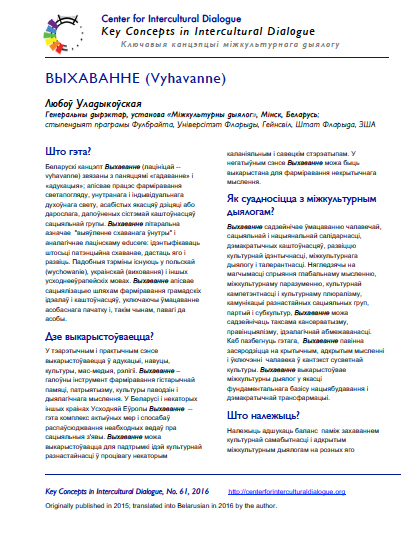
Key Concept #61: Vyhavanne Translated into Belarusian

Key Concepts in ICDContinuing translations of Key Concepts in Intercultural Dialogue, today I am posting KC61: Vyhavanne, a Belarusian concept originally discussed in English by Liubou Uladykouskaja in 2015, which she has now translated into Belarusian.

As always, all Key Concepts are available as free PDFs; just click on the thumbnail of the translation to read it. Lists of Key Concepts organized chronologically by publication date and number, alphabetically by concept, and by languages into which they have been translated, are available, as is a page of acknowledgments with the names of all authors, translators, and reviewers.

KC61 BblXABAHHE_BelarusianUladykouskaja, L.(2016). Выхаванне. Key Concepts in Intercultural Dialogue, 61. Available from:
https://centerforinterculturaldialogue.org/wp-content/uploads/2016/07/kc61-d0b2d18bd185d0b0d0b2d0b0d0bdd0bdd0b5_belarusian.pdf

If you are interested in translating one of the Key Concepts, please contact me for approval first because dozens are currently in process. As always, if there is a concept you think should be written up as one of the Key Concepts, whether in English or any other language, propose it. If you are new to CID, please provide a brief resume. This opportunity is open to masters students and above, on the assumption that some familiarity with academic conventions generally, and discussion of intercultural dialogue specifically, are useful.

Wendy Leeds-Hurwitz, Director
Center for Intercultural Dialogue


Creative Commons License
This work is licensed under a Creative Commons Attribution-NonCommercial-NoDerivatives 4.0 International License.

EIUC Training for International Electoral Observers

EIUC training seminar for International Electoral Observers is now ready to accept candidatures.

EIUC has developed two three-day modules aiming at providing training to civilian staff in election observation missions at the first steps of their career (i.e. short term observers). Selected applicants will be allowed to become aware of the role, the tasks and the status of international observers, and will be given a theoretical and practical training on election observation and election observation missions functioning.

The first module (7 – 9 November 2016) will highlight the quantitative observation of the STOs. Starting with a thorough introduction on the international observation theory and legal standards the first module will analyse the practical life of a short term observer from the selection procedure to the end of mission including the observation of the polls, the filling of the forms, the reporting system and the code of the conduct. The methodology will combine frontal lecturers in plenary, working groups as well as role plays, discussions and simulation exercises.

The second module (10 – 12 November 2016) is principally intended as a complementary step for those participants who have already attended the first module. EIUC will nevertheless also accept candidatures from first time applicants to EIUC’s trainings seminars. The second module will introduce the participants to the long-term election observation by analysing in depth some of the aspects related to an international observation mission such as working relations, interviewing techniques, media and security.

EIUC will accept candidatures for each separate module or both combined. Applicants will therefore have a possibility to choose the module which is more closely related to their interests and experience or combine the two of them for a more complete understanding of the topic.

The faculty is composed by well-known international trainers and professionals with a long standing practical experience in election observation missions within international organisations such as the European Union and the Organisation for Security and Cooperation in Europe.

The deadline for sending applications is 7 October 2016 through the online application form.

For further enquiries please contact EIUC at: training.ieo[at]eiuc.org

Save

Save

Save

CFP iMean5 Conference: Language & Change (UK)

Call for Papers
iMean 5 Conference
University of the West of England, Bristol
6- 8 April 2017 (with pre-conference Workshops on 5 April)
Abstract submission deadline: 5 January 2017.

The fifth iMean conference maintains its traditional focus on meaning in social interaction, with a thematic orientation to Language and Change. We will be considering changes at the linguistic level but also how changes at a societal level affect linguistic usage and our conceptions and analysis of it. Our increasingly interconnected and fast-moving world has led to an upsurge in mobility and to the possibility of greater variation and change in language use. The linguistically diverse nature of contemporary societies has implications for social justice, with potentially differential access to the public sphere. Different contexts of use and new media may also bring new styles and manners of expression. As society changes, so must our conceptual and epistemological models and old questions and concepts require new approaches and angles.

The conference welcomes papers which focus on Language and Change, on norms and/or shifts in language usage and, more generally, on theoretical and methodological developments in research on sociopragmatics. iMean5 aims to  take a critical approach to current conceptions of ‘language and change’, focused around (but not restricted to) the following themes: ·the impact of globalisation, population mobility, the growth of cities and multiethnolects and the interrelation of  language choice, language use and social justice; ·how identities (regional, class, gender, ethnic and so on) are constructed and negotiated in and through language and how these shift from one community to another;·theory/ method aiming to forge new understandings of social class and gender identities in the 21st century and how we incorporate these in linguistic research; ·language change at phonological, syntactic, semantic or discourse levels of analysis;·the impact of new media on linguistic use. Invited plenary speakers (confirmed):
• Gisle Andersen, University of Bergen
• Christine Béal, Université Paul Valéry Montpellier 3
• Jenny Cheshire, Queen Mary, University of London
• Michael Haugh, University of Queensland
• Barbara Johnstone, Carnegie Mellon University
• Zuraidah Mohd Don, University of Malaya

In line with the iMean tradition, the conference aims to encourage multidisciplinary thinking and to create new pathways in linguistic research. The conference will, as usual, include two specialist Colloquia, an Atelier AFLS and a summative Round Table at which the keynote speakers are invited to debate the conference theme.
Invited Colloquia
iMean 5 will host two invited colloquia.
1.     Language migration and change
Convened by Jo Angouri
2.     “Just how sorry are you, mate?” Norms and Variations in im/polite language behaviour.
Convened by Kate Beeching and James Murphy

Further details will be announced by the end of October 2016 or soon after.  Atelier AFLS
Participants who would like to present in French or present specifically French data are invited to join the Atelier AFLS which will take place as part of the conference.

Round table: What’s new in Language and Change?

Submission Details:
Panel Proposals: Panel proposals are invited by 1 December 2016. Decisions about panels will be made by 15 December. Panel organisers should oversee abstracts from panel members, with up to 6 papers in a panel (2 X 90 minute slots). Individual panel members should submit abstracts, clearly marked with Panel names, to the main conference email address by 5 January 2017 as below. All abstracts (in panels and the main conference) will be subject to double blind review as always. For information on panel proposals please contact the organisers (J.Angouri[at]warwick.ac.uk and Kate.Beeching[at]uwe.ac.uk).

Individual Papers: Abstracts of no more than 350 words (max and including references, if absolutely necessary) are invited. They should be submitted to https://easychair.org/conferences/?conf=imean2017.The deadline for receipt of abstracts is 5 January 2017. Abstracts should not include the name and affiliation of the author(s). If your submission is part of a Panel, or the Atelier AFLS, or you would like to propose your paper as part of one of the Colloquia, please state this clearly at the top of your submission. Further details will be published on the iMean website soon.  In the meantime, don’t hesitate to contact Kate.Beeching[at]uwe.ac.uk or J.Angouri[at]warwick.ac.uk for further information.

ProEtnica Intercultural Festival (Romania)

The Centre for Interethnic Youth Education Sighisoara (ibz) together with the Department for Inter-Ethnic Relations present the preliminary programme of the 14th edition of ProEtnica – Intercultural Festival Sighisoara which takes place from August 18 – 21, 2016.

Proetnica 2016

This year’s edition takes place under the patronage of the President of Romania, Klaus Werner Iohannis. There are going to be more than 50 artistic performances on the main stage as well as an arts and crafts fair featuring traditional craftworks manufactured by the national minorities. Further, a fine arts exhibition displays the works from ten contemporary artists belonging to the national minorities and is supplemented by three film screenings addressing the topic of intercultural dialogue.

In times of increased global migration, interethnic dialogue steadily gains importance within international peace negotiations. The ibz decided to dedicate this year’s edition of ProEtnica to the topic of interreligious dialogue. Eight events, i.a. scientific presentations and a symposium, address this subject matter from different perspectives and encourage further discussion on the challenges to intercultural peace in today’s world.

ProEtnica brings together more than 600 representatives of the 20 national minorities in Romania and offers them an opportunity to share their customs and actively engage in intercultural dialogue through different channels, e.g. the arts, scientific research or roundtable discussions. ProEtnica is an instrument which promotes the rights of cultural expression of the national minorities and, at the same time, strengthens cultural dialogue. Thus, ProEtnica contributes to the preservation and creation of the intercultural peace in a pluralistic and democratic society.

The ibz was founded in 2000. Its mission is to promote dialogue and interaction between people to foster mutual understanding and strengthen acceptance of ethnocultural differences.

Preliminary programme of ProEtnica –Intercultural Festival Sighisoara