Media Literacy Week 2016

Media Literacy Week logoNational U.S. “Media Literacy Week” Returns for Second Year
October 31 thru November 4, 2016

Media Literacy Week (#MediaLitWk) in the U.S. is being held October 31 – November 4, 2016. The mission of Media Literacy Week is to highlight the power of media literacy education and its essential role in education today. Sponsored by Trend Micro and hosted by the National Association for Media Literacy Education (NAMLE), Media Literacy Week already has the support of numerous partnering organizations and dedicated, passionate media literacy experts and practitioners across the nation. Kicking off U.S. Media Literacy Week will be the Digital Citizenship Summit on October 28 at Twitter’s San Francisco headquarters with panels and presentations highlighting the themes of “Citizenship, Literacy, and Advocacy.”

Media Literacy Week is designed to bring attention and visibility to media literacy education in the U.S. Inspired by Canada’s Media Literacy Week now in its 11th year, NAMLE is leading the efforts to create an annual media literacy week in the U.S that showcases the work of amazing media literacy educators and organizations nationwide and drives conversation that creates positive social change.

In an effort to raise national awareness of the escalating demand for media literacy education at home and in schools, affiliated Media Literacy Week partners are working with NAMLE to execute participatory events including #MediaLitWk classroom lessons, live webinars, tweet chats, screenings, PSAs and more.

Organizations and Educators Welcome to Contribute
All are welcome to participate in Media Literacy Week efforts. If you are an organization interested in being a Media Literacy Partner, email mlwpartners@namle.net. If you are a teacher interested in getting involved, email mlwteachers@namle.net. If you are interested in sponsoring, email Michelle Ciulla Lipkin, Executive Director at mciullalipkin@namle.net.

It’s up to each educator and organization to decide how they will participate, but given the proximity to the presidential election, NAMLE is encouraging the exploration of news literacy and civic engagement. For help planning, feel free to visit http://medialiteracyweek.us for tips and ideas or reach out directly to medialiteracyweek@namle.net.

About NAMLE (Host)
The National Association for Media Literacy Education (NAMLE) is a professional association for educators, academics, activists, and students with a passion for understanding how the media we use and create affect our lives and the lives of others in our communities and in the world. The NAMLE vision is to help individuals of all ages to develop the habits of inquiry and skills of expression they need to be critical thinkers, effective communicators and active citizens in today’s world. NAMLE is a member of the Council of Communication Associations, the parent organization of the Center for Intercultural Dialogue.

About Trend Micro (Sponsor)
Trend Micro Incorporated, a global leader in security software, strives to make the world safe for exchanging digital information. Built on 25 years of experience, our solutions for consumers, businesses and governments provide layered data security to protect information on mobile devices, endpoints, gateways, servers and the cloud. Trend Micro enables the smart protection of information, with innovative security technology that is simple to deploy and manage, and fits an evolving ecosystem. All of our solutions are powered by cloud-based global threat intelligence, the Trend Micro™ Smart Protection Network™ infrastructure, and are supported by more than 1,200 threat experts around the globe.

Save

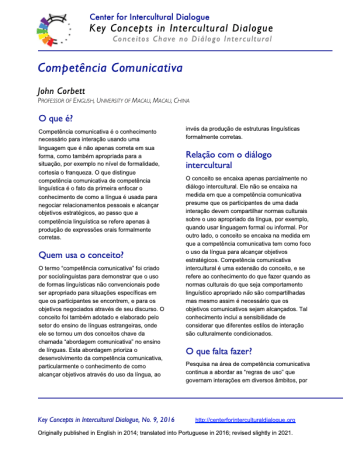
Key Concept #9 Communicative Competence Translated into Portuguese

Key Concepts in ICDContinuing translations of Key Concepts in Intercultural Dialogue, today I am posting KC9: Communicative Competence, written by John Corbett and published in English in 2014, now translated into Portuguese by Maria Augusta Rodrigues Alves.

As always, all Key Concepts are available as free PDFs; just click on the thumbnail to download. Lists of Key Concepts organized chronologically by publication date and number, alphabetically by concept, and by languages into which they have been translated, are available, as is a page of acknowledgments with the names of all authors, translators, and reviewers.

KC9 Communicative Competence_PortugueseCorbett, J. (2016). Competência comunicativa (M. A. Rodrigues Alves, Trans.). Key Concepts in Intercultural Dialogue, 9. Available from:
https://centerforinterculturaldialogue.org/wp-content/uploads/2021/05/kc9-communicative-competence_portuguese-v2.pdf

If you are interested in translating one of the Key Concepts, please contact me for approval first because dozens are currently in process. As always, if there is a concept you think should be written up as one of the Key Concepts, whether in English or any other language, propose it. If you are new to CID, please provide a brief resume. This opportunity is open to masters students and above, on the assumption that some familiarity with academic conventions generally, and discussion of intercultural dialogue specifically, are useful.

Wendy Leeds-Hurwitz, Director
Center for Intercultural Dialogue


Creative Commons License
This work is licensed under a Creative Commons Attribution-NonCommercial-NoDerivatives 4.0 International License.

Spelman College on Encouraging African-American Studies to Study Abroad

Lizette Terry Study Abroad 2016 (crop)

“According to the Spelman College Gordon-Zeto Center for Global Education, which oversees the Study Abroad Office, a record-breaking 277 students traveled to 18 countries during summer 2016. All total, more than 400 Spelman students traveled to 35 countries during the 2015-2016 academic year compared to 218 participants just four years ago – demonstrating sustained growth of the study abroad program and underscoring the importance of global education in students’ overall educational experience.

The photo captures Lizette Terry, C’2017, and her peers during a study abroad trip to Santo Domingo, Dominican Republic.

Spelman is outpacing the national average in the number of African-American students studying abroad. A 2015 “Open Doors Report” by the Institute of International Education determined African Americans comprised just 5.6 percent of U.S. college students who participated in study abroad programs during the 2013-2014 academic year. During that same period, 20 percent of Spelman’s 2,100 students studied abroad in 43 countries, and 71 percent of the class of 2015 had a global travel experience.”

For the rest of the article, read the original here.

Soumia Bardhan Profile

ProfilesSoumia Bardhan (Ph.D., University of New Mexico) is associate professor of Communication at the University of Colorado Denver.

Operating at the intersection of intercultural communication and global communication, Bardhan uses qualitative and rhetorical approaches to explore the role of media, AI, and communication in the cultural-political transformation of Middle Eastern and South Asian societies. She investigates the complex ways diverse rhetorical dynamics and discursive practices of Islam shape MENA (Middle East and North Africa) politics and how Western actors—scholars, publics, and policy makers—might respond to such discourses. Through her research, Bardhan aims to a) minimize stereotypes and advance dialogue and understanding between Muslim and non-Muslim communities, b) explore how culture and communication affect democratic institutions globally, and b) identify extremist discourses and imminent threats to then help shape foreign policy and global security strategies. Due to the global emphasis of her work, Bardhan is also invested in contributing to the internationalization of the communication discipline.

Bardhan teaches courses related to intercultural communication; intercultural and transnational rhetoric; religion, culture, and communication; communication theories; history and philosophy of communication studies; AI and human communication; qualitative research methodologies; and directs global study programs in Spain, France, Morocco, and India. As a certified mediator, she also teaches mediation (creative dispute resolution) courses. Bardhan is recipient of several curriculum development awards, including University of Notre Dame’s Global Religion and Research Initiative grant. CU Denver College of Liberal Arts and Sciences recognized her with the 2025 Excellence in Teaching award.

Bardhan was named Henry Luce Foundation’s Sacred Writes Public Scholarship on Religion fellow (2023-2024), CU Denver’s ThinqStudio fellow (2022-2024), Big 12 Faculty fellow (2017-2018), and is Association of College and University Educators (ACUE) fellow. She serves as director on the board of the International Communication Association (ICA) and chair of its Membership and Internationalization Committee; she was chair of ICA’s Intercultural Communication Division (2019-2021). She served on the National Communication Association’s Task Force on Fostering International Collaborations in research, teaching, and service (2015-2019). She served on the editorial board of Journal of International and Intercultural Communication (2018-2021) and is associate editor of Frontiers in Intercultural Communication (2020-present). Bardhan currently serves as interim director of International Studies at CU Denver.

Selected publications:

Book:

Turner, P. K., Bardhan, S., Holden, T. Q., & Mutua, E. M. (Eds.). (2019). Internationalizing the communication curriculum in an age of globalization: Why, what, and how. New York: Routledge.

Articles and chapters:

Bardhan, S., Chen, Y., AlSumait F. Y., Lee, P.,  & Wang, H. L. (2024). Pluriversal possibilities for the Euro/U.S.-centric intercultural communication field? Review of the GCC States and Taiwan. Annals of the International Communication Association. DOI: 10.1080/23808985.2024.2324153

Evans, E., & Bardhan, S. (2023). Adult Third Culture Kids and sojourner intercultural communication: Exploring belonging through a multilevel approach. International Journal of Intercultural Relations, 96.

Bardhan, S. (2022). Rhetoric and intercultural communication. In Moy, P. (Ed.), Oxford Bibliographies in Communication. New York: Oxford University Press.

Bardhan, S. (2022). #egyptian and #tunisiangirl: The (micro)politics of self-presentation on Instagram. International Journal of Communication, 16, 681-99.

Bardhan, S., & Cutter, D. (2021). Recruiting foreign warriors: Function of moral and temporal tropes in the Islamic State’s “Dabiq”. Rhetoric and Public Affairs, 24, 483-520.

Bardhan, S. & Foss, K. (2020). Revolutionary graffiti and Cairene women: Performing agency through gaze aversion. In Charrad, M & Stephan, R. (Eds.), Women rising: Resistance, revolution, and reform in the Arab Spring and beyond. New York: New York University Press.

Bardhan, S. (2019). Internationalizing the communication curriculum: Benefits to stakeholders. In Turner, P. K., Bardhan, S., Holden, T. Q., & Mutua, E. M. (Eds.), Internationalizing the communication curriculum in an age of globalization (pp. 11-20). New York: Routledge.

Bardhan, S., Colvin, J., Croucher, S., O’Keefe, M., & Dong, Q. (2019). Intercultural communication: A 17-year analysis of the state of the discipline. In Turner, P. K., Bardhan, S., Holden, T. Q., & Mutua, E. M. (Eds.), Internationalizing the communication curriculum in an age of globalization (pp. 23-35). New York: Routledge.

Bardhan, S. (2018). Affordances of websites for counterpublicity and international communication: Case of the Egyptian Muslim Brotherhood. Georgetown Journal of International Affairs, 19, 3-11.

Bardhan, S. (2018). The Egyptian Muslim Brotherhood and ‘Ikhwanweb’: Deliberative ethic/voice in a counterpublic’s rhetoric? Journal of Public Deliberation, 4(1), Article 5.

Bardhan, S. (2017). Rhetorical approaches to communication and culture. In J. Nussbaum (Ed.), Oxford Research Encyclopedia of Communication. Oxford University Press.

Bardhan, S. & Wood, R. (2015). The role of culture in civil society promotion in the Middle East: A case study approach with technology for social networking. Digest of Middle East Studies, 24(1), 111-138.

Bardhan, S. (2014). Egypt, Islamists, and the Internet: The Muslim Brotherhood and its rhetoric of dialectics in ‘Ikhwanweb’. Digest of Middle East Studies, 23(2), 235-261.

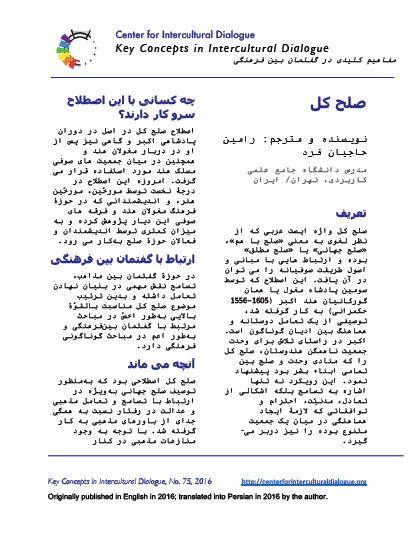
Key Concept #75: Sulh-i Kul Translated into Persian

Key Concepts in ICDContinuing translations of Key Concepts in Intercultural Dialogue, today I am posting KC#75: Sulh-i kul, written by Ramin Hajianfard and published in English earlier this year, which he has now translated into Persian.

As always, all Key Concepts are available as free PDFs; just click on the thumbnail to download. Lists of Key Concepts organized chronologically by publication date and number, alphabetically by concept, and by languages into which they have been translated, are available, as is a page of acknowledgments with the names of all authors, translators, and reviewers.

KC75 Sulh-i-Kul_PersianHajianfard, R. (2016). Sulh-i kul [Persian]. Key Concepts in Intercultural Dialogue, 75. Available from:
https://centerforinterculturaldialogue.org/wp-content/uploads/2018/08/kc75-sulh-i-kul_persian-revised.pdf

If you are interested in translating one of the Key Concepts, please contact me for approval first because dozens are currently in process. As always, if there is a concept you think should be written up as one of the Key Concepts, whether in English or any other language, propose it. If you are new to CID, please provide a brief resume. This opportunity is open to masters students and above, on the assumption that some familiarity with academic conventions generally, and discussion of intercultural dialogue specifically, are useful.

Wendy Leeds-Hurwitz, Director
Center for Intercultural Dialogue


Creative Commons License
This work is licensed under a Creative Commons Attribution-NonCommercial-NoDerivatives 4.0 International License.

U Reading Job Ad: International Partnerships Manager

International Partnerships Manager (China and East Asia)
University of Reading – International Study and Language Institute (ISLI)
Closes: 27th September 2016
Start date: as soon as possible
Interview date: 6 October 2016

An International Partnerships Manager (China and East Asia) is required to join our recently established International Partnerships team. The strategic importance of this region is demonstrated in the University’s significant investment in a joint Academy with Nanjing University of Information Science and Technology (NUIST). Launched in September 2015, the NUIST-University of Reading Academy (NUIST-UoR Academy) aims to enrol 300 undergraduate students in China across six discipline areas, with the option to study in Reading as part of their programme. The programmes are taught through the medium of English and the students graduate with a dual degree.

Initially, the post holder will spend a significant portion of their time contributing to further development of the NUIST-UoR partnership to ensure successful joint delivery and implementation of the Academy’s programmes. Once these are well-established, the role will evolve to focus more broadly on other East Asia transnational education (TNE) partnerships

You will have:
–  Ability to develop, manage and analyse data to evidence recommendations and actions and to monitor and report on the specialist areas allocated to the role, assessing appropriate governance and advising on risk management and operational issues.
–   Ability to contribute pro-actively as part of the team, and to articulate effectively in written and oral communications
–   Good knowledge of internationalisation strategies in HE, and the global context for their development and operational implementation.  Good knowledge of UK HE institutional policies and procedures.
–  Strong commitment to excellence and accountability, with the maturity, perspective and credibility to work effectively with all levels of staff and the ability to manage unanticipated situations calmly, knowing when and where to seek advice and guidance
–  A good undergraduate degree and excellent IT skills to support the effective analysis of data and communication of ideas and information.
–  Good networking and intercultural communication skills; availability for international travel.
–  Fluency in Mandarin would be an additional advantage.

Informal contact details
Contact role:    Head of ISLI
Contact name:  Prof Ros Richards
Contact email:  r.j.richards[at]reading.ac.uk

Interviews will be held on 6th October 2016.

Imperial College London Job Ad: International Relations Officer

International Relations Officer (North America)
Imperial College London – International Relations Office
Closes: 26th September 2016
South Kensington Campus

Imperial College London is a world-leading, research-intensive university specialising in science, technology, engineering, medicine and business, located in the heart of London. Imperial’s Strategy 2015-2020 emphasises international collaboration, placing it at the core of the College’s mission. Working with colleagues in the International Relations Office (IRO), as well as the College’s senior management and four Faculties, you will play a role in supporting the delivery of Imperial’s international engagement strategy.

The IRO supports the development and implementation of the College’s international engagement strategy. The team’s work spans the College and is informed by close working with the College’s senior management and Faculties. Activities focus on three areas: supporting the development of sustainable international partnerships with peer institutions, government agencies and relevant organisations; enhancing the College’s international influence by engaging with policymakers; and contributing to an excellent student experience by developing international mobility programmes and scholarships. Please note that the IRO is not responsible for international student recruitment.

The Role:

Your primary responsibility will be supporting the development of partnership activity with North American stakeholders, including making strategic recommendations to management and academic colleagues. Secondary responsibilities include supporting the College’s international mobility programmes for postgraduates.

With a strong knowledge of the higher education, research and translation landscape in North America, you will report on trends and developments, and advise on opportunities and risks for Imperial. In addition, you will provide advice to colleagues (including senior management and Faculty representatives) on building strategic engagement and joint initiatives across the region.

A key element will be the management of important external relationships in – and relating to – the region. You will be involved in the planning and briefing for high-level inward visits, as well as visits made to North America by senior College representatives. You will build networks for the College, both in the region and the UK: including representatives of higher education institutions, governments and their agencies, and funding organisations for scholarships and research.

You will support the College’s international collaborative PhDs and work with the International Relations Officer (Mobility and Programmes) to develop postgraduate student mobility programmes.

We are looking for a candidate with strong knowledge of North America, and of the issues relating to international higher education, research and translation. You must be able to present credibly to senior academic and management and represent Imperial at internal and external meetings. You should have experience of building relationships with a range of stakeholders, and be able to build credibility with colleagues at varying levels. We are looking for a team member with a strategic mind-set and who is comfortable working in complex and changeable situations. Excellent intercultural awareness and an understanding of the complexities of developing international partnerships is essential.

For further information, please see www.imperial.ac.uk. If you have any queries, please contact Mr Alex Page, Senior International Relations Officer at a.page[at]imperial.ac.uk.

Closing date: 26 September 2016 (midnight BST)

Interview date: Tuesday 11 October 2016

CFP Human Rights Memory Special Issue

Call for Papers: Special Issue on Human Rights Memory
Popular Communication: The International Journal of Media and Culture
Guest edited by Susana Kaiser, University of San Francisco

What is to be remembered, and what forgotten? Who takes ownership of memories or presents credentials to speak authoritatively about the past—e.g. the direct victims of human rights abuses, or society at large? We can link the emergence, growth, and proliferation of memory studies to post-violent environments and processes by which communities must come to terms with human rights violations and traumatic events. The aftermath of dictatorships, genocide, wars, massacres, forced migrations, the effects of environmental destruction, as well as the legacy of discrimination based on class, race, ethnicity, gender, and sexual orientation are problems of pressing concern to scholars working in critical traditions. The duty to remember human rights abuses and the need to re-focus on memory at the service of justice occupy central stage of this special issue.

Communication and media are interlinked with human rights matters and engaged with memory processes. This engagement is evinced in strategies geared toward keeping records of abuses, encouraging intervention to stop them, and using memories as tools to search for truth and justice. This special issue aims to contribute to the body of literature in what we label “human rights memory” and to narrow the gap in research about audiences/publics and media production processes. We are interested in research articles in an array of cultural productions, ranging from television series to artworks. We welcome submissions which highlight the processes by which people interact with, interpret, appropriate, consume, and use these productions, as well as those which elucidate how creative memory-writing—such as the activities of camera persons and museum guides—can work in practice. We seek to complement research centering on textual analysis, authorial intent, and expectations about the potential effect on audiences/ publics and will look for empirical support in studies that show the concrete impact of these initiatives while also illustrating their producers’ creativity and commitment to achieve specific goals.

The focus is global and multi-disciplinary. We are interested in innovative methodological approaches and theoretical frameworks that can contribute to the development of empirically grounded theory. We welcome submissions analyzing the richness of popular communication in matters of memory and human rights (civil, political, economic, social, and cultural). We invite contributions focusing on grassroots and mainstream popular communication, including traditional formats (theater, film, print, television, radio), new media (social, digital, screen media, video games, mobile phones), the arts (photography, exhibits, museums, memorials, public shrines, music, concerts, performances, fashion, graphic/comic books, cartoons), sports tournaments, and demonstrations. Topics may also include, but are not limited to:

•       Theoretical and methodological approaches useful for researching human rights memory audiences/publics and production processes, and especially, approaches highlighting conflicts between dominant/ hegemonic memories and those of the groups contesting them.

•       Audiences/publics’ decoding and use of productions promoting official memories and/or advancing counter-memory(ies).

•       Communication strategies developed by activists that have been effective tools for educating, broadening the human rights memory public sphere, generating action, and opening dialogical spaces (local, global, diasporic).

•       Tactics for accessing and impacting heterogeneous publics/audiences, and for securing resources for production, distribution, and exhibition (e.g., funding, technology, know-how).

•       Production processes documenting and writing memories of ongoing human rights violations (e.g. digital witnessing of major current crises). Production teams’ participation in human rights memory processes, including the role played by artists, writers, actors, technicians—the “above” and “below-the-line” crews. Profiles of producers (e.g., filmmakers, musicians, bloggers, Wikipedians).

The deadline for submissions is December 15, 2016.

Papers should be no longer than 7,000 words (all inclusive)

Papers should be submitted using ScholarOne.

Full instructions for authors, including APA 6th Edition style guidelines, can be found at the same page.

Correspondence and questions about this call for papers can be directed to Susana Kaiser (kaisers[at]usfca.edu)

Intercultural Harmony Grants – Musser Fund 2016

The LAURA JANE MUSSER FUND would like to promote mutual understanding and cooperation between groups and citizens of different cultural backgrounds within defined geographical areas through collaborative, cross-cultural exchange projects.  Projects must be intercultural and demonstrate intercultural exchange, rather than focused on just one culture.

PRIORITY IS PLACED ON PROJECTS THAT:
• Include members of various cultural communities working together on projects with common goals
• Build positive relationships across cultural lines
• Engender intercultural harmony, tolerance, understanding, and respect
• Enhance intercultural communication, rather than cultural isolation, while at the same time celebrating and honoring the unique qualities of each culture

PROJECTS MUST DEMONSTRATE:
• Need in the community for the intercultural exchange project
• Grassroots endorsement by participants across cultural lines, as well as their active participation in planning and implementation of the project
• The ability of the organization to address the challenges of working across the cultural barriers identified by the project
• Tangible benefits in the larger community

LIMITS OF GEOGRAPHY:
Only programs in Colorado, Hawaii, Michigan, Minnesota, and Wyoming may apply.

OUTCOMES SHOULD INCLUDE:
A demonstration of intercultural exchange between cultures
• Increased comfort in interaction between the groups and individual citizens addressed by the project
• Harmonious shared use of public space and community facilities
• Continued cooperation by the participants or communities addressed by the project

WHAT THE PROGRAM WILL COVER:
New programs or projects within their first three years
• The planning and implementation phase of a project
• Grants are typically in the $8,000-$25,000 range

WHO CAN APPLY:
• Nonprofit 501(c)(3) organizations
• Organizations located within one of the eligible states listed above

HOW TO APPLY:
Proposals will be accepted starting September 19, 2016 and must be submitted online by October 19, 2016. Funding decisions will be announced by February 2017.

To apply online please click here.

Archana Shrivastava Profile

ProfilesDr. Archana Shrivastava is Associate Professor & Head of the Business Communication Area at Birla Institute of Management Technology, India.

Archana ShrivastavaHaving worked at various universities and colleges, she has 19 years of research, teaching and training experience. Dr. Shrivastava earned her Ph.D. and M.A. in English literature from Dr. Hari Singh Gour University, Sagar in M.P. She is a Thomas certified professional and can perform Personal Profile Analysis (PPA) and Human Job Analysis (HJA). She is trained to teach “Business English Certificate Course and is also an active member of the Association for Business Communication, Communication Institute of Greece, and Eastern Communication Association.

Her current research and publications are in the areas of cross-cultural communication, leadership, team building, skill development. She has participated and presented papers in various conferences both in India and abroad. She has authored numerous case studies and research papers published in journals like IVEY, Emerald,  and Case Centre (European Case Clearing House). She is a recipient of a travel grant awarded by AICTE in 2015 to present her research at Columbia University in New York. She is the recipient of the best paper award in 2017 at the conference in Oxford University, and in 2018 in the international conference at Teri University.

Dr. Shrivastava has more than 19 years of academic experience to teach/train a variety of courses including: Business Communication, Soft Skills, Business Etiquette, Handling Interviews, Presentation Skills, Nonverbal Communication, Audience Analysis, Crisis Communication, Conflict Management, Negotiation Skills, Intercultural Communication, and Empathic Listening. She has been conducting trainings and Management Development Programmes (MDPs) for senior executives of several renowned  organizations and PSUs in India, including NTPC, NHPC, GAIL, IFFCO, and Power Grid. She has also been mentoring and developing students in the area of Soft Skills, especially People Skills.

Selected Publications

Shrivastava A. (2018). Using connectivism theory and technology for knowledge creation in cross-cultural communication. Research in Learning Technology, 26.

Shrivastava, A. (2018). A small initiative in the journey of making leaders with the help of authentic leadership model. Kybernetes47(10), 1956-1972.

Shrivastavam, A., Midha, M., & Vama, R. (2017). Employability skills: A comparative study of students from metro and two tier cities in India. FOCUS: The International Journal of Management, 12(2), 51-58.

Shrivastava, A., & Midha, M. (2016) Transactional style inventory: A tool to enhance interpersonal effectiveness. International Journal on Leadership, 4(2).

Shrivastava, A., & Srivastava A. (2016). Measuring communication competence and effectiveness of ASHAs (accredited social health activist) in their leadership role at rural settings of Uttar Pradesh (India). Leadership in Health Services, 29(1), 69-81.

Shrivastava, A., & Bindra, A. (2015). Re-designing organizational communication model of Akosha: An online consumer forum in India to resolve consumer complaints. The Case Centre, Reference no. 315-033-1.

Shrivastava, A. (2014). Active empathic listening as a tool for better communication. International Journal of Marketing and Business Communication, 3(3/4), 13-18.

Shrivastava, A. (2014). Sustainable development and inclusive growth model for improving organic agriculture in India: A case study on communication and awareness strategies of Morarka Foundation. The Case Centre, Reference number 914-017-1.


Work for CID:
Archana Shrivastava has served as a reviewer for translations into Hindi.