CFP Discourse: Multidisciplinary Perspectives (UK)

One day-colloquium on ‘Discourse: Multidisciplinary Perspectives’
University of Sussex, Friday 18th November 2016 (Please note the change of date)

Call for papers

The English Language & Linguistics group at the University of Sussex is organizing a one-day colloquium on ‘Discourse: Multidisciplinary Perspectives’. We invite papers from the full range of disciplines that use discourse analysis, such as literature, media studies, anthropology, history, linguistics, politics, psychology, gender studies, medicine, education, literature and more.  The sub-topic of the colloquium is ‘Reflections on Representation, Identity and/or (Non)Belonging’, which we encourage participants to interpret in the broadest sense. As such, we welcome both illustrative research papers detailing discourse analyses on the topic/s, as well as position papers which help show how representation, identity and (non)belonging are understood from a discourse perspective within your particular discipline. Various perspectives are encouraged and some themes which have emerged from discussions with colleagues across disciplines include:
• representation of public/political figures or groups in the media,
• patients’ self-accounts in medicine/psychology,
• defendants’ self-presentations in criminology/law,
• negotiation of self-identity in the classroom in sociology/education or representation of values in public and/or educational texts
• identity construction in oral/written memories of war veterans and/or historical crucial moments in oral history
• and much more.

We hope that the event will lead to greater understanding of how discourse is conceptualised and approached across disciplines and reveal opportunities for interdisciplinary collaboration. Depending on interest, we also envisage a selection of papers being published in a special issue of CADAAD Journal (Critical Approaches to Discourse Analysis Across Disciplines).

If you are interested in contributing a paper, please send a 300 word abstract to Roberta Piazza (r.piazza[at]sussex.ac.uk) by September 30th 2016.

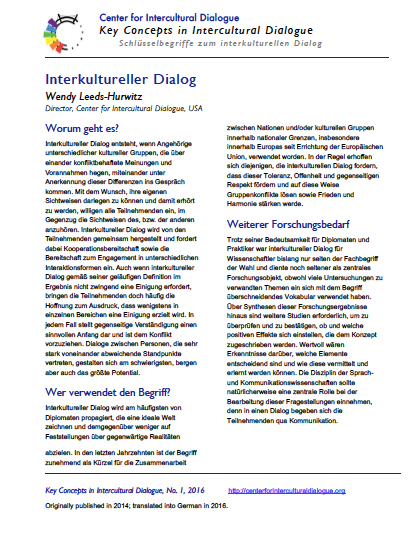
Key Concept #1: Intercultural Dialogue Translated into German

Key Concepts in ICDContinuing translations of Key Concepts in Intercultural Dialogue, today I am posting KC1: Intercultural Dialogue, which I published in English in 2014 as the first in the series, and which Dominic Busch has now translated into German.

As always, all Key Concepts are available as free PDFs; just click on the thumbnail to download. Lists of Key Concepts organized chronologically by publication date and number, alphabetically by concept, and by languages into which they have been translated, are available, as is a page of acknowledgments with the names of all authors, translators, and reviewers.

KC1 Interkultureller dialog_GermanLeeds-Hurwitz, W. (2016). Interkultureller dialog. (D. Busch, trans). Key Concepts in Intercultural Dialogue, 1. Available from:
https://centerforinterculturaldialogue.org/wp-content/uploads/2016/09/kc1-icd_german.pdf

If you are interested in translating one of the Key Concepts, please contact me for approval first because dozens are currently in process. As always, if there is a concept you think should be written up as one of the Key Concepts, whether in English or any other language, propose it. If you are new to CID, please provide a brief resume. This opportunity is open to masters students and above, on the assumption that some familiarity with academic conventions generally, and discussion of intercultural dialogue specifically, are useful.

Wendy Leeds-Hurwitz, Director
Center for Intercultural Dialogue


Creative Commons License
This work is licensed under a Creative Commons Attribution-NonCommercial-NoDerivatives 4.0 International License.

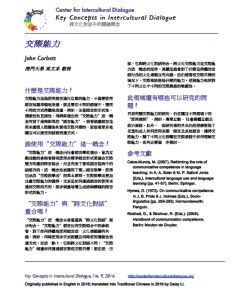
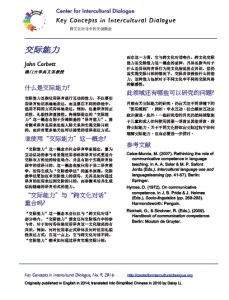
Key Concept #9: Communicative Competence Translated into Chinese

Key Concepts in ICDContinuing translations of Key Concepts in Intercultural Dialogue, today I am posting KC9: Communicative Competence, written by John Corbett and published in English in 2014, now translated into both traditional and simplified Chinese by Daisy Li.

As always, all Key Concepts are available as free PDFs. Click on the thumbnail of the translation you wish to read. Lists of Key Concepts organized chronologically by publication date and number, alphabetically by concept, and by languages into which they have been translated, are available, as is a page of acknowledgments with the names of all authors, translators, and reviewers.

KC9 Comm Competence_Chinese trad
Traditional Chinese
KC9 Comm Competence_Chinese sim
Simplified Chinese


Corbett, J. (2016). Communicative competence [Simplified Chinese]. (D. Li, Trans.). Key Concepts in Intercultural Dialogue, 9. Available from: https://centerforinterculturaldialogue.org/wp-content/uploads/2016/09/kc-9-communicative-competence_chinese-sim3.pdf

Corbett, J. (2016). Communicative competence [Traditional Chinese]. (D. Li, Trans.). Key Concepts in Intercultural Dialogue, 9. Available from: https://centerforinterculturaldialogue.org/wp-content/uploads/2016/09/kc-9-communicative-competence_chinese-trad.pdf

If you are interested in translating one of the Key Concepts, please contact me for approval first because dozens are currently in process. As always, if there is a concept you think should be written up as one of the Key Concepts, whether in English or any other language, propose it. If you are new to CID, please provide a brief resume. This opportunity is open to masters students and above, on the assumption that some familiarity with academic conventions generally, and discussion of intercultural dialogue specifically, are useful.

Wendy Leeds-Hurwitz, Director
Center for Intercultural Dialogue


Creative Commons License
This work is licensed under a Creative Commons Attribution-NonCommercial-NoDerivatives 4.0 International License.

CFP Beyond Words & Into the Message (Romania)

Beyond Words and into the Message. Building Communication across Languages, Media and Professions
10-Nov-2016 – 11-Nov-2016
Research Centre for Specialised Translation and Intercultural Communication
Bucharest, Romania

Meeting Description:
Our world is basically made up of words, the very essence of communication. These words find their way among us in one big conversation. In James W. Carey’s words: “Life is a conversation”. This holds good even more so when it comes to conveying our thoughts across the borders of language, culture, country and profession. The conversation between individuals on different sides of these borders is enlarged by an instance of otherness while crossing into many instances of translation.

We invite you to discuss these topics in the following sections of the conference:

1) Communication and Language Studies:
The growing need for mediation and communication across cultures for a variety of professionals in a broad range of fields calls for a fresh theoretical framing of practices involving social activities. These are not to be relegated to fixed and separate systems for, in the words of Mahatma Gandhi, “No culture can live if it attempts to be exclusive”.

This section of our conference welcomes papers on topics including, but not limited to:
– Communication theory and theories
– Digital media and online communication
– Professional communication
– Media and education
– Visual and non-verbal communication
– Cross-cultural communication
– Language learning and teaching
– Discourse analysis and applied linguistics
– New trends in linguistics

2) Literature and Cross-Cultural Studies:
“Great literature is simply language charged with meaning to the utmost possible degree.” (Ezra Pound). In one way or another literature has accompanied mankind for thousands of years. The need to tell and listen to stories is inherent to human nature, just as language and cognition are intertwined. Nevertheless, several questions should be addressed, such as: How much have the topics of literature changed and diversified? To what extent has modern narration influenced storytelling? What is its cross-cultural impact on literature?

In order to provide answers these questions (and others) this section welcomes papers on topics including, but not limited to:
– Media and cultural identity
– Postcolonial studies
– Gender studies
– Minority literature
– Literary and political relations in cross-cultures
– Historical approaches to literary studies
– Comparative literature

3) Translation and Interpreting Studies:
In the last two decades, the contribution of translators and interpreters has become essential in the coherent transfer of (specialized) information. Today the concept of translation goes deep beyond the simple knowledge of terminologies and has expanded to cover a wide range of factors, which can only be learned, understood and applied efficiently by means of a thorough academic training.

This section aims at debating over the following areas in connection with the role of translation and interpreting:
– Translating and interpreting as mediating between cultures
– Conference interpreting: trends and developments
– Ethical issues in translation across cultures
– Training and practice in translation and interpreting
– Literary vs. specialized translation: competition or compatibility?
– New media support in translation
– Social network language and its impact on speaking and translating

CFP Communication for Development & Social Change

Special Issue: Communication for Development and Social Change: Experiences & Future Convergences
Journal of Communication

Guest Editors: Thomas Tufte and Rafael Obregon

Communication for development and social change is at the crossroads of multiple approaches in communication scholarship, including visual communication, organizational communication, media and communication technologies, intercultural communication, and other communication practices. It also constitutes an established practice carried out and supported by agencies in international development and cooperation. In recent years, we have seen a proliferation of experiences and approaches, led by global partnerships and alliances as well as civil society organizations which, in many cases, crystallized in social movements across the globe.

In the aftermath of the financial crisis in 2008 and the so-called ‘Arab Spring’, social movements came to represent a rich and heterogeneous amount of bottom-up citizen and community-driven initiatives. They are cause-driven mobilizations pursuing goals across various issues and sectors, including public health, education urban development, sustainable development, and children’s and women’s rights. Recent humanitarian crises, such as the Ebola crisis and the refugee crises, have led to a widespread citizen engagement through a variety of social change communication and community-led initiatives.

In this processes, digital media and digital-centered forms of mobilization have been crucial, but also contested. The debate has moved beyond the initial techno-determinist fascination with so-called “Facebook” and “Twitter” mobilizations to the recognition of complex and dynamic relations between online and offline communication, organizations and social change, movements and media, performance and protest, communication and public deliberation, as well as among a variety of actors including communities, non-governmental and governmental organizations, movements, and companies pursuing similar agendas.

The energy, creativity, discourses, tactics, and strategies through which various political and social actors communicate for social change have come to challenge and inspire both research and practice. Many governmental and non-governmental organizations are seeking ways and means to reach and connect with constituencies, spark new energy, drive stronger public and policy agendas, build social movements, and promote social change.

Against this backdrop, the focus of this special issue of the Journal of Communication is to offer an in-depth understanding of the role of communication in social movements and various forms of collective action that promote equity, social justice, and human rights by tackling a range of global social problems.

We invite authors to send submissions informed by various theoretical perspectives and methodological approaches in communication studies. We are interested in submissions that:
– Revisit communication and social change theories, models, and arguments that inform research about communication in times of digital media and widespread citizen engagement.
– Examine case studies that bring original theoretical, analytical and conceptual insights about new dynamics of citizen engagement, organizational communication, and other communication practices related to multiple dimensions of social change.
– Critically reflect upon opportunities and limitations that social movements, organizations, non-government organizations, community-based organizations, and other civil society actors confront to spark communication, citizen engagement, and promote social change.
– Address communication experiences in a wide range of policy and development sectors and issues, including health, environment, poverty alleviation, energy, labor, culture, religion, diversity, gender equality, social accountability, and social inclusion.

Manuscripts should not exceed 28 pages (6000 words), including references and figures, and must be submitted through the online submission system of the Journal of Communication. Authors should indicate that they wish to have their manuscript considered for the special issue. Information about author guidelines can be found in the Journal of Communication website.

Deadline for submissions: December 1, 2016.

Inquiries should be sent to Dr. Thomas Tufte (ttufte[at]ruc.dk) and Dr. Rafael Obregon (robregon[at]unicef.org).

This theme issue will be published in 2017.

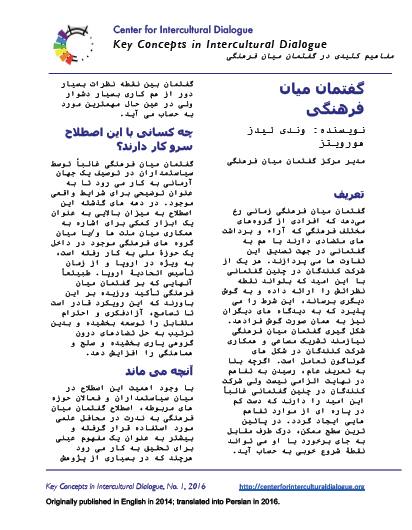
Key Concept #1: Intercultural Dialogue Translated into Persian

Key Concepts in ICDContinuing translations of Key Concepts in Intercultural Dialogue, today I am posting KC#1: Intercultural Dialogue, which I published in English in 2014 as the first in the series, and which Ramin Hajianfard has now translated into Persian.

As always, all Key Concepts are available as free PDFs; just click on the thumbnail to download. Lists of Key Concepts organized chronologically by publication date and number, alphabetically by concept, and by languages into which they have been translated, are available, as is a page of acknowledgments with the names of all authors, translators, and reviewers.

KC1 Intercultural Dialogue_PersianLeeds-Hurwitz, W. (2016). Intercultural dialogue [Persian]. (R. Hajianfard, trans). Key Concepts in Intercultural Dialogue, 1. Available from:
https://centerforinterculturaldialogue.org/wp-content/uploads/2018/08/kc1-intercultural-dialogue_persian.pdf

If you are interested in translating one of the Key Concepts, please contact me for approval first because dozens are currently in process. As always, if there is a concept you think should be written up as one of the Key Concepts, whether in English or any other language, propose it. If you are new to CID, please provide a brief resume. This opportunity is open to masters students and above, on the assumption that some familiarity with academic conventions generally, and discussion of intercultural dialogue specifically, are useful.

Wendy Leeds-Hurwitz, Director
Center for Intercultural Dialogue


Creative Commons License
This work is licensed under a Creative Commons Attribution-NonCommercial-NoDerivatives 4.0 International License.

CFP SIETAR Europa 2017

SIETAR Europa Congress 2017
Cultural Dexterity for Turbulent Times
May 22nd to 27th, 2017- Dublin, Ireland

This congress welcomes everyone whose life and work puts them at the interface of cultures, from the perspectives of economy, society and education, with the aim of reshaping intercultural discourse, questioning our current cultural paradigms and exploring new thinking to help us navigate complexity in our emerging global world.

With the aim of re-examining our cultural dimensions, understandings and paradigms, we invite submissions that question, critique, explore and refresh our cultural paradigms and theories, and simultaneously share new methods and best practices. We invite those engaged in business, training and research (including independent consultants and educational institutions) shaping the European public sphere, (NGOs, governmental organisations and institutions and private ones as well) as well as media and arts, to participate and share contributions from all disciplines and fields that deal with intercultural topics.

Track 1: Business and Organizational Challenges
Track 2: Sociopolitical Concerns
Track 3: Shaping Intercultural Professions
*Deadlines
Deadline for submission:  31 October 2016
Notice of acceptance:  15 December 2016

IACCM Academic Track:
Deadline for submission:  31 October 2016
Full paper deadline:  15 March 2017

The official SIETAR Europa Congress language is English. Submissions of proposals must be in English.

If you have any other queries, please send them to dublin2017[at]sietareu.org specifying ”QUERY” and your name in the email subject. The Congress Committee will get back to you as soon as possible.

Newcastle U Job Ad, Critical Heritages: Identities in Europe (UK)

Research Associate for Critical Heritages: performing and representing Identities in Europe
Newcastle University – Faculty of Humanities and Social Sciences – Arts & Cultures
Closes: 30th September 2016

Media, Culture, Heritage at Newcastle University wishes to appoint a talented digital heritage research associate to join the international team of the Horizon 2020 – funded project Critical Heritages: performing and representing Identities in Europe (COHERE). The successful applicant will work closely with Dr Areti Galani to explore current institutional and grass-roots digital heritage practices and the use of digital design methodologies in fostering dialogue around European heritage(s) with a variety of stakeholders and/or communities. The post holder will organise fieldwork, contribute to workshops and develop training materials and academic publications.

You will have an excellent scholarship record and wide knowledge of heritage and museum studies, digital heritage theory and practice, literature on national identity and identity construction, and media studies. You will also have strong communication skills and experience in working across disciplines and with a diverse group of people.

The post requires flexible working hours and the ability to travel to other consortium countries in Europe and Turkey.

The post is fixed term for 3 years, at 20% FTE.

For an informal conversation about this post please contact Dr Areti Galani (areti.galani[at]ncl.ac.uk)

U Leicester Job Ad: Media & Communication (UK)

Teaching Fellow in Media and Communication
University of LeicesterMedia and Communication
Closes: 27th September 2016
Fixed term contract for one year.

Our Department of Media and Communication are looking to recruit a Teaching Fellow to join their Department. Media and Communication research has just celebrated its 50th year at Leicester and the department can boast a high level of Research and Teaching Excellence in their field, ranked 8th in the 2016 Complete University Guide.

We are looking for a teaching fellow to contribute to the following areas:
• Journalism Studies
• Public Relations
• Advertising
• Media and Communication

You will also be responsible for scholarship, teaching, and administration and other activities supporting the work of the Department and developing and enhancing its reputation.

Please click here for further information and details about the position

Informal enquiries are welcome and should be made to Professor Helen Wood hw177[at]le.ac.uk.