Quote of the Day: Communication as a Miracle of Translation

Intercultural Dialogue QuotesOccasionally when I read, a quote related to intercultural dialogue strikes me as particularly noteworthy for being insightful, concise, beautifully written, and/or original. One example is provided below. Given the translations I have been publishing, not to mention the state of the world these days, it seems particularly apropos.

“Every act of communication is a miracle of translation.” (p. vii)

• Liu, K. (2016). The paper menagerie and other stories. London: Saga Press.

If you have quotes you would like to see posted, submit them for consideration to intercult.dialogue@[at]gmail.com

Wendy Leeds-Hurwitz, Director
Center for Intercultural Dialogue

CFP European Television and Nations (Romania)

Call for proposals
European television and nations: Between centers and peripheries, 1950-1980
9-10 November 2017, Bucharest, Romania

Since the end of the 2000s, research into television history has
revealed different realities depending on the country (Bignell & Fickers
2008, see also Socialist Television Studies). Far from being limited
to the development of main television (British, German, or French), the
European television landscape seems to have been configured along a
number of dividing lines: the classical divisions (East / West, public
service / commercial TV) overlapped with new dichotomies (North / South (Bourdon 2011), democratic / authoritarian systems (Goddard 2013)).

In order to evaluate the relevance of these taxonomies and to account
for different dynamics which were thus created, our symposium aims at
exploring the less known history of the television referred to here as
peripheral in relation to pre-existing television models (continuing
Wallerstein’s world economy theory, 1974). The symposium is meant to
explore the attraction, imitation and diffusion of practice and content
between central and/or peripheral television. Particular attention will
be given to the period of emergence and development of television
institutions and to the established or presumed relationships between
television operators and national construction.

We are welcoming contributions which will analyze the influence,
convergence or opposition between European television, from different
perspectives:
-television techniques (introduction of color TV, modes of transmission
and recording etc.);
-institutional organization (regulation of relations between political
authorities and public television, recruitment of staff etc.);
-formation or practice of television professionals;
-design of broadcast schedules;
-circulation and possible adaptation of the program formats (fiction or
non-fiction);
-dissemination of national or international content;
-reception of programs by trans-border audiences.

Contributions may also address methodological issues or the problem of
access to television archives, in so far as these issues form the basis
of future research.

Lecturers:
Prof. Jérôme Bourdon, University of Tel Aviv
Géraldine Poels, responsible for scientific development, INA, Paris

The abstracts, in French or English, up to 250 words, are to be sent to
the following e-mail addresses: anne.roekens@unamur.be, romina.surugiu@fjsc.ro, amatei25@yahoo.com, by 10 April 2017. The languages of the symposium will be French and English.

Participation fee: 50 euros.

Organized by CEREFREA Villa Noël and the Faculty of Journalism and Mass Communication of the University of Bucharest within the trilateral Belgium(Wallonie)-Bulgarian-Romanian project “Television and nations in the European semi-periphery: Establishing a national identity through television (1958-1980)”

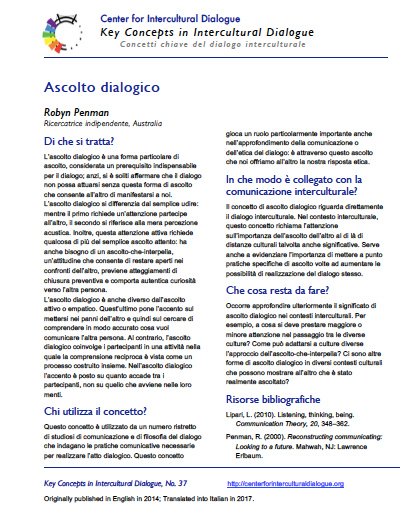
Key Concept #37: Dialogic Listening Translated into Italian

Key Concepts in ICDContinuing translations of Key Concepts in Intercultural Dialogue, today I am posting KC37: Dialogic Listening, which Robyn Penman wrote in English in 2014 and which Maria Flora Mangano has translated into Italian, with the help of Paola Giorgis.

As always, all Key Concepts are available as free PDFs; just click on the thumbnail to download. Lists of Key Concepts organized chronologically by publication date and number, alphabetically by concept, and by languages into which they have been translated, are available, as is a page of acknowledgments with the names of all authors, translators, and reviewers.

KC37 Dialogic Listening_ItalianPenman, R. (2017). Ascolto dialogico. (M. F. Mangano with P. Giorgis, Trans.). Key Concepts in Intercultural Dialogue, 37. Available from: https://centerforinterculturaldialogue.org/wp-content/uploads/2017/03/kc37-dialogic-listening_italian.pdf

If you are interested in translating one of the Key Concepts, please contact me for approval first because dozens are currently in process. As always, if there is a concept you think should be written up as one of the Key Concepts, whether in English or any other language, propose it. If you are new to CID, please provide a brief resume. This opportunity is open to masters students and above, on the assumption that some familiarity with academic conventions generally, and discussion of intercultural dialogue specifically, are useful.

Wendy Leeds-Hurwitz, Director
Center for Intercultural Dialogue


Creative Commons License
This work is licensed under a Creative Commons Attribution-NonCommercial-NoDerivatives 4.0 International License.

Arab Master in Democracy and Human Rights (Lebanon)

Graduate StudyThe Arab Master in Democracy and Human Rights is a unique programme designed to meet the needs of students, professionals and experts who want to deepen their knowledge and develop their skills in the field of democratic governance and human rights in the Middle East and North Africa. It is part of the Global Campus of Regional masters in Human Rights and Democracy supported by the European Union.

Our aim is to support the next generation of experts, academics and practitioners and to give them the practical experience needed for building up their professional career and academic activities.

The Arab Master in Democracy and Human Rights is supported by a growing network of partner universities from the region and beyond. The partnership is composed of the following academic institutions:

  • Saint Joseph University (Lebanon) as the coordinating University (Lebanon),
  • Birzeit University (Palestine),
  • International University of Rabat (Morocco),
  • University of Carthage (Tunisia)

The University of Jordan (Jordan) and the University of Cairo (Egypt) are currently in the process of joining ARMA.

EWHA-KACA Research Award

EWHA-KACA RESEARCH AWARD

Ewha Womans University, Division of Communication and Media (EWHA) and The Korean American Communication Association (KACA) jointly award outstanding research proposals focusing on Korea-related communication and/or media studies. A total of $3,500 will be awarded to the winning recipient(s). Ideally, one or two faculty-led projects (faculty as a PI) will be competitively selected to receive up to $3,500. The half of the award will be distributed at the beginning of the award cycle (August 2017) and the remaining half will be distributed at the completion of the study within two years (August 2019). The research findings should be presented at one of the KACA research sessions at NCA, ICA, or AEJMC in 2018 or 2019.

All material must be submitted electronically to the Award Committee Chair, Dr. Joonghwa Lee, by April 15, 2017 at 11:59pm EST.

RESEARCH TOPIC

Any topic that advances Korea-related communication and/or media research is eligible for the award. Proposals must emphasize contributions to relevant research streams and the Korean society in general. All methods, whether qualitative or quantitative, are welcomed.

ELIGIBILITY

Any full-time faculty member who is currently teaching, researching or studying communication or media in North America, Korea, or elsewhere is eligible to apply. To be considered for the award, the PI should be a KACA member as of April 15, 2017. In other words, an applicant should be a KACA member at the time of a proposal submission. Members of the KACA Executive Committee (2015-2017) are not eligible to apply. NOTE: EACH SUBMITTER/AUTHOR IS LIMITED TO ONE PROPOSAL.

Ariane de Rothschild Fellowships 2017

Ariane de Rothschild Fellowship 2017
Call for Applications

The AdR Fellowship represents a unique experience for entrepreneurs, social innovators and those who practice doing business while at the same time doing good, particularly (but not exclusively) from a Jewish and Muslim cultural background, who demonstrate a proven commitment towards inclusion and forging bridges to other communities while at the same time strengthening the sustainability of their organization/ enterprise or business. This is an amazing opportunity to spend one week at Windsor Castle’s, St. George’s House in the UK to network and work on your project with other entrepreneurs, all expenses paid from July 21st to July 29th 2017.

Deadline for applications: Sunday, April 16th 2017 (midnight EST New York)

GHI West Fellowship: History of Migration (California)

PostdocsBinational Visiting Fellow Tandem Program in the History of Migration at GHI WEST in Berkeley

The German Historical Institute (GHI) is seeking applications for a Binational Visiting Fellow Tandem. The Fellowship program contributes to the creation of the new research network “Knowledge in Transit – Migrant’s Knowledge in Comparative Perspective” at the GHI’s branch office GHI WEST at the University of California, Berkeley.

A member institution of the Max Weber Foundation, the German Historical Institute Washington is a distinguished non-university affiliated historical research institute, conducting inter- and transdisciplinary research with a transatlantic focus. GHI WEST, which is located at UC Berkeley’s Institute of European Studies, will organize a series of programs and scholarly events aimed at facilitating cooperation and dialogue among North American and Germany researchers in the humanities and social sciences. GHI West’s research programs will focus on knowledge and migration in a broadly comparative perspective, addressing the experiences of many different migrant groups, transit lands, and receiving countries.

The GHI’s fellowship program promotes cutting-edge research in history and related disciplines and international exchange of scholars. For this purpose, the GHI in cooperation with the Institute of European Studies at UC Berkeley is now offering German and North American postdoctoral scholars the opportunity to develop a binational research tandem which links up two academics – one from Germany and one from North America – working on research in the field of history of migration. The projects should contain productive areas of overlap with the tandem partner either in their topics or in their conceptual frameworks. The new visiting fellow tandem program at GHI WEST presents an excellent opportunity for scholars from Germany and North America to develop their expertise by collaborating closely, to work with additional resources and to make connections with others in their fields. It is funded by the VolkswagenStiftung, one of Germany’s most important non-profit foundations.

The program is designed for postdoctoral historians from Germany and North America in the fields of history of migration preferably with an interest in the history of knowledge, and with an outstanding academic record. For German applicants, a good working knowledge of English is essential. In order to ensure successful collaboration, our preference is for applicants to already have identified their potential tandem partner. The GHI would also support candidates in finding potential Tandem partners. Preference will also be given to candidates doing original research for a new book project.

Starting in September 2017, the successful applicants will be in residence at GHI WEST at UC Berkeley for a nine-month fellowship roughly corresponding to the Berkeley academic year. They will be expected to conduct their research and fully participate in the academic life at GHI WEST. Most prominently, they are invited to participate in the annual Bucerius Lecture “Histories of Migration: Transatlantic and Global Perspectives” and the attached Young Scholars Forum. Further, in collaboration with the permanent staff at GHI WEST, they will organize an exploration workshop for the currently developing research network “Knowledge in Transit”.

As affiliated researchers at GHI WEST, the fellows will have access to the UC Berkeley academic and social facilities (library, databases, email address, office space at the IES, etc.) and are offered the opportunity to make use of further resources in the greater Bay Area – including the Magnes Collection, the Hoover Institution Library and Archives in Stanford or the National Archives/ Pacific Region in San Bruno – while pursuing their research agendas.

Funding will be provided for a 9-month stay at GHI WEST/ UC Berkeley. The monthly stipend will be 3,500 Euro per month (or the equivalent in USD). In addition, fellowship recipients will receive reimbursement for their round-trip economy airfare. The GHI regrets that it is unable to provide accommodation for its fellows.

The deadline for applications is April 1, 2017. To apply, please send a cover letter, a CV, a copy of the certificate of your most recently achieved qualification, a research project proposal (5 pages or 2,000 words max), and the names and contact details of two referees. While applicants may write in either English or German, we recommend that they use the language in which they are most proficient. We can accept applications in electronic form only. Please submit your documents in a single PDF file to: fellowships@ghi-dc.org

All candidates will be notified in early May 2017 of the result of their application. For more information, please contact: Bryan Hart (hart@ghi-dc.org).


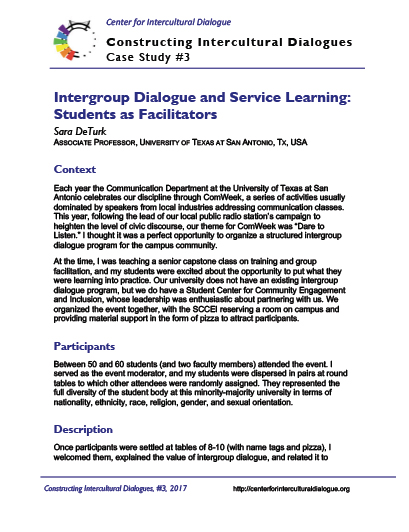
Constructing Intercultural Dialogues #3: Intergroup Dialogue & Service Learning

Constructing ICDFollowing the recent announcement of a new series to be published by the Center for Intercultural Dialogue, the third issue of Constructing intercultural Dialogues is now available. Here is “Intergroup Dialogue and Service Learning: Students as Facilitators” by Sara DeTurk.

As a reminder, the goal of this series is to provide concrete examples of how actual people have managed to organize and hold intercultural dialogues, so that others may be inspired to do the same. As with Key Concepts in Intercultural Dialogue, these may be downloaded for free. Click on the thumbnail to download the PDF.

CICD 3 deTurkdeTurk, S. (2017). Intergroup dialogue and service learning: Students as facilitators. Constructing Intercultural Dialogues, 3. Available from: https://centerforinterculturaldialogue.org/wp-content/uploads/2017/03/constructing-icd-3-deturk.pdf

If you have a case study you would like to share, send an email to the series editor, Wendy Leeds-Hurwitz.


Creative Commons License
This work is licensed under a Creative Commons Attribution-NonCommercial-NoDerivatives 4.0 International License.

Sociolinguistics Summer School 2017 (Spain)

Sociolinguistics Summer School 8
July 4-7, 2017
Barcelona, Spain

Sociolinguistics Summer School is an annual international meeting point organised by and directed to MA and PhD students and early career researchers. SSS provides them a great opportunity to both attend plenary lectures and workshops conducted by leading researchers in the field and to present and discuss their own findings with fellow ECR’s.

Traditionally organised in England, Scotland and Ireland, the 7th edition of SSS disembarked for the first time on the continent to take place in Lyon in 2016. For 2017, the IdentiCat research group of the Universitat Oberta de Catalunya (UOC) offered to host SSS8 in Barcelona as part of the activities of the ISCH COST Action IS1306 New Speakers in a Multilingual Europe. Newspeakerness in relation to globalisation, management of multilingualism, and social identity will be the core theme of the SSS8, although presentations about all the current trends in sociolinguistics will be welcomed.

New deadline: 27 March 2017

St. Mary’s U Job Ad: Communication (UK)

Reader in Communication
St Mary’s University, Twickenham – School of Arts and Humanities
Closes: 22nd March 2017

This is an exciting opportunity to join the University’s multidisciplinary School of Arts and Humanities at a key moment in its development. The School currently offers excellent programmes in creative arts and humanities including BAs in Acting, Screen and Film Media, History, and Creative and Professional Writing, as well as innovative postgraduate courses in Sports Journalism, Public History, Theatre Directing, and Human Trafficking.

The School is now embarking on a new phase of curriculum and research development in several areas including Communication. The person appointed will join the Communication team and contribute to the production of cutting edge research and scholarship which will underpin excellent teaching and engage effectively with the public square including industry and international audiences.

We invite applications from outstanding candidates whose research and teaching experience lie in the general field of Communication and may relate, more specifically, to areas such as strategic communication, public relations, content strategy, public or political communication, and reputation management.

You will have experience of managing projects in an HE environment and will have the enthusiasm and creative energy necessary to contribute to the development of the Communication teaching portfolio and research profile. You will have a strong publishing record, excellent student-centred teaching experience, outstanding research and industry networks, and a commitment to developing students’ creative, entrepreneurial, and ethical capacities.

Since 1850, St Mary’s mission has been to provide a high quality academic and professional environment, inspired by its distinctive ethos and values. The University is an inclusive academic community where everybody is welcomed.

At St Mary’s you will not just be choosing a place of work but an inspiring and welcoming community where you will nurture and educate students to be ready to meet the challenges of today and anticipate those of tomorrow. We place a particular emphasis on character and life skills development in the student experience.