KC84: Double Intercultural Dialogue by María José Coperías-Aguilar

Key Concepts in ICDThe next issue of Key Concepts in intercultural Dialogue is now available. This is KC#84: Double Intercultural Dialogue, by María José Coperías-Aguilar. Click on the thumbnail to download the PDF. Lists organized chronologically by publication date and numberalphabetically by concept in English, and by languages into which they have been translated, are available, as is a page of acknowledgments with the names of all authors, translators, and reviewers.
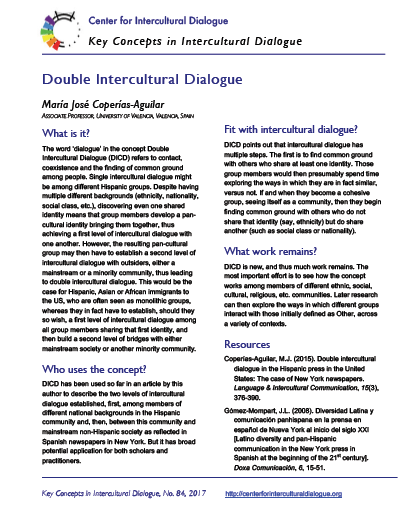
KC84 Double ICDCoperías-Aguilar, M. J. (2017). Double intercultural dialogue. Key Concepts in Intercultural Dialogue, 84. Available from:
https://centerforinterculturaldialogue.org/wp-content/uploads/2017/10/kc84-double-icd.pdf

The Center for Intercultural Dialogue publishes a series of short briefs describing Key Concepts in Intercultural Dialogue. Different people, working in different countries and disciplines, use different vocabulary to describe their interests, yet these terms overlap. Our goal is to provide some of the assumptions and history attached to each concept for those unfamiliar with it. As there are other concepts you would like to see included, send an email to the series editor, Wendy Leeds-Hurwitz. If there are concepts you would like to prepare, provide a brief explanation of why you think the concept is central to the study of intercultural dialogue, and why you are the obvious person to write up that concept.


Creative Commons License
This work is licensed under a Creative Commons Attribution-NonCommercial-NoDerivatives 4.0 International License.


Canterbury Christ Church U Job: Politics & International Relations (New Zealand)

Job adsLecturer in Politics and International RelationsCanterbury Christ Church University – School of Psychology, Politics and Sociology. Closes: October 26, 2017.

The role is focused on key aspects of the delivery of the foundation, undergraduate and post graduate levels of the curriculum, with specific reference to international relations and contemporary security studies. The successful applicant will also be expected to contribute to strong research record of Politics and International Relations team, and use their research to inform their teaching practice.

Applicants should have a doctorate in International Relations or Politics, with experience of teaching in the university sector and a strong emerging record of research and publications. The ability to teach international relations and contemporary security studies will be crucial to the post, thought the successful applicant will need to be sufficiently flexible to deliver other aspects of the curriculum as required.

Newcastle U Job: Professional Intercultural Communicative Competence

Job adsResearch Assistant/Associate in Professional Intercultural Communicative Competence for Refugee Professionals – B89444R. The post will be based in the Applied Linguistics and Communication section of the School of Education, Communication and Language Sciences at Newcastle University. Closes: 30th October 2017

You will play a central role in the success of an Erasmus+ Higher Education project on developing professional intercultural communication competence among refugees. You will contribute to research design, data collection and analysis, and liaison with project partners and participants in the UK, Austria and the Netherlands, including refugees and language teachers working with them. You will also contribute to project administration and management, under the supervision of the project Principal Investigator, and to the writing of project materials and research reports and peer-reviewed publications, as well as to dissemination of the project at seminars and conferences.

For this role we are seeking an experienced and professional researcher who will be a subject specialist in the area of education and intercultural communication.  You will also have a good knowledge of mixed methods research approaches.

A good Master’s degree in a relevant discipline (education, applied linguistics, languages) is essential, as is good knowledge of the fields of intercultural communication and language pedagogy. A PhD or equivalent significant relevant experience (either completed or close to completion) in a relevant discipline (for example, education, applied linguistics, modern languages, technology) is desirable.

You will be expected to take significant initiative in their work and to work closely with the Principal Investigator over the details of the project. You will also contribute, where practical, to teaching and teacher training related to professional intercultural communication competence.

The post is fixed term to 31.8.2019, and will be part-time at 40% FTE.

Click here for further details.


Pontifical Catholic U Job: International Relations (Chile)

Job adsAssistant or Associate Professor in International RelationsPontifical Catholic University of Chile – The Institute of Political Science, Closes: November 1, 2017

The Institute of Political Science (ICP) of the Pontificia Universidad Católica de Chile invites applications for a full-time tenure-track position (Assistant or Associate Professor) in International Relations. The University strongly values diversity and we encourage members of all nationalities and backgrounds to apply.

The ICP is among the highest ranked political science departments in Latin America.  Comprised of a highly international group of scholars, it is a hub of theoretical, empirical and applied research in the region. The ICP offers undergraduate, M.A. and Ph.D. programs. It admits the most talented Chilean students to its undergraduate and graduate programs, and hosts a large number of exchange students and a steady stream of visiting professors from all over the world.  Santiago is a vibrant metropolitan area and a short drive from Chile’s renowned pacific coast and spectacular Andean mountain range.

Applicants must demonstrate a strong commitment to high quality research, publication and teaching.  Teaching obligations are limited to three courses per year.  Fluency in Spanish is valued, but candidates who express the willingness to perfect basic proficiency are encouraged to apply. The ICP offers financial support for language classes and courses may initially be taught in English.

Utah State U Job Ad: Global Communication

Job adsAssistant Professor in Communication Studies – Global Communication and Rhetoric at Utah State University

The Department of Languages, Philosophy, & Communication Studies at Utah State University invites applications for a tenure-track position: Assistant Professor in Communication Studies. Candidates must have a Doctorate in a Communication-related field completed by August 14, 2018. Candidates should have demonstrated the ability to conduct scholarly research and teach a variety of courses. Candidates must be willing to mentor undergraduate students and will also need to pass a background check, per university policy. Other qualifications include: expertise in and the ability to teach rhetorical methods; specialization in global communication and related issues, such as intercultural conflict, diplomacy, human rights, or international negotiation. Utah State University is located in a mountain valley 80 miles north of Salt Lake City. Applications should be submitted by November 1, 2017 to receive full consideration.

CFP Our (Digital) Humanity

ConferencesOur (Digital) Humanity: Storytelling, Media Organizing, and Social Justice, 20-22 Apr. 2018, Lehigh University.  Deadline for CFP 15 Nov. 2017.

We are calling on scholars, media makers, public historians, artists, designers, technologists, and social justice activists to submit a session proposal for the Our (Digital) Humanity: Storytelling, Media Organizing and Social Justice conference in Bethlehem, Pennsylvania  April 20-22, 2018.

Submit your session online by filling out this form.  The deadline is November 15, 2017.

Sessions may be proposed under one of the conference’s six tracks.  A track is a series of sessions connected by a shared theme; in this case,

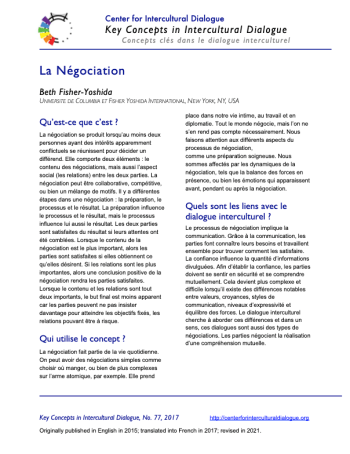
KC77: Negotiation Translated into French

Key Concepts in ICDContinuing translations of Key Concepts in Intercultural Dialogue, today I am posting KC#77: Negotiation, which Beth Fisher-Yoshida wrote for publication in English in 2016, and which Colin Olphand has now translated into French.

As always, all Key Concepts are available as free PDFs; just click on the thumbnail to download. Lists of Key Concepts organized chronologically by publication date and number, alphabetically by concept, and by languages into which they have been translated, are available, as is a page of acknowledgments with the names of all authors, translators, and reviewers.

KC77 Negotiation_French_v2Fisher-Yoshida, B. (2017). La négotiation. (C. Olphand, trans). Key Concepts in Intercultural Dialogue, 77. Available from:
https://centerforinterculturaldialogue.org/wp-content/uploads/2021/05/kc77-negotiation_french_v2.pdf

If you are interested in translating one of the Key Concepts, please contact me for approval first because dozens are currently in process. As always, if there is a concept you think should be written up as one of the Key Concepts, whether in English or any other language, propose it. If you are new to CID, please provide a brief resume. This opportunity is open to masters students and above, on the assumption that some familiarity with academic conventions generally, and discussion of intercultural dialogue specifically, are useful.

Wendy Leeds-Hurwitz, Director
Center for Intercultural Dialogue


Creative Commons License
This work is licensed under a Creative Commons Attribution-NonCommercial-NoDerivatives 4.0 International License.
CFP Language & Borders Conference (UK)

ConferencesLANGUAGE AND BORDERS: RETHINKING MOBILITY, MIGRATION AND SPACE, UNIVERSITY OF BRISTOL (UK) 26 MARCH – 27 MARCH 2018
Deadline for abstracts: 14 November 2017

The widespread movement of people and their linguistic repertoires has contributed to growing pressure on the model of the nation-state and related notions of linguistically and culturally homogeneous societies. Supposed homogeneity of communities is contingent on the notion of the border as a device of containment. However, in light of increased population movement, recent multidisciplinary approaches seek to capture the complex qualities of the border as both a locus of mobility (a line to be crossed – a bridge) and a site of enclosure (an untraversable barrier – a wall). So what are borders, how are they constructed and how do they impact our lived experience? Additionally, how can sociolinguistic and cognate research enhance our understanding of the interface between language and borders?

In this context, it has become increasingly urgent to reconsider how ‘migration’ is theoretically conceptualized, especially because ‘migration’ itself has become a salient object of contemporary discourse. This objectification and frequent vilification of migration potentially casts a shadow on the complex and diverse forms of (im)mobility that social actors experience, be it in relation to their own (im)mobility or that of others. Discussion of the roles of borders, mobility and migration in sociolinguistic research encourages us to reflect on the broader concept of space, and on its role in the formation and perpetuation of language ideologies. At this conference, we aim to address a number of questions, including:

– What constitutes a border for sociolinguistic researchers? What linguistic practices do borderlanders engage in?
– As sociolinguists, what can we learn from multidisciplinary approaches to border studies? What insights can be drawn from advances in geography, sociology, history, anthropology, politics and cultural studies?
– How do different sociolinguistic methodological frameworks (qualitative, quantitative, mixed) address borderland scenarios.

Confirmed Keynote Speakers: Brigitta Busch (University of Vienna), Carmen Llamas (University of York), Clare Mar-Molinero (University of Southampton).

This conference invites contributions from researchers in a range of disciplinary backgrounds, whose work focuses on the role of language in relation to borders, mobility, migration, and/or space. The conference has been generously supported by the British Academy’s ’Tackling the UK’s International Challenges’ initiative, as part of an ongoing project by Dr James Hawkey (Bristol) and Dr Kristine Horner (Sheffield).

Continue reading “CFP Language & Borders Conference (UK)”

María José Coperías-Aguilar Profile

ProfilesMaría José Coperías-Aguilar is a professor at the University of Valencia, where she teaches in the Department of English and German Philology.

MJ Coperías-Aguilar

She has a PhD in English Literature. Her main teaching areas are literature, cultural studies and English for specific purposes, especially for the media. She has participated in many international conferences and published widely on several fields of English studies both in books and journals. Her main areas of research are cultural studies, intercultural communicative competence, the media, and literature by women. She is a member, and the current Secretary, of the International Association for Languages and Intercultural Communication (IALIC).

Selected publications:

Coperías-Aguilar, M.J. & Gómez-Mompart, J.Ll. (2019). Hispanic cultural identity in US Spanish-Language newspapers. In R. A. Lind (Ed.), Race / gender / class / media: Considering diversity across audiences, content, and producers (pp. 109-114). New York, Routledge.

Coperías-Aguilar, M.J. (2019). Diversity and second language acquisition in the university classroom: A multilingual and multicultural setting. In A. Gras-Velázquez (Ed.), Project-based learning in second language acquisition: Building communities of practice in higher education (pp. 9-24). New York,  Routledge.

Coperías-Aguilar, M.J. (2015). Double intercultural dialogue in the Hispanic press in the United States: the case of New York newspapers. Language & Intercultural Communication, 15(3), 376-390.

Gómez-Mompart, J.L. & Coperías-Aguilar, M.J. (2014). Importancia de la prensa hispana. La victoria de Obama en los periódicos en español estadounidenses [The importance of the Hispanic press. The victory of Obama in newspapers in Spanish in the United States]. Comunicación y Sociedad / Communication and Society, 27(2), 101-124.

Coperías-Aguilar, M.J. (2010). Intercultural Communicative Competence as a Tool for Autonomous Learning. Revista de Estudios Canarios, 61, 87-98

Coperías-Aguilar, M.J. (2009). Intercultural Communicative Competence in the Context of the European Higher Education Area. Language & Intercultural Communication, 9(4), 242-255.

Coperías-Aguilar, M.J. (2007). Dealing with Intercultural Communicative Competence in the Foreign Language Classroom. In Alcón, E. & Safont, P. (eds.), Intercultural Language Use and Language Learning, Dordrecht, Springer, 59-78.

Coperías-Aguilar, M.J. (2002). Intercultural Communicative Competence: A Step beyond Communicative Competence. ELIA. Estudios de Lingüística Inglesa Aplicada, 3, 85-102.

Coperías-Aguilar, M.J. (1998). Intercultural (Mis)Communication. The Influence of L1 and C1 on L2 and C2: A Tentative Approach. Cuadernos de Filología Inglesa, 7(1), 99-113.


Work for CID:
María José Coperías-Aguilar wrote KC84: Double Intercultural Dialogue.

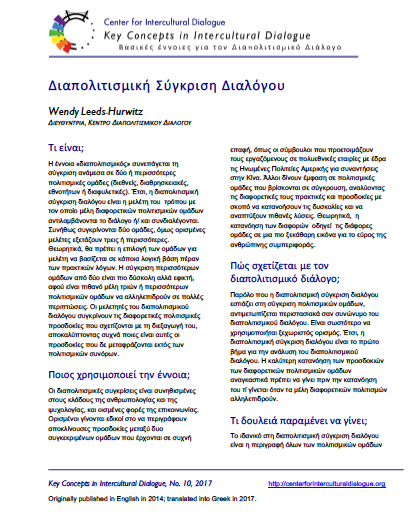
KC10 Cross-Cultural Dialogue Translated into Greek

Key Concepts in ICDContinuing translations of Key Concepts in Intercultural Dialogue, today I am posting KC#10: Cross-Cultural Dialogue, which I wrote for publication in English in 2014, and which Rania Spiridakou has now translated into Greek.

As always, all Key Concepts are available as free PDFs; just click on the thumbnail to download. Lists of Key Concepts organized chronologically by publication date and number, alphabetically by concept, and by languages into which they have been translated, are available, as is a page of acknowledgments with the names of all authors, translators, and reviewers.

KC10 Cross-cultural dialogue_GreekLeeds-Hurwitz, W. (2017). Cross-cultural dialogue [Greek]. (R. Spiridakou, Trans). Key Concepts in Intercultural Dialogue, 10. Available from:
https://centerforinterculturaldialogue.org/wp-content/uploads/2017/09/kc10-cross-cultural-dialogue_greek.pdf

If you are interested in translating one of the Key Concepts, please contact me for approval first because dozens are currently in process. As always, if there is a concept you think should be written up as one of the Key Concepts, whether in English or any other language, propose it. If you are new to CID, please provide a brief resume. This opportunity is open to masters students and above, on the assumption that some familiarity with academic conventions generally, and discussion of intercultural dialogue specifically, are useful.

Wendy Leeds-Hurwitz, Director
Center for Intercultural Dialogue


Creative Commons License
This work is licensed under a Creative Commons Attribution-NonCommercial-NoDerivatives 4.0 International License.