KC87: Culture Shock

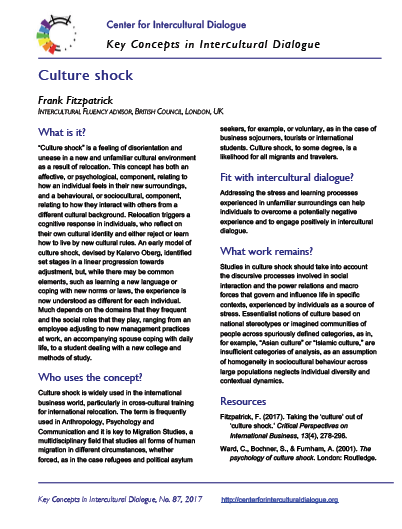
Key Concepts in ICDThe next issue of Key Concepts in intercultural Dialogue is now available. This is KC#87: Culture Shock, by Frank Fitzpatrick. Click on the thumbnail to download the PDF. Lists organized chronologically by publication date and numberalphabetically by concept in English, and by languages into which they have been translated, are available, as is a page of acknowledgments with the names of all authors, translators, and reviewers.

KC87 Culture shockFitzpatrick, F. (2017). Culture shock. Key Concepts in Intercultural Dialogue, 87. Available from:
https://centerforinterculturaldialogue.org/wp-content/uploads/2017/11/kc87-culture-shock1.pdf

The Center for Intercultural Dialogue publishes a series of short briefs describing Key Concepts in Intercultural Dialogue. Different people, working in different countries and disciplines, use different vocabulary to describe their interests, yet these terms overlap. Our goal is to provide some of the assumptions and history attached to each concept for those unfamiliar with it. As there are other concepts you would like to see included, send an email to the series editor, Wendy Leeds-Hurwitz. If there are concepts you would like to prepare, provide a brief explanation of why you think the concept is central to the study of intercultural dialogue, and why you are the obvious person to write up that concept.


Creative Commons License
This work is licensed under a Creative Commons Attribution-NonCommercial-NoDerivatives 4.0 International License.

Northwestern U Postdocs: Global Studies

PostdocsThe Buffett Institute for Global Studies at Northwestern University invites applications for two-year postdoctoral fellowships in the study of global, comparative, or international affairs. Up to three fellows will be selected. Applications are welcome from scholars from any range of social science or interdisciplinary perspectives whose research addresses global, international, or transnational social processes, problems, governance, or conflicts. Fellowships will run from September 1, 2018 to August 31, 2020.

The salary is $55,000. In addition, fellows are eligible for $5,000 per year to fund research and conference travel and up to $2,000 in reimbursement for allowable relocation expenses in the first year. This is a full-time, benefits-eligible position.

Applicants must have received their PhD between December 14, 2015, and August 31, 2018. Application deadline is December 15, 2017, at 5 p.m. (CT).

Intercultural Communication MOOC

Job adsSteve Kulich, at Shanghai International Studies University, just sent the following invitation to CID followers:

Join us in the ongoing “Intercultural Communication” MOOC (on FutureLearn by Shanghai International Studies University, SISU, China).

If you’ve not yet checked out the SISU-FutureLearn Intercultural Communication Course, the 5th run is still open! This 5-week course started in mid-October, but new learners from many countries and regions are joining in the social learning! The course highlights different ways we (1) understand intercultural contexts and introduce ourselves, (2) construct our identities, (3) express communication styles preferences or (3) diverse value orientations, and (5) find ways to cope or adapt. Click on the link to enroll now (and invite your colleagues or students) for 5 additional weeks to  learn and interact with this global learning community.

U New England Job: International Relations (Australia)

Job adsLecturer in International RelationsUniversity of New England, Australia – School of Humanities. Deadline: 1 January 2018

The University of New England in Armidale, Australia is a unique university, in the enviable position of boasting an excellent international reputation as well as being a leader in research and academic innovation.  We aim to foster a constructive and engaged culture where creative ideas and innovation thrive. 

The School of Humanities offers an exciting and challenging academic program covering the disciplines of Political & International Studies, Classics & Ancient History, Archaeology, History, Indigenous Studies, Peace Studies, and Philosophy & Religious Studies. Established in the early 1970s, Politics has a long and well-established tradition of high-quality teaching and internationally recognised research. Currently the School is seeking a dynamic academic for the role of Lecturer in International Relations with focus on Asian politics. 


KC62 Diaspora Translated into Vietnamese

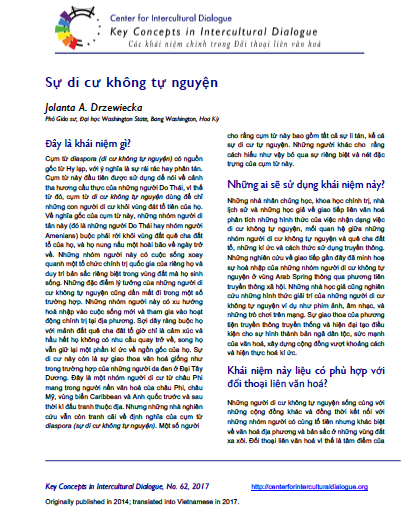
Key Concepts in ICDContinuing translations of Key Concepts in Intercultural Dialogue, today I am posting KC#62: Diaspora, which Jolanta A. Drzewiecka published in English in 2015, and which Khanh Bui has now translated into Vietnamese.

As always, all Key Concepts are available as free PDFs; just click on the thumbnail to download. Lists of Key Concepts organized chronologically by publication date and number, alphabetically by concept, and by languages into which they have been translated, are available, as is a page of acknowledgments with the names of all authors, translators, and reviewers.

KC62 Diaspora_VietnameseDrzewiecka, J. A. (2017). Diaspora [Vietnamese]. (K. Bui, trans). Key Concepts in Intercultural Dialogue, 62. Available from:
https://centerforinterculturaldialogue.org/wp-content/uploads/2017/10/kc62-diaspora_vietnamese.pdf

If you are interested in translating one of the Key Concepts, please contact me for approval first because dozens are currently in process. As always, if there is a concept you think should be written up as one of the Key Concepts, whether in English or any other language, propose it. If you are new to CID, please provide a brief resume. This opportunity is open to masters students and above, on the assumption that some familiarity with academic conventions generally, and discussion of intercultural dialogue specifically, are useful.

Wendy Leeds-Hurwitz, Director
Center for Intercultural Dialogue


Creative Commons License
This work is licensed under a Creative Commons Attribution-NonCommercial-NoDerivatives 4.0 International License.

Agence ITER: Professional Development in International Organizations (France)

Events9th Intercultural Seminar of the Agence ITER France: Professional Development in International Organizations, to be held Thursday, 30 November 2017

This event is hosted by the Institute for American Universities, 2 bis rue du Bon Pasteur, Aix en Provence, France.

PROGRAM

Introduction by Shawn Simpson, Training Project Manager, Agence ITER France: Cultural Quotients and Training

Workshop 1: Frédérique CHOPIN, Aix Marseille University: Professional Training as part of Corporate Social Responsibility

Workshop 2: Dorottya MARKI, Airbus Helicopters: Highly Technical Training in Intercultural Situations

Workshop 3: Yves Daumas, IBM Marketing and Sales: Sulitest in Professional Development – International Trend in Corporate Social Responsibility Awareness/Capabilities/Literacy for Leaders

Workshop 4: Hans-Henrich Altfeld, PhD, Head of Project Control Office, ITER Organization: Learning Academies in Organizations

KC5 Intercultural Communication Translated into Greek

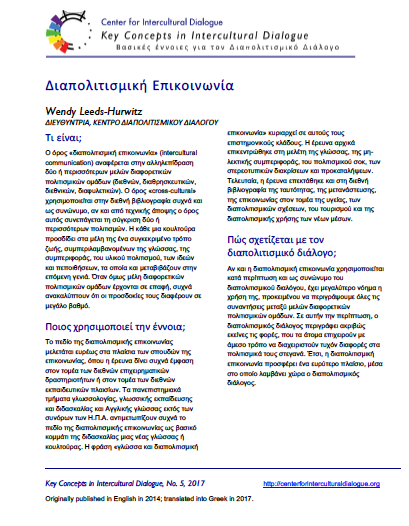
Key Concepts in ICDContinuing translations of Key Concepts in Intercultural Dialogue, today I am posting KC#5: Intercultural Communication, which I published in English in 2014, and which Evelyn Vovou has now translated into Greek.

As always, all Key Concepts are available as free PDFs; just click on the thumbnail to download. Lists of Key Concepts organized chronologically by publication date and number, alphabetically by concept, and by languages into which they have been translated, are available, as is a page of acknowledgments with the names of all authors, translators, and reviewers.

KC5 Intercultural Communication_GreekLeeds-Hurwitz, W. (2017). Intercultural communication [Greek]. (E. Vovou, trans). Key Concepts in Intercultural Dialogue, 5. Available from:
https://centerforinterculturaldialogue.org/wp-content/uploads/2017/11/kc5-intercultural-communication_greek.pdf

If you are interested in translating one of the Key Concepts, please contact me for approval first because dozens are currently in process. As always, if there is a concept you think should be written up as one of the Key Concepts, whether in English or any other language, propose it. If you are new to CID, please provide a brief resume. This opportunity is open to masters students and above, on the assumption that some familiarity with academic conventions generally, and discussion of intercultural dialogue specifically, are useful.

Wendy Leeds-Hurwitz, Director
Center for Intercultural Dialogue


Creative Commons License
This work is licensed under a Creative Commons Attribution-NonCommercial-NoDerivatives 4.0 International License.

Khanh Bui Profile

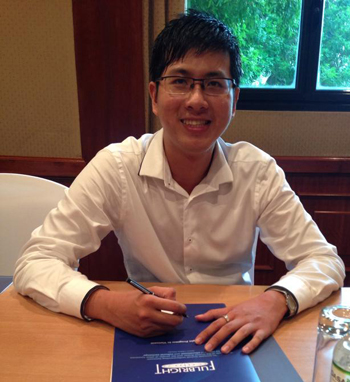
ProfilesKhanh Bui is currently a PhD student in Department of Language and Literacy Education at the University of Georgia, Athens, Georgia, majoring in TESOL and World Language Education. He is also a teacher educator working with K-12 pre-service teachers in a course entitled “Language and Culture in the classroom”.

Khanh Bui

He was granted a Fulbright Foreign Student Exchange Scholarship to get his Master of Education in TESOL at the University of Georgia in 2014 and graduated in 2016. His research interests are content-based language teaching, Systemic Functional Linguistics, and multimodalities in teaching mathematics.

Selected Publications:

Bui, K. (2015). Teachers’ concerns and solutions towards the implementation of digital storytelling in teaching English in ESL classroom in Asian countries. Journal of Journalism and Mass Communication, 5(9), 454-462.

Bui, K. (2014). Review of The book with no pictures. Journal of Language and Literacy Education, 11(1).

Bui, K., Dinh, T., & Kabilan, M. K. (2012). The implementation of ICT training among academic in Vietnamese universities. In M. K. Kabilan, W. K. Too & H. P. Widodo (Eds.), ICT & ELT: Research & Perspectives in South East Asia (pp. 214-228). Malaysia: Penerbit Universiti Sains Malaysia.

Conferences:

Bui, K. (2015). An investigation of pragmatics development during telecollaborative dialoguing between Vietnamese and American students. Paper presented at Language Education and Diversity Conference 2015, Auckland, New Zealand.

Bui, K. (2015). An examination of intercultural development during telecollaborative dialoguing between Vietnamese and American students. Paper presented at ALAA/ALANZ/ALTAANZ Conference, Adeleide, Australia.

Bui, K. (2015). My Fulbright journey. Paper presented at 2nd Fulbright Academic Symposium, Columbia, South Carolina, USA.

Bui, K. (2014). The implementation of project-based learning-An investigation and a case study in Lawrence S. Ting School, Ho Chi Minh City, Vietnam. Paper presented at 6th Engaging with Vietnam Conference, Eugene, Oregon, USA.

Bui, K (2013). An investigation of using Skype in teaching English to Vietnamese students. Paper presented at English Department Conference 2013, Ho Chi Minh City, Vietnam.

Bui, K. (2012). The utilization of ICT among academics in the universities in Vietnam. Paper presented at 4th Engaging with Vietnam Conference, Honolulu, Hawaii, USA.

Bui, K. (2012). Re-designing Speaking Activities in Textbooks for Vietnamese Highschool Students. Paper presented at CamTESOL (Cambodia Teachers of English as a Second Language) Conference, Phnom Penh, Cambodia.

Bui, K (2012). Ứng dụng hình thức dạy tình huống trong giảng dạy (The implementation of task-based language teaching in teaching English to highschool students). Paper presented at Youth Conference 2015, Ho Chi Minh City, Vietnam.

Bui, K. (2011). The implementation of task-based language teaching in teaching speaking for students in Vietnamese high schools. Paper presented at MELTA – Malaysian English Language Teaching Association Conference, Terengganu, Malaysia.


Work for CID:
Khanh Bui translated KC62: Diaspora into Vietnamese, and has served as a reviewer for Vietnamese.

CID Video Competition: What does Intercultural Dialogue Look Like?

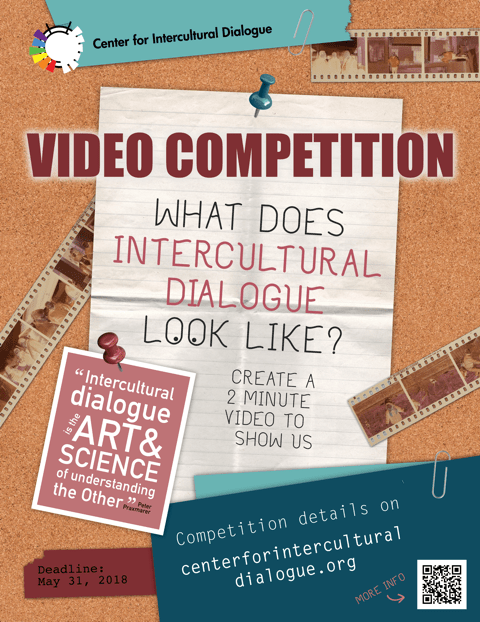
CID Video CompetitionCID has organized its first ever video competition, open to students enrolled in any college or university during the 2017-2018 academic year.

WARNING: Please read the entry rules carefully! Several submissions have not met the requirements, and cannot be considered for a prize until they are revised. Make sure you submit a video file (not audio), that is between 30 seconds and 2 minutes (not 30 minutes!), with the last line “Intercultural dialogue looks like…” and upload it to the server provided (not to YouTube directly). Final deadline is May 31, 2018, at midnight (east coast US time).

NEW Clarification: When someone asks “Intercultural dialogue looks like…” in English, the “…” (read out loud as dot-dot-dot) means your job is to complete the sentence and include your answer as the last shot in the video. (So, “intercultural dialogue looks like a tiger, an ice cream cone, a braid, etc.” – choose whatever image makes sense given your video.) Please do NOT include the literal phrase “Intercultural dialogue looks like…” as the last shot in your video!

CID Video Competition

To enter, participants must submit a video no longer than 2 minutes that highlights the importance of intercultural dialogue, responding to the question: “What does intercultural dialogue look like?”

Entries will be accepted April 15-May 31, 2018.

One winner will receive a $200 prize. The top entries will be posted to the CID YouTube channel, and be highlighted on the CID website, along with posts describing the creators and highlighting each of their videos, throughout the rest of 2018.

Submissions will be evaluated based on originality, clarity, cultural message, effective use of technology, and overall impact. Feel free to work independently or in groups. Get creative, show off your skills and, most importantly, have fun!

To submit an entry, click here.

Video Competition FAQ

Competition Rules

Continue reading “CID Video Competition: What does Intercultural Dialogue Look Like?”