Relationship as a Space “In Between”

Resources in ICD“ width=Mangano, M. F. (2018). Relationship as a space “in between”: A transcultural and transdisciplinary approach mediated by dialogue in academic teaching. Bergamo, Italy: University of Bergamo Press.

What is special and uncommon about Maria Flora Mangano’s research is her clear focus on dialogue as a space of relationship. Often intercultural dialogue has been viewed as occurring at the global, international level, typically involving politicians. Maria Flora is one of a very few scholars to become interested in how intercultural dialogues occur within face-to-face interactions, thus at a more personal level. Dialogue more easily develops among those who have already succeeded in establishing a relationship, rather than between strangers.

The metaphor of creating a social space in which dialogue can occur is not unique to Maria Flora, but it is uniquely appropriate to her concerns. The data which form the body of the project demonstrate praxis in this case, her actual teaching experience, where she creates a space of relationship in the classroom, permitting dialogue to occur. This should encourage others to follow where she has led, since sufficient details are provided which others can immediately use.

In sum, Maria Flora Mangano not only studies dialogue, she demonstrates it in a way others can easily follow. And her theoretical argument clearly explains why they should do so. As the conclusion suggests: “dialogue needs relationship to be realized, and, at the same time, dialogue creates relationship” (p. xiv). May we all learn to create a space for dialogue in our relationships.

Maria Flora Mangano has frequently been mentioned on this site, contributing a number of publications (Key Concepts in Intercultural Dialogue, 81 on dialogue as a space of relationship, Constructing Intercultural Dialogues, 2 on reconciliation, and CICD 9 on intercultural dialogue as an activity of daily living), translations into Italian (KC1, KC14, KC37KC81, CICD 2), and guest posts (A space of relationship for dialogue among cultures, and Example of dialogue among cultures).

NOTE: This post is a shortened version of my Foreword to this book, appearing on pp. v-vi.
Japan Studies Institute Faculty Fellowship (USA)

“Fellowships“Japan Studies Institute, San Diego State University, CA, June 3-16, 2019. Deadline: February 28, 2019.

The Japan Studies Institute (JSI) offers faculty members without prior experience in Japanese studies to learn from scholars, business leaders, artists and journalists about Japan, both past and present. JSI encourages participants to develop strategies for incorporating Japanese studies into courses on their campuses. The Institute involves intensive seminars, lectures, readings, films, and cultural activities related to Japanese history, culture, literature, government, business, language and education. Previous programs have included topics as diverse as wartime and occupation Japan, social relations and the changing role of women in Japan, Japanese foreign policy and regional relations, classical music, ikebana, calligraphy, survival Japanese, Japanese film in the classroom, and philosophical and religious traditions in Japan. The formal program is complemented by a number of off-campus and evening activities. Institute faculty will include scholars, representatives from the local Japanese community, artists, journalists, and government officials.  Most of the costs of the JSI are covered by a grant from the Japan Studies Institute endowment.

CFP Nonviolence & ICD (UK)

ConferencesCall for papers: Nonviolence and Intercultural Dialogue International Conference, 8-9 June, 2019 – London, UK. Deadline: 1 February 2019.

Organised by London Centre for Interdisciplinary Research, this conference seeks to explore, analyse and discuss the complex concept of nonviolence as a strategy toward peace and progress. It will apply an interdisciplinary approach to various manifestations of nonviolence and will also act as an academic space to explore solutions for creating peace.

Conference presentations will be related, but not limited, to: Theories of nonviolence, History of nonviolence, Nonviolence and religion, Nonviolence and philosophy, Nonviolence and peace studies, Nonviolence and literature, Nonviolence and media, Nonviolence and art, Nonviolence and culture, Nonviolence and activism, Nonviolence and politics, Icons of nonviolence, Teaching nonviolence.

The conference will bring together scholars from different fields including philosophy, religion, sociology, international relations, history, literature, art, peace studies, cultural studies, political studies and others.

KC55 Stereotypes Translated into Greek

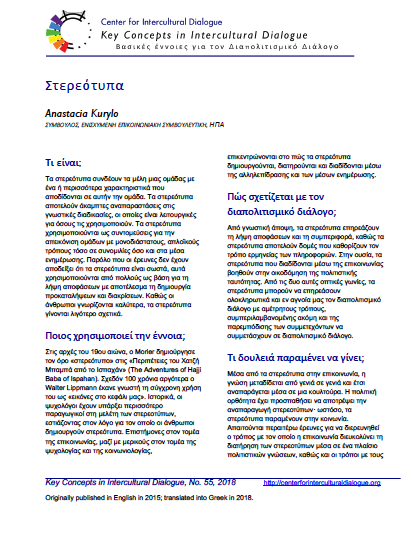
Key Concepts in ICDContinuing translations of Key Concepts in Intercultural Dialogue, today I am posting KC#55: Stereotypes, which Anastacia Kurylo wrote for publication in English in 2015, and which Eleftherios Margaritis and Anastasia Karakitsou have now translated into Greek.

As always, all Key Concepts are available as free PDFs; just click on the thumbnail to download. Lists of Key Concepts organized chronologically by publication date and number, alphabetically by concept, and by languages into which they have been translated, are available, as is a page of acknowledgments with the names of all authors, translators, and reviewers.

KC55 Stereotypes_GreekKurylo, A. (2018). Stereotypes [Greek]. (E. Margaritis & A. Karakitsou, trans). Key Concepts in Intercultural Dialogue, 55. Available from:
https://centerforinterculturaldialogue.org/wp-content/uploads/2018/12/kc55-stereotypes_greek.pdf

If you are interested in translating one of the Key Concepts, please contact me for approval first because dozens are currently in process. As always, if there is a concept you think should be written up as one of the Key Concepts, whether in English or any other language, propose it. If you are new to CID, please provide a brief resume. This opportunity is open to masters students and above, on the assumption that some familiarity with academic conventions generally, and discussion of intercultural dialogue specifically, are useful.

Wendy Leeds-Hurwitz, Director
Center for Intercultural Dialogue


Creative Commons License
This work is licensed under a Creative Commons Attribution-NonCommercial-NoDerivatives 4.0 International License.

U Bern Job Ad: Sociolinguistics (Switzerland)

“JobAssociate Professorship in Sociolinguistic Methods and Analysis, Center for the Study of Language and Society, University of Bern, Switzerland. Deadline: 10 February 2019.

The Institute seeks a scholar who can work and train both quantitatively and qualitatively in the discipline, and impart the strengths of both to his/her students. In their own research, applicants need to work across a range of different empirical approaches and can teach courses which integrate method and hands-on practice as well as theory, including in real-world applications of sociolinguistics.

Relevant subdisciplines include, but should not be seen as limited to: forensic sociolinguistics, socio-pragmatics, ethnography, linguistic anthropology, interactional sociolinguistics, variationist sociolinguistics, perceptual sociolinguistics, linguistic landscapes, applied sociolinguistics, language policy, historical sociolinguistics, critical sociolinguistics, and cognitive sociolinguistics.

Gonzaga U Job Ads: Critical Race & Ethnic Studies (USA)

“Job2 tenure track positions, Critical Race and Ethnic Studies, Gonzaga University, Spokane, WA (USA). Deadline: January 18, 2019.

  1. Associate Professor or Professor / Department Chair.
    The successful candidate will provide expert leadership on the development of a robust critical race and ethnic studies curriculum in conjunction with affiliated departments and programs, support a dedicated CRES tenure-track colleague (also to begin in Fall 2019), teach courses in the program (initially 2 courses over the academic year), and offer faculty development opportunities. We welcome candidates who demonstrate excellence in reflective multicultural and inclusive teaching practices and display a strong commitment to collaboration and interdisciplinarity.

  2. Assistant Professor.
    The successful candidate will work with the inaugural Department Chair (also beginning Fall 2019) on the development of a robust critical race and ethnic studies curriculum in conjunction with affiliated departments and programs, and teach courses in the program. We welcome candidates who demonstrate excellence in reflective multicultural and inclusive teaching practices, and who display a strong commitment to collaboration and interdisciplinarity.

Fiction Celebrates Common Humanity

Applied ICDEmre, M. (1 November 2018).  This library has new books by major authors, but they can’t be read until 2114. New York Times

The Future Library is a work of art that will take an astonishing 100 years to complete:

“In a small clearing in the forests of Nordmarka, one hour outside the city limits of Oslo [Norway], a thousand spruce trees are growing. They will grow for the next 96 years, until 2114, when they will be felled, pulped, pressed and dyed to serve as the paper supply for the Scottish artist Katie Paterson’s Future Library: an anthology of 100 previously unpublished books written by some of the 21st century’s most celebrated writers. There will be one book for every year the trees will have grown, each a donation from a writer chosen by the Future Library’s board of trustees — a gift from the literary gatekeepers of the present to the readers of the future.”

How is this relevant to intercultural dialogue?

“Turkish novelist Elif Shefak [who provided the fourth manuscript in the project]…describes writing a novel for the Future Library as ‘a secular act of faith’ in a world that seems to have gone mad, a world that violently accentuates the differences between people instead of celebrating their common humanity. ‘When you write a book,’ she says, ‘you have the faith that it will reach out to someone else, to someone who is different from you and it will connect us. That you will be able to transcend the boundaries of the self, that was given to you at birth, that you will be able to touch someone else’s reality.'”

Grawemeyer Award for Ideas Improving World Order

AwardsThe Grawemeyer Award for Ideas Improving World Order is given to those who have taken on issues of world importance and presented viewpoints that could lead to a more just and peaceful world. Award: $100,000. Deadline: January 31, 2019.

The Award is presented annually to the winner of a competition designed to stimulate the recognition, dissemination and critical analysis of outstanding proposals for improving world order. Submissions will be judged according to originalityfeasibility and potential impact, not by the cumulative record of the nominee. They may address a wide range of global concerns including foreign policy and its formation; the conduct of international relations or world politics; global economic issues, such as world trade and investment; resolution of regional, ethnic or racial conflicts; the proliferation of destructive technologies; global cooperation on environmental protection or other important issues; international law and organization; any combination or particular aspects of these, or any other suitable idea which could at least incrementally lead to a more just and peaceful world order.

U Sheffield Global Challenge Research Postdoc (UK)

PostdocsGlobal Challenge Research Postdoctoral Fellowships, University of Sheffield, UK. Deadline: 14 January 2019.

“Our Global Challenge Fellowships present the opportunity to work on a truly international project, addressing some of the biggest and most challenging problems of our time, and translating cutting edge research into local impact. As one of our fellows you will embark on either a 12- or 24-month project to address problems faced by those in the Global South. This could be, for example, developing access to secure food, sustainable health and wellbeing, inclusive and quality education, clean sanitation or affordable energy. You will work in collaboration with overseas institutions where you will spend between 25-50% of your time. It will be up to you to design and complete a major research project.”

CFP Cultural Histories Creative Futures UK-China (UK)

ConferencesCall for papers /Cultural Histories, Creative Futures 2019/ July 15-16, 2019, University of Southampton, Winchester, UK. Deadline: 31 January 2019.

The Cultural Histories, Creative Futures conference will bring together scholars from the UK and China to engage with the past, present and future of scholarship in culture, history, and creativity.

The conference will play an important role in the further promotion of a UK-China discussion of culture, history, and creativity. It is a major international conference where scholars from two continents will gather to exchange research, views, and insights. Organized and hosted by Winchester School of Art, the Cultural Histories, Creative Futures conference builds on former conferences held every other year in the UK and China. Previous conferences have taken place in Nanjing, China, and Winchester, UK.

A Joint British – Sino International Conference: Winchester School of Art, University of Southampton, UK and Culture Industry Research Centre, Nanjing University, China. Hosted by Winchester School of Art, University of Southampton, UK. Sponsored by Confucius Institute at University of Southampton.