Merian IAS Africa Fellowships (Ghana)

FellowshipsFellowships, Merian Institute for Advanced Studies in Africa (MIASA), University of Ghana, Ghana. Deadline: 31 March 2020.

MIASA supports different kinds of fellowships:

  • individual fellowships,
  • tandem fellowships with one tandem partner from Germany and the other from West Africa, and
  • Interdisciplinary Fellow Groups.

    From 2021 until 2026, MIASA will grant some 20 fellowships per year in total.

    The Maria Sibylla Merian Institute for Advanced Studies in Africa (MIASA) is dedicated to research in the Humanities and Social Sciences, with ‘Sustainable Governance’ as its central topic. More specific sub-topics under this umbrella prominently include sustainable democracy, sustainable peace and conflict management and environmental transformation as well as migration and displacement, restitution of cultural objects, and human rights research. Overarching aims of MIASA are working towards a reduction of global asymmetries in knowledge production and bridging the cultural divide between anglophone and francophone Africa. MIASA, established in 2018, serves as a hub for exchange, networking and collaboration amongst leading researchers from Germany, Ghana, the African and European continents and beyond. It is located on the beautiful campus of the University of Ghana at Legon (Accra). The Institute offers time and space for supporting innovative academic projects in the Humanities and Social Sciences of top international quality.

Maria Flora Mangano: Space of Relationship as a Space of Distance

Guest PostsSpace of relationship as a space of distance: A new proximity. Guest post by Maria Flora Mangano.

NOTE: Maria Flora Mangano has previously written about dialogue as a space of relationship (2018, 20172014) as long-term followers of this site will remember. She suggested this might be a good time to think about what is now being called “Social distancing” and how it relates to the space of relationship that is required for intercultural dialogue to occur.  

Among the measures for controlling the infection of Coronavirus disease 2019 (COVID-19) is the need to avoid interaction among human beings, and, when that is not possible, to fix a distance of at least one meter, according to the World Health Organisation. In addition to the medical masks, in almost every part of the world, this measure implies a prohibition on shaking hands, or hugging and kissing. The warnings stress the need to interact with others without having any contact, especially of hands and face, the parts of the human body which, more than others, may transmit the infection. These two also are the parts of the body which, more than others, transmit the message, thus play a central role in communication.

During these last few days, the global news media have reported several alternatives to greetings and physical contacts created by many people around the world, involving touching elbows, or feet. Also, people have rediscovered the use of non-touching hand gestures, as with namaste, the Buddhist greeting, where hands are put together, or even blinking, as ways to respect a safe distance, yet still acknowledge another person.

The COVID-19 infection is introducing a new space of relationship among individuals, related to our interpersonal communication. This is affecting everyday life at the moment and will probably have effects in the future on human communication. A “new distance” is arising, which may be added to the original four proposed by the anthropologist Edward Hall in 1966 in The Hidden Dimension. He distinguished four levels of distance in spatial interrelationships among humans, which vary by such factors as culture, education, gender, and status. We might now add what has been popularized as “social distancing”) to the intimate, the personal, the social, and the public spaces proposed by Hall.

Despite Hall’s emphasis on cultural differences, as the new distance is required for global safety reasons, this relationship of distance between individuals is the same all over the world. Therefore, it cannot, and it is not supposed to be, different depending such factors as culture, age, education, gender, or status. What may change is the resilient capacity of human beings to find alternatives, to adapt themselves to (almost) every condition, and to try to find an answer, even when it seems hard, as during this time.

The challenge to us all will be to consider this necessary distance imposed on individuals as an opportunity to rethink the space of relationship as a space of proximity to the Other. Distance, as well as proximity, are terms generally related to a physical space of relationship among humans. What happens when this space is dramatically and unexpectedly avoided or altered, as it imposes another dimension, even a fixed measure of separation among individuals?

The opportunity which this social distancing offers is to consider distance, and consequently proximity, unbound from a physical space of relationship. Distance may become another term for proximity, if we will be able to look at the face of the Other even through a medical mask, and from one meter. We may still be touched by the Other’s call, even without touching her/him with our hands.

If we will be able to overcome a physical space of relationship – in the sense of going beyond it, rather than over it – we might also discover a new sense for proximity. It may sound like a paradox, and probably it is, as the challenges required to the human behaviour which affect our daily life. If we will be able to accept the paradox of distance and proximity as one, we may discover that the safe distance established by social distancing can be overcome, in a way, not because we violate the prohibitions, but as we are able to go beyond ourselves towards the Other.

The Latin term alter literally refers to “the other than two”; social distancing is offering us all the chance to alter our perspective of the Other, every Other than us: close or distant, with a medical mask or without, by touching her/him or without using our hands. This implies the opportunity to modify the distance at which we stand from the Other, in terms of prejudices rather than medical or safety prescriptions. It might be surprising to realise, when the COVID-19 epidemic will eventually end, that we have reduced our mental and heart distance from the Other, in addition to again being able to reduce our physical distance.
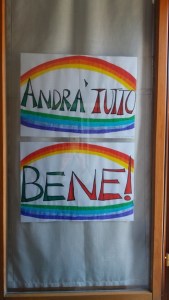
In these new and solitary days, in our creative country [Italy], a spontaneous proposal was born. It was soon shared among the people and became viral (in every sense!): find a way to encourage the others, with messages posted on the windows and the balconies. The sentence proposed was: “Andrà tutto bene,” or “Everything is going to be fine.” The idea was to write on white sheets, drawing the rainbow. It was soon made by children and families. I thought to draw it on paper and I posted the design on my window facing the road.

Download the entire post as a PDF.

CID VIdeo Competition Resources 2020

Job adsThe following resources discussing listening and intercultural dialogue are intended to help to those preparing entries for the CID Video Competition in 2020.

This year’s competition has the theme “listening is how intercultural dialogue starts.” This means students need to demonstrate their understanding of 2 concepts. The first is Listening. Materials published on the CID site that should be useful include:

Key Concepts in Intercultural Dialogue
#37: Dialogic listening

Constructing Intercultural Dialogues
#6: The privilege of listening first

As well as several posts related to listening:
LIST(e)N and The Day of Listening
Call for Papers: International Listening Association
Call for Papers: Special issue of International Journal of Listening on Listening in mediated contexts

The second part is Intercultural Dialogue. CID has produced a number of overlapping explanations, including:

Key Concepts in Intercultural Dialogue
#1:    Intercultural dialogue
#8:   Public dialogue
#10: Cross-cultural dialogue
#14: Dialogue
#81: Dialogue as a space of relationship
#84: Double intercultural dialogue

Constructing Intercultural Dialogues
#9: Intercultural dialogue as an activity of daily living
#11: Creating connection through intercultural dialogue partners

CID Posters
#3: Intercultural dialogue
#6: Dialogue defined
#8: Intercultural competence/intercultural dialogue

If you have further questions, see previously published competition rules, and FAQ. See the reflection by one winning team on creating their video. Or send an email with a question. When you’re ready to submit an entry, click here [URL to be added when the competition opens].

Lewis & Clark U: Overseas & Off-Campus Program (USA)

“JobAssistant Director of Overseas and Off-Campus Programs, Lewis and Clark College, Portland, Oregon, USA. Deadline: Open until filled, posted March 5, 2020.

The Assistant/Associate Director will report to the Director of Overseas and Off-Campus Programs and manage external and internal administrative operations for 40 Lewis & Clark programs, manage physical and mental health concerns, disciplinary issues, and academic accommodations for all students. The Assistant/Associate Director will assist in budget management and office strategic planning, develop program assessment criteria and evaluations for faculty and students, manage all pre-departure orientation and re-entry programming for participants, and promote and implement education abroad opportunities that support and enhance the institutional mission of the College.

Media Inequality & Change Center: Postdoc (USA)

PostdocsPost-Doctoral Researcher for Philadelphia’s Media Ecosystem: Journalism, Community Organizing, and the Narratives and Power Structures that Shape our City, Media, Inequality & Change Center, Philadelphia, PA. Deadline extended: May 1, 2020.

This project will explore the way that community groups across the region harness media and journalism and other tools to build community power. The researcher will focus on understanding the interrelationship between community-oriented media, organizing, and social change. This research will include a network analysis of both community media institutions and local community groups to understand their interconnections, as well as a qualitative examination of the ways media and other tools are harnessed to build within and across communities in the region. This post is full-time and for up to 24 months (part-time applications will also be considered).

The Media, Inequality and Change Center (MIC) is a collaboration between the University of Pennsylvania’s Annenberg School and Rutgers University’s School of Communication and Information. The Center explores the intersections between media, democracy, technology, policy, and social justice. It is committed to studying the political economy of social problems, media, and democracy, while engaging local activist projects, and drawing connections with national and international social movements. 

Cyber-conference on Dispute Resolution (Online)

Conferences
10th Annual International Cyber-conference on Dispute Resolution: Community Engagement and Human Flourishing, April 8, 12-2:30, 2020.

Organizers invite participation in the 10th Annual International Cyber-Conference on Dispute Resolution, Wed. April 8 @ Noon-2:30 pm (US Pacific Coast Time). Please invite students, colleagues, and community members to participate in this international event. For nearly a decade, the Cyber-conference has promoted a global town-hall style dialogue between students, professors, mediators, arbitrators, Indigenous Peacemakers, scholars, lawyers, judges, law-makers, teachers, policy think-tanks, community leaders, and restorative practitioners in both the public and private sector. The conference supports the work of those building safer and healthier communities all over the world.

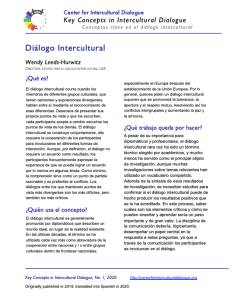
KC1 Intercultural Dialogue Translated into Spanish

Key Concepts in ICDContinuing translations of Key Concepts in Intercultural Dialogue, today I am posting KC#1: Intercultural Dialogue, which I wrote for publication in English in 2014, and which Milton Machuca-Galvez has now translated into Spanish.

As always, all Key Concepts are available as free PDFs; just click on the thumbnail to download. Lists of Key Concepts organized chronologically by publication date and number, alphabetically by concept, and by languages into which they have been translated, are available, as is a page of acknowledgments with the names of all authors, translators, and reviewers.

KC1 Intercultural Dialogue_Spanish

Leeds-Hurwitz, W. (2020). Diálogo Intercultural. (M. Machuca-Galvez, trans). Key Concepts in Intercultural Dialogue, 1. Available from:
https://centerforinterculturaldialogue.org/wp-content/uploads/2020/02/kc1-intercultural-dialogue_spanish.pdf

If you are interested in translating one of the Key Concepts, please contact me for approval first because dozens are currently in process. As always, if there is a concept you think should be written up as one of the Key Concepts, whether in English or any other language, propose it. If you are new to CID, please provide a brief resume. This opportunity is open to masters students and above, on the assumption that some familiarity with academic conventions generally, and discussion of intercultural dialogue specifically, are useful.

Wendy Leeds-Hurwitz, Director
Center for Intercultural Dialogue


Creative Commons License
This work is licensed under a Creative Commons Attribution-NonCommercial-NoDerivatives 4.0 International License.

CFP Intercultural Public Relations

“PublicationCall for Chapter Proposals: Intercultural Public Relations: Realities and Reflections in Practical Contexts. Editors: Lan Ni , University of Houston, Qi Wang, Villanova University,  Bey-Ling Sha, California State University, Fullerton. Extended Deadline: April 30, 2020.

The editors are pleased to invite submissions for chapter proposals for a forthcoming Routledge book, Intercultural Public Relations: Realities and Reflections in Practical Contexts. This book is a continuation from their earlier theory book, Intercultural Public Relations: Theories for Managing Relationships and Conflicts with Strategic Publics.

This “practical contexts” book examines how the overall theoretical framework developed in the theory book can have implications to multiple levels of intercultural public relations practices, from training of practitioners to become more interculturally competent, identifying and understanding publics or stakeholders with different cultural backgrounds and identities, building and maintaining relationships with these publics/stakeholders, and managing conflicts with them. These areas represent the most critical functions that public relations and strategic communication contribute to organizational effectiveness and social change: scanning the environment, identifying strategic publics, and building long-term, quality relationships with these publics to reduce costs, gain support, and empower the publics themselves.

Contact Lan Ni for details.

Milton Machuca-Galvez Profile

Profiles

Milton Machuca-Galvez is International Collections Librarian at the University of Kansas, Lawrence, Kansas, USA.

Milton Machuca-Galvez

He holds a Licenciatura in Psychology from UCA in his native El Salvador and a Ph.D. in Anthropology from Temple University, Philadelphia. He is a freelance translator. He has a 25-year teaching-mentoring-advocacy interdisciplinary career in several U.S. higher education institutions. This experience was built upon his undergraduate studies and his work with indigenous communities in Central America; these experiences led to his anthropology Ph.D. and his work with Latino communities in the U.S. He also has administrative, collaborative and organizational development experience as Director of a study abroad program in Costa Rica and Coordinator of a Latin American and Latino Studies interdisciplinary program. He has served as Humanities Librarian and Visiting Scholar at the University of New Mexico, Visiting Instructor at Rutgers University, Visiting Assistant Professor of Latin American and Latino Studies at Swarthmore College, and he has also taught at Claremont Colleges, in California. For further information, see this excellent recent article about him and his work at Kansas.


Work for CID:
Milton Machuca-Galvez translated KC1: Intercultural Dialogue into Spanish, and has served as a reviewer for Spanish.

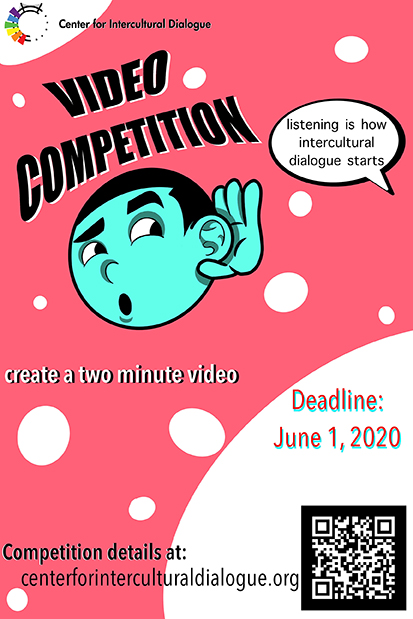
CID Video Competition 2020: Listening is How Intercultural Dialogue Starts

Job adsThe Center for Intercultural Dialogue announces its third annual video competition, open to students enrolled in any college or university during spring 2020. Deadline: June 1, 2020, at midnight (east coast US time). Submissions now open.

CID Video Competition 2020


This year’s competition asks students to focus on listening, as listening is how intercultural dialogue starts.

Listening gives shape to speaking, inviting other people into a dialogue…Our acts of listening, like all communication, are shaped by our cultural and individual differences. – Elizabeth S. Parks

Listening is what happens when people stop focusing on what they say or do, and start attending to what someone else is saying or doing. Without listening, there can be no intercultural dialogue.

Intercultural dialogue is the art and science of understanding the Other. – Peter Praxmarer

Intercultural dialogue can include international, interracial, interethnic, and interfaith interactions, but it is always active (people doing something) rather than passive (people thinking about something).

Faculty members are invited to discuss intercultural dialogue in a class, perhaps showing winning entries from 2018 or 2019, and to suggest that students produce very short videos as their response. Students are encouraged to be creative, show off their knowledge and skills, and have fun with the topic.

The top award winner will receive a $200 prize. And the top three winners will receive a copy of Elizabeth Parks’ 2019 book, The Ethics of Listening: Creating Space for Sustainable Dialogue, courtesy of the publisher, Lexington Books.

All award-winning entries will be posted to the CID YouTube channel, and highlighted on the CID website, LinkedIn group, Facebook group, and Twitter feed, through posts describing the creators and highlighting each of their videos. Perhaps most important to student learning, all entries will be sent comments from the judges. Past winning entries have come from Italy, the UK, Peru, Spain, Denmark, Hong Kong, and the USA.

In addition to the rules below, a list of Resources and FAQ have been posted, as well asReflection by winning students, which provides peer-to-peer advice. Contact Wendy Leeds-Hurwitz, CID Director, with any questions.

Competition Rules:

  1. Entries must be between 30 seconds to 2 minutes in length. Longer videos will be disqualified.

  2. Entries may be submitted May 1-June 1, 2020. CID is not responsible for any entry that is misdirected, corrupted, or not received by this date. Judging will occur in June, and winners will be announced in July.

  3. Submissions will be evaluated based on: originality, clarity, showing how listening permits intercultural dialogue, effective use of technology, and overall impact.

  4. All part-time or full time undergraduate or graduate students (post-graduates for those outside the USA) currently enrolled at any university or college or community/ technical college/school, anywhere in the world, are eligible. If high school students wish to join in, they are welcome as well. Students can work independently or in groups. Given the topic, incorporating more than one viewpoint may be particularly appropriate. Ensuring that at least someone in the group knows something about the idea of intercultural dialogue, and at least someone has created a video before, should be useful.

  5. Videos should be created by students, not edited and corrected ahead of time by their instructors. Students must submit videos themselves.

  6. In addition to a video, each entry must be accompanied by a completed brief information form about the creator(s). This will be used as a resource in contacting winners, and then in sharing information about them on the CID website and other social media at the end of the competition.

  7. By submitting your entry, you are attesting that you have the necessary authorization to use the images, audio, text, music, and any other content contained in your video. Please do not enter if you are in violation of, or uncertain of your rights to, any copyrights, patents, trademarks, video, music or other intellectual property. Consult your faculty advisor if you have any questions or doubts about the content of your entry. Online resources include the Documentary Filmmakers Statement of Best Practices in Fair Use and the Code of Best Practices in Fair Use for Online Video; these and other such best-practices codes are available from the Center for Media and Social Impact.

  8. Submissions found incomprehensible, inappropriate, or in violation of intellectual property rights for any reason in the sole judgment of CID will not be accepted into the competition.

  9. Funding for the first prize cash award is provided by the Broadcast Education Association (BEA), one of the members of CID’s parent organization, the Council of Communication Associations.