CID Poster 3: Intercultural Dialogue Translated into French

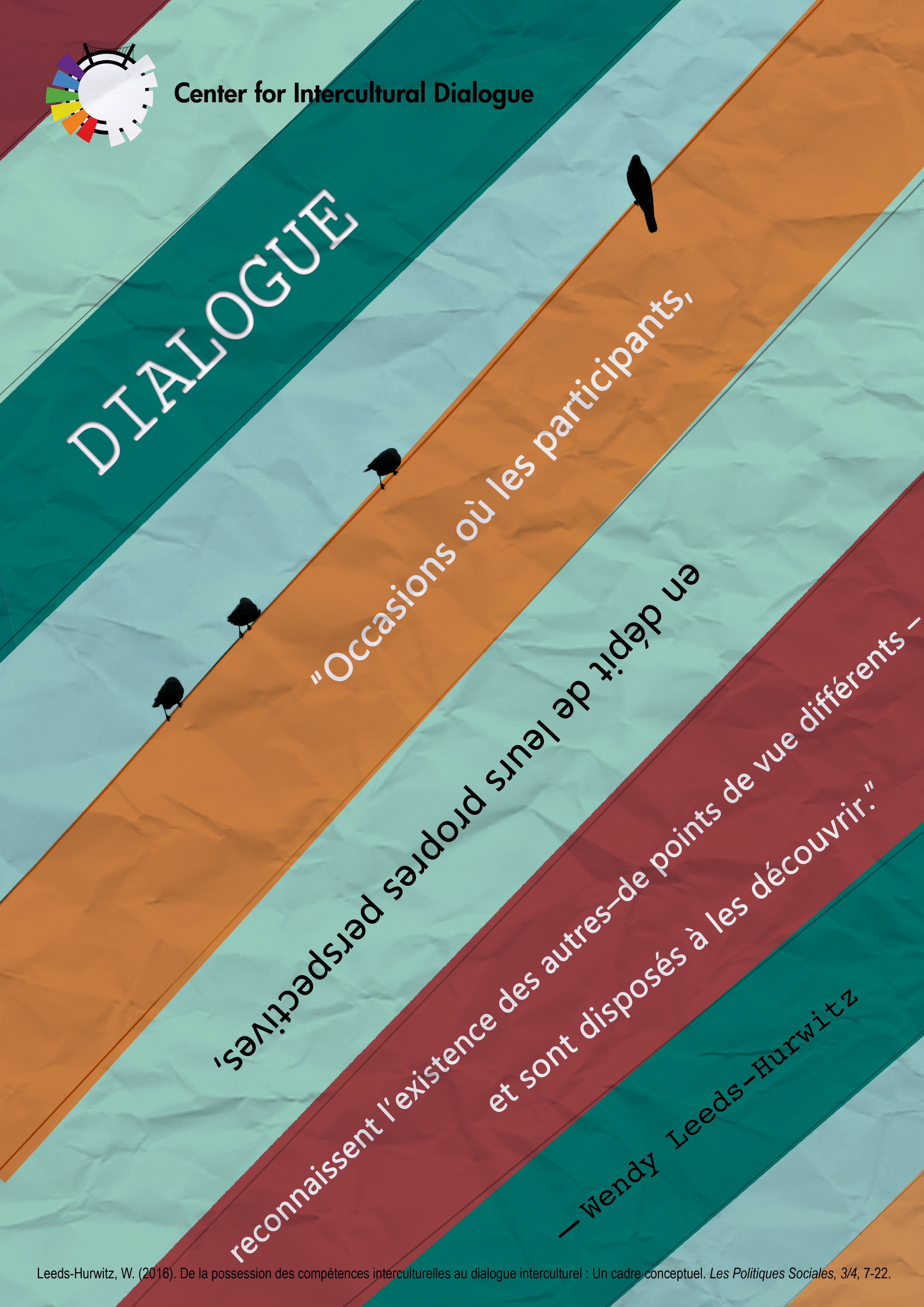
CID PostersThis is the third of the posters designed by Linda J. de Wit, in her role as CID intern. The quote by Peter Praxmarer does not come from a publication, but from a Skype conversation we had on April 25, 2017. I was struck by what he said, and how nicely it summed up the concept of intercultural dialogue, and requested permission to turn the definition into a poster, and he graciously agreed. In terms of visual design, Linda indicated “art” by the picture frame, and “science” by the design in the background. Hopefully this definition will find a wide audience, because I think it does a better and more concise job of explaining intercultural dialogue than other definitions I’ve seen.

The French translation was provided by Léonie Potvin, and the graphic design work necessary to revise was by Yan Qiu. Here then is CID Poster 3: Le dialogue interculturelle.

CID Poster 3: Intercultural dialogue translated into French

Just in case anyone wants to cite this poster, the following would be the recommended format:

Center for Intercultural Dialogue. (2024). Le dialogue interculturelle [L. Potvin, trans.]. CID Posters, 3. Available from: https://centerforinterculturaldialogue.org/wp-content/uploads/2025/11/cid-poster-3-art-and-science-french.jpg

As with other series, CID Posters are available for free on the site; just click on the thumbnail to download a printable PNG. They may be downloaded, printed, and shared as is, without changes, without cost, so long as there is acknowledgment of the source.

As with other CID Publications, if you wish to contribute an original contribution, please send an email before starting any work to receive approval, to minimize inadvertent duplication, and to learn about technical requirements. As is the case any series, posters should be created initially in English. If you want to volunteer to translate a poster into a language in which you are fluent, send in a note before starting, to receive approval and to confirm no one else is working on the same one.

Wendy Leeds-Hurwitz
Director, Center for Intercultural Dialogue
intercult.dialogue AT gmail.com


Creative Commons License
This work is licensed under a Creative Commons Attribution-NonCommercial-NoDerivatives 4.0 International License.

University of California Education Abroad Program: Multiple Positions (USA)

“JobMultiple positions, University of California Education Abroad Program, Goleta, CA, USA. Deadline: varies by position.

Through international academic experiences, the University of California Education Abroad Program (UCEAP) inspires students to explore and transform their lives, UC, and the world. Since 1962, UCEAP has served as the UC systemwide study abroad program. In support of this mission, it has served over 100,000 students across all ten UC campuses and over 40,000 international exchange students. UCEAP is committed to promoting excellence through diversity, equity, and inclusiveness. Recognizing that diversity is integral to the University’s achievement of academic excellence, UCEAP upholds the principle of equal opportunity for all, adheres to the University of California Diversity statement, and strives to create an environment that is welcoming for all. UCEAP typically has over 6,000 student participants annually, is active in over 40 countries worldwide, and welcomes about 1,500 Reciprocity students annually to the University of California. Sustained by strong academic excellence, spirited faculty collaboration, and an interrelated support system, UCEAP produces future global citizens and thought leaders.

Current career opportunities include:

  • Academic Development Coordinator
  • Lead Academic Specialist, Global Programs
  • Lead Program Specialist, Global Programs (2 Openings)
  • Marketing And Communications Specialist
  • Student Exchanges Specialist

CUHK: Postdoc at Centre for Cultural Studies (Hong Kong)

Postdocs

Postdoctoral Fellow, Chinese University of Hong Kong, Hong Kong, China. Deadline: 4 January 2025.

The Centre for Cultural Studies invites applications for a Postdoctoral Fellowship in Inter-Asia Decolonial Epistemologies. Preferred areas of expertise include, but are not limited to, Environmental Humanities, Critical Humanities, Public Humanities, Cultural Studies, Digital and Interactive Media, and Science and Technology Studies.

Applicants should have a PhD in Cultural Studies, Arts and Humanities, Science and Technology Studies, or related disciplines received within the past five years. Preference will be given to applicants who have not previously enjoyed the resources at CUHK, and who would particularly benefit from and contribute to CUHK’s intellectual life. Applicants who can contribute to the intellectual and cultural diversity of the Centre are especially welcome to apply.

Cultural Dialogue at Home – Austrian Hosts and Syrian Refugees

Resources in ICD“ width=

Cultural dialogue at home – Austrian hosts and Syrian refugees: An autoethnographic narrative by by Corina Ahlers (printed version, 2019; Taos Institute Publications WorldShare Books version, 2024). The ebook version is free to download.

This book is filled with tender, funny and frustrating scenes, as Viennese and Syrian cultures meet and mingle, and sometimes clash. Much can be learned about multicultural relations by reading this book.

In 2015 a great influx of Syrian refugees flooded Europe. Vienna was one of the cities that had a large group of people with no place to be. Many citizens who were sympathetic to these people became involved in charitable projects, including providing food, money, and other forms of care. Few went so far as to open up their homes so that refugees could live with them. This book describes the experience of Corina Ahlers, a family therapist and teacher, who opened up the apartment on the ground floor of her home, in a lovely suburb of Vienna to several refugees. Inter-cultural experiences of a great variety are described, as Corina, her husband, Reinhard, and their dog, invite their new residents to share in the Austrian lifestyle, as they open themselves to share in theirs. In the first month they hosted two men (Tarek, age 45 and Can, age 33). One month later, the second wife of Tarek, a widow with a little girl (Samira, age 25 and Leyla, age 6), arrived. Tarek’s first wife arrived in Vienna with 5 children (aged 18, 17, 14, 10, and 9) six months later. Previously his first family had lived in a big Jordanian refugee camp. From the moment his first family arrived, he switched between Corina’s house, where his second wife and her daughter lived, and the new home of his first family in another district of Vienna. Can had no relatives in Austria, and he stayed until May 2016. Tarek, Samira and Leyla moved out at the end of 2017. They found a one-room apartment on the other side of the city, very near to Tarek’s first family’s flat.

Related publication: Key Concept #1: Intercultural dialogue by Wendy Leeds-Hurwitz.

CFP International Conference on Human Rights: Youth in Asia (Japan)

ConferencesCall for submissions: International Conference on Human Rights: Youth in Asia, University of Tokyo, Komaba, Japan, March 2025. Deadline: 31 January 2025.

The 2025 International Conference on Human Rights: Youth in Asia (2025 ICHR) is co-organized by East Asia Young Scholars Association (EAYSA)Young Professionals in Foreign Policy (YPFP) Tokyo, and the Graduate Program on Human Security (HSP) and Research Center for Sustainable Peace (RCSP), the University of Tokyo. The ICHR positions Japan as a nexus for students and young scholars to express their ideas, exchange thoughts, and participate in the progressive development of the international human rights agenda. To this end, they invite academic submissions related to one or more of the following conference subthemes:

Contemporary Society

  • Technology and Human Rights
  • Climate Change and Humanitarian Action
  • Inequalities and Education
  • Gender and Conflict
  • Business and Human Rights

Democracy and Autocracy

  • Democratic Upheavals and Autocratization
  • Immigration and the Sustainability of Multiethnic Democracies
  • Refugees
  • Far-Right, Far-Left, and Polarization
  • Censorship and the Right to Express

They are particularly proud to encourage submissions from young scholars, studying Japanese human rights issues, and/or writing in the Japanese language! Detailed submission guidelines are now available here (English version, Japanese version). You may also review the Concept Note here: English version, Japanese version. Abstracts will be assessed in a double-blind review process on a rolling basis.

NOTE: The conference is free of charge to all presenters and participants.

US-Japan Leadership Program 2025/26 (Japan/USA)

FellowshipsCall for applications: US-Japan Leadership Program (USJLP), participants expected to be in Japan July 27 – August 3, 2025 AND in the US in late July 2026. Deadline: 6 January 2025.

USJLP is the flagship program of the United States-Japan Foundation. It launched in 2000 with the purpose of developing a network of communication, friendship and understanding among the next generation of leaders in each country.  With the goal of bridging the gap between East and West, the Program fosters a continuing dialogue among future leaders in a broad variety of professions. It starts this process by bringing some young leaders together from each country for two intensive weeklong conferences over two years, with discussions revolving around historical and current issues in bilateral relations, as well as issues reaching beyond our two countries. Through serious conversation as well as recreation and shared cultural activities it seeks to nurture lifelong friendships. The Program is designed to keep the leaders in touch with each other throughout their careers through a dedicated website and member directory, frequent reunions and newsletters, and online social networks.

All members hold US or Japanese citizenship, enter the Program between the ages of 28-44 and have demonstrated leadership in their respective fields. Membership requires a commitment to participate in two consecutive summer conferences as a Delegate (one in Japan, and one in the USA), and the intent to remain active in the Program as a Fellow (alumnus).

CFP CARGC: 2025 Biennial Conference (USA)

ConferencesCall for submissions: The Center for Advance Research for Global Communication Fellows 2025  Biennial Conference: Unsettling Global Media and Communication Studies, University of Pennsylvania, Philadelphia, PA, USA, 10-11 April 2025. Deadline: 15 December 2024.

In April 2023, CARGC hosted the Fellows’ Symposium, centered around “Doing Global Communication and Media Studies.” Since then, the world has witnessed a surge in political violence, multiple genocides, media censorship, and a subsequent dependence on social media for news. During this time, student activists across college campuses raised awareness about what the United Nations and the International Court of Justice believe to be evidence of a genocide in Gaza. As the intersections of manufactured humanitarian and media crises continue to evolve, this symposium asks not what a global approach to media and communication can achieve today, but rather, what it should strive to accomplish. What are the conditions under which we produce knowledge in our field, and what are the outcomes of that production — is there a media scholarship crisis? This symposium reflects upon our tools and methodologies to rethink entrenched power structures and disrupt prevailing narratives of objectivity and neutrality.

This conference asks: historically, what has been the role of media and communication scholars in times of global crises? To what extent is the “political” — whether understood broadly or through specific contextualization — linked with the civic, ethical, elemental or epistemic underpinnings of global media scholarship? How can scholarly practices — methodologically and pedagogically — challenge and unsettle existing ideological frameworks? Certainly, media reporting on Palestine and the erasure of its people raises questions regarding the responsibilities of media studies scholars in and out of academic spaces. What broader insights can we glean from this crisis about the strengths and limitations of global media studies? Additionally, how can a critical analysis of these crises deepen our understanding of the historical, geographical, and future dimensions of the field?

Scam Alert Using CID Email: Do NOT Be Fooled!

About CID

SCAM alert! I have received multiple messages today stating that emails using my name and a slightly changed version of the Center for Intercultural Dialogue’s email have been sent to those affiliated with the Center.

There are two parts to this scam. The first is a general call for help, and the second asks for money.

This is the first message you may have received:

“How are you doing today?.
Please, I need your assistance for the CID.
Get back to me by email so I can explain further
Regards
Wendy”

This is followed by my correct name, titles, and affiliations. The email comes from “interculit.dialogue@gmail.com” instead of the Center’s correct email.

One of those who was fooled into thinking it was an actual message from me answered, and then received a request for a large amount of cash (about $1000 in USD) to be sent immediately, and reimbursed later due to an unnamed emergency. Luckily this colleague then noticed the incorrect email and did not send money.

I will be doing everything possible to stop this scam, but am having trouble getting through to a human at Gmail. In the meantime, please do not respond to these scammers, and definitely do not send money to them! This is not how the Center conducts business; I would never send colleagues supposedly urgent messages requesting large amounts of money.

**Update: anyone receiving these phishing messages should report and block them – instructions (and more information on how to identify phishing attacks to protect yourself) can be found here.

Wendy Leeds-Hurwitz, Director
Center for Intercultural Dialogue

CID Poster 1: Intercultural Communication / Competence / Dialogue Translated into French

CID PostersThis is another of the posters designed by Linda J. de Wit, and now translated into French. This one provides a quick and easy way to understand, and differentiate between, the concepts of “intercultural communication,” “intercultural competence,” and “intercultural dialogue,” using a rooster and a sheep to represent members of different cultures (and she notes that the animals are vector designs by vecteezy.com).

The article where these explanations of these concepts (as well as lots of other concepts) were published is:

Leeds-Hurwitz, W. (2016). De la possession des compétences interculturelles au dialogue interculturel: Un cadre conceptuel [Moving from having intercultural competencies to constructing intercultural dialogues: A conceptual framework]. Les Politiques Sociales, 3/4, 7-22.

The French translation was provided by Léonie Potvin, and the graphic design work necessary to revise was by Yan Qiu. Here then is CID Poster 1: Communication/Compétence/Dialogue Interculturel.

CID Poster 1: Intercultural Communication / Competence / Dialogue Translated into FrenchJust in case anyone wants to cite this poster, the following would be the recommended format:

Center for Intercultural Dialogue. (2024). Communication / Compétence / Dialogue Interculturel [L. Potvin, trans.]. CID Posters, 1. Available from: https://centerforinterculturaldialogue.org/wp-content/uploads/2024/10/cid-poster-1-animals_french.png

As with other series, CID Posters are available for free on the site; just click on the thumbnail to download a printable PNG. They may be downloaded, printed, and shared as is, without changes, without cost, so long as there is acknowledgment of the source.

As with other CID Publications, if you wish to contribute an original contribution, please send an email before starting any work to receive approval, to minimize inadvertent duplication, and to learn about technical requirements. As is the case any series, posters should be created initially in English. If you want to volunteer to translate a poster into a language in which you are fluent, send in a note before starting, to receive approval and to confirm no one else is working on the same one.

Wendy Leeds-Hurwitz
Director, Center for Intercultural Dialogue
intercult.dialogue AT gmail.com


Creative Commons License
This work is licensed under a Creative Commons Attribution-NonCommercial-NoDerivatives 4.0 International License.

U Notre Dame: Associate Director, Global Education (USA)

“Job Associate Director, Global Education, University of Notre Dame, Notre Dame, IN, USA. Deadline: 7 December 2024.

The Associate Director of Global Education, a member of the Study Abroad and the Global Engagement Teams, plays a key role in advancing the global education for outbound study abroad students as well as inbound short-term international students. The Associate Director is charged with the responsibility of elevating study abroad students’ intercultural learning and global competencies. The position has the overall responsibilities of designing and implementing the strategies for developing the global competencies of study abroad students through pre-departure orientations, study abroad online courses, and reentry programming. The Associate Director will create workshops for inbound international students focusing on intercultural communication, leadership skills and English language skills. The position will also offer academic support to faculty and staff on intercultural competency development. The Associate Director of Global Education reports to the Senior Director of Global Education at Notre Dame Global and will work very closely with the Director of Study Abroad, the Summer/Short-Term Study Abroad Programs Director and the Global Engagement Programs Director.