CFP Technology, Knowledge and Society Conference (Buenos Aires)

Call for Papers
Twelfth International Conference on Technology and Society
The Technology and Society Conference will be held from 18-19 February 2016 at the Universidad de Buenos Aires in Buenos Aires, Argentina. We welcome submissions from a variety of disciplines and perspectives and encourage faculty and students to jointly submit proposals, discussing technology and society through one of the following themes:

Conference Themes
Technologies for Human Use
Technologies in Community
Technologies for Learning
Technologies for Common Knowledge

2016 Special Focus: Ideas, Objects, Waste: Critically Approaching The Life Cycle of Technologies in the Age of the Anthropocene
Technologies have life cycles. They begin as ideas reverberating within normative contexts of innovation and progress. These ideas then materialize as objects. This materiality connects the object to epochs of production and the natural world: metals, bio-matter and other natural resources. Finally, as their life cycle comes to a close, these objects become waste. In this final stage, another set of material impacts comes into view: their disposal as waste or our reuse of these objects for similar or different purposes. The increasing speed of this life cycle stimulates a ‘what is to be done?’ reflexivity that pervades the whole cycle. What does pace of this life cycle today reveal about us as individuals, communities or societies?

Parallel to our annual thematic streams, the Special Focus for the 12th Technology Knowledge and Society Conference – “Ideas, Objects, Waste: Critically Approaching The Life Cycle of Technologies in the Age of the Anthropocene” – will be to analyze the life cycle of technology in the context of our current ecological condition, in an era that has been coined the age of the Anthropocene. To be precise: how do we use findings of the impacts human action on the environment as an evaluative criterion assessing the ideas, objects and waste of technological developments? In turn, how can such questioning shape our understanding of the social impact of technologies, and the ideals of human needs and community interests manifest in the developmental direction and objects of technologies?

Proposal Submissions and Deadlines
The current review period closing date for the latest round of submissions to the Call for Papers (a title and short abstract) is 18 March 2015*. Please visit the conference website for more information on submitting your proposal, future deadlines, and registering for the conference.

If you are unable to attend the conference, you may still join the community and submit your article for peer review and possible publication, upload an online presentation, and enjoy subscriber access to The Technology Collection of Journals.

*Proposals are reviewed in rounds adhering to monthly deadlines. Check the website often to see the current review round.


Juana Du Profile

ProfilesJuana Du is associate professor in the Master of Arts in Intercultural and International Communication on-campus program at Royal Roads University in Victoria, BC, Canada.

Juana DuShe draws on personal experience from working in Beijing, Hong Kong, Germany, United States and Canada to frame the way she studies culture, communication and organizations. Du’s professional experience includes cross-cultural adaptation, corporate communication, organizational culture and innovation. She has worked internationally with multinational enterprises, and has acted as a communication research consultant for subsidiaries of MNEs. She provided strategic and tactical advice to Western and Chinese companies to improve the performance of their global operations in talent management, negotiation, multi-cultural teams and innovation.

Her research fields of interest include Asian communication, intercultural communication, intercultural competency and organizational communication. Her interest in the role of culture in communication in different social contexts at various level of interaction and in intercultural encounters has been a center of research and scholarship. She has been conducting research on such topics as cross-cultural adaptation of sojouners, intercultural training, Chinese traditional value orientations, intercultural conflict in M&As, managerial communication in business organizations, organizational culture and learning, knowledge sharing and transfer in MNEs.

Her research on intercultural communication within organizational settings is driven by solving complex problems in the real world. She has worked with many multinational enterprises for different research projects. Currently she is working on a research project on intercultural competence with collaboration with CNPCI (China National Petroleum Co. International).

Du was a post-doctorate researcher at New York University, and a visiting scholar at Techinische Universitat Bergakademie Freiberg in Germany and at Ohio University in U.S. She has published numerous book chapters and peer-reviewed journal papers. She has presented at several international conferences, including the International communication Association, the National Communication Association, the Academy of International Business, and the Shanghai Normal University International Conference of Intercultural Communication. She got the Best Student Paper Award of intercultural communication division of ICA (International Communication Association) in 2009.


Work for CID:
Juana Du wrote KC52: Guanxi, has served as a reviewer of translations into Simplified Chinese, and has co-authored a guest post on Museums as Third Spaces for Intercultural Dialogue.

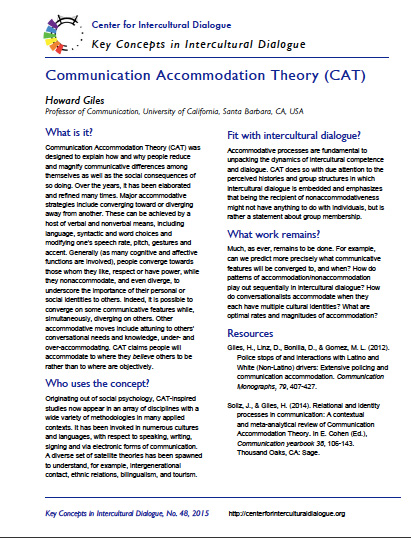
Key Concept #48: Communication Accommodation Theory by Howard Giles

Key Concepts in ICDThe next issue of Key Concepts in intercultural Dialogue is now available. This is KC48: Communication Accommodation Theory by Howard Giles. As always, all Key Concepts are available as free PDFs; just click on the thumbnail to download. Lists organized  chronologically by publication date and numberalphabetically by concept in English, and by languages into which they have been translated, are available, as is a page of acknowledgments with the names of all authors, translators, and reviewers.

Key Concept #48: Communication Accommodation Theory

Giles, H. (2015). Cultural accommodation theory. Key Concepts in Intercultural Dialogue, 48. Available from:
https://centerforinterculturaldialogue.org/wp-content/uploads/2015/01/key-concept-cat.pdf

The Center for Intercultural Dialogue publishes a series of short briefs describing Key Concepts in Intercultural Dialogue. Different people, working in different countries and disciplines, use different vocabulary to describe their interests, yet these terms overlap. Our goal is to provide some of the assumptions and history attached to each concept for those unfamiliar with it. As there are other concepts you would like to see included, send an email to the series editor, Wendy Leeds-Hurwitz. If there are concepts you would like to prepare, provide a brief explanation of why you think the concept is central to the study of intercultural dialogue, and why you are the obvious person to write up that concept.


Creative Commons License
This work is licensed under a Creative Commons Attribution-NonCommercial-NoDerivatives 4.0 International License.

Michele Koven Profile

ProfilesMichele Koven is Professor in the Department of Communication at the University of Illinois at Urbana-Champaign, with courtesy appointments in the Departments of Anthropology. French, Global Studies, and the Center for Writing Studies.

Michele Koven

Using ethnographic and discourse analytic approaches, her research interests include how people enact, infer, and evaluate images of social types in interaction. She is particularly interested in people’s interpretations and experiences of their own and others’ « identities » in multilingual contexts She has most extensively addressed these issues through the prism of oral storytelling among young people of Portuguese origin, raised in France. More recently, she has begun exploring these issues in social media.

Publications

Marques, I. S., & Koven, M. E. J. (2017). “We are going to our Portuguese homeland!”: French Luso-descendants’ diasporic Facebook conarrations of vacation return trips to Portugal. Narrative Inquiry27(2), 286-310.

Koven, M. E. J. (2016). Essentialization strategies in the storytellings of young Luso-descendant women in France: Narrative calibration, voicing, and scale. Language and Communication46, 19-29.

Jaffe, A., Koven, M. E. J., Perrino, S., & Vigouroux, C. (2015). Heteroglossia, performance, power, and participation. Language in Society, 44(2) , 135-139.

Koven, M. E. J., & Simões Marques, I. (2015). Performing and evaluating (non)modernities of Portuguese migrant figures on YouTube: The case of Antonio de Carglouch. Language in Society 44(2), 213-242.

Koven, M. E. J. (2014). Interviewing: Practice, ideology, genre, and intertextuality. Annual Review of Anthropology43, 499-520.

Koven, M. (2013). Antiracist, modern selves and racist, unmodern others: Chronotopes of modernity in Luso-descendants’ race talk. Language and Communication. 33(4), 544-558.

Koven, M. (2013). Speaking French in Portugal: An analysis of contested models of emigrant personhood in narratives about return migration and language use. Journal of Sociolinguistics, 17(3), 324-354.

Koven, M. (2007). Selves in two languages: Bilingual verbal enactments of identity in French and Portuguese. Amsterdam: John Benjamins.

Koven, M. (2004). Transnational perspectives on sociolinguistic capital among Luso-descendants in France and Portugal. American Ethnologist, 31(2), 270-290.


Work for CID:
Michele Koven wrote KC72: Intertextuality and translated it into French; she has also served as a reviewer of French translations.

Intercultural Bloggers wanted by Niagara Foundation

Niagara Foundation is searching for bloggers to contribute to their blog, The Falls. The Niagara Foundation is a Chicago-based nonprofit that focuses on fostering intercultural and interfaith dialogue, relationships and social cohesion. Bloggers would write about anything related to this mission from the perspective of their expertise. Contact Kathleen Ferraro at kathleen@niagarafoundation.org or 312-240-0707 Ext: 106 if you are interested in contributing in any capacity. Thank you!

Call for Book Chapters: Video Games in East Asia

Contributors are sought for an interdisciplinary book on video games in East Asia to be edited by Austin Lee and Alexis Pulos and published by Palgrave Macmillan for its East Asian Popular Culture Series. The series was launched in 2014 in order to meet an increased interest in the subject among scholars of various disciplines in recent years. East Asia refers to China, Hong Kong, Japan, North Korea, South Korea, and Taiwan. Reflecting the interdisciplinary nature of popular culture studies, the series will accept submissions from different social sciences and humanities disciplines that use a variety of methods.

Dedicated to video games in East Asia, this book examines the development and prominence of video games within historical, cultural, industrial, and global contexts. The editors are seeking contributions that cover a wide range of interdisciplinary work and that address topics such as:
–    Quantitative and qualitative approaches to industry, content, culture and players;
–    Studies examining eSports events, the politics of games, gamer culture and popular culture;
–    Studies examining the influence of political, economical and cultural factors on video game content, platforms (e.g., PC, console, mobile) and genres (e.g., RPG, FPS, strategy, sports);
–    Investigations of games, players, narratives, ludology or game environments;
–    Analysis of the ways technologies, celebrity status, and subculture (e.g., cosplay) impact both local and global perspective of gaming;
–    Historical analyses of game developments, cultural reactions, or significant moments;
–    Analyses of future trends and challenges for East Asian gaming culture and industry;
–    Research that explores the realities of power relations and oppression that stem from pervasive stereotypes of race, class, gender, sexual orientation or place within the context of East Asian games and players;
–    Ethnographic, rhetorical and other qualitative research on topics around video games.

Please submit a 500-word abstract, current contact information along with brief biography (or CV) as Word attachments to both Alexis Pulos and Austin Lee by February 15, 2015. Authors will be notified of the outcome of their submission within four weeks. The deadline for completed chapters (which should not exceed 9,000 words, inclusive of references) is May 31, 2015.

All submissions should be in MS Word format. The submission of images where appropriate, is also welcome.

CFP Asia Pacific Regional Intercultural Conference (Bali)

The First Asia Pacific Regional Intercultural Conference
Call for Proposals

You are invited and encouraged to participate in the AFS-AAI-SIETAR 2015 Conference on 15-17 April, 2015 in Bali, Indonesia.
Deadline for submission: January 31, 2015

The theme of this conference is: Learning to Live Together. Intercultural Education: From Ideas to Action.

Please submit proposals that explore the best thoughts on the intercultural field evidenced by theory, research or best practices. Asia Pacific regional perspectives highly appreciated. The conference review committee seeks for proposals that reflect emerging ideas, stimulate engaging discussion and learning outcomes.

The criteria for selection: Connection to the theme; Originality and Relevance to the Intercultural Learning and Education audience.

Promotion of product or service is not acceptable topic for session but sponsorship opportunities provided.

Please send submission of Abstract; Session Title; Biography of the presenter/s; Contact details and Audio-visual needs. The tracks are theory, research and best practices. Time allocations: 40 minutes for presentations or 60 minutes for panel discussion.
to : afs.aai.sietar2015@gmail.com

Public Anthropology Competition 2015

International Publishing Competition
California Series In Public Anthropology

The California Series in Public Anthropology encourages scholars in a range of disciplines to discuss major public issues in ways that help the broader public understand and address them. Two presidents (Mikhail Gorbachev and Bill Clinton) as well as three Nobel Laureates (Amartya Sen, Jody Williams, and Mikhail Gorbachev) have contributed to the Series either through books or forwards.  Its list includes such prominent authors as Paul Farmer co-founder of Partners in Health, Kolokotrones University Professor at Harvard and United Nations Deputy Special Envoy to Haiti.

Each year the Series highlights a particular problem in its international call for manuscripts.  The focus this year will be on STORIES OF INEQUALITY.

We are particularly interested in authors who convey both the problems engendered by inequality as well as ways for addressing it.  Prospective authors might ask themselves:  How can they make their study “come alive” for a range of readers through the narration of powerful stories?  They might, for example, focus on the lives of a few, select individuals tracing the problems they face and how they, to the best of their abilities, cope with them.  Prospective authors might examine a specific institution and how, in various ways, it perpetuates inequality.  Or authors might describe a particular group that seeks to address a facet of the problem.  There are no restrictions on how prospective authors address STORIES OF INEQUALITY – only an insistence that the proposed publication draw readers to its themes through the inclusion of powerful stories about real people.  The series is directed at the general public as well as college students.

The University of California Press in association with the Center for a Public Anthropology will review proposals for publication independent of whether the manuscripts themselves have been completed. We are open to working with authors as they wind their way through the writing process.  The proposals can describe work the author wishes to undertake in the near future or work that is currently underway. The proposals submitted to the competition should be 3-4,000 words long and describe both the overall work as well as a general summary of what is (or will be) in each chapter.  We expect the completed, publishable manuscripts to be between 250-300 pages (or 60,000-100,000 words) long excluding footnotes and references.  Examples of the types of analyses we are looking for include:
*Death Without Weeping: The Violence of Everyday Life in Brazil by Nancy Scheper-Hughes
*Behind the Beautiful Forevers: Life, Death and Hope in a Mumbai Undercity by Katherin Boo
*Imperial Reckoning: The Untold Story of Britain’s Gulag in Kenya by Caroline Elkins
*American Dream: Three Women, Ten Kids, and a Nation’s Drive to End Welfare by Jason DeParle
*Five Days at Memorial: Life and Death in a Storm-Ravaged Hospital by Sheri Fink
*There Are No Children Here: The Story of Two Boys Growing Up in the Other America by Alex Kotlowitz

We are interested in establishing committed, supportive relationships with authors that insures their books are not only published but are well publicized and recognized both within and beyond the academy.  We are committed to insuring the success of winning proposals.

DEADLINE FOR SUBMISSIONS IS APRIL 21, 2015
Submissions should be emailed to: bookseries@publicanthropology.org with the relevant material enclosed as attachments. They can also be sent to: Book Series, 707 Kaha Street, Kailua, HI. Questions regarding the competitions should be directed to Dr. Rob Borofsky at: bookseries@publicanthropology.org.

All entries will be judged by the Co-Editors of the California Series in Public Anthropology: Rob Borofsky (Center for a Public Anthropology & Hawaii Pacific University) and Naomi Schneider (University of California Press).

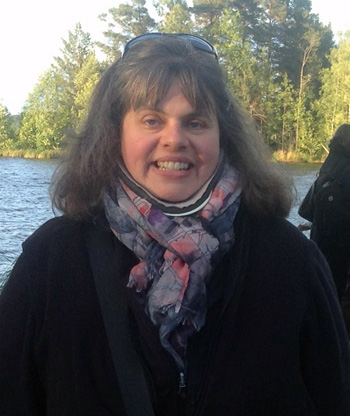
Howard Giles Profile

ProfilesHowie Giles, past Head of Psychology and Chair of Social Psychology at the University of Bristol, England, has been Professor of Communication at the University of California, Santa Barbara (with affiliations with Linguistics and Psychology) since 1989.  He is a Charter Fellow of the Intercultural Academy and elected Fellow of other Associations in Psychology, Communication, and Gerontology.

Howard_Giles

Giles has worked in language, intercultural, interpersonal, health, lifespan, and media arenas, with intergroup communication being his umbrella identification; the other subfields are subtended by this.  In this regard, he was editor of the 2012 Handbook of Intergroup Communication and with Jake Harwood is co-editor of the upcoming Oxford Research Encyclopedia of Intergroup Communication.  With Antonis Agardiki, he will be co-convening the 1st International Symposium on Intergroup Communication in Thessaloniki in June 2017.  Giles is currently Chair of the International Communication Association’s Intergroup Communication Interest Group which he founded with Scott Reid in 2003, and was co-founder with Peter Robinson of the International Conferences on Language and Social Psychology (ICLASP); the 15th ICLASP will occur in Bangkok in 2016.

Conducting cross-cultural research across dozens of nations and ethnic communities around the world, Giles has worked in an array of intercultural settings, including between-gender, interability, interethnic, intergenerational, police-community, and gay-straight relations.  Within these, for example, he has explored language attitudes, ethnic identity, tourism, acculturation, and successful aging.  Among the research questions he has posed are:

•    How when, and why do we mark our many social identities via language and communicative practices – and how transactively doing so sustains, reshapes these very same identities?

•    How do we age successfully as well as possibly unsuccessfully from different cultures’ standpoints, and how can communication be empowering or disempowering in these regards?

An integrative framework across these domains has been Communication Accommodation Theory, being its architect in the early 1970s (see Key Concepts in Intercultural Dialogue, #48).   Giles has recently been working to inject the salience of “culture” into intergroup theory and was editor of the “Intergroup and Intercultural” section of the International Encyclopedia of Communication (2008-).  Elected Past President of the International Communication Association and the International Association for Language and Social Psychology, Giles is founding/current Editor of the Journal of Language and Social Psychology (1981-) and the Journal of Asian Pacific Communication (1990-) as well as elected Editor of Human Communication Research (1995-98.  He is also General Editor for Peter Lang Publishers of a book series entitled, ”Language as Social Action.”

Giles spent much of his “leisure” time as a Reserve Detective Lieutenant in the Santa Barbara Police Department.  He did this for 15 years and was the recipient of over a dozen outstanding service awards.  This experience fueled his interest in researching police-community relations which is currently a very hot topic in the American media and public discourse.

It is possible to download his vita, or send him an e-mail.


Work for CID:
Howie Giles wrote KC48: Communication Accommodation Theory.

CFP Different Games Conference (New York)

Different Games, the first conference on inclusivity and diversity in games, invites participants for its 2015 edition at NYU’s Polytechnic School of Engineering, located in Brooklyn, NY, on Friday April 3 and Saturday April 4.

After a hugely successful 2nd year that welcomed 40 some speakers, dozens of original games and more than 300 attendees, Different Games is back for a third edition and we can’t wait to come together again this April!

Critical voices from across the games community— including designers, activists, researchers, journalists and others— are invited to present new and recent work as part of our two day program.

Submissions are invited before Feb 1, 2015 in three categories (though we welcome other ideas):

Arcade: Designers interested in showcasing their game in the Different Games arcade should submit a brief overview of their game (no more than 500 words) that includes their design vision and concept of the game. In addition, please submit the cover art and two screenshots of gameplay. We welcome pieces that will be in (beta) or playtesting phase as well as those further along in the development process.

Paper Presentations and Talks: We invite academics and creative minds alike to share recent work (written or otherwise) as speakers on our conference panels. We encourage participants from every field to submit writing or talks exploring topics pertaining to diversity and inclusion. Possible topics may include, but are not limited to: post mortems, design methodology, reflections on playtesting, analysis/commentary on games content (theme, gender, sexuality, etc.), game reception, and game culture/communities.

Breakout or Workshop Sessions: We invite topic specific or exploratory discussions on challenges and solutions for promoting diversity and inclusion in the broader game community/communities and other pertinent subjects. Hands-on workshop sessions geared towards learning design and development skills are also invited. Your proposal should include an explanation of any equipment participants will need for your workshop. If your session will be facilitated collaboratively, please include bios and links for all co-facilitators.

Visit our website for more info or to submit. Send questions to DifferentGamesConference@gmail.com.