KC104 Constructive Intercultural Management

Key Concepts in ICDThe next issue of Key Concepts in intercultural Dialogue is now available. This is KC104: Constructive Intercultural Management, by Madeleine Bausch. Click on the thumbnail to download the PDF. Lists organized chronologically by publication date and numberalphabetically by concept in English, and by languages into which they have been translated, are available, as is a page of acknowledgments with the names of all authors, translators, and reviewers.
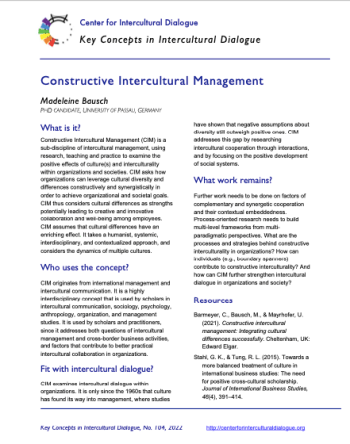
KC104 Constructive Intercultural ManagementBausch, M. (2022). Constructive intercultural management. Key Concepts in Intercultural Dialogue, 104. Available from: https://centerforinterculturaldialogue.org/wp-content/uploads/2022/02/kc104-constructive-intercultural-management.pdf

The Center for Intercultural Dialogue publishes a series of short briefs describing Key Concepts in Intercultural Dialogue. Different people, working in different countries and disciplines, use different vocabulary to describe their interests, yet these terms overlap. Our goal is to provide some of the assumptions and history attached to each concept for those unfamiliar with it. As there are other concepts you would like to see included, send an email to the series editor, Wendy Leeds-Hurwitz. If there are concepts you would like to prepare, provide a brief explanation of why you think the concept is central to the study of intercultural dialogue, and why you are the obvious person to write up that concept.


Creative Commons License
This work is licensed under a Creative Commons Attribution-NonCommercial-NoDerivatives 4.0 International License.

U London in Paris: International Politics (France)

“Job
Lecturer in International Politics,
University of London Institute in Paris (ULIP), Paris, France. Deadline: 29 April 2022.

The University of London Institute in Paris seeks to appoint a Lecturer in International Politics to contribute to the delivery of innovative and engaging teaching at undergraduate and postgraduate levels, and to further enhance the Institute’s reputation for interdisciplinary research. ULIP’s BA programmes in International Politics, and French Studies, continue to grow, with student recruitment increasing each year. The new appointment is made in light of this growth, and the successful candidate will join a vibrant interdisciplinary department. The initial duration of the contract is one year and is subject to French law (Contrat à durée déterminée).

Located in the French capital, ULIP is committed to the development of students’ intercultural skills and transnational perspectives. Programmes at ULIP foreground comparative and connected approaches which situate France and the francophone world in relation to wider global dynamics and local diversities.

The successful candidate will hold a relevant PhD (or be close to completion) in International Politics or International Relations and have native or near-native fluency in English and French. Previous experience of module design, delivery and assessment at a Higher Education Institution is essential. They will have prior experience of teaching in these subject areas at undergraduate and/or graduate levels, including through virtual learning environments (VLEs). Experience of supervising student projects and dissertations is an asset.

U Oxford: Diplomatic Studies (UK)

“JobAssistant Course Manager (Diplomatic Studies Programme),
Department for Continuing Education, University of Oxford, UK. Deadline: 13 April 2022.

The Department for Continuing Education is seeking to appoint an Assistant Course Manager to be responsible for leading the smooth administration of the Diplomatic Studies Programme (DSP). The DSP comprises a number of postgraduate courses designed primarily for professional diplomats. You will ensure the efficient and effective administration of all key processes for the DSP in line with departmental and University requirements. The role includes daily contact with some 30-40 full-time students per year from all over the world. It offers the opportunity to accompany the students on their annual study tours within the UK and in continental Europe.

The ideal candidate will have significant experience of student administration within Higher Education or a similar environment, together with strong team work skills, significant experience of supervising staff, and excellent standards of accuracy. You also need excellent communication skills, including a high degree of intercultural communicative competence, and experience of conveying detailed and complex policies and procedures.

Intercultural Cities: Building Bridges not Walls

Applied ICD

Bogdanovic, N., & Wilson, R. (2022).  Mediterranean Intercultural Cities Network: Youth – sport – inclusion 2021. Intercultural Cities Unit, Council of Europe.

“The Intercultural Cities of Limassol, Haifa, and Ioannina, supported by the Intercultural Cities programme of the Council of Europe, have jointly worked during 2021 on unlocking the potential of sports for intercultural inclusion, in terms both of policy and practice…While sport can be a force for division where competition aligns with ethnic or other fault lines, it can be a much more positive factor for integration for a number of reasons.”

This example shows how sports – even competitive sports – can be a vehicle to develop overlapping solidarities among diverse individuals in a globalised world. It reminds us that while ‘identity politics’ can divide people into antagonistic groups in fact our identity is what makes each of us unique: we are all complex combinations of different elements. And so, the commonalities of interest which sport engenders can bring the most unlikely individuals together and build bridges when others want to build walls.

KC17 Multilingualism Translated into Marathi

Key Concepts in ICDContinuing translations of Key Concepts in Intercultural Dialogue, today I am posting KC#17: Multilingualism, which Josep Soler wrote for publication in English in 2014, and which Sameer Patankar and Apurva Chaugule have now translated into Marathi.

As always, all Key Concepts are available as free PDFs; just click on the thumbnail to download. Lists of Key Concepts organized alphabetically by conceptchronologically by publication date and number, and by languages into which they have been translated, are available, as is a page of acknowledgments with the names of all authors, translators, and reviewers.

KC17 Multilingualism_MarathiSoler, J. (2022). Multilingualism [Marathi]. (S. Patankar & A. Chaugule, Trans.). Key Concepts in Intercultural Dialogue, 17. Available from: https://centerforinterculturaldialogue.org/wp-content/uploads/2022/02/kc17-multilingualism_marathi.pdf

If you are interested in translating one of the Key Concepts, please contact me for approval first because dozens are currently in process. As always, if there is a concept you think should be written up as one of the Key Concepts, whether in English or any other language, propose it. If you are new to CID, please provide a brief resume. This opportunity is open to masters students and above, on the assumption that some familiarity with academic conventions generally, and discussion of intercultural dialogue specifically, are useful.

Wendy Leeds-Hurwitz, Director
Center for Intercultural Dialogue


Creative Commons License
This work is licensed under a Creative Commons Attribution-NonCommercial-NoDerivatives 4.0 International License.
Creating a Culture of Encountering the Other (UK but Online)

Events

Creating a Culture of Encountering the Other, ETHER, University of Leeds, UK but Online, 6 April 2022, 9:30-15:30 (British summer time).

The theme centres on the notion of the ‘contact zone’… a space in which people with different biographies, understandings and social trajectories engage in everyday encounters. Linguistic ethnographers have generated detailed descriptions of communicative encounters that take place there. Artists and philosophers, on the other hand, have studied people’s emotional, imaginative and moral investment in such encounters. Organizers conceptualize these contact zones as metaphorical ‘unsafe spaces’ to highlight initial discomforts that encounters with difference are likely to produce. This seminar aims to explore ways in which such ‘disturbing encounters’ can be harnessed for the good. Participants will draw on insights from the previous two seminars and draw on experiences and questions of participants to map the transformative potential of these spaces across diverse layers of social activity. The seminar will engage participants with the ‘why’ and ‘how’ questions of enabling such encounters in public life.

ETHER (Ethics and Aesthetics of Encountering the Other), an international AHRC research network, is a research partnership of the University of Leeds, the University of Stirling, Opera North, and Leeds Museums and Galleries.  ETHER asks: ‘How do people of conflicting worldviews, memories and future visions encounter each other?’

CFP Taos Institute: Co-Constructing the Future (Puerto Rico)

Conferences

Call for papers: Co-Constructing the Future: Relational Resources for a Flourishing World, Taos Institute, Puerto Rico, November 9-12, 2022. Deadline: TBA.

From the local to the global, the challenges of relating are everywhere with us – increasingly complex and potentially volatile. Social constructionist ideas and practices have offered new insights and inspired wide ranging practices addressing these challenges. Come share, explore, and co-create with practitioners, scholars and students from around the world as we generate conversations and actions for community collaborations through local and global resources.

Details to come soon. For now, Save the Date and plan to join in this exciting gathering.

KC26 Global-Local Dialectic Translated into Turkish

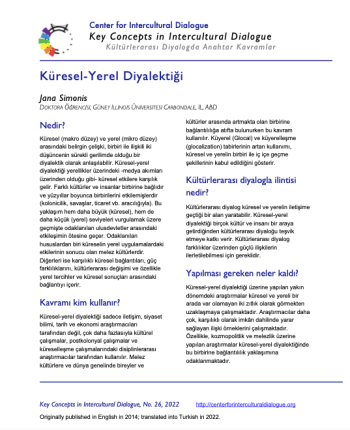
Key Concepts in ICDContinuing translations of Key Concepts in Intercultural Dialogue, today I am posting KC26 Global-local dialectic, which Jana Simonis published in English in 2014, and  which Candost Aydın has now translated into Turkish.

As always, all Key Concepts are available as free PDFs; just click on the thumbnail to download. Lists of Key Concepts organized chronologically by publication date and number, alphabetically by concept, and by languages into which they have been translated, are available, as is a page of acknowledgments with the names of all authors, translators, and reviewers.

KC26 Global-local dialectic_TurkishSimonis, J. (2022). Global-local dialectic [Turkish]. (C. Aydın, Trans.). Key Concepts in Intercultural Dialogue, 26. Available from:
https://centerforinterculturaldialogue.org/wp-content/uploads/2022/01/kc26-global-local_turkish.pdf

If you are interested in translating one of the Key Concepts, please contact me for approval first because dozens are currently in process. As always, if there is a concept you think should be written up as one of the Key Concepts, whether in English or any other language, propose it. If you are new to CID, please provide a brief resume. This opportunity is open to masters students and above, on the assumption that some familiarity with academic conventions generally, and discussion of intercultural dialogue specifically, are useful.

Wendy Leeds-Hurwitz, Director
Center for Intercultural Dialogue


Creative Commons License
This work is licensed under a Creative Commons Attribution-NonCommercial-NoDerivatives 4.0 International License.

U Arts Helsinki: Global Music & Community Engagement (Finland)

“JobTwo positions in Global Music and Community Engagement, Sibelius Academy, University of the Arts Helsinki, Finland. Deadline: different for each position (see below).

With a focus on intercultural dialogue and collaboration, the Global Music Department creates a unique educational environment for musicians from diverse musical and cultural backgrounds. Through the interwoven areas of the curriculum and immersion in an intercultural environment, students expand and deepen their musicianship, artistic identities, and approaches to arts-based community engagement and research. Degree studies are offered at bachelor, master, and doctoral levels, with students developing the ability to perform, create, communicate, collaborate, facilitate, carry out research, and lead in a wide range of musical, cultural, and socially engaged contexts.

In 2022, the new Elsa Brule Centre for Global Music and Community Engagement is being established under the umbrella of the Global Music Department, which will include this new lectureship post. As part of the work of the centre, students will utilise their unique skills to connect with the world around them through working on socially engaged community projects as an integral part of the curriculum. With the focus on creating art in collaboration with diverse areas of society, students and teachers facilitate projects in refugee centres, immigrant communities, schools, prisons, and with marginalised community groups in Finland and around the world.

There are two positions available:

Lecturer of Global Music and Community Engagement – deadline 23 April 2022

Professor of Global Music and Community Engagement – deadline 1 May 2022

U Colorado Denver: Health Communication (China)

“JobInstructor of Health Communication, International College of Beijing, University of Colorado Denver, Beijing, China. Deadline: open until filled, posted February 28, 2022.

The University of Colorado Denver Department of Communication invites applications for a full-time, non-tenure-track teaching position at the International College of Beijing (ICB). The job will commence in Beijing in Fall 2022, with arrival required potentially several weeks before then due to evolving COVID-19 travel and quarantine requirements. Depending on the performance of the individual hired, multi-year renewals are possible.

They seek to hire a colleague who can teach a wide range of Communication courses to support our health communication certificate, such as health communication, designing health messages, and advanced health communication, as well as introductory level communication courses required for the major and courses supporting one or more of the Department’s pathways in global and intercultural communication, media and cultural studies, and strategic communication. Above all else, we seek a dynamic teacher committed to best practices in student-centered pedagogy and advancing the internationalization of communication via hands-on, skills-based, experiential and problem-based learning. The ICB is a unique international collaboration embodying best practices in international and intercultural communication, so the ideal candidate will function not only as a classroom teacher and student advocate, but as a cultural ambassador helping to merge U.S.-style pedagogies with Chinese cultural practices.