CFP The Politics of Intercomprehension (Belgium)

Conferences

Call for extended abstracts: The politics of intercomprehension, Université de Mons, Mons, Belgium, 18-19 June 2026. Deadline: 15 January 2026.

Studies of language acquisition, language education and other contexts of multilingualism present intercomprehension as the phenomenon of understanding, or being understood, through different modes of communication. It is a transdisciplinary and “polyhedral concept”: researchers employ distinct formulations, but all play with the (inter)action of understanding in contexts of difference. This has real political stakes, though they have not always been acknowledged. What does it mean to understand a message, as it relates to power and recognition? What does it mean to understand a person, or to understand each other? Is understanding always necessary? And when (and for whom) is it a privilege? The aim of this two-day conference is to tug at the ideological threads woven into intercomprehension and unfasten it from its purely linguistic interpretation to achieve a transdisciplinary understanding. We hope that this gathering of different academic and activist perspectives will engender a more inclusive framing of the concept.

In the Global North, linguistic intercomprehension is understood as the process of an interlocutor understanding unknown languages within the same linguistic family as their primarily used languages. It has been lauded as a practice subversive to monolingual norms and aligned with European values, without much contextualization of the colonial ontology underpinning European frameworks of multilingualism and multiculturalism. Projects of minority language revitalization have increasingly promoted intercomprehension as a tool for democratic collaboration, but its consequences for linguistically-isolated communities (e.g. Euskera in Euskal Herria, which does not belong to the same linguistic family as neighboring minority languages) has not been explored. What are the benefits and limitations to such practices? How does increased technological intervention transform these practices? Furthermore, we invite contributions that critically explore how politics of intercomprehension are enacted for vulnerable groups, particularly when understanding and intelligibility are transformed into responsibilities rather than rights. For instance, situations of migration and (im)mobility offer unique contexts to further understand how intercomprehension happens when people are mixed together or forced apart.

Organizers invite participants to analyze the relationships between intercomprehension and different conceptualizations of multilingualism. Of particular interest is the moral and ideological work that surrounds this intersection. For example, does the application of intercomprehension practices signify a more democratic future for language users, or are its liberatory aspects overstated, as Jürgen Jaspers warned with translanguaging (2018)? Moreover, the ontological limits of linguistic intercomprehension seem to be restrained to human multilingualism. How can the “animal turn” in sociolinguistics (Cornips: 2025) contribute to theorizing intercomprehension as a distributed and emergent property between sociomaterial actors, human and non-human?

This conference welcomes creative approaches to questions such as these to understand the political and ideological contours of a multilingual future based in intercomprehension.

U Warwick: PhD Scholarship: The Wheeler History of Travel Writing (UK)

“Studentships“PhD Scholarship: The Wheeler History of Travel Writing, University of Warwick, Coventry, UK. Deadline: 15 January 2026.

The programme seeks to attract talented researchers whose projects may focus on any period or region of the world. Applicants are expected to show that their project is primarily historical in nature, engaging with travel and travel writing as a historical practice and/or source for historical research. Preference may be given to candidates who adopt a global historical perspective and have the ability to work with sources in more than one language.

Successful applicants will benefit from the wide-ranging expertise represented by Warwick’s Department of History and its Global History and Culture Centre as well as the range of training and development opportunities offered by the Department and Doctoral College. Candidates are encouraged to explain how their proposal fits within the department’s existing research profile.

They welcome projects that engage with the history of travel and travel writing from a variety of perspectives and disciplinary approaches, including global history, the history of science and technology, environmental history, histories of race and empire, gender history, the history of material culture, and postcolonial studies. Candidates interested in co-supervision across departments (e.g. with English and Comparative Literary Studies, School of Modern Languages and Cultures, Politics and International Studies) are invited to indicate their preference on their application. Potential areas of focus include, but are not limited to:

  • Travel advice literature, from merchant manuals to commercial guidebooks
  • Travel, gender, and intersectionality
  • Travel and travel writing from the Global South
  • Vicarious travel, from armchair geography to VR
  • Underrepresented histories of travel and global inequalities
  • Travel, sustainability, and the environment

CID Poster 5: Communication as Culture Definition Translated into Italian

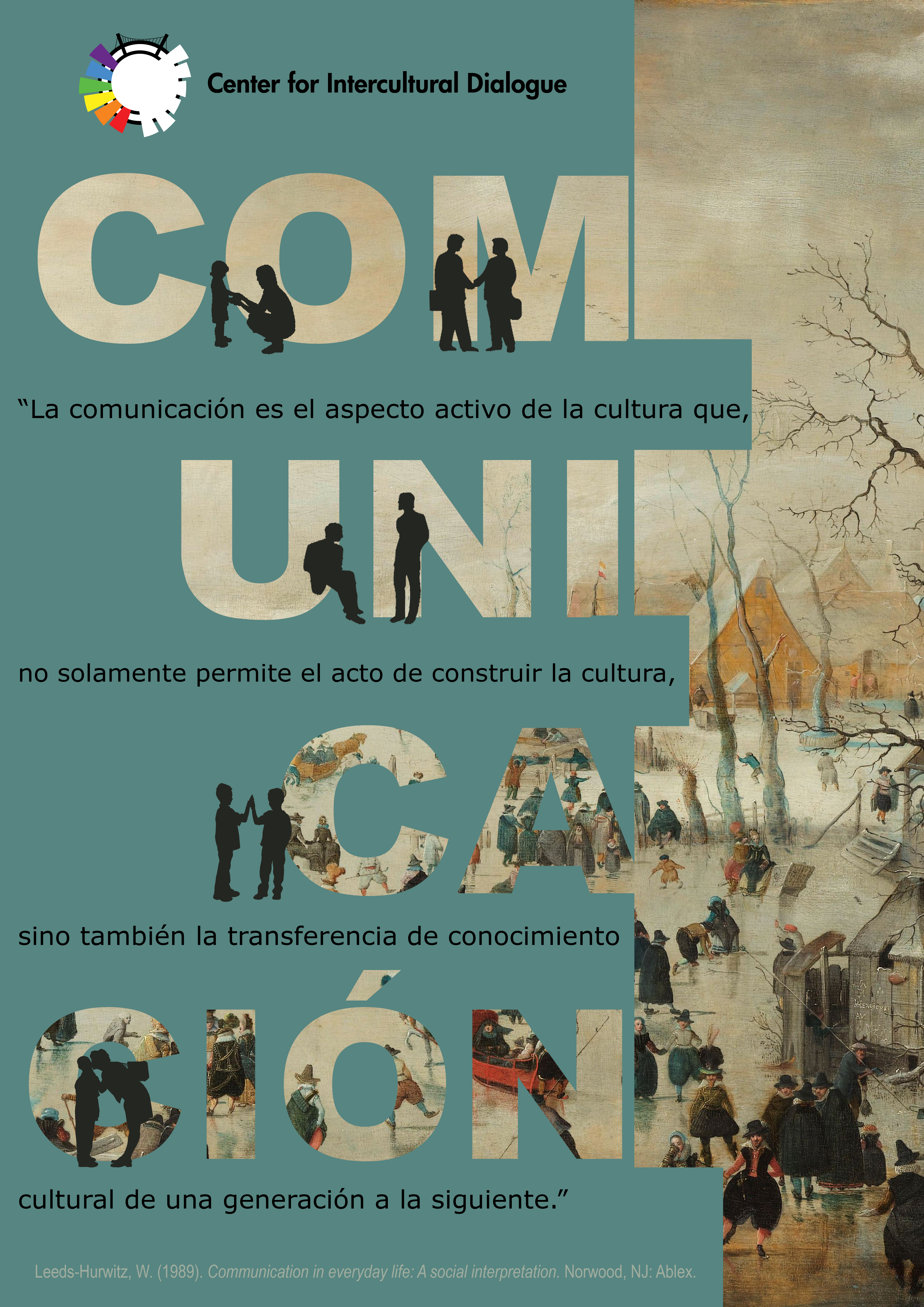
CID PostersThis poster was designed by Linda J. de Wit, and published previously; it now has been translated into Italian. The painting is Winter Landscape with Ice Skaters, by Dutch painter Hendrick Avercamp, painted around 1608. It is on display in the Dutch national museum Rijksmuseum in Amsterdam, which has made many of its paintings available online in high resolution and copyright free. The painting illustrates the quote not only because it shows social interaction, but also because ice skating is considered a typical example of Dutch culture (and recently has officially been named part of Dutch cultural heritage). The silhouettes are designs from vecteezy.com. The quote comes from the following book:

Leeds-Hurwitz, W. (1989). Communication in everyday life: A social interpretation. Norwood, NJ: Ablex.

The Italian translation was provided by Maria Flora Mangano, and the graphic design work necessary to revise was by Yan Qiu. Here then is CID Poster 5: Definizione di comunicazione come cultura.

CID Poster 5 Communication translated into Italian

Just in case anyone wants to cite this poster, the following would be the recommended format:

Center for Intercultural Dialogue. (2026). Definizione di comunicazione come cultura [M. F. Mangano, trans.]. CID Posters, 5. Available from:
https://centerforinterculturaldialogue.org/wp-content/uploads/2025/12/cid-poster-5-communication-italian.png

As with other series, CID Posters are available for free on the site; just click on the thumbnail to download a printable version. They may be downloaded, printed, and shared as is, without changes, without cost, so long as there is acknowledgment of the source.

As with other CID Publications, if you wish to contribute an original contribution, please send an email before starting any work to receive approval, to minimize inadvertent duplication, and to learn about technical requirements. As is the case any series, posters should be created initially in English. If you want to volunteer to translate a poster into a language in which you are fluent, send in a note before starting, to receive approval and to confirm no one else is working on the same one.

Wendy Leeds-Hurwitz
Director, Center for Intercultural Dialogue
intercult.dialogue AT gmail.com


Creative Commons License
This work is licensed under a Creative Commons Attribution-NonCommercial-NoDerivatives 4.0 International License.

Central European U: Assistant Professor in International Relations (Austria)

“JobAssistant Professor of International Relations, Central European University, Vienna, Austria. Deadline: 28 February 2026.

The Department of International Relations at Central European University invites applications for a full-time Assistant Professorship position. Applicants should have a research background in the field of International Relations (IR), with a focus on Conflict and Security Studies and proven ability to teach and supervise across a range of IR topics at the undergraduate and graduate levels. These topics include, but are not limited to, IR Theory, diplomacy, high-tech warfare, European security, and climate security. Candidates should be able to work across a range of research methods and teach courses in research design and methods. We seek a junior scholar with an emerging research and teaching agenda that demonstrates originality, commitment to cross-disciplinary debates, and the potential to address contemporary challenges in global politics. The ideal candidate will complement the existing expertise in the department and should be willing to build bridges across departments.

Texas Tech U: Campus Dean, Texas Tech in Costa Rica (Costa Rica)

“JobCampus Dean, Texas Tech University in Costa Rica, Escazú, San José, Costa Rica. Deadline: 17 January 2026.

For a candidate for Campus Dean of Texas Tech University – Costa Rica (TTU-CR) offers a distinctive leadership platform: steward a cross-border partnership with institutional gravitas, shape a growing suite of professional and degree programs, and drive measurable impact on regional workforce and innovation ecosystems — all while stewarding the academic integrity of a major U.S. research university. The Campus Dean will also steward significant growth, not only in terms of the number of academic programs, but also in the number of students and faculty. The role will require a leader who can blend strategic vision, international partnership acumen, and operational rigor to translate TTU-CR’s promising foundation into sustained institutional maturity and regional leadership.

Using Social Virtual Reality in Teaching Intercultural Communication

Resources in ICD“ width=

Knutzen, K., Rothenberger, L., Tribusean, I., & Xu, Y. (2025). Using social virtual reality in teaching intercultural communication. Technology, Knowledge and Learning, 30: 1167-87.

“In this study, we investigated whether intercultural communication can be learned as effectively through desktop-based social virtual reality (social VR) as it can through online study, and if social VR improves the motivation to gain cultural intelligence in distance learning. Two groups of international students attended a seminar called “Intercultural Communication”—one online via social VR rooms and videoconferencing, and one via videoconferencing only. The students then completed an online questionnaire and qualitative interviews regarding their experiences of learning intercultural encounters and development of intercultural communication skills through social VR. Based on our findings, social VR is an engaging complement to online study for learning intercultural communication competence. However, students claimed that it could not replace online or face-to-face study, and the quality of students’ experiences depended on their technical equipment. The rapid development of virtual teaching methods, virtual reality hardware, and international Internet connectivity offers the hope that learning intercultural communication via social VR will become easier in the future.”

Happy New Year 2026

About CID

Happy New Year 2026 from the Center for Intercultural Dialogue.

Roses gifted by a stranger in Halifax

Roses gifted by a stranger in Halifax.
May we all be so generous with the Other.

Thank you to all those who have supported CID over the past year, and over the past 16 years. Our work would not be possible without the considerable contributions of numerous scholars and practitioners around the world. See the acknowledgments for specific names, but you know who you are. Your time and effort are much appreciated.

Wendy Leeds-Hurwitz, Director
Center for Intercultural Dialogue

Casey Man Kong Lum, Associate Director
Center for Intercultural Dialogue

King’s College: Arts & Humanities Studentships (UK)

“Studentships“

Arts and Humanities Studentships, King’s College London, UK. Deadline: 13 February 2026.

The Doctoral School for Arts & Humanities is the home of the new Arts & Humanities Doctoral Studentships, offering a range of full and partially funded PhD scholarships. Starting October 2026, the programme offers 13 fully funded studentships, including 2 AHRC Doctoral Landscape Awards, plus four fees-only studentships.

Studentships cover all PhD programmes offered by the Faculty of Arts and Humanities, namely:

  • Byzantine & Modern Greek Studies
  • Classics
  • Comparative Literature
  • Creative Writing
  • Culture, Media & Creative Industries
  • Digital Humanities
  • English
  • Film Studies
  • French
  • German
  • History
  • Interdisciplinary Humanities
  • Music
  • Palaeography & Manuscript Studies
  • Philosophy
  • Spanish, Portuguese & Latin American Studies
  • Theology & Religious Studies

Funding will be for 3.5 years (full-time) or 7 years (part-time). Full tuition fees covered, including international fees.

U Hong Kong: Postdoctoral Fellowships in Humanities (Hong Kong)

Postdocs
Postdoctoral fellowships in the Society of Fellows in the Humanities, University of Hong Kong, Hong Kong.  Deadline: 28 February 2026.

The Society seeks outstanding applicants (appointed at the rank of Research Assistant Professor), with a flexible commencement date between June and August 2026 for a period of three years.

The Society aims to establish a vibrant research community where Fellows interact with each other and other members of the Faculty. Fellows will be expected to teach two courses during the term of their appointment and are required to submit a brief annual summary of their activities and accomplishments. The University of Hong Kong is an English-medium university. A host department within the Faculty of Arts will be selected on the basis of a Fellow’s proposed area of research.

Applicants must have a PhD conferred after January 1, 2024, but not later than June 30, 2026. They will not be currently employed in tenure-track positions.

CID Poster 4: Types of Cultural Communication Translated into Italian

CID PostersThis poster was designed by Linda J. de Wit, and published previously; it now has been translated into Italian. This one clarifies the differences between intercultural, intracultural, cross-cultural, and international communication.

The Italian translation was provided by Maria Flora Mangano, and the graphic design work necessary to revise was by Yan Qiu. Here then is CID Poster 4: Tipi di comunicazione tra culture.

Poster 4 Types of cultural communication translated into ItalianJust in case anyone wants to cite this poster, the following would be the recommended format:

Center for Intercultural Dialogue. (2025). Tipi di comunicazione tra culture. [M. F. Mangano, trans.]. CID Posters, 4. Available from: https://centerforinterculturaldialogue.org/wp-content/uploads/2025/11/cid-poster-4-cultural-communication-italian.png

As with other series, CID Posters are available for free on the site; just click on the thumbnail to download a printable version. They may be downloaded, printed, and shared as is, without changes, without cost, so long as there is acknowledgment of the source.

As with other CID Publications, if you wish to contribute an original contribution, please send an email before starting any work to receive approval, to minimize inadvertent duplication, and to learn about technical requirements. As is the case any series, posters should be created initially in English. If you want to volunteer to translate a poster into a language in which you are fluent, send in a note before starting, to receive approval and to confirm no one else is working on the same one.

Wendy Leeds-Hurwitz
Director, Center for Intercultural Dialogue
intercult.dialogue AT gmail.com


Creative Commons License
This work is licensed under a Creative Commons Attribution-NonCommercial-NoDerivatives 4.0 International License.